
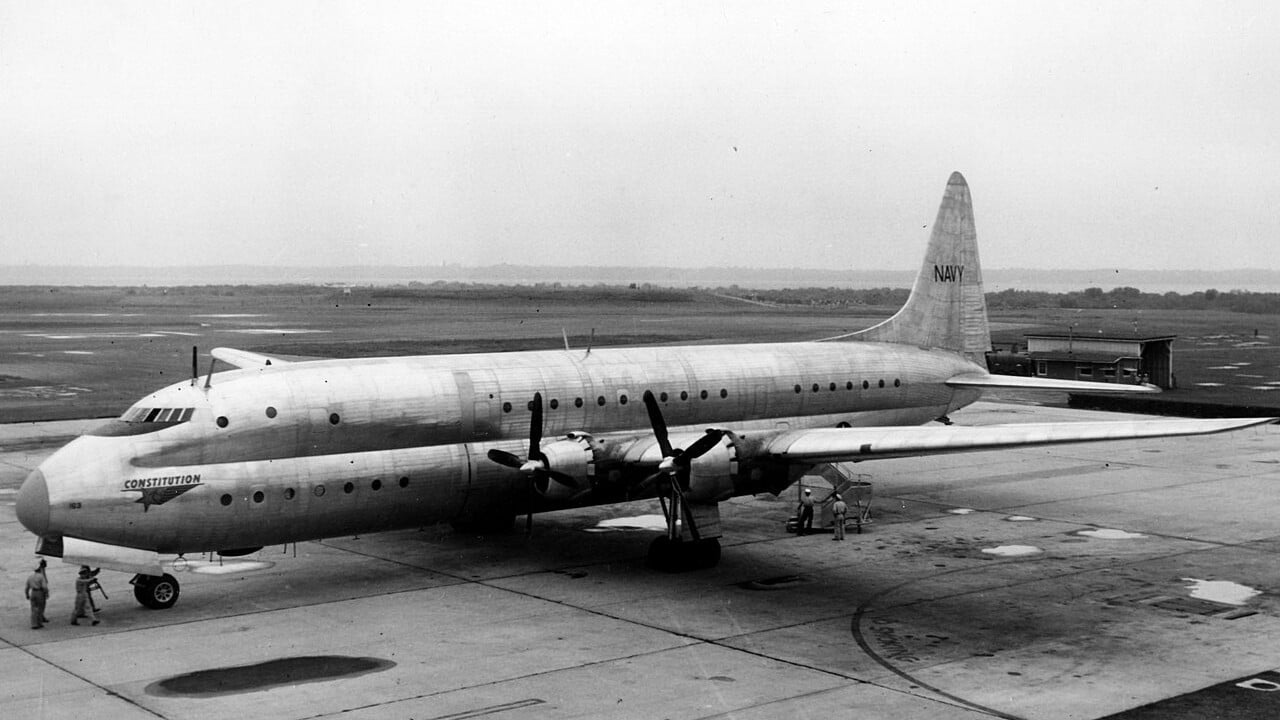
On 3 February 1949, a silver four-engined giant lifted off from Naval Air Station Moffett Field in California with rockets helping it into the air. Nine hours and 35 minutes later it landed at Washington National Airport, having carried more people across the United States in a single flight than any aircraft before it.
Its crew had served 180 meals on the way, starting with T-bone steak dinners. Lockheed officials predicted that airliners like it would be common within five years. They were wrong. The aircraft was the Lockheed Constitution, the US Navy’s double-deck transport, and only two were ever built.
Informations clés
- Taper: Double-deck, four-engined long-range transport
- Fabricant: Lockheed (Model 89), Burbank, California
- Opérateur: US Navy, Transport Squadron 44 (VR-44), NAS Alameda
- Designations: XR6O-1, redesignated XR6V-1 in 1950
- Premier vol : 9 November 1946 (BuNo 85163); second aircraft June 1948
- Nombre d'exemplaires construits : 2
- Moteurs : 4 × Pratt & Whitney R-4360, finally 3,500 hp each
- Taille: Length 156 ft 1 in; span 189 ft 1¼ in; max weight 184,000 lb
- Capacité: 168 passengers in normal military seating
- Destin: In storage by 1953, sold in 1955 and scrapped
A flying boat replacement with two floors
The Constitution began in 1942 as Lockheed’s Model 89. Pan American Airways wanted a much bigger long-range airliner, and it persuaded the US Navy to sponsor the design as a transport. A Lockheed team led by Willis Hawkins and W.A. Pulver worked through 28 different layouts, according to historian J. Rickard, before settling on a fairly conventional four-engined, mid-wing aircraft.
Lockheed was thinking well beyond the war. A planned post-war civil version, Rickard notes, would have carried 51 seated passengers and 58 in sleeper berths, with 11 crew. That was the market Pan Am had in mind: long, overnight ocean crossings in comfort, the kind of flying that until then had belonged to the big flying boats.
The radical part was the fuselage. Seen head-on, it formed a figure eight: two pressurised decks stacked one above the other, joined by spiral staircases. Both decks were pressurised. The lower deck could carry passengers or cargo, including vehicles up to the size of a jeep, and in normal military seating the aircraft could carry 168 people.
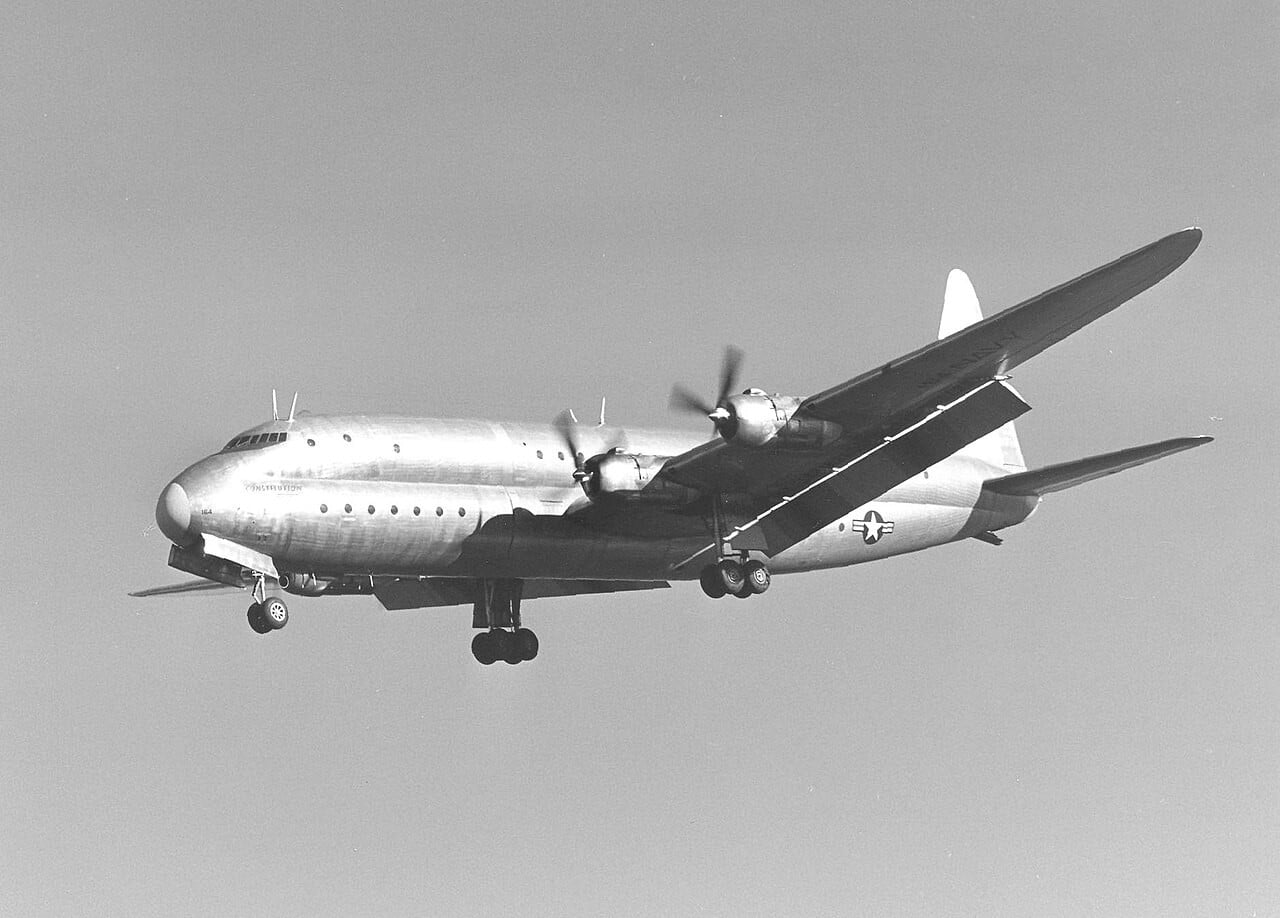
Wartime priorities pushed the project back, and the two XR6O-1 prototypes were not finished until well after the war ended. When the first one rolled out at Burbank, it was 156 feet long with a wingspan of more than 189 feet, and it weighed up to 184,000 pounds fully loaded.
First flight, and a crowd of ten thousand
The first Constitution, Navy Bureau Number 85163, made its maiden flight on 9 November 1946, from the Lockheed Air Terminal at Burbank to Muroc in the California desert. Its main landing gear had electric motors to spin the wheels up before touchdown.
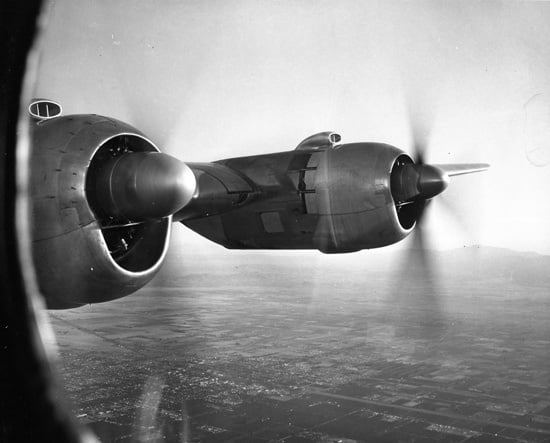
The test programme quickly showed the problem that would haunt the type. Its four Pratt & Whitney R-4360 Wasp Major radials were not enough. The first aircraft flew with 3,000 hp R-4360-18s, which were soon replaced by water-injected R-4360-22Ws of 3,500 hp each. The second prototype, BuNo 85164, flew with the more powerful engines from its first flight in June 1948.
British Pathé newsreel of the Constitution airliner from 1946, the year of its first flight.
Even 14,000 horsepower struggled to haul the Constitution around. The engines also ran hot, so crews often flew with the engine cooling flaps partly open. That added drag and cut into the aircraft’s range, the one thing a long-distance transport could not afford to lose.
Record breaker with VR-44
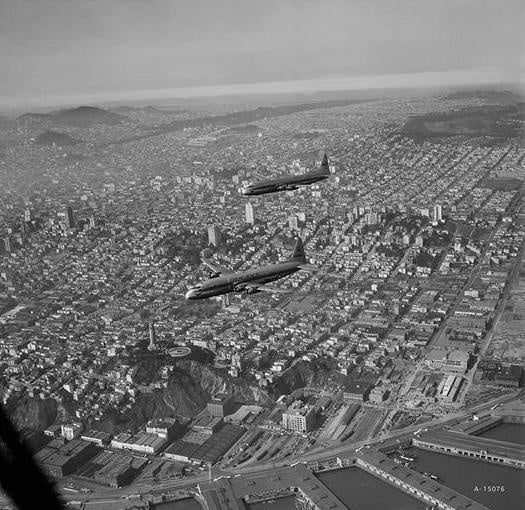
In early 1949 the Constitutions joined Navy Transport Squadron 44 (VR-44) at Naval Air Station Alameda, on San Francisco Bay. The first aircraft arrived on 2 February. The very next day came the rocket-assisted transcontinental flight, with Commander William M. Collins in command and about 90 people aboard including the crew, the most anyone had flown coast to coast in one aircraft.
The galley, one report noted, would have shamed many apartment kitchens. The first round of meals was 90 T-bone steak dinners, and by the time the Constitution reached Washington the crew had served 180 meals. Then came the landing.
The Constitutions also flew the long overwater route between California and Hawaii. Historian J. Rickard notes, though, that the aircraft could only reach Hawaii from California with a reduced payload. For a transport designed around range and capacity, that was a damning limitation.
Archive footage from Reuters of a 1946 test flight of the Constitution.
In 1950 the pair were redesignated XR6V-1, the designation by which the type is usually remembered today. Lockheed gave them a major overhaul in 1951 and 1952, but it did not cure the underlying lack of power.
Too big, too early
By 1953 both Constitutions were in storage, and neither flew for the Navy again. The Navy offered them to the airlines, but nobody wanted them. Lockheed sketched civilian derivatives, including a Model 289 that depended on the Wright Typhoon turboprop, but when that engine was cancelled the project went with it.
Both aircraft were sold off in 1955 and scrapped by their new owners. Ship No. 1 ended its days in Las Vegas, where it was broken up in 1969. Neither ever carried a fare-paying airline passenger.
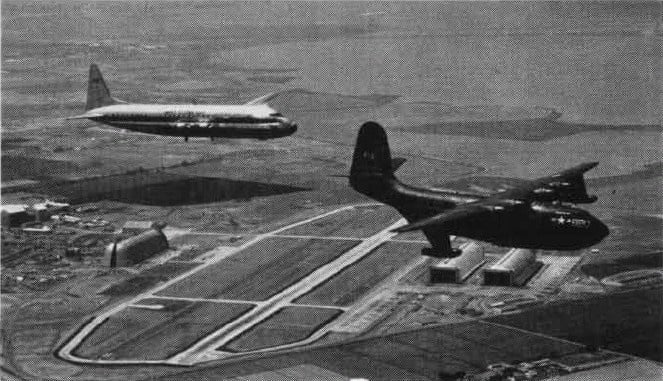
The Constitution’s timing was the real problem. Its airframe was ahead of its engines, and the turboprop that Lockheed hoped would rescue a civil version never arrived. About two decades later, the Boeing 747 would revive the idea of a wide, partly double-deck airliner, this time with engines big enough to carry it.
British Movietone newsreel introducing the new American “Constitution” airliner.
For a few years after the war, though, the US Navy owned the biggest landplane transports in America, flew them across the continent with a record load of passengers, and fed everyone steak on the way. Only two were built, and none survives.
Sources: National Naval Aviation Museum (Naval History and Heritage Command), HistoryOfWar.org (J. Rickard, Lockheed XR6O Constitution), Naval Aviation News, San Diego Air and Space Museum Archives, René Francillon (Lockheed Aircraft since 1913)
Header photo: U.S. Navy / Wikimedia Commons, public domain

0 Comments