
On 15 April 1928, a single-engined monoplane lifted off a scraped-out strip of snow at Point Barrow, Alaska, and pointed its nose across the top of the world. Aboard were the Australian explorer Hubert Wilkins and his pilot, Carl Ben Eielson. Their machine was not made of steel or aluminium. Its fuselage was a shell of glued spruce, less than a quarter of an inch thick.
Roughly 20 hours of flying later, after a blizzard forced them down within sight of their goal and kept them pinned there for days, they reached Spitsbergen. It was the first flight from North America across the Arctic Ocean to Europe. The aircraft was the third Lockheed Vega ever built.
Over the next seven years, the Vega carried Amelia Earhart alone across the Atlantic and took Wiley Post around the world, twice. Two of them now belong to the Smithsonian. This is the story of the aircraft itself: a wooden airliner that turned into the record-breaker of its age.
Informations clés
- Taper: Lockheed Vega, single-engine high-wing cabin monoplane
- Designer: Jack Northrop, for Allan Loughead’s Lockheed Aircraft Company
- Premier vol : 4 July 1927 (Aigle royal), Los Angeles
- Construction: Moulded spruce monocoque fuselage, cantilever wooden wing
- Moteurs : 225 hp Wright Whirlwind (Vega 1) to 450 hp Pratt & Whitney Wasp (Vega 5)
- Vitesse maximale : About 135 mph (Vega 1); up to 185 mph (Vega 5C)
- Construit: 131, according to the Smithsonian
- Famous flights: Wilkins/Eielson Arctic 1928; Earhart Atlantic 1932; Post and Gatty 1931; Post solo 1933
A garage in Hollywood
The Vega was the first aircraft of a brand-new company. In December 1926, Allan Loughead, the self-taught aviation pioneer, and his former draftsman Jack Northrop set up the Lockheed Aircraft Company, using the phonetic spelling of the family name. Northrop was chief engineer. They wanted a fast, streamlined monoplane for four passengers and a pilot.
The two men disagreed about one thing: the wing. Northrop wanted a self-supporting cantilever wing with no struts at all. Loughead worried that the public would not want to fly in an aircraft without visible wing supports. Northrop won. The Vega would carry its one-piece wooden wing on top of the fuselage, braced entirely from the inside.
The first Vega, named Aigle royal, flew from Lockheed’s Los Angeles plant on 4 July 1927 with test pilot Eddie Bellande at the controls. He landed delighted.
Its first owner, the newspaper publisher George Hearst, entered Aigle royal in the Dole race from California to Hawaii in August 1927. It was the fastest aircraft in the field, but it never arrived and no trace of it was found. Lockheed’s first Vega was lost within weeks. The company’s fortunes were saved by Wilkins, who had watched it on a test flight over San Francisco and ordered one for the Arctic.
Why a wooden fuselage was so fast
The Vega’s secret was the way it was built. Northrop had developed a moulded plywood monocoque, a self-supporting shell, for the little Lockheed S-1 racer of 1918. For the Vega, three sets of spruce strips were soaked with glue and laid in a semicircular concrete mould that looked like a bathtub. Under a clamped lid, a rubber balloon was inflated inside to press the layers hard against the mould.
Twenty-four hours later, a smooth half-shell came out. Two of them were glued and nailed together around a light framework of wooden rings. According to the Smithsonian, the method cut the time needed from several days to about 20 minutes.
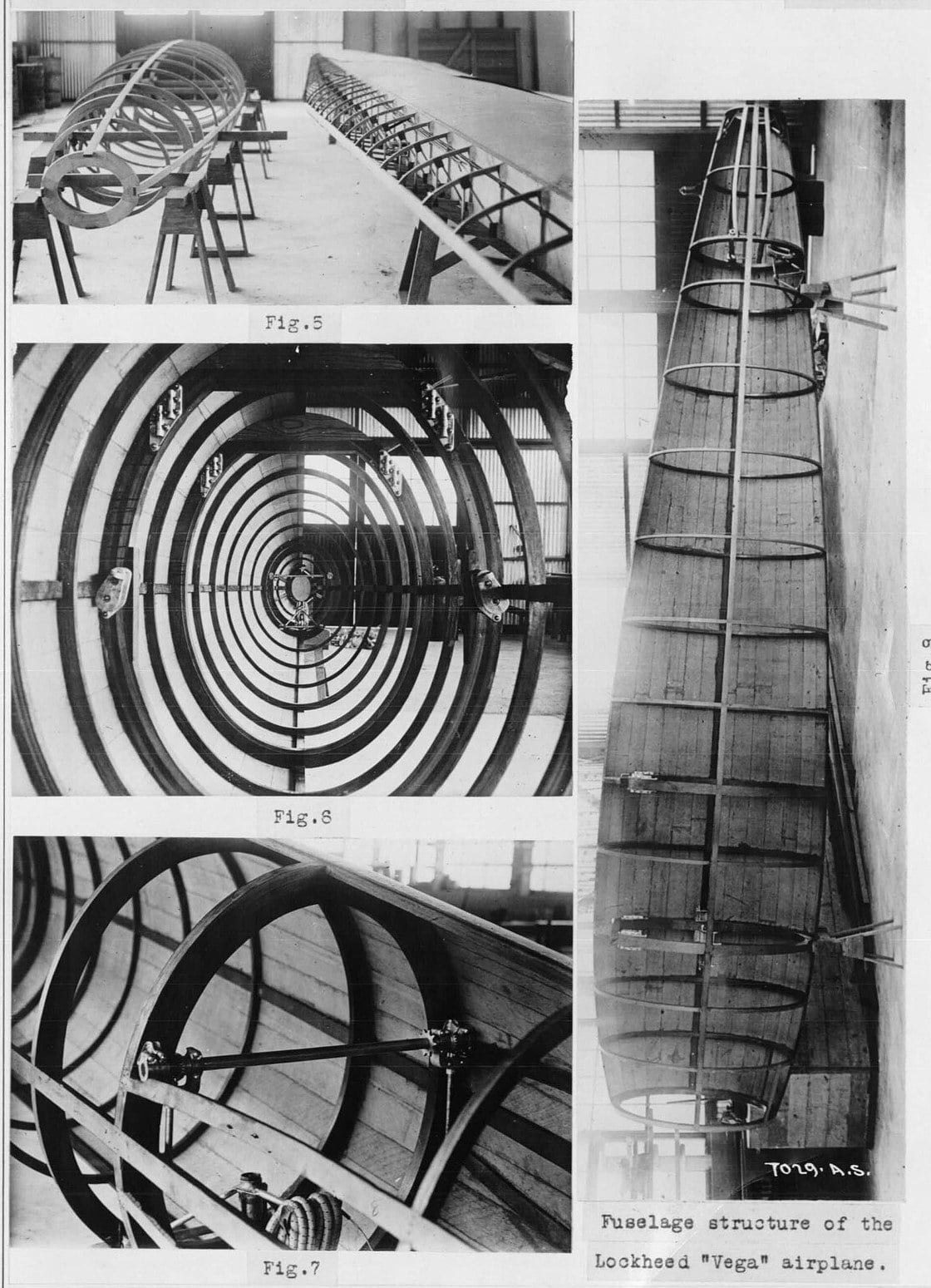
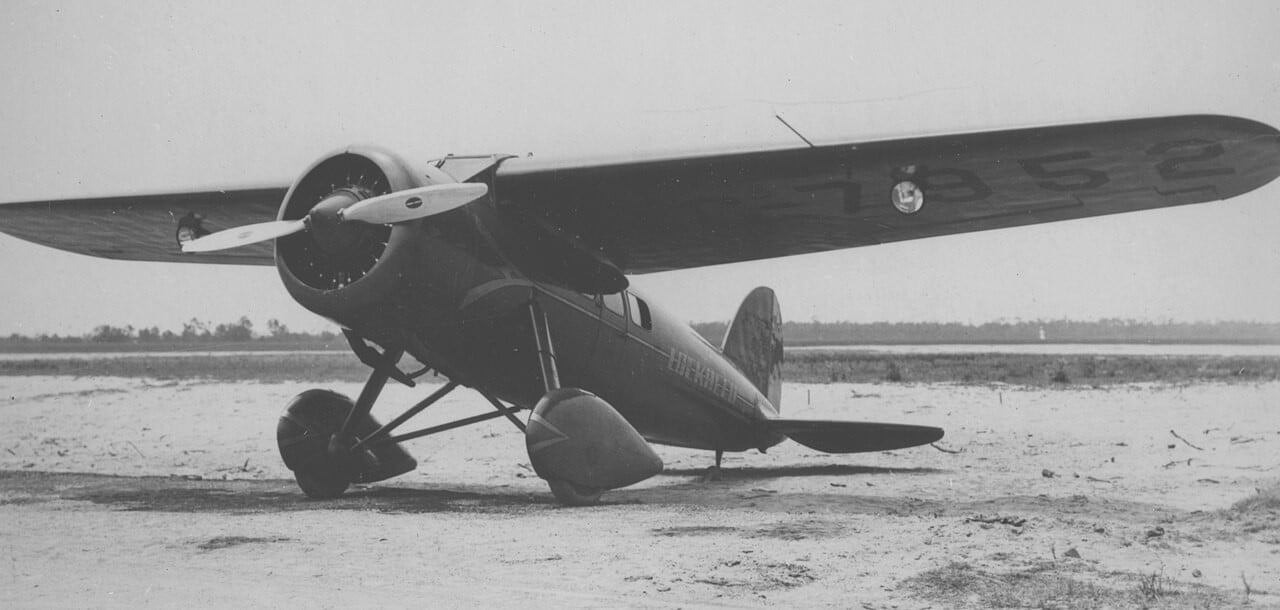
The result was a fuselage with no bracing wires, no fabric and no bumps. Together with the internally braced wing, it gave the Vega a remarkably clean shape for 1927. On the original 225 hp Wright Whirlwind, the Vega 1 cruised at about 120 mph and topped out at around 135 mph. Later versions added a NACA engine cowling and teardrop wheel pants to cut the drag of the radial engine and landing gear.
Kermit Weeks’ restoration team glues a fresh plywood skin onto a Vega fuselage, showing just how the wooden shell is built.
The 1929 Vega 5 swapped in a 450 hp Pratt & Whitney Wasp, gained two seats and cruised at 155 mph. A late Vega 5C with the NACA cowl could reach 185 mph. Vegas dominated the speed events at the National Air Races in Cleveland at the end of the 1920s, and Lockheed adopted a slogan: “It takes a Lockheed to beat a Lockheed.”
Not an easy aeroplane
All that streamlining came at a price. The Vega was slippery on approach, and the pilot sat behind a big engine with very little forward view on take-off and landing. Elinor Smith, the teenage record-setter of the late 1920s, summed up its landing manners in her memoir.
The pilots who loved the Vega were the ones who needed range and speed more than comfort. Hubert Wilkins went straight from his Arctic triumph to Antarctica, and in December 1928 he and Eielson used Vegas to make the first aeroplane flights over the continent. Wilkins was knighted. Eielson, whose name lives on at Eielson Air Force Base in Alaska, received the Harmon Trophy.
The Little Red Bus
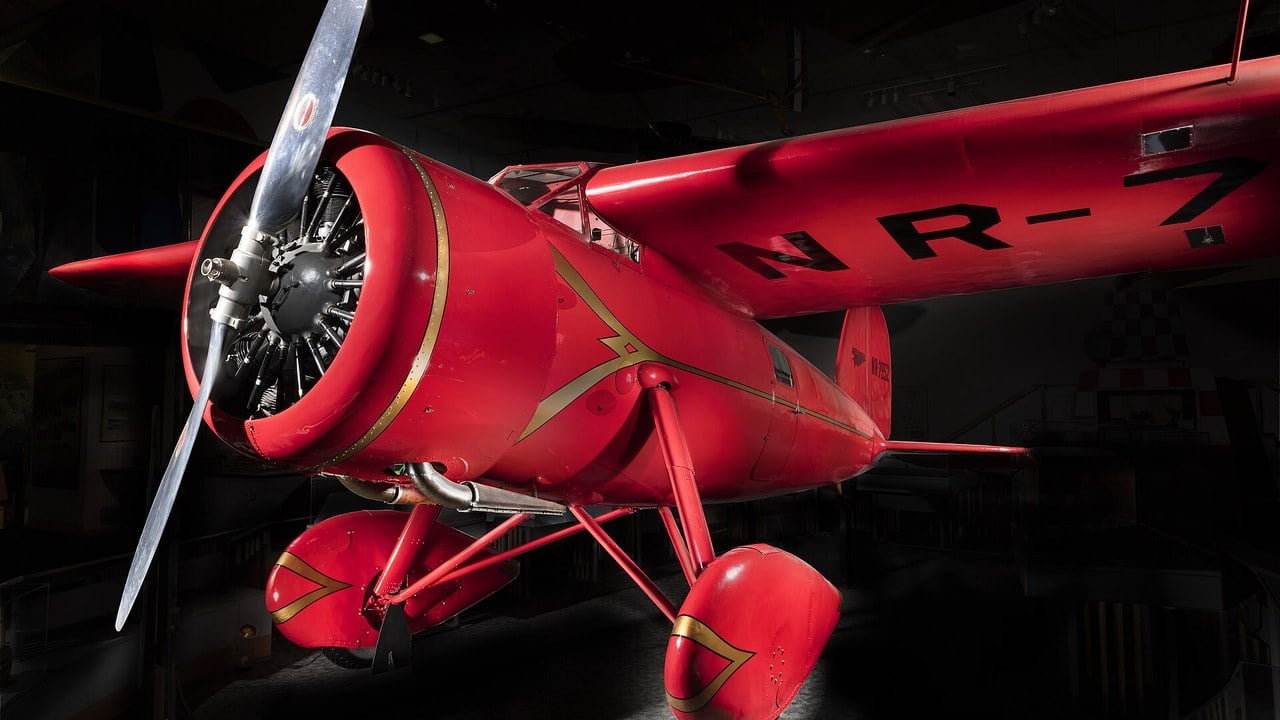
Amelia Earhart bought a Vega 5B in 1930 and called it her “Little Red Bus.” After a nose-over accident that year, the fuselage was replaced and strengthened to carry extra fuel tanks, and she added three types of compass, a drift indicator and a more powerful engine. She would end up owning four Vegas and leasing two more.
On 20 May 1932, five years to the day after Charles Lindbergh took off for Paris, she left Harbor Grace in Newfoundland alone. The Smithsonian records a leaking fuel tank, a cracked exhaust manifold spitting flames along the cowling, and ice that pushed the Vega down to just above the waves. About 15 hours and 2,026 miles later, she landed in a field near Londonderry in Northern Ireland, the first woman to fly the Atlantic solo and nonstop.
Smithsonian National Air and Space Museum footage of Amelia Earhart departing Harbor Grace, Newfoundland, in her Vega on 20 May 1932.
Three months later the same aircraft carried her nonstop from Los Angeles to Newark, 2,447 miles in about 19 hours, the first solo nonstop crossing of the United States by a woman. In January 1935 she flew a newer Vega 5C from Hawaii to Oakland, the first solo flight from Hawaii to the US mainland. You can read more about her career in our story Amelia Earhart: First Across the Atlantic.
Winnie Mae: around the world, twice
The most famous Vega of all was bought new in June 1930 by the Oklahoma oilman F. C. Hall, who named it after his daughter and hired Wiley Post to fly it. Post won the 1930 Los Angeles to Chicago air derby in 9 hours, 9 minutes and 4 seconds, a result still painted on the fuselage.
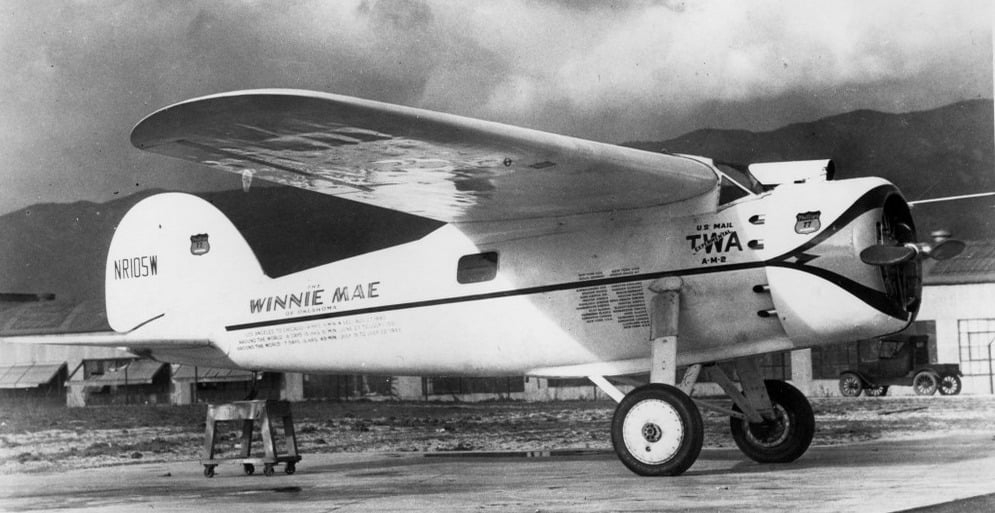
On 23 June 1931, Post and the Australian navigator Harold Gatty left New York to fly around the world. With stops across Europe, Russia, Siberia, Alaska and Canada, they were back on 1 July after 8 days, 15 hours and 51 minutes. A grateful Hall gave the aircraft to Post.
British Pathé newsreel of Wiley Post and Harold Gatty with Winnie Mae at Roosevelt Field before their 1931 round-the-world flight.
In July 1933 Post did it again, this time alone, helped by a Sperry autopilot and a radio compass. He flew 15,596 miles in 7 days, 18 hours and 49 minutes, the first solo flight around the world. Our story Article de Wiley : Le pilote borgne qui a fait le tour du monde en solitaire follows the man; here the machine is the hero.
Then Post took Winnie Mae into the stratosphere. Its wooden fuselage could not be pressurised, so he wore a pressure suit he developed with B. F. Goodrich, and dropped the landing gear after take-off to land on a skid. On 15 March 1935 he flew from Burbank to Cleveland, 2,035 miles in 7 hours and 19 minutes, at times reaching a ground speed of 340 mph, proof that he was riding the jet stream.
The end of the wooden era
The Smithsonian counts 131 Vegas built. Lockheed’s new parent company, the Detroit Aircraft Corporation, built Vegas with metal fuselages, and the Vega’s descendants, such as the low-wing Lockheed Orion, pushed the formula further. By the mid-1930s, all-metal designs such as Lockheed’s own Electra had taken over, and the moulded spruce shell was obsolete.
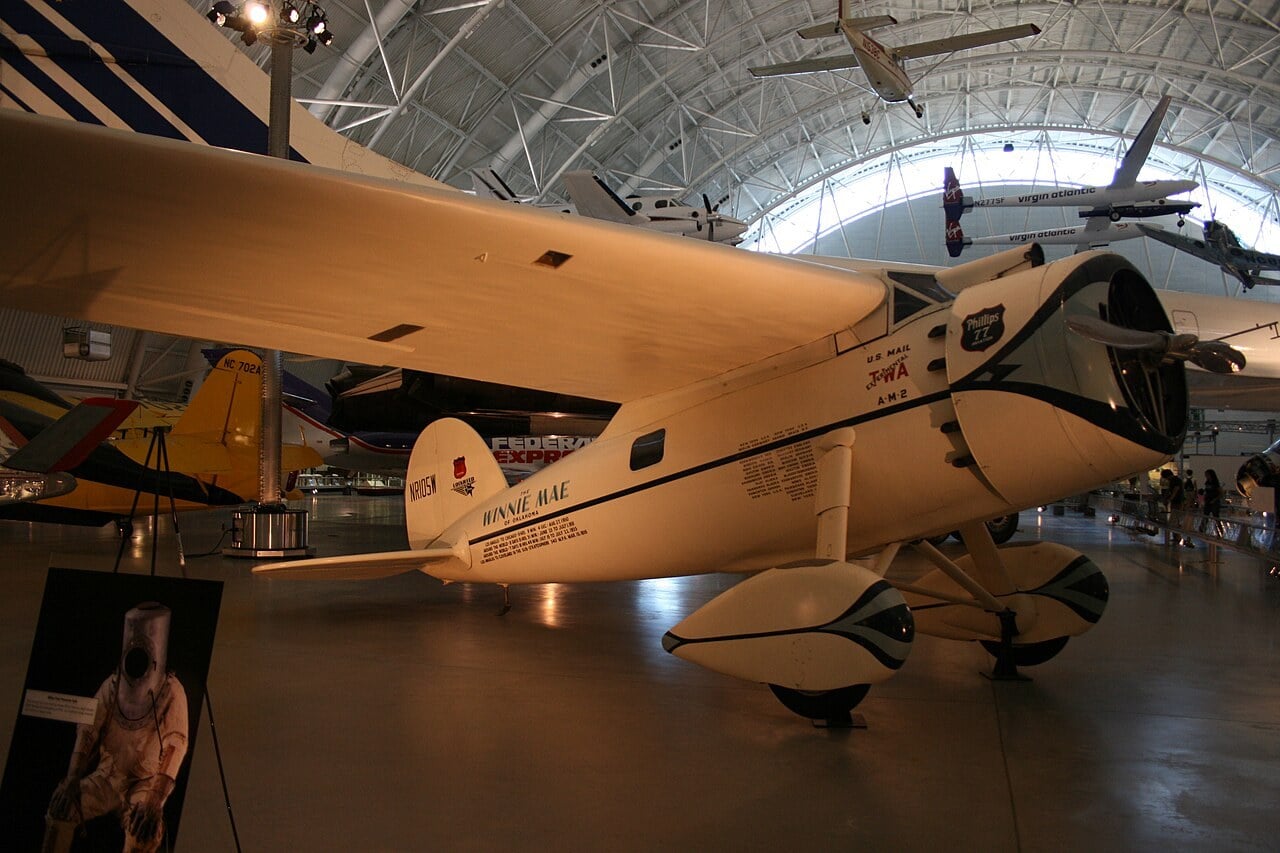
But no wooden aeroplane ever did more. Earhart’s red Vega 5B went to the Franklin Institute in Philadelphia and reached the Smithsonian in 1966. Post’s widow sold Winnie Mae to the Smithsonian in 1936. Today both are in the National Air and Space Museum’s collection: two thin shells of glued spruce that once shrank the world.
Sources: Smithsonian National Air and Space Museum (Lockheed Vega 5B, Amelia Earhart; Lockheed Vega Winnie Mae), US Centennial of Flight Commission, NACA Aircraft Circular No. 61, Wikipedia (Lockheed Vega; Winnie Mae; Allan Loughead; Hubert Wilkins; Carl Ben Eielson; Jack Northrop)
0 Comments