
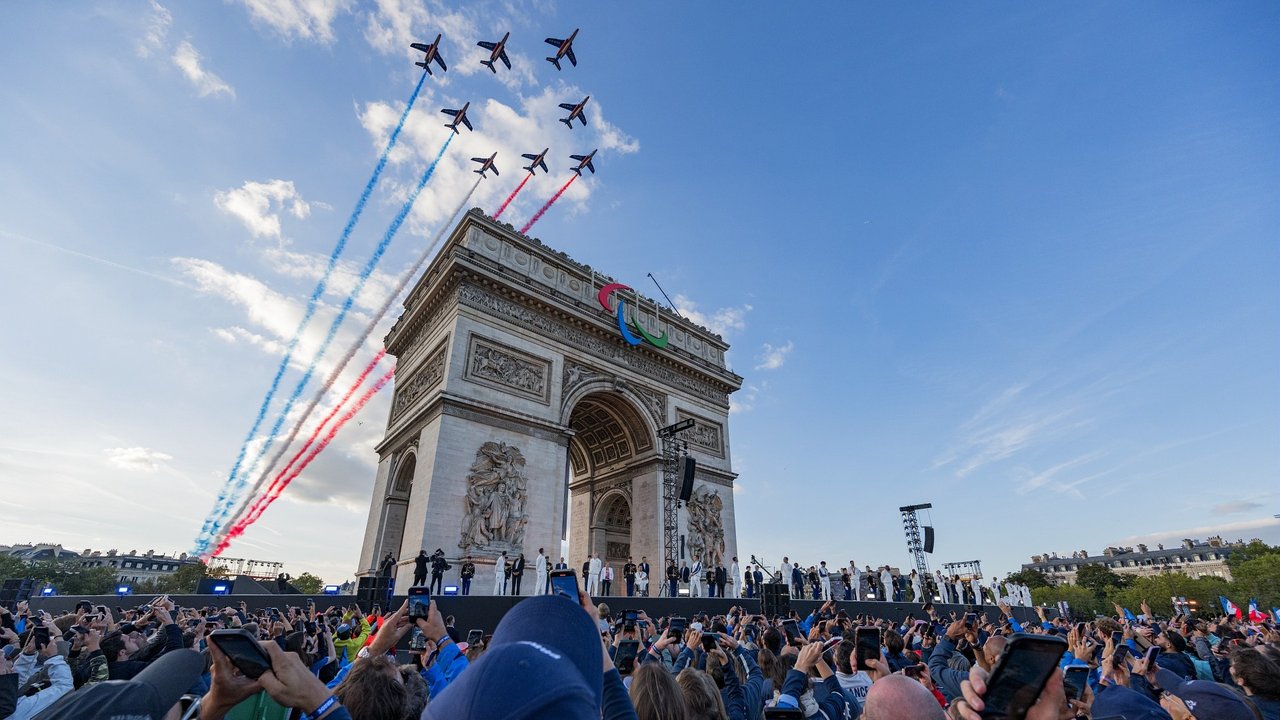
Algiers, 17 May 1953. Four Republic F-84G Thunderjets of the 3e Escadre have just finished their routine over the Maison-Blanche airfield, and the man on the microphone gets carried away. Jacques Nœtinger, pilot, journalist and show commentator, tells the crowd that the Patrouille de France salutes them. Nobody had ordered him to give the team a name. He simply did, and it stuck.
Four months later, on 14 September 1953, the French Air Force staff made it official. Seventy-three years on, that improvised title belongs to one of the most recognisable display teams on Earth: eight blue Alpha Jets, a ninth in reserve, and a tricolour smoke signature that every French schoolchild can draw from memory.
But the story does not start in Algiers. It starts in 1931, on an airfield south of Paris.
Informations clés
- Nom officiel : Patrouille acrobatique de France (PAF)
- Roots: Patrouille d'Étampes, first displayed in 1931
- Name adopted: 17 May 1953 (Algiers), confirmed 14 September 1953
- Base principale : Base aérienne 701 Salon-de-Provence
- Current aircraft: Dassault/Dornier Alpha Jet, since 1981
- Display formation: 8 aircraft, plus a replacement pilot (Athos 9)
- Radio callsign: Athos
- Pilot entry bar: Patrol-leader qualification, 1,500 hours on jets
Three monoplanes and a captain called Fleurquin
In 1931 instructors from the École de perfectionnement au pilotage flew the first French formation display at Étampes-Mondésir, in three Morane-Saulnier MS.230 trainers. Between 1932 and 1939, under Captain Pierre Fleurquin, the Patrouille d'Étampes built a reputation good enough to represent France at international meetings. French Wikipedia records that the aircraft, sometimes as many as 18, flew tied to one another with ropes.
In 1935 the team converted to the MS.225 and by 1936 it was flying five aircraft. A year later it moved to Salon-de-Provence, in the south of France, and took the name Patrouille de l'École de l'air. The Second World War stopped everything.
Peace brought a fresh start. In 1947 the Air Ministry created a presentation squadron equipped with twelve Stampe SV-4 biplanes, led by a former Étampes pilot. Then the jets arrived, and in 1952 Commandant Pierre Delachenal of the 3e Escadre de chasse at Reims formed a four-ship of F-84G Thunderjets. That is the team Nœtinger christened in Algiers.
Five jets in eleven years
For its first decade, the Patrouille de France was a travelling honour rather than a fixed unit. The title passed from wing to wing, and the aircraft changed with it. The F-84G flew the shows in 1953 and 1954. The Dassault Ouragan took over from 1954 to 1957, and the swept-wing Dassault Mystère IV from 1957 to 1964.
Home bases moved just as often: Reims, then Dijon, Cambrai, Bremgarten in West Germany and Nancy-Ochey. In 1956 the team was even split in two, with a Mystère IVA patrol at Cambrai flying the foreign shows and an Ouragan patrol at Bremgarten covering France itself.
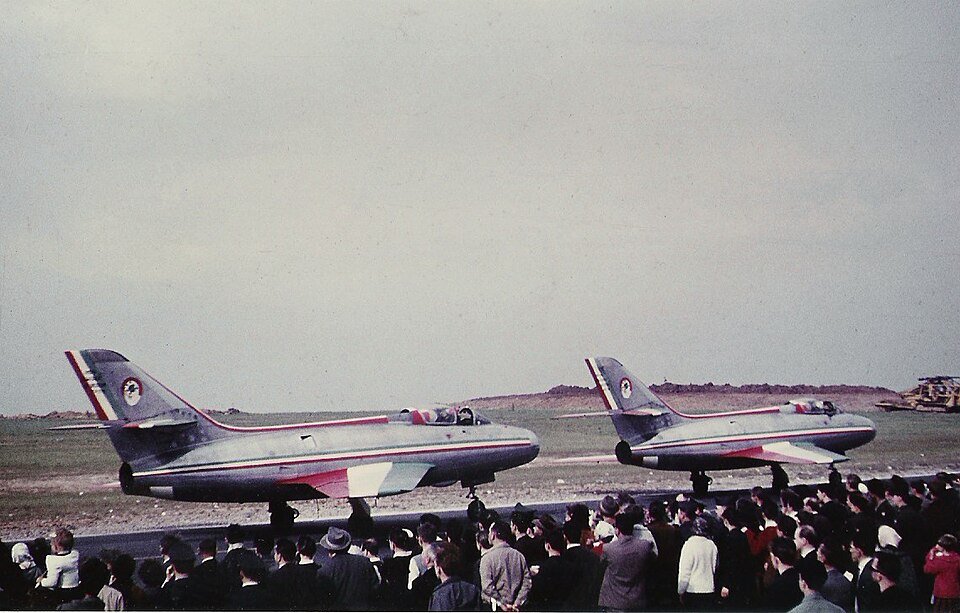
It could not last. In 1964 budget cuts dissolved the Mystère IV patrol. The ministry did not want the name to disappear, so a few months later it handed the title to the Patrouille de l'École de l'air at Salon-de-Provence, the direct heir of the Étampes team. The old 1931 lineage and the 1953 name were finally joined.
That is why the team's two key dates are both correct. The French Air and Space Force itself describes the Patrouille de l'École de l'air as the heir of the Patrouille d'Étampes, created in 1931, and dates the name to the 1953 meeting at Algiers-Maison Blanche.
A French-language look at every aircraft type the Patrouille de France has flown in its first 70 years.
The butterfly-tail years
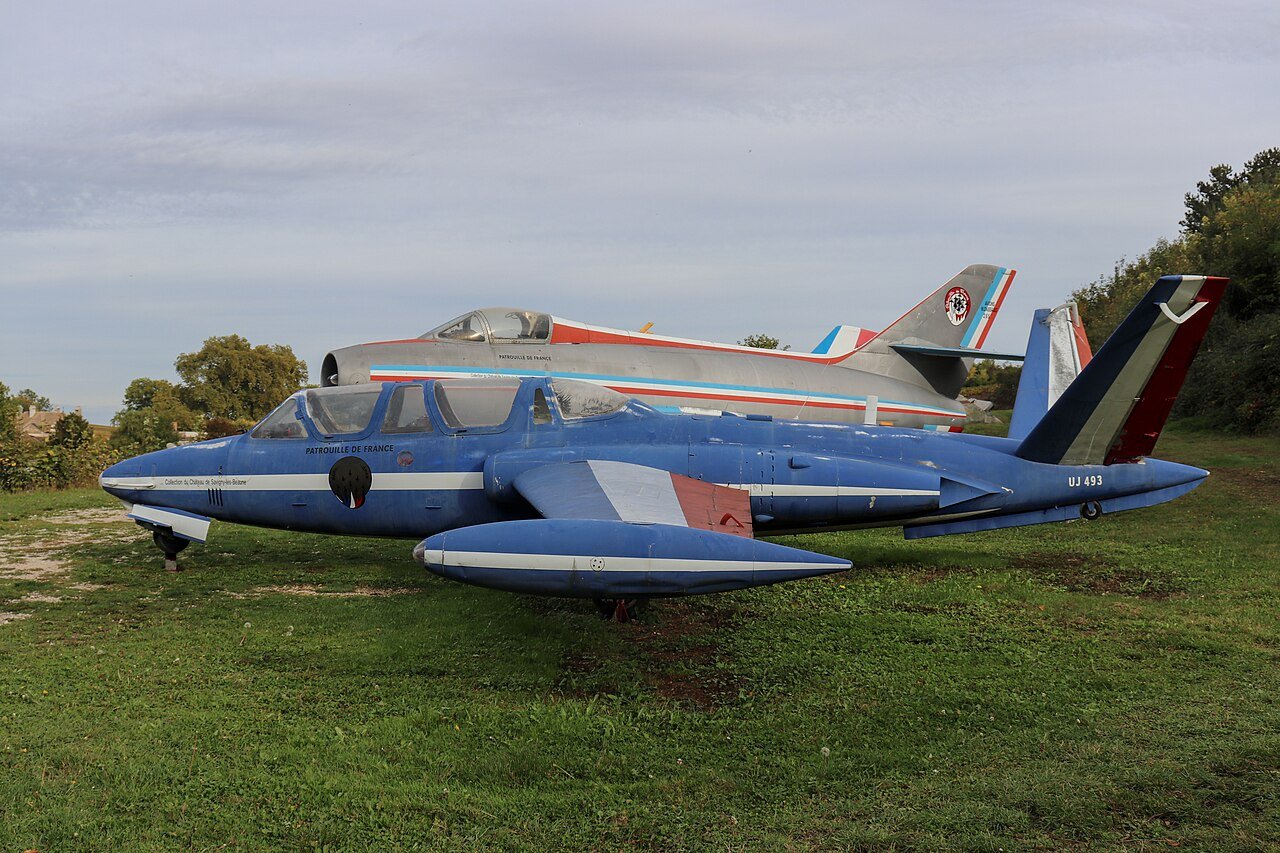
The new Patrouille de France flew the Fouga CM.170 Magister, a slow, graceful twin-jet trainer with its distinctive V-tail. It started with six aircraft, grew to nine and briefly to eleven in 1972 and 1973, before dropping back to nine after the first oil crisis.
The Fouga carried the team for sixteen years. Its last display took place at Salon-de-Provence on 16 September 1980. Those years also showed the price of the work: in 1980 two Fougas collided during a synchronised manoeuvre and both pilots were killed.
The jet that replaced it is still flying today. The Dassault/Dornier Alpha Jet joined in 1981 with seven aircraft, and an eighth was added from 1982. The display Alpha Jets are modified for the job: the ventral gun pod is replaced by a smoke pod, a light is fitted in the nose, and the gunsight is removed to give the pilot a clearer view ahead.
Inside Salon-de-Provence
The team lives at Base aérienne 701 Salon-de-Provence, home of the French air force academy, within the display teams of the Armée de l'air et de l'espace française. According to the service, the unit counts more than sixty airmen, among them pilots, mechanics, operations staff and photographers, all volunteers drawn from operational squadrons.
The pilots are chosen by co-optation. Candidates must be fighter pilots who volunteer, hold the patrol-leader qualification and have at least 1,500 hours on jets. Three new pilots join every year, and the serving team picks them.
Every seat has a job and a nickname. Athos 1 is the leader, the one pilot who cannot be replaced. Athos 2 and 3 are the first-year inner wingmen. Athos 4, flying directly behind the leader and swallowing his smoke, is the charognard, the scavenger, and traditionally becomes leader the following year. Athos 5 and 6 are the solos, Athos 7 and 8 the outer wingmen, and Athos 9, the most senior pilot, is the replacement who can fill any slot except the leader's.
Winter training runs from October to May, with two or three flights a day, and the full routine is traditionally put together at Solenzara in Corsica over the sea. The pilots work at speeds between 300 and 800 km/h, two or three metres apart, and prepare three versions of the show: a full vertical programme for good weather, an oblique one for intermediate cloud bases, and a flat programme for poor weather.
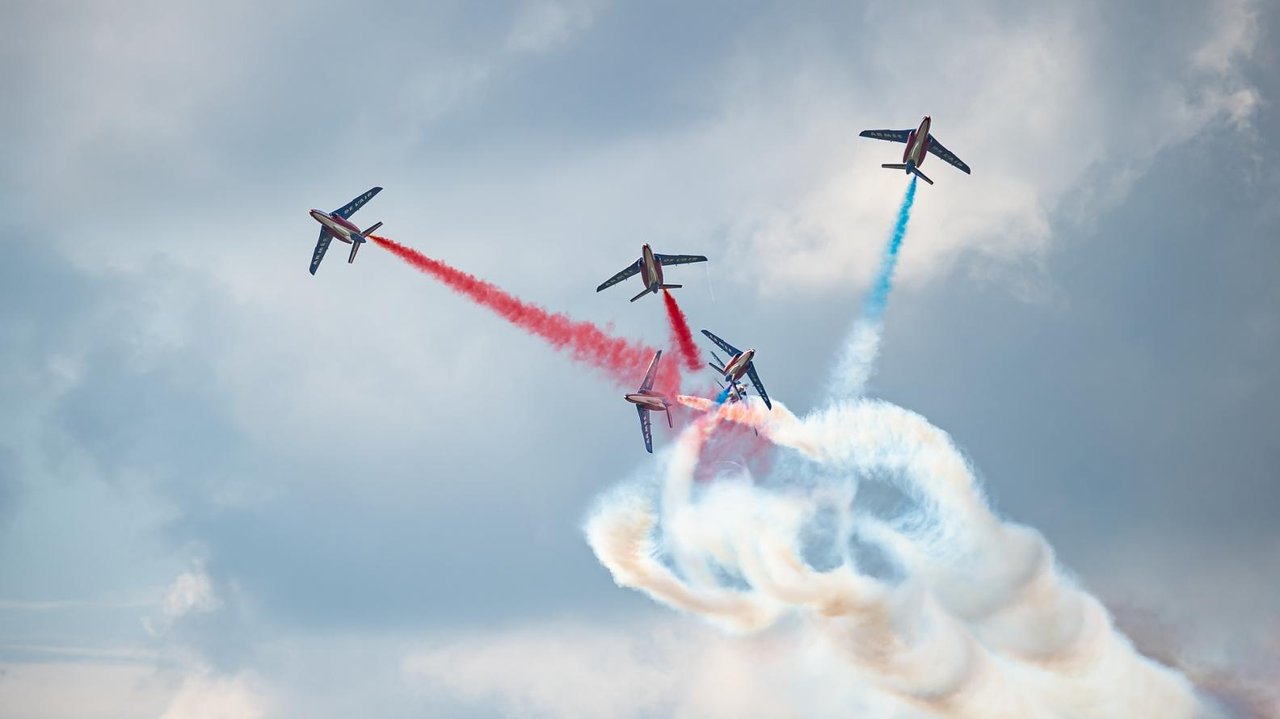
Each season's routine, called the series, is split into two halves. In the ribbon, all eight jets fly in tight formation and change shape. In the synchro, the team splits into two groups that alternate figures of two, four or six aircraft. The signature figure is the heart, drawn by six jets and pierced by the two solos.
From New York to the Élysée
The Patrouille de France flew a historic parade over New York City in 1986. On 25 November 2009, Commandant Virginie Guyot became its leader, which French sources describe as the first time a woman had commanded an aerobatic team of this kind.
Between 17 March and 6 May 2017, the team toured North America to mark the centenary of the United States' entry into the First World War alongside France, flying over cities on both coasts and in formation with the Blue Angels at Pensacola and the Thunderbirds at Nellis. On 8 July 2022 it carried a serving French president for the first time, when Emmanuel Macron flew in the back seat of Athos 5.
From the 2017 North American tour: Thunderbirds pilots fly in the back seats of Patrouille de France Alpha Jets.
The team also traditionally opens the Bastille Day parade on the Champs-Élysées, with nine Alpha Jets. In 2026, the French Air and Space Force says, it took part in the Liberté 250 mission, with symbolic flypasts in the United States marking 250 years of American independence and Franco-American friendship.
How long can the Alpha Jet last?
The Alpha Jet has now carried the team for 45 years, far longer than any of its predecessors. French Wikipedia reports that its retirement is planned for around 2035, and the question of what replaces it is already a regular topic in the French aviation press.
Whatever comes next will inherit something older than any airframe. The heart, the tricolour smoke, the Athos callsign and a name shouted into a microphone in Algiers have outlived the F-84G, the Ouragan, the Mystère IV and the Fouga. The jets change. The patrol stays.
The Paris Air Show's official film of the Patrouille de France Alpha Jet display at Le Bourget in 2013.
Sources: Armée de l'Air et de l'Espace, Wikipedia (EN, FR), The Connexion, AeronewsTV, Paris Air Show
0 Comments