
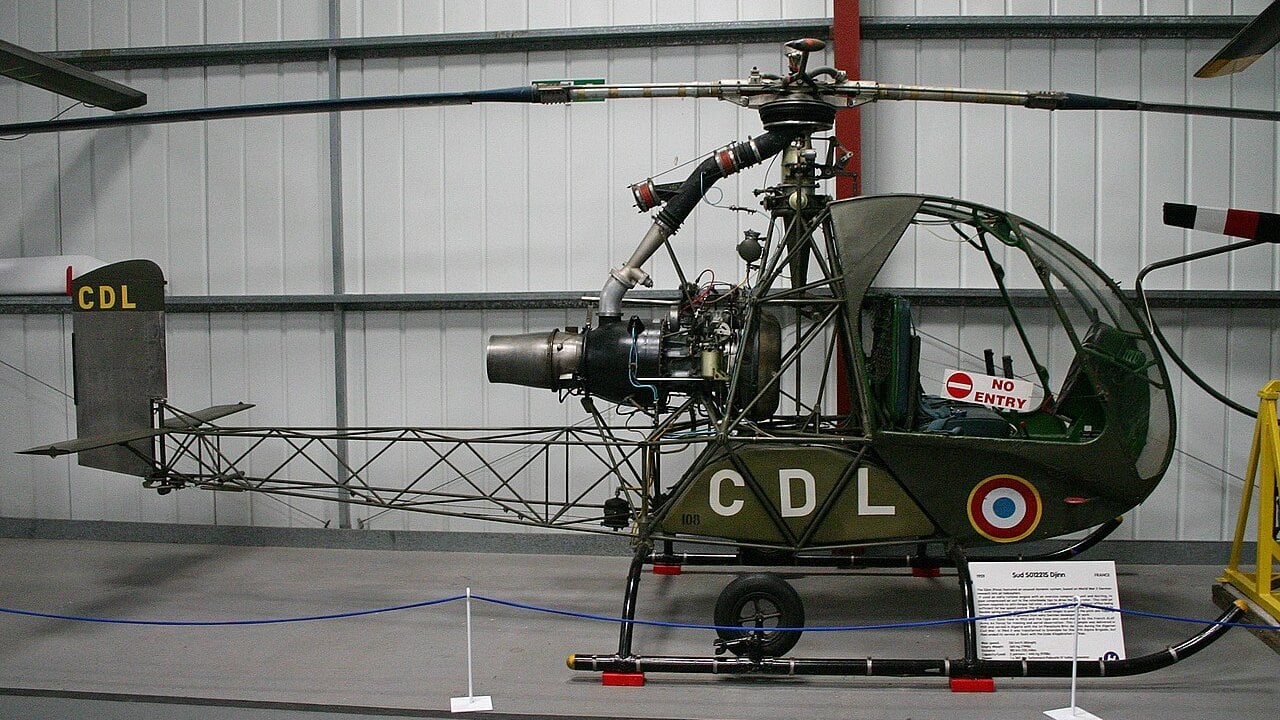
Look closely at a Sud-Ouest Djinn helicopter from the 1950s and something seems to be missing. There is a bubble cockpit, a rotor and a long open-frame tail boom, but no tail rotor at the end of it, and no gearbox under the rotor head either. Instead, a fat black pipe runs from the engine up the mast.
The Sud-Ouest SO.1221 Djinn was driven by air. A turbine blew compressed air through hollow rotor blades and out of small nozzles at their tips, pushing the blades round like a garden sprinkler. It became the first helicopter with tip-jet propulsion to go into series production, and one of the first practical European helicopters of any kind.
Informations clés
- Aéronef: Sud-Ouest (SNCASO) SO.1221 Djinn, two-seat light helicopter
- Propulsion: Cold tip jets: compressed air blown out of the rotor blade tips
- Moteur: Turbomeca Palouste turbine-compressor, about 240 hp
- Premiers vols : SO.1220 test rig 2 January 1953; SO.1221 prototype December 1953
- Enregistrer: 4,789 metres, an altitude record for its class
- Construit: 178, including 100 for the French Army
- French Army service: 1956 to 1969: observation, liaison, training, casualty evacuation
- Remplacé par : Sud Aviation Alouette II
An idea from wartime Vienna
The idea was not new. During the Second World War the Austrian engineer Friedrich von Doblhoff built and flew the WNF 342, which pumped air and fuel through the rotor blades to small combustion chambers at the tips. In 1946 three members of his team, among them Theodor Laufer, moved to France to work for the state-owned manufacturer SNCASO, better known as Sud-Ouest.
Their first French design, the Ariel, flew in 1947 with burning tip jets, like Doblhoff’s. For the next machine Sud-Ouest chose a simpler route. The Djinn used cold tip jets: the air was compressed, and warmed by the compression to about 180°C, but nothing burned at the blade tips. That made them far quieter.
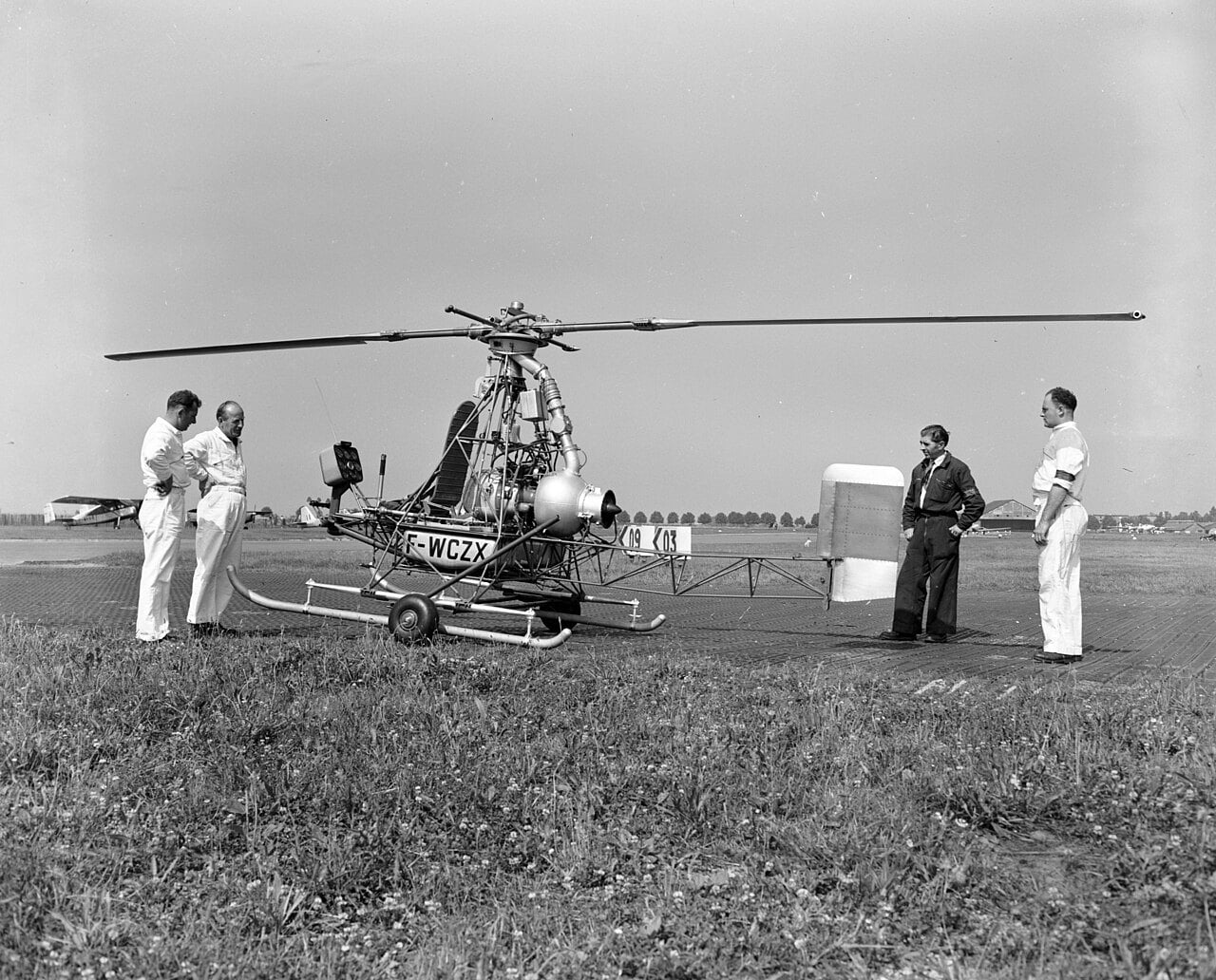
The compressor was a Turbomeca Palouste, a small gas turbine of about 240 horsepower. Behind the cockpit it fed air up the mast to the rotor, while its exhaust blew past a rudder on the tail. Turning that rudder in the jet blast gave the pilot directional control.
No torque, no tail rotor
The beauty of the system was what it left out. In a conventional helicopter the engine turns the rotor through a gearbox, and the fuselage tries to spin the opposite way. That is why almost every helicopter needs a tail rotor. Because the Djinn’s blades were pushed from their tips, with no mechanical drive from the fuselage, there was next to no torque to fight.
A single-seat test rig, the SO.1220, made the first flight on 2 January 1953. It was little more than an open frame with an exposed seat for the pilot. The two-seat SO.1221 Djinn prototype followed in December 1953, and within days one of the prototypes climbed to 4,789 metres, a record for its class.
British Pathé, 1955: a French tip-jet helicopter lands on skis in the Swiss Alps, with close-ups of the nozzles at the blade tips.
The engine had no electrics and was started with a hand crank on the side of the fuselage. Even the instruments, heaters and demisters ran on bleed air. A Djinn weighed about 360 kg empty, carried a pilot and one passenger side by side in a glazed cabin, and had a top speed of about 130 km/h.
Because nothing burned at the tips, the rotor was remarkably quiet, and Sud-Ouest advertised its nozzles as noiseless. The warm air flowing through the blades also kept them free of ice. The heavy, spinning rotor stored so much energy that a skilled pilot could use it to hop briefly into the air at well above normal weights, a technique the manufacturer used to get the Djinn certified for unusually heavy loads.
Into service with the French Army
Le French Army had watched the Djinn’s development closely and ordered a pre-series batch for evaluation, followed by 100 production helicopters. From 1956 it flew them for observation, liaison and training, and as an air ambulance carrying two stretchers mounted outside the cabin.
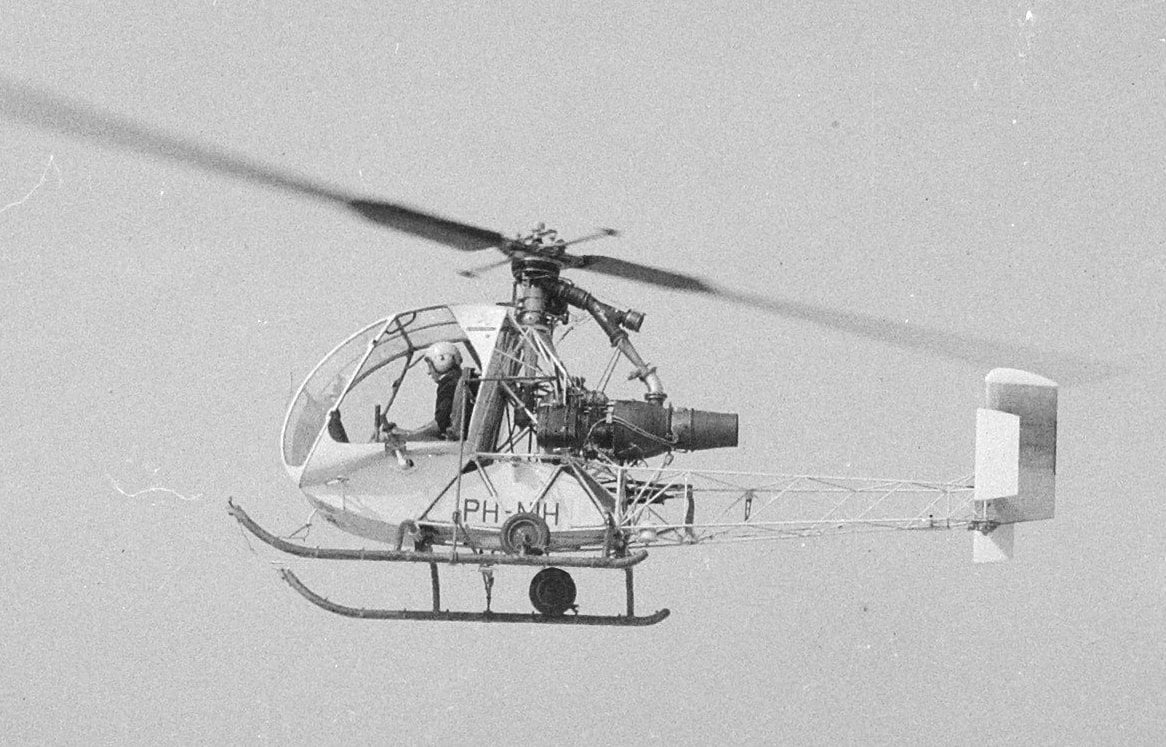
The Djinn also served in Algeria, where the heat showed up the limits of its air-driven rotor. Thin, hot air meant less lift, and the little helicopter struggled.
Abroad, Sud-Ouest demonstrated the Djinn far and wide. In 1956 British Pathé filmed one in Sydney carrying Australia’s Air Minister, Athol Townley. In the Netherlands, a Djinn registered PH-NIH rescued four boys from a sinking boat off the beach at Zandvoort in May 1958.
Ten nations, and a US Army trial
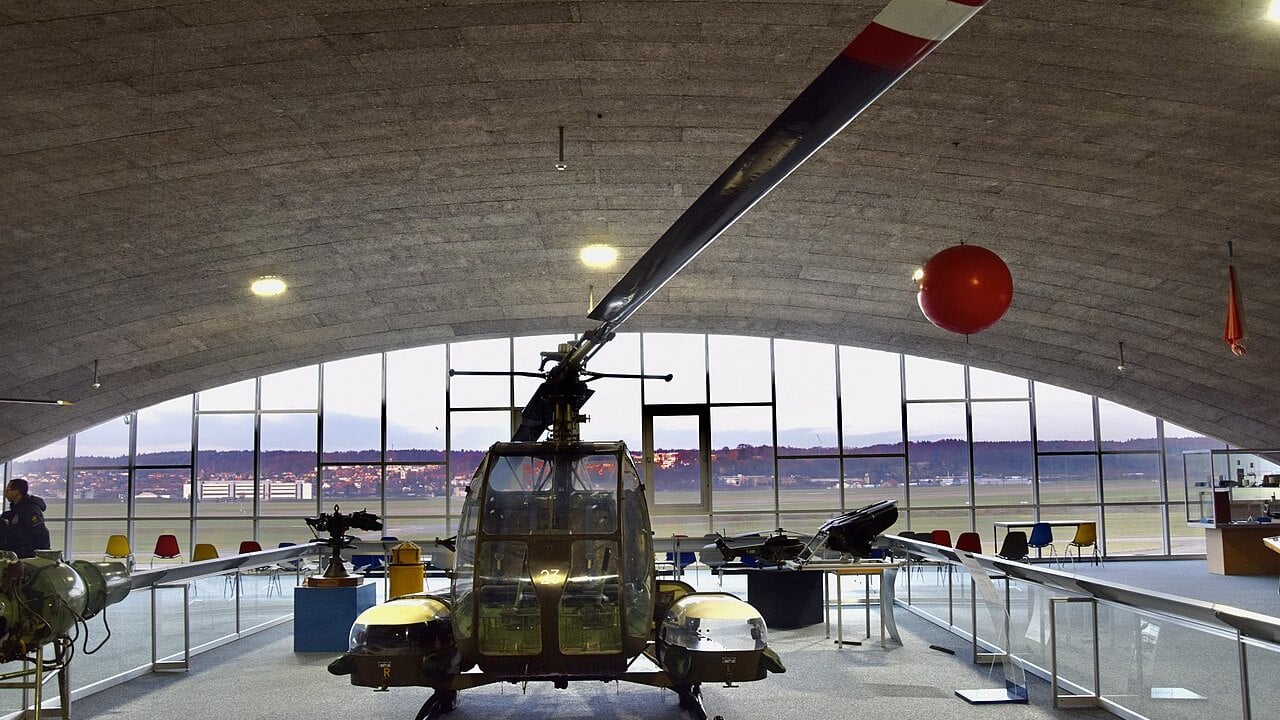
In the end about ten countries besides France bought Djinns. The German Army took six, and the Swiss military flew four until 1966. In 1958 the US Army leased three as the YHO-1 and tested them at Fort Rucker, Alabama. Its evaluators found the Djinn nimble and well built, but budget limits and resistance to buying foreign equipment meant no order followed.
The Army had even looked at it as a weapons platform. Armed versions could carry a machine gun fired from the second seat or an anti-tank guided missile, and the author Wayne Mutza records that the Americans judged the YHO-1 an excellent platform for them. The little Djinn was an early glimpse of the armed scout helicopter.
British Pathé, 1956: Djinn helicopters fly in Sydney, with Australia’s Air Minister Athol Townley on board.
Production ended in the 1960s after 178 Djinns. Its successor came from the same industry: the Alouette II, a conventional turbine helicopter with a gearbox and tail rotor that could carry more, further, and in hotter weather. It sold in the thousands, and the French Army retired its last Djinns in 1969.
Many surplus Djinns found new work as crop sprayers, with chemical tanks and spray bars bolted to their frames. Their pneumatic systems even let operators drive the spraying equipment with bleed air.
Still whistling
A number of Djinns survive. One hangs in the Swiss Air Force Museum at Dübendorf, another in French Army markings is at the Helicopter Museum in Weston-super-Mare in England, and the Musée de l’Air et de l’Espace at Le Bourget holds one restored by volunteers of Ailes Anciennes Toulouse, who have since been restoring a second.
The flame of a Djinn’s Turbomeca Palouste IV turbine as it is started (in French).
A few are still kept in airworthy condition by private collectors. When their Palouste turbines light up with a swirl of flame and the rotor starts to turn, there is still no tail rotor in sight. The tip-jet helicopter never became the future, but for a few years in the 1950s the Djinn showed that a rotor could be driven by air alone.
Sources: Ailes Anciennes Toulouse (AATLSE), Grace’s Guide to British Industrial History, Vertical magazine (Bob Petite, 2019), British Pathé, Ray Watkins Collection (1000aircraftphotos.com), Stanley S. McGowen (Helicopters: An Illustrated History of Their Impact, 2005), Wayne Mutza (Helicopter Gunships, 2010)
0 Comments