
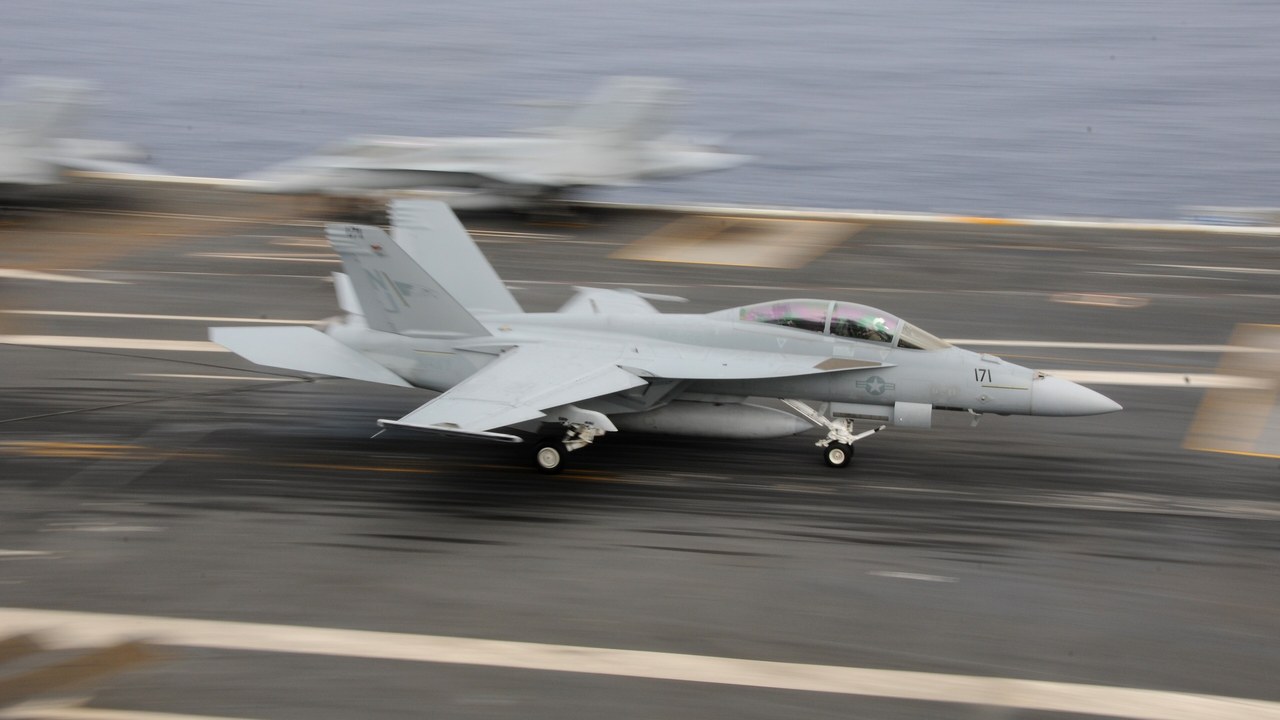
Watch a training airfield on a busy afternoon and you will see the same thing again and again: an aircraft settles onto the runway, the wheels touch, and instead of slowing down, the engine roars and it lifts straight back into the air. A minute or two later, it is back on final approach to do it again. That is a touch-and-go, and the racetrack it flies between landings is the traffic pattern.
For a student pilot, it is the fastest way to practise landings. For a navy pilot, it is how carrier landings are rehearsed on land, and touch-and-goes on the deck itself are part of carrier qualification.
Informations clés
- Touch-and-go: land, then take off again without stopping
- Stop-and-go: come to a full stop on the runway, then take off again
- Low pass: fly down the runway without the wheels touching
- Traffic pattern legs: upwind, crosswind, downwind, base, final
- Standard direction: left-hand turns, unless published otherwise
- Military jets: often join with an overhead break
- Navy version: Field Carrier Landing Practice (FCLP), carrier-style touch-and-goes on a runway
What Happens in a Touch-and-Go
In a normal landing, the pilot flies the approach, flares, touches down and then slows the aircraft with brakes, spoilers and, if fitted, reverse thrust. In a touch-and-go, the first half is identical. The difference starts the moment the wheels are on the runway. The pilot does not brake. Instead, power goes up to full, the flaps are partly retracted, and the aircraft accelerates back to rotation speed and climbs away.
The appeal is obvious: many landings in a short time. The approach, flare and touchdown are the hardest part of learning to fly, and a touch-and-go lets a student repeat them every few minutes instead of taxiing back to the start of the runway after each one.
There are close relatives. If the aircraft comes to a full stop before taking off again, it is a stop-and-go. If the wheels never touch, it is a low pass. An unplanned touch-and-go, when a pilot decides after touchdown that the landing should not continue, is a rejected or balked landing, a form of go-around.
The manoeuvre is not without critics. Some flight instructors argue that touch-and-gos lead students to pay less attention to learning to land properly, and they point out that the US Federal Aviation Administration's practical test standards and Airplane Flying Handbook do not discuss them. Supporters reply that more landings per hour means faster learning, and that being able to take off again from a landing is a safety skill every pilot needs.
The Traffic Pattern: A Racetrack in the Sky
Between touch-and-gos, the aircraft flies a standard circuit around the airfield. It is called the traffic pattern in the US and the circuit in Britain and much of the Commonwealth. Everyone flying it follows the same path, so pilots know where to look for each other. At small airfields without a tower, that predictability is what keeps aircraft apart.
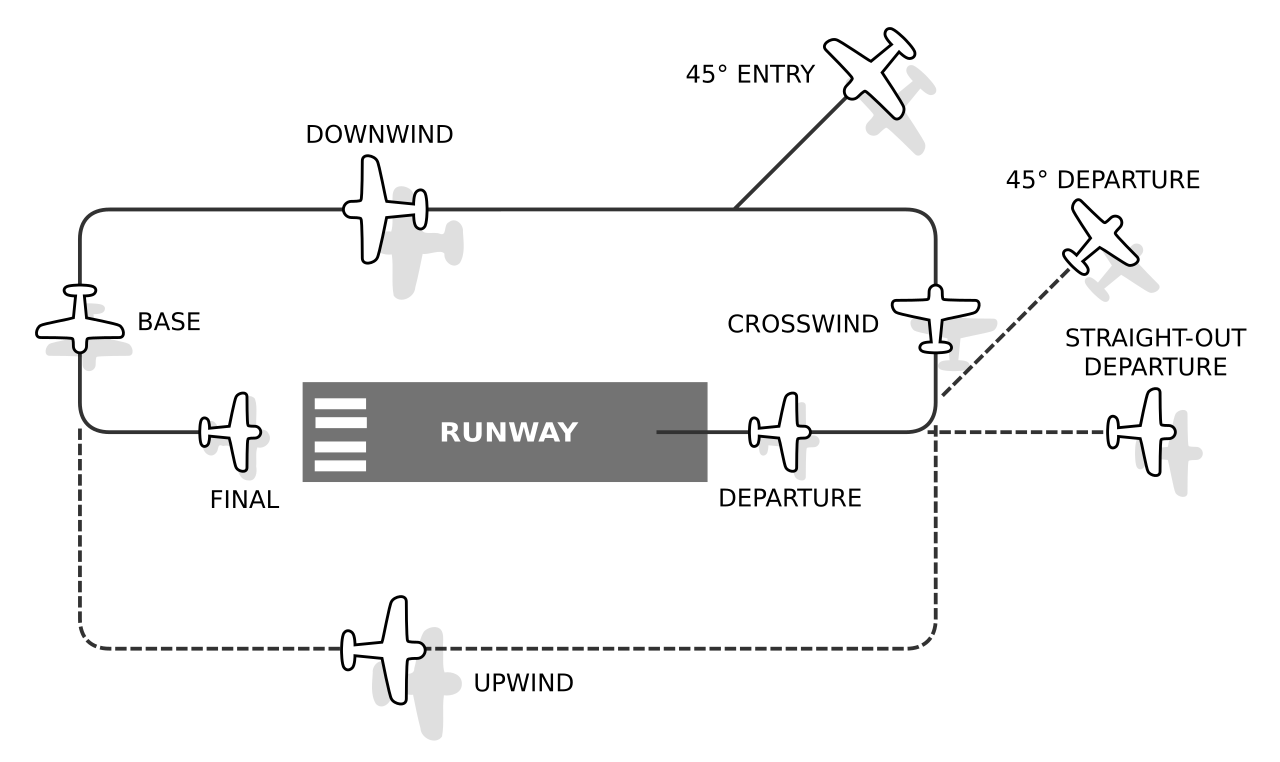
The pattern is a rectangle with the runway along one long side, and each leg has a name:
- Upwind: parallel to the runway, in the landing direction, offset from it
- Crosswind: a short climbing leg at right angles to the runway, after the departure end
- Downwind: the long, level leg flown parallel to the runway in the opposite direction
- Base: a short, descending leg at right angles to the runway, before the approach end
- Final: the descent along the extended runway centreline to touchdown
The names come from the wind. Aircraft take off and land into the wind, so the upwind leg heads into it, the crosswind leg crosses it, and the downwind leg runs with it. Patterns turn left unless the airfield publishes otherwise, because the pilot in command usually sits in the left seat and can see the runway out of the left window. Right-hand patterns are used for parallel runways, noise abatement or terrain.
Joining the pattern has its own rules, and they differ from country to country. In the United States and much of Europe, pilots usually join at a 45-degree angle to the downwind leg. In the UK, South Africa and New Zealand, an overhead join is recommended: cross above the circuit, descend on the far side, and join on the crosswind leg. Getting it wrong is dangerous, as we described in our story about a wrong pattern entry at an untowered field.
The Fighter Pilot's Version: The Overhead Break
Military airfields often bend the rectangle into a racetrack, flying the crosswind and base legs as continuous curved turns. Fast jets also have their own way of joining. Instead of entering on downwind, a fighter flies down the runway at speed and then makes a sharp, high-g turn above it, called the break. The turn bleeds off speed, so the jet rolls out on the downwind leg at pattern altitude, slow enough to drop the gear and flaps. In the US it is called the overhead manoeuvre or overhead break; elsewhere it is often known as a run-and-break.
Touch-and-Go on a Carrier
Navy pilots take the touch-and-go further than anyone. Before they can land on a carrier, they rehearse on land in Field Carrier Landing Practice. The training is meant to mimic the carrier as closely as possible. Pilots fly a tight, left-hand racetrack pattern and touch down again and again, day and night, while Landing Signal Officers grade every pass on centreline, glide slope and aircraft attitude. According to a US Navy fact sheet, the FCLP pattern extends about 1.25 to 1.5 nautical miles from the runway, and up to five aircraft can fly it at once.

The rules are strict, and with reason. Carrier landing qualification goes out of date after more than two weeks without a carrier landing, and night qualification after more than one week, according to the same fact sheet. Cmdr. Dwight Clemons of Navy Region Japan put it bluntly in 2017, when Carrier Air Wing 5 was practising on the island of Iwo To: "Many lessons have been learned the hard way at the cost of lives and aircraft."
Out at sea, touch-and-goes keep going. Pilots fly touch-and-goes on the real deck as part of their carrier qualifications. It is also a safe way to bring visiting aircraft aboard: navies sometimes let foreign jets fly touch-and-goes on each other's carriers. In April 2007, French Navy Rafale fighters from the Charles de Gaulle did exactly that on the USS John C. Stennis in the Arabian Sea.

The numbers add up quickly. Before USS Ronald Reagan left on its summer 2016 patrol, it planned 4,200 touch-and-go landings. Cmdr. Barrett Smith, executive officer of Strike Fighter Squadron 102, explained during the 2017 Iwo To training why none of it is optional.
For students in a light aircraft or naval aviators preparing for a night carrier landing, the principle is the same: land, go, go around, and do it again until it becomes automatic. The AiirSource Military video below shows Super Hornets flying touch-and-goes during field carrier landing practice.
Sources: Wikipedia (Touch-and-go landing; Airfield traffic pattern); US Navy, Field Carrier Landing Practice fact sheet (2022); DVIDS, "Tried and Tested: Carrier Air Wing 5 conduct Field Carrier Landing Practice" (Naval Air Facility Atsugi, May 2017); US Navy photo captions via Wikimedia Commons

0 Comments