
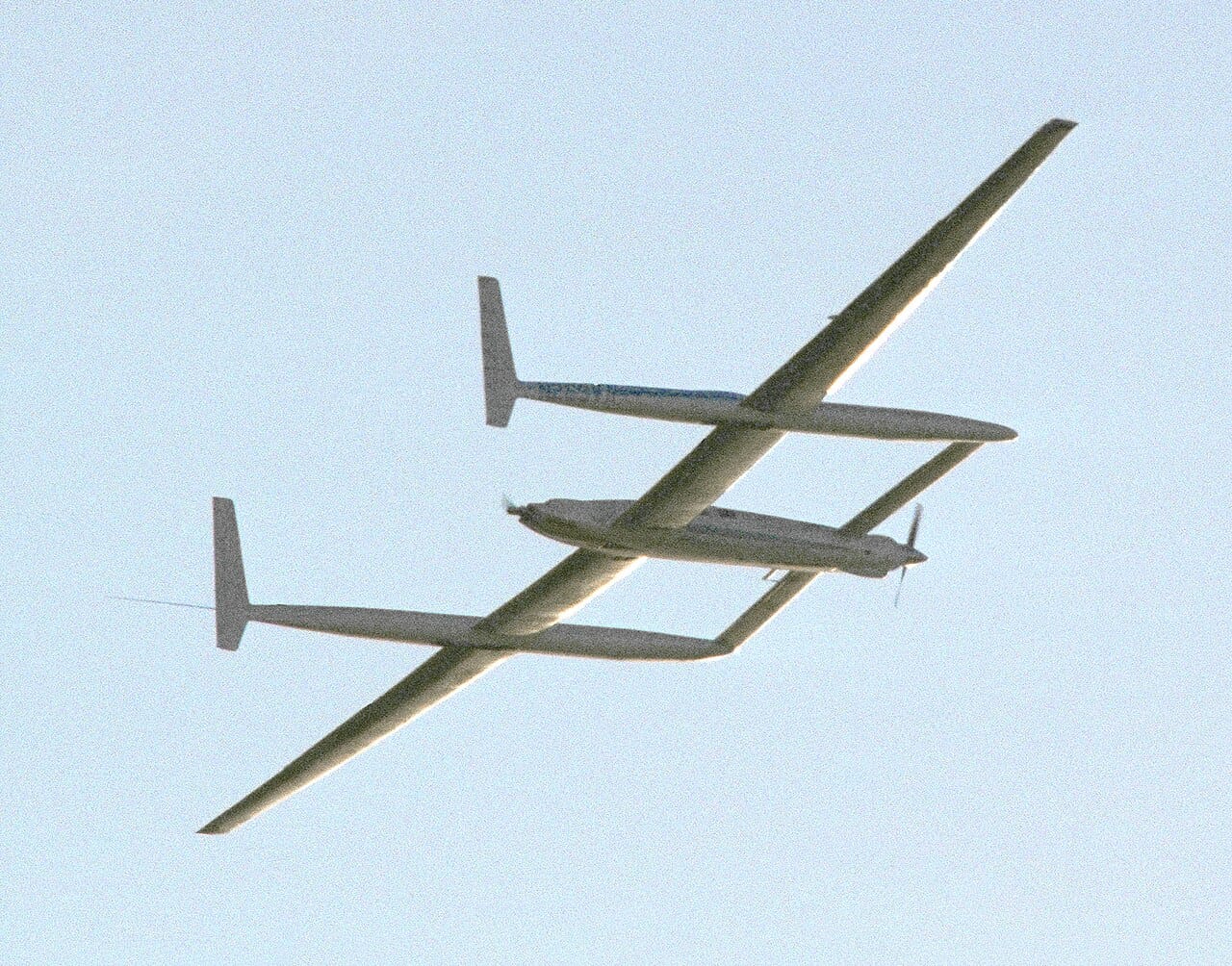
Two minutes and six seconds into its take-off roll, with less than 800 feet of a 15,000-foot runway left, an aeroplane made almost entirely of paper honeycomb and graphite fibre finally came unstuck from Edwards Air Force Base.
Its wingtips had been dragging along the concrete for most of that roll. Nine days later it came back, having flown around the world without landing and without taking on a drop of fuel, with about 106 pounds left in the tanks.
Nobody had done it before. Nobody has needed to do it since.
Informazioni rapide
Aeromobili: Rutan Model 76 Voyager, registration N269VA. One built
Designer: Burt Rutan, with chief aerodynamicist John Roncz
Equipaggio: Dick Rutan and Jeana Yeager
Structure: Roughly 98 per cent composite. No metal in the airframe at all
Motori: Rear Teledyne Continental IOL-200 of 110 hp; front Continental O-240 of 130 hp
Decollare: 8:01:44 a.m. PST, 14 December 1986, Edwards AFB, California
Approdo: 8:05:28 a.m. PST, 23 December 1986, same runway
Durata: 216 hours, 3 minutes, 44 seconds
Fuel remaining: About 106 lb, roughly 1.5 per cent of what it started with
An aeroplane that was mostly fuel
Voyager was built at Mojave from the summer of 1982 by a tiny group: Dick Rutan, Jeana Yeager and crew chief Bruce Evans, with something over 22,000 work hours and 99 volunteers on the ground. There was no government contract and no corporate sponsor. Yeager set up a donor scheme instead.
The numbers explain the design. The bare airframe weighed 939 lb. Fitted out with engines and systems the aircraft weighed 2,250 lb. It left the ground at 9,694.5 lb. Fuel accounted for 72.3 per cent of the take-off weight, spread across seventeen separate tanks, eight in each wing and one in the centre, and the crew had to move it between tanks throughout the flight simply to keep the aeroplane in balance.
The structure was a quarter-inch sandwich of paper honeycomb and graphite fibre. There was no metal in it anywhere.
The take-off that nearly did not happen
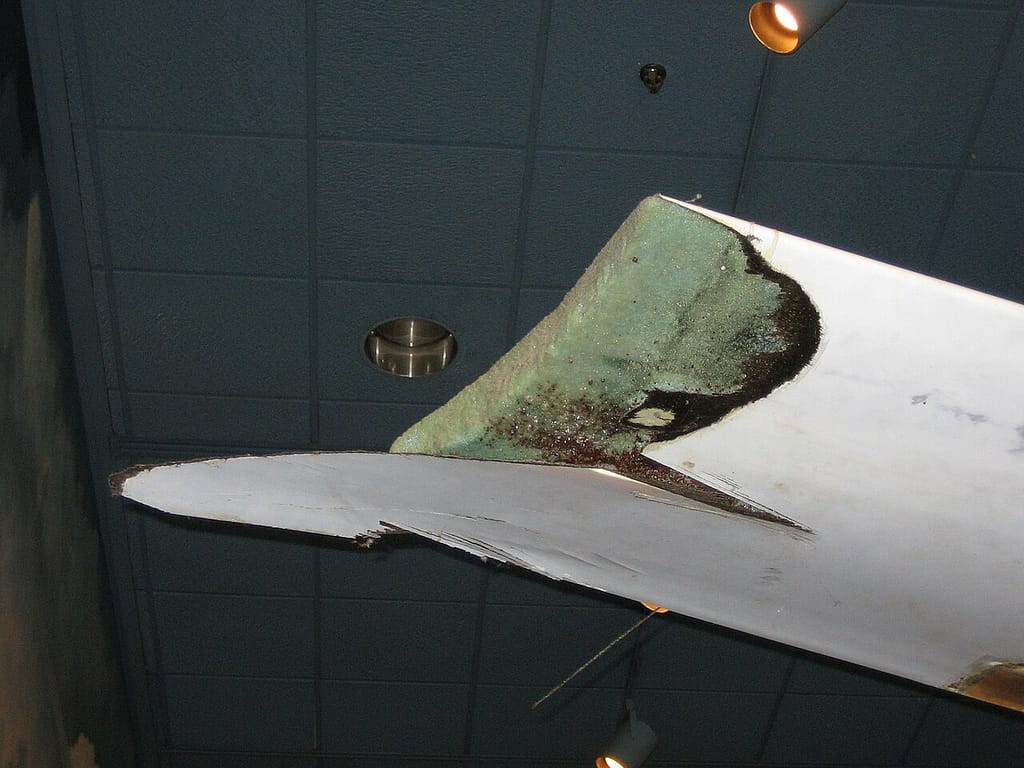
Fully loaded, the wings flexed so far that the winglets touched the runway. Both were damaged during the roll.
There was an abort point at the 7,500-foot mark, and Voyager was four knots short of the speed it needed. Dick Rutan kept going. He reached the number at around 11,000 feet down the runway and rotated on Yeager's call.
The winglets were then hanging by a thin layer of carbon fibre. Rather than fly on with them flapping, the crew deliberately shook them off, increasing speed and slipping the aircraft to build up side loads until they broke away. The right one came off about five miles from the base and landed in somebody's garden; it is now in storage at the Smithsonian. The left one also came off and was never found.
Burt Rutan, flying chase alongside with Mike Melvill, judged the aircraft still within limits and cleared them to continue.
Nine days in a cabin the size of a phone box
The route went west, and the weather did not cooperate. Libya refused them airspace. A typhoon six hundred miles across sat in the way, and instead of going around it they worked the edges of it deliberately, using the tailwinds to slingshot the aircraft along at up to 130 knots over the ground.
The rear engine ran essentially the entire flight. The front engine was used for a total of 70 hours and 8 minutes, mostly for climb and when they needed the power.
The worst moment came near the end. A strainer on a small fuel pump and an air pocket in the line starved the rear engine and it stopped. The aeroplane fell 5,000 feet while the crew fought to get the front engine started, fumes filling the cabin badly enough that they went onto oxygen. Rutan's radio call was flat: he had just lost the rear engine. It took about ninety seconds to get the front one running. They cleared the air block, restarted the rear engine, and levelled off at 3,500 feet.
What the numbers were
They landed at Edwards at 8:05:28 in the morning on 23 December 1986, after 216 hours, 3 minutes and 44 seconds. Estimates of the crowd run from around 40,000 to 55,000.
The officially recognised distance for the round-the-world record is 24,986.727 miles, at an average of 115.65 mph. The actual air miles flown were longer, somewhere above 26,000, because of the detours. Eight absolute and world-class records came out of the flight, along with the Collier Trophy for 1986.
Jeana Yeager, at the same conference, was more matter-of-fact about it: like anything, it was a lot more difficult than you imagine, and if it had been easy somebody would have done it a long time earlier.
Built by nobody in particular
When Burt Rutan collected the Presidential Citizens Medal a few days later, he made a point of who had actually done it.
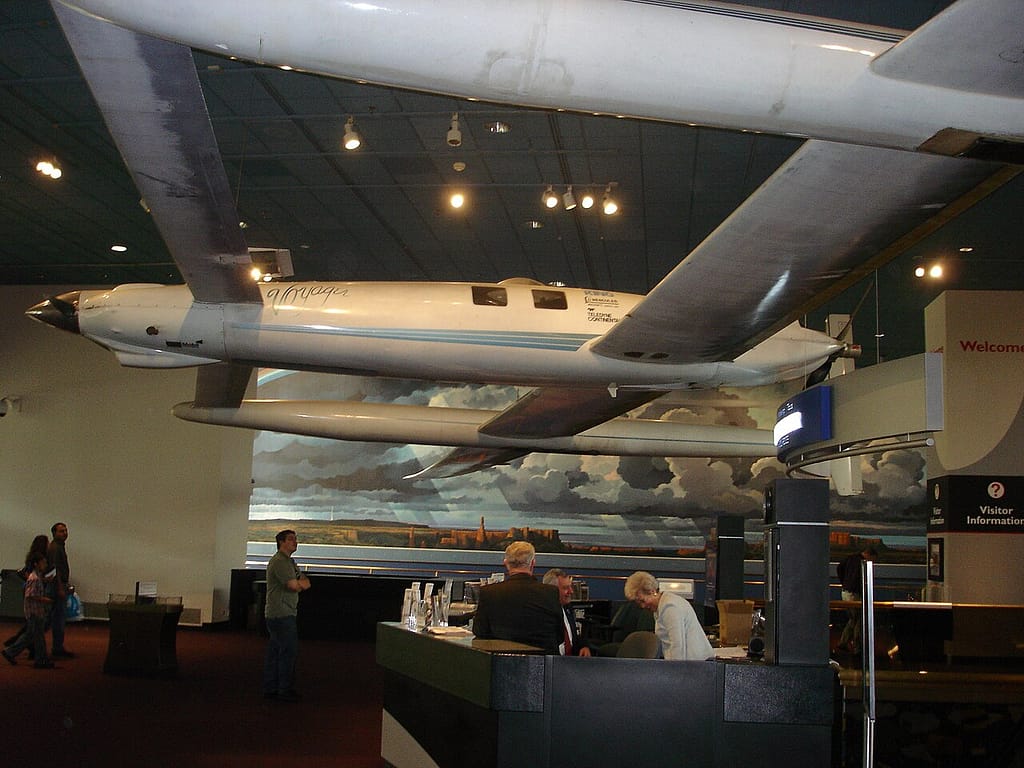
Voyager hangs in the National Air and Space Museum now, wings spread across the entrance hall, looking less like an aircraft than like a drawing of one. It flew once around the world and never needed to prove anything again.
Sources: National Air and Space Museum collection record for the Rutan Voyager; UPI, 23 December 1986; Public Papers of the Presidents, Remarks on Presenting Presidential Citizens Medals, 29 December 1986; Aviation History, November 2019; dickrutan.com; FAI and NAA absolute record tables.
0 Commenti