

Buried in a routine American contract announcement on Monday was a single word that set the European defence press moving: Poland.
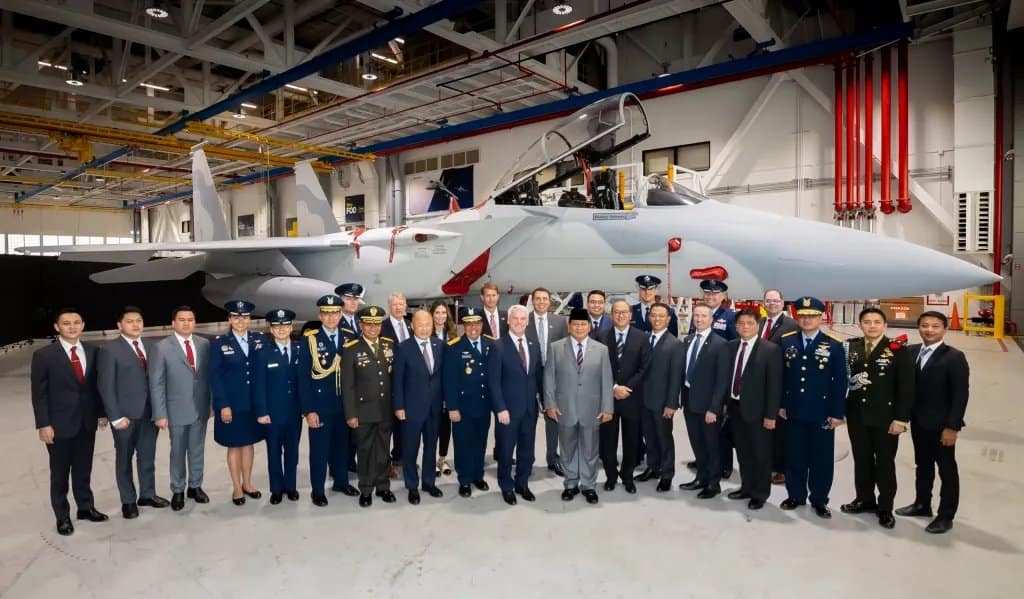
The US Department of War confirmed that Boeing had been awarded an indefinite-delivery, indefinite-quantity contract for the F-15 Eagle Crest programme, with a ceiling value of $131.23 billion. Among the Foreign Military Sales customers named in the framework, alongside Japan, Israel, Saudi Arabia, South Korea, Singapore and Indonesia, sat Warsaw.
Poland has never announced an intention to buy the F-15. Its Ministry of National Defence moved quickly to say it still has not. And yet nobody in Warsaw or St Louis is treating the matter as closed, for a reason that dates to 2017.
Informazioni rapide
| The contract | Boeing IDIQ for the F-15 Eagle Crest programme |
| Ceiling value | $131.23 billion, a maximum framework value, not an order book |
| Annunciato | Monday 24 August 2026, by the US Department of War |
| Covers | Production, systems integration, modernisation, upgrades, retrofits, sustainment, depot maintenance |
| Durata | Work through August 2037; orders through August 2031, extendable to 2036 |
| FMS customers named | Japan, Israel, Saudi Arabia, South Korea, Singapore, Indonesia, Poland |
| Warsaw’s position | Polish Armed Forces do not plan to acquire the F-15EX |
| Polish F-35 order | 32 aircraft ordered, with plans confirmed for a further 32 |
What an IDIQ contract actually is, and is not
The distinction matters, and it is routinely lost in translation. An IDIQ contract does not buy anything. It is a purchasing mechanism: a pre-negotiated vehicle through which orders may later be placed, by the United States or by approved foreign customers, without starting the contractual process from zero each time.
The $131.23 billion figure is therefore a ceiling for the entire F-15 programme across all participants over more than a decade. It is not a sum anyone has committed to spend, and it is emphatically not a Polish order.

Warsaw’s denial was correspondingly precise. The Ministry of National Defence told the Polish outlet Defence24 that the armed forces have no such plan, and that inclusion in the American framework implies neither a decision nor an active procurement.
Read literally, that is unambiguous. Read against precedent, it is rather less so.
The Apache precedent
This is where the story acquires its edge. In 2017, Poland was named in a similar American contract, that one covering sensors. The US Department of Defense denied at the time that Warsaw had selected the AH-64 Apache.
Poland went on to order 96 of them, becoming the largest international Apache customer in the world.
The observation comes from Gareth Jennings, aviation desk editor at Janes, who was careful to frame it as a pattern rather than a prediction. Boeing, for its part, told him that Poland has not yet made a decision on the F-15EX. Which is not quite the same sentence as the one Warsaw used.
Why the aircraft would make sense for Warsaw
Poland has been rearming since February 2022 at a pace no other European state has matched. Forty-eight FA-50 light combat aircraft. One hundred and eighty K2 tanks. Two hundred and fifty M1A2 SEPv3 Abrams. A fleet of 32 F-35As, named Husarz after the winged hussars, with a further 32 confirmed. The existing F-16 force is queued for a substantial upgrade.
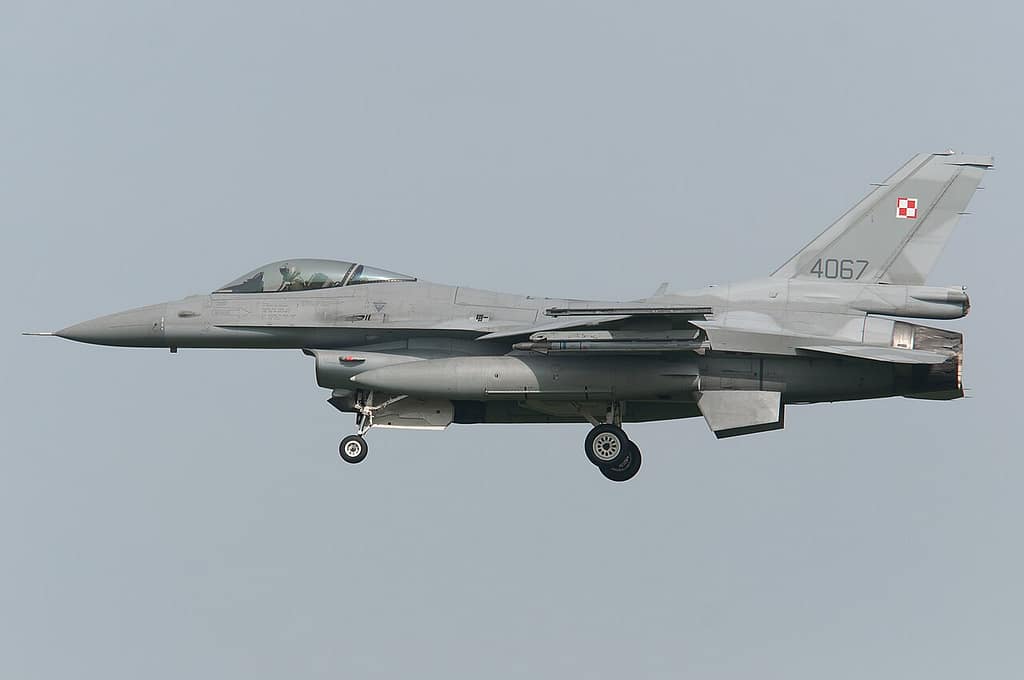
What that inventory lacks is a heavy fourth-generation fighter: something with the payload, the internal fuel and the raw air-to-air magazine depth to complement a stealth force rather than duplicate it. The F-35 opens the door; something larger carries the ordnance through it.
Boeing has understood this for years and courted Warsaw accordingly. Polish officers have visited St Louis, and in 2025 the then-Inspector of the Polish Air Force, General Ireneusz Nowak, flew the F-15EX himself at Boeing’s facilities. Governments do not usually put a three-star in the front seat of an aircraft they intend to ignore.
The video above marks the arrival of the Husarz, Poland’s F-35A, which formally entered service at the 32nd Tactical Air Base at Lask in June.
What to watch, and what not to conclude
Nothing has been bought. The framework names potential participants, not confirmed purchasers, and Indonesia’s presence on the same list is the cautionary note: Jakarta was once poised to become the first export operator of the F-15EX and abandoned the idea earlier this year after two years of stasis.
What has changed is procedural rather than political. Washington has now built the contractual plumbing through which a Polish F-15EX order could flow quickly, should Warsaw ever decide it wants one. That is not a decision. It is the removal of an obstacle to a decision.
Poland says no. Boeing says not yet. In 2017, the same two sentences preceded the largest Apache export order ever placed.
Sources: TWZ (Thomas Newdick, 25 August 2026), U.S. Department of War contract announcement (24 August 2026), Defence24, Janes, Polish Ministry of National Defence.

0 Commenti