
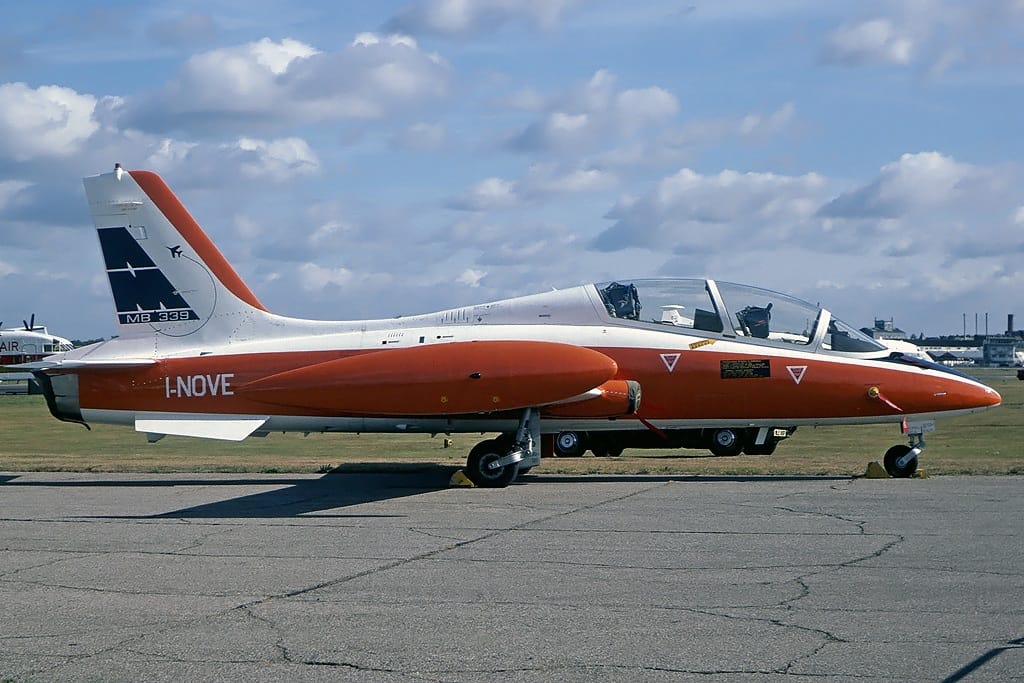
On 12 August 1976 a small blue-and-white jet lifted off from Venegono, north of Milan, with Aermacchi test pilot Franco Bonazzi at the controls. It was registered I-NOVE and it was not, by any measure, a revolutionary aeroplane. It was an old design with a new front end.
Fifty years later the Aermacchi MB-339 has taught roughly 2,500 Italian military pilots to fly, flown a combat mission against a Royal Navy frigate, and become the aircraft the Frecce Tricolori are still flying today. Not bad for a warmed-over trainer.
Informazioni rapide
Primo volo: 12 August 1976, Venegono, Italy — prototype MB-339X, I-NOVE, flown by Franco Bonazzi
Designer: Ermanno Bazzocchi — the “B” in MB
Motore: One Rolls-Royce Viper Mk 632-43 turbojet, 4,000 lbf (17.8 kN)
Equipaggio: Two, in tandem, on Martin-Baker seats
Hardpoints: Six underwing, up to 1,815 kg (4,000 lb); no internal gun
Costruito: Approximately 230, production ending in 2006
Operatori: Italy, Argentina, Eritrea, Ghana, Malaysia, New Zealand, Nigeria, Peru, UAE
Stato: MB-339A retired 12 June 2025; MB-339CD flies to 2030; Frecce Tricolori PANs to be replaced by the M-346
The cheapest good idea Aermacchi ever had
In 1972 Aermacchi lined up seven clean-sheet designs for a new Italian trainer, collectively the MB-338, and compared them against a cheaper option: improve the MB-326 the company was already building. The improved MB-326 won, and in 1975 it was selected. It kept most of the older jet's airframe, including the MB-326K wing.
The one change that mattered was the front. Instructors in the MB-326 spent their working lives peering around the student's head. Bazzocchi redesigned the forward fuselage to step the rear seat up, and gave it a bigger fin. That is close to the whole story of why the MB-339 worked and the MB-326 was superseded: the man in the back could finally see out.
A trainer that went to war
Argentina's Navy bought ten MB-339As in 1980 and had them in service by 1981. When the Falklands War began, six went to Port Stanley — light attack aircraft in everything but name, with rocket pods and gun pods on those six hardpoints.
On 21 May 1982, flying a reconnaissance sortie, Lieutenant Guillermo Owen Crippa found the British amphibious force in San Carlos Water and attacked it alone. Argentine accounts, corroborated by HMS Argonaut's own record, credit him with cannon and rocket hits that damaged the frigate's Type 965 radar. It was light damage — the serious harm to Argonaut came hours later from A-4 bombs — but a single trainer pressing an attack on a landing force is not a small thing.
The type's war was short and costly. One MB-339A was shot down by a Blowpipe missile at Goose Green on 27 May, killing its pilot; another pilot had died in a crash earlier in the month. Three airframes were captured. Eritrea later used six MB-339CEs against Ethiopia from June 1998.
The Italian Air Force's own profile of the MB.339 — the best short look at the cockpit and the airframe.
The team, and the day it went wrong
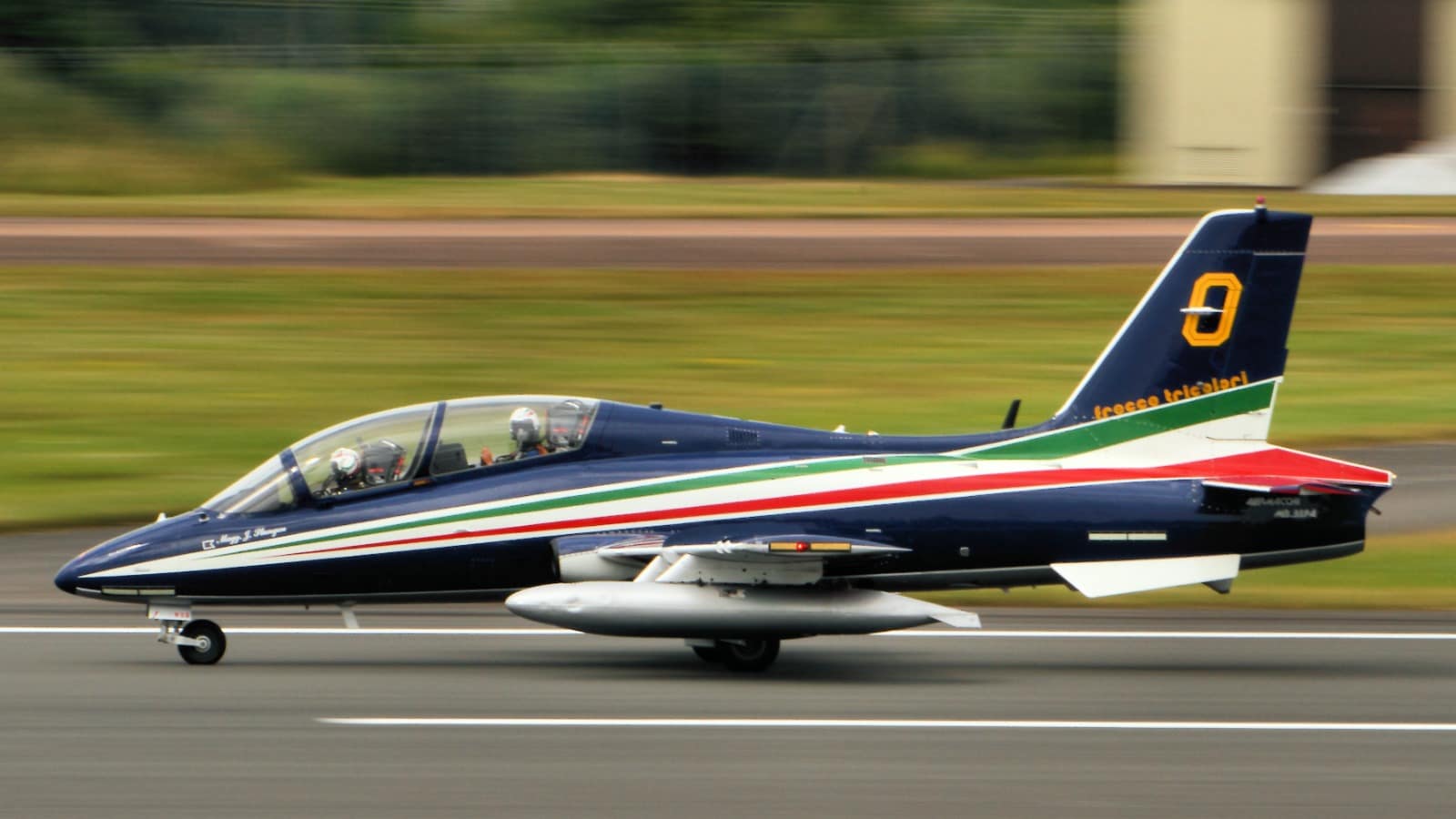
The Frecce Tricolori selected the MB-339 in 1981 to replace the Fiat G.91, and the first MB-339PANs — smoke generators fitted, tip tanks deleted — arrived in 1982. The team has flown nothing else since: nine aircraft in the formation and a solo, for more than forty years.
It has to be said plainly that the aircraft is also bound up with the worst accident in airshow history. At Ramstein on 28 August 1988, during the "Cardioide" manoeuvre, the solo aircraft arrived early and low and collided with two others. Seventy people died — the three pilots and 67 others on the ground — and 346 spectators were seriously injured. The disaster rewrote airshow safety regulation across Europe.
Il lungo addio
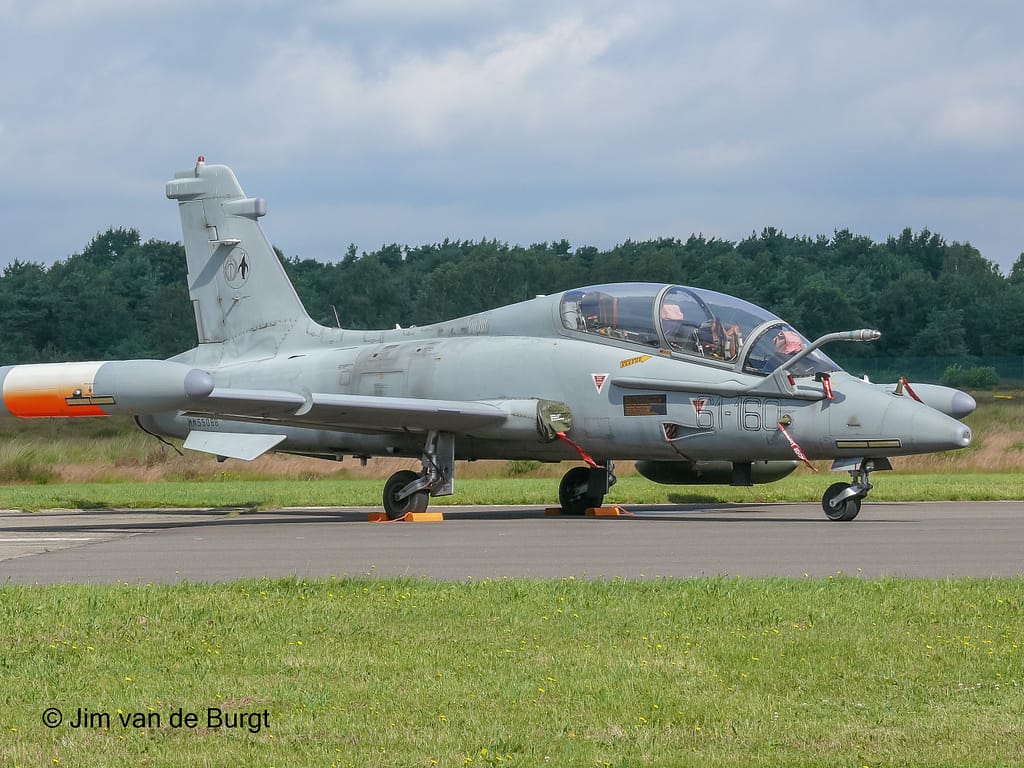
On 12 June 2025 the Italian Air Force formally retired the T-339A at Lecce-Galatina after 45 years, handing basic training to the Leonardo T-345A. Franco Bonazzi, the man who first flew the prototype, sent a video message to the ceremony.
It is not over yet. The MB-339CD keeps flying until about 2030, and the Frecce Tricolori will hold on to their PANs until the M-346 takes over. By then the design will be closer to sixty than fifty, and its ancestry will run back to a 1950s trainer.
Aviation likes to celebrate the clean sheet — the radical prototype, the leap forward. The MB-339 is the other story: take something that works, fix the one thing that is wrong with it, and then fly it for half a century.
Sources: Aermacchi/Leonardo company material; Italian Air Force (Aeronautica Militare); The Aviationist, 24 August 2026 and 12 June 2025; NATO Allied Air Command; HMS Argonaut service record; Wikipedia cross-checks.


0 Commenti