

When people picture the first practical helicopters, they usually think of Igor Sikorsky and wartime America. But years before Sikorsky’s machines matured, Nazi Germany built a genuinely usable transport helicopter — and in September 1945, one of them became the first helicopter in history to fly across the English Channel.
The Focke-Achgelis Fa 223 Drache (“Dragon”) is one of aviation’s great overlooked pioneers.
Informazioni rapide
| Aeromobili | Focke-Achgelis Fa 223 Drache (“Dragon”) |
| Designer | Heinrich Focke |
| Disposizione | Two side-by-side rotors on outriggers, one central engine |
| Motore | One BMW Bramo 323 radial (~1,000 hp) |
| Primo volo | 1940 |
| Performance | 182 km/h and 7,100 m in altitude trials |
| Costruito | Fewer than about 20 completed |
| Pietra miliare | First helicopter to cross the English Channel, 1945 |
Two rotors, one engine
Heinrich Focke had co-founded Focke-Wulf, but after being pushed out he set up a new company with the aerobatic pilot Gerd Achgelis to pursue rotary flight. The Fa 223 that emerged used a configuration that looks strange today: two large three-bladed rotors mounted on outriggers on either side of the fuselage, turning in opposite directions, both driven by a single BMW radial engine buried in the middle. It is one engine and two rotors — not, as it appears, a twin.
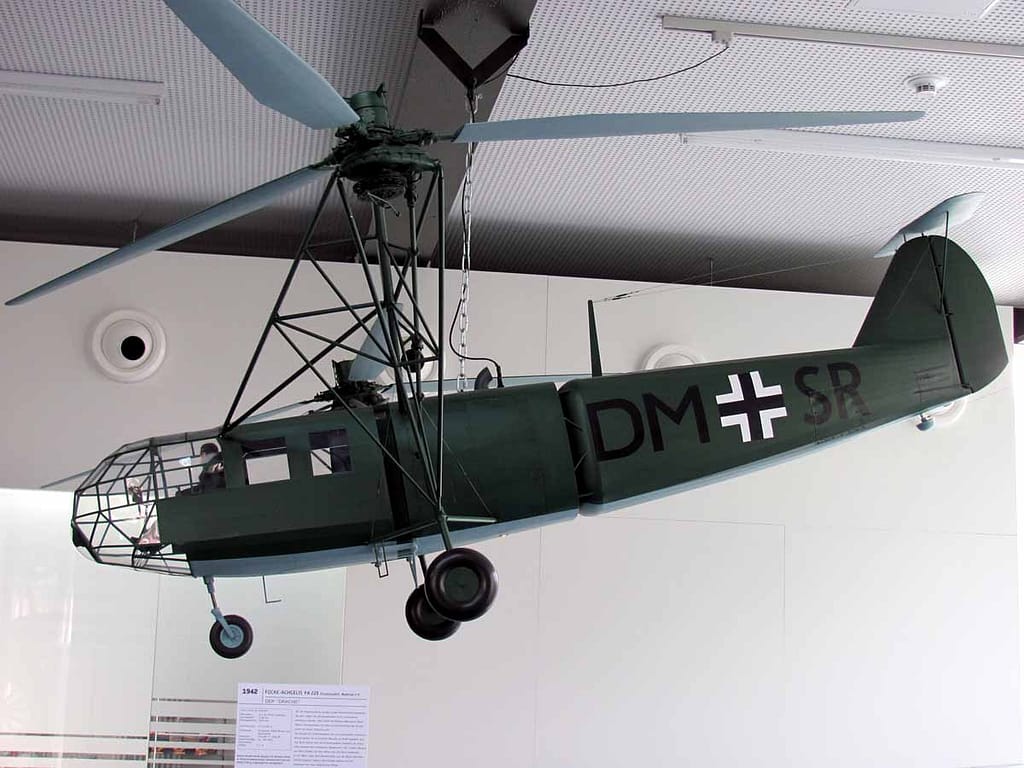
Its performance was remarkable for the early 1940s. In trials it reached 182 km/h and climbed to over 7,000 metres, and it could lift more than a tonne of cargo — enough to sling a small vehicle beneath it. Even Adolf Hitler, shown the machine, immediately grasped its potential.
Bombed out of production
The Dragon never got the chance to prove itself in numbers. Allied bombing repeatedly flattened the factories building it, and fewer than twenty were ever completed. The handful that flew were used for mountain transport and rescue work, hauling loads to places no fixed-wing aircraft could reach.

Across the Channel
After the war, the British wanted to evaluate the technology. In September 1945 a surviving Fa 223, flown by German pilot Hans-Helmut Gerstenhauer, was flown from Cherbourg across the sea to England — the first time any helicopter had crossed the English Channel. Gerstenhauer recorded the moment in his diary.
The story did not end happily for that particular aircraft: it crashed in England weeks later after a drive-shaft failed. But the Dragon’s ideas lived on — in postwar French and Czech helicopters built from its design, and in the simple, proven fact that a rotary-wing aircraft could do useful work. Germany had built a real helicopter before almost anyone else, and then bombed and lost most of the evidence.
Sources: Smithsonian Magazine; National Air and Space Museum; Wikipedia.


0 Commenti