
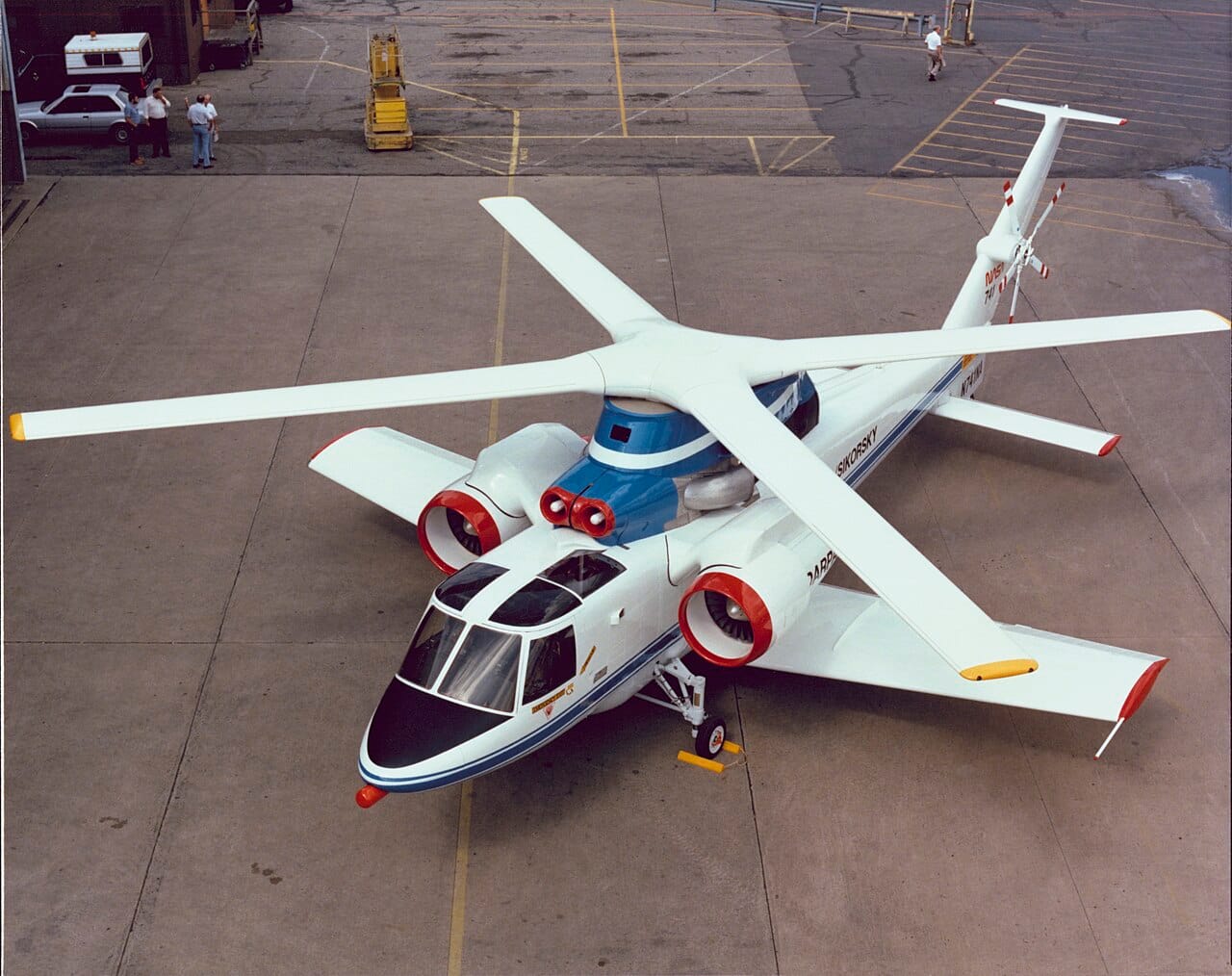
Every helicopter engineer has the same dream: a machine that lifts straight up off a rooftop like a helicopter, then flies as fast as an aeroplane. The trouble is the rotor. It gives you vertical flight, but it also limits your speed — so what if, once you were up and moving, you could simply stop the rotor in mid-air and let its four blades freeze into a rigid, X-shaped wing?
That was the Sikorsky X-Wing. It was one of the most audacious ideas in the history of rotorcraft. Sikorsky, NASA and the Pentagon spent most of the 1980s and a fortune trying to make it work. It never flew.
Aeromobili: Sikorsky S-72 X-Wing (based on the NASA/Army RSRA)
Idea: Take off as a helicopter, then stop the rotor in flight to fly on it as a fixed X-shaped wing
Controllare: No swashplate — compressed air blown from the blades (circulation control)
Testbed first flew: 1976 (as the RSRA)
Destino: Cancelled in 1988; the X-Wing never flew
Motivo: Staggering complexity, cost and risk
The flying laboratory
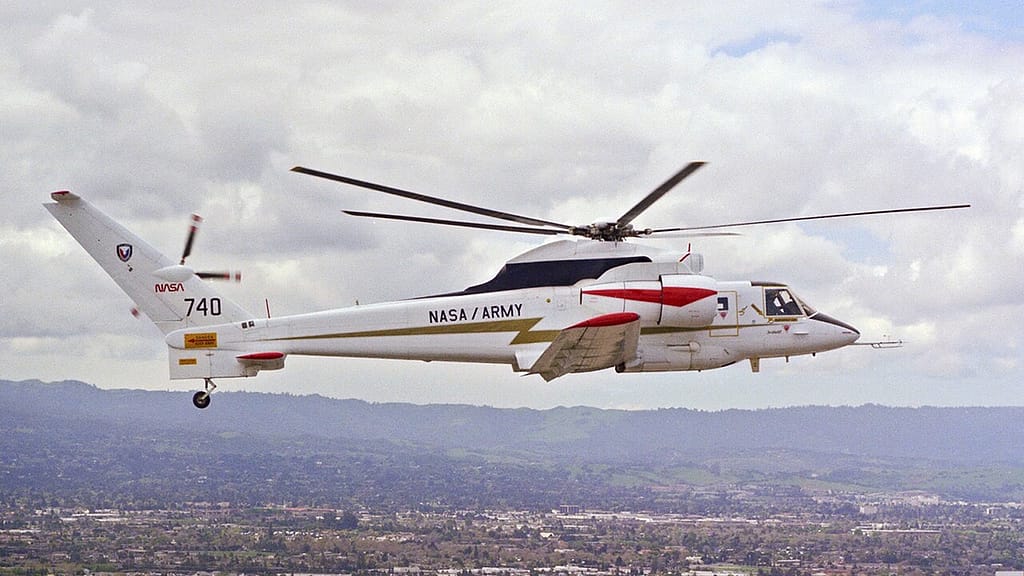
The X-Wing was built on top of an already unusual aircraft: the Sikorsky S-72 Rotor Systems Research Aircraft, or RSRA. Developed for NASA and the US Army and first flown in 1976, the RSRA was a flying laboratory designed to test experimental rotors, complete with stubby wings and its own auxiliary jet engines so it could fly even with its rotor unloaded. It was the ideal guinea pig for the wildest rotor concept anyone had yet proposed.
Stopping a rotor in flight
The physics of stopping a rotor in forward flight are brutal. A spinning rotor blade sweeping forward into the airflow makes lots of lift; the blade on the other side, sweeping backward, makes very little. As you slow the rotor to stop it, that imbalance grows wildly, and a conventional helicopter’s method of controlling lift — mechanically changing the pitch of each blade through a swashplate — simply cannot keep up.
Sikorsky’s answer was to throw out moving control parts on the rotor altogether. Instead of twisting the blades, the X-Wing blew compressed air from the engines out of thin slots along each rigid blade, using the Coandä effect to steer the airflow and control the lift electronically — a technique called circulation control. A high-frequency valving system metered air to each blade many times per revolution, controlling lift as the rotor turned, slowed, and stopped. It was elegant in theory and fiendish in practice.
Too clever to fly
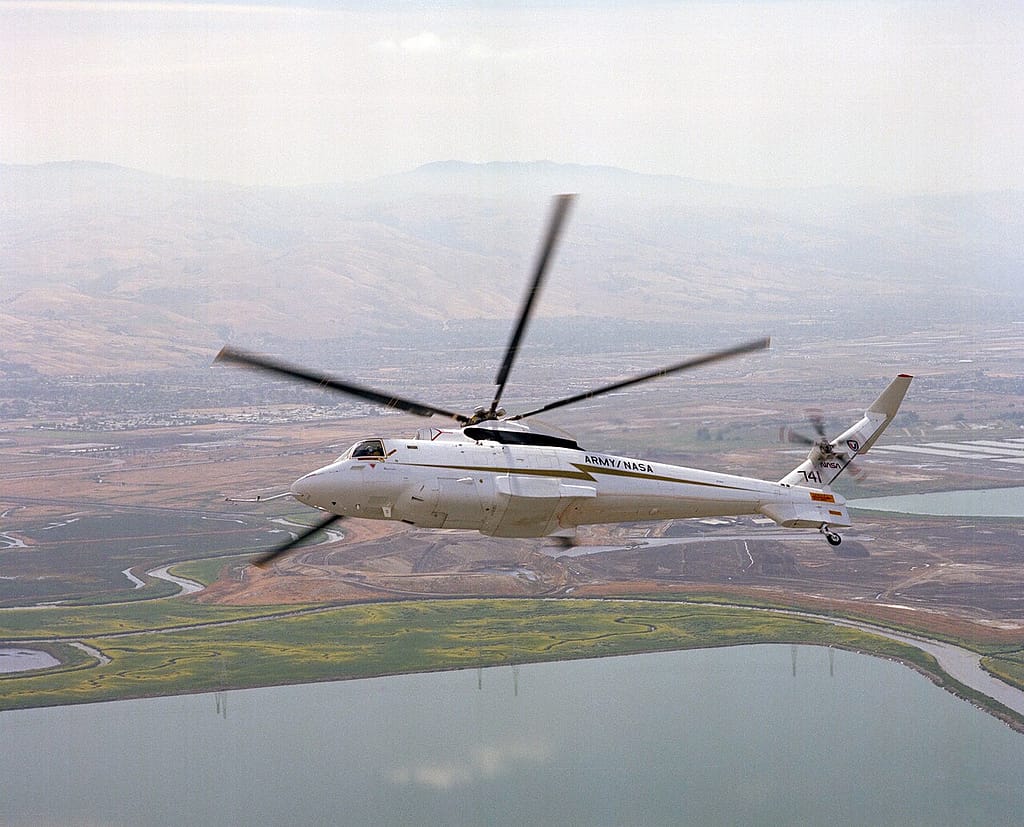
For all its brilliance, the X-Wing kept running into the same wall: the moment of conversion. Transitioning smoothly from a spinning rotor to a stopped wing — and back again — without losing control was extraordinarily difficult, and the consequences of getting it wrong were catastrophic. Testing was exhaustive: the rotor system spent weeks in NASA’s giant Ames wind tunnel, and an operational X-Wing rotor logged many hours of ground running.
But the costs climbed, the risks never really came down, and confidence that the conversion could be made reliable never arrived. In 1988, after years of work, the programme was cancelled. The X-Wing aircraft was, by then, essentially complete. It never left the ground in its X-Wing form.
The stopped-rotor dream has never fully died — variations still surface in modern high-speed rotorcraft and drone concepts. But the Sikorsky X-Wing remains the boldest attempt of all: a helicopter that wanted to become a jet in mid-air, defeated not by bad physics but by the sheer, unforgiving complexity of the moment in between.
Sources: Igor I. Sikorsky Historical Archives; NASA; Wikipedia; Vertipedia (VTOL.org).


0 Commenti