
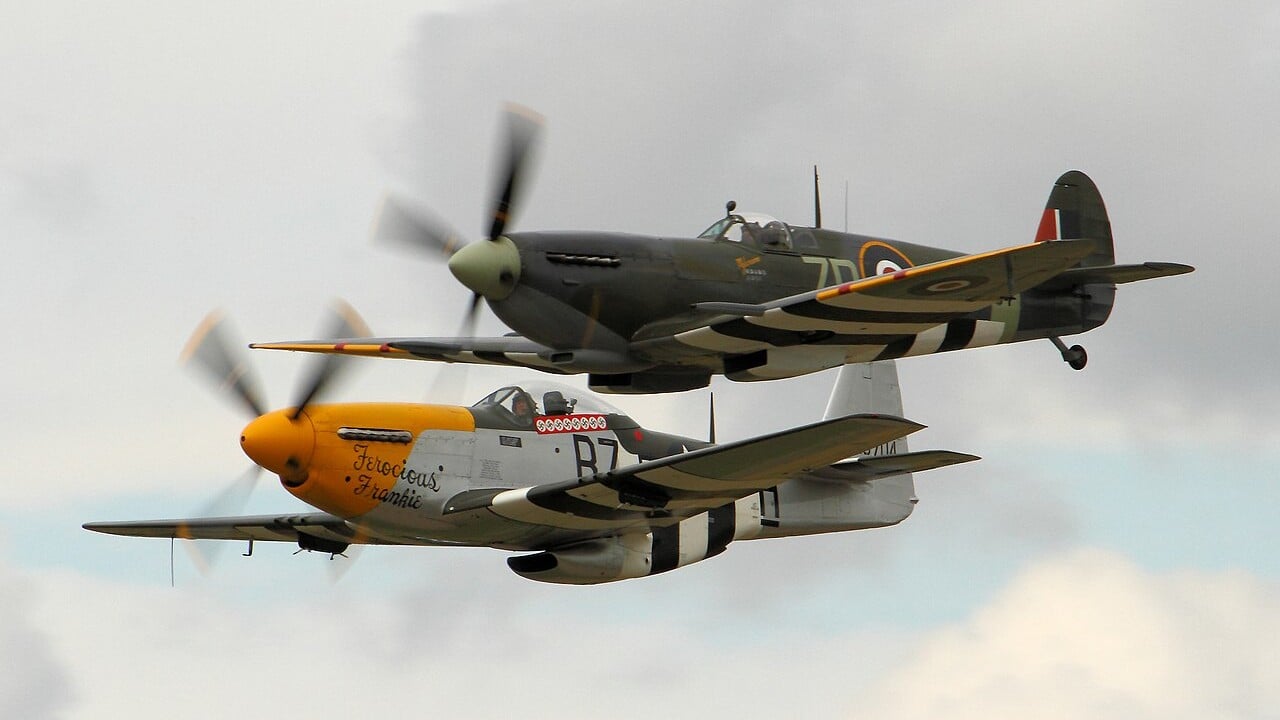
Ask a room of warbird enthusiasts which was the best piston-engined fighter of the Second World War in Europe and you will start an argument that has been running for 80 years. Two names come up again and again: the American P-51D Mustang and the British Supermarine Spitfire Mk XIV.
They make a fascinating pair. Both were born from the same family of Rolls-Royce engine technology. Both reached roughly 440 mph. Yet they were built for different jobs, and that is the key to answering the question.
Here is how the two compare, using the figures and the words of the people who flew them.
Quick Facts: Spitfire Mk XIV vs P-51D
Spitfire XIV engine: Rolls-Royce Griffon 65, about 2,050 hp
P-51D engine: Packard V-1650-7, a licence-built two-stage Merlin
Spitfire XIV top speed: About 440 to 446 mph at altitude
P-51 top speed: Around 440 mph at altitude (P-51B: 441 mph at 30,000 ft)
Spitfire XIV climb: 20,000 ft in just over five minutes
Allineare: Spitfire XIV about 460 miles on internal fuel; P-51 could escort bombers from England to Germany and back
Armamento: Spitfire XIV: 2 x 20mm cannon, 2 x .50 MG; P-51D: 6 x .50 MG
Costruito: Spitfire XIV 957; P-51D 8,102
Two Fighters, Two Jobs
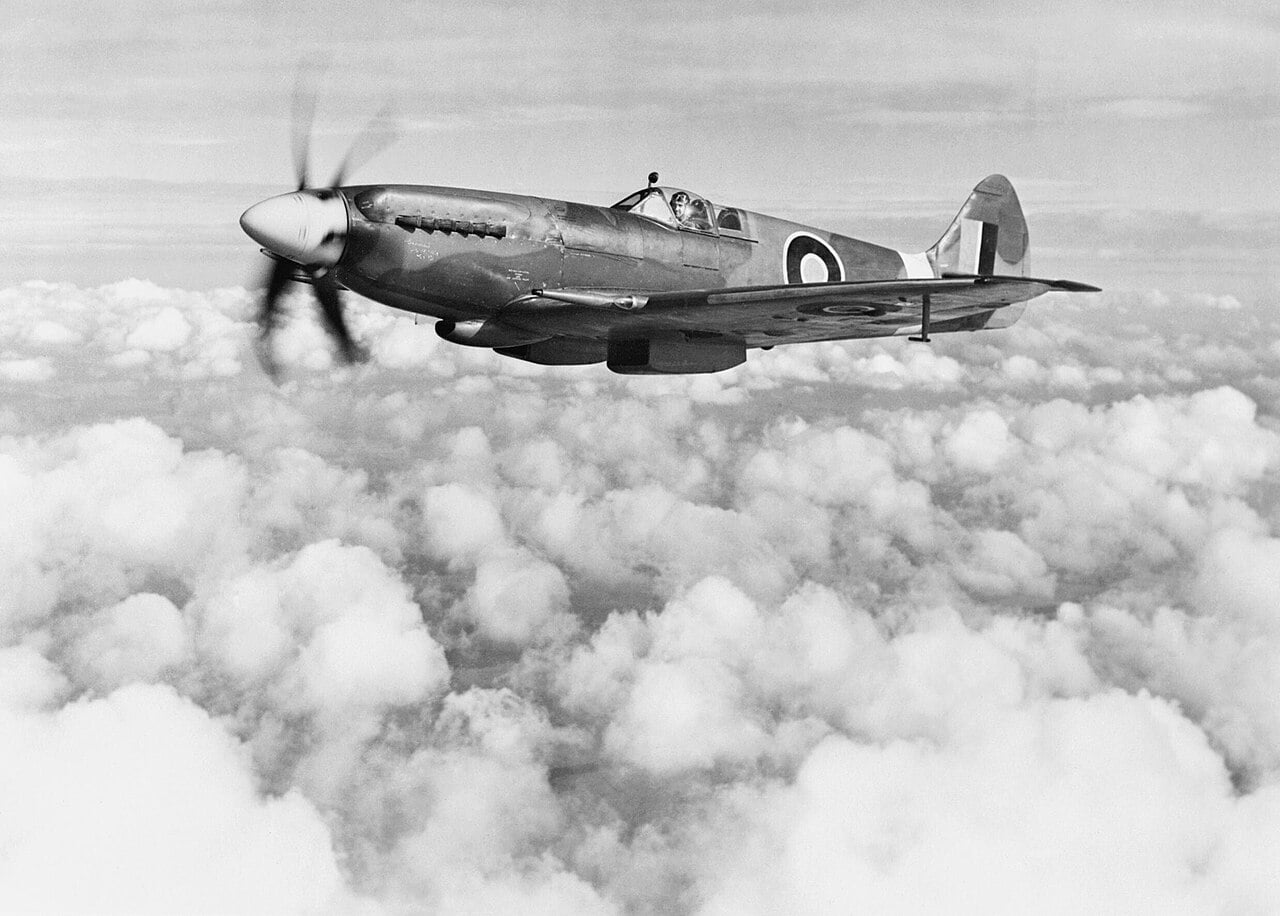
IL Spitfire was designed in the 1930s as a short-range interceptor to defend Britain. By 1943 its designers had squeezed a much bigger engine into it: the Rolls-Royce Griffon, a 37-litre V12 that gave the Mk XIV about 2,050 hp. The result entered service with 610 Squadron in December 1943 and could climb to 20,000 feet in just over five minutes.
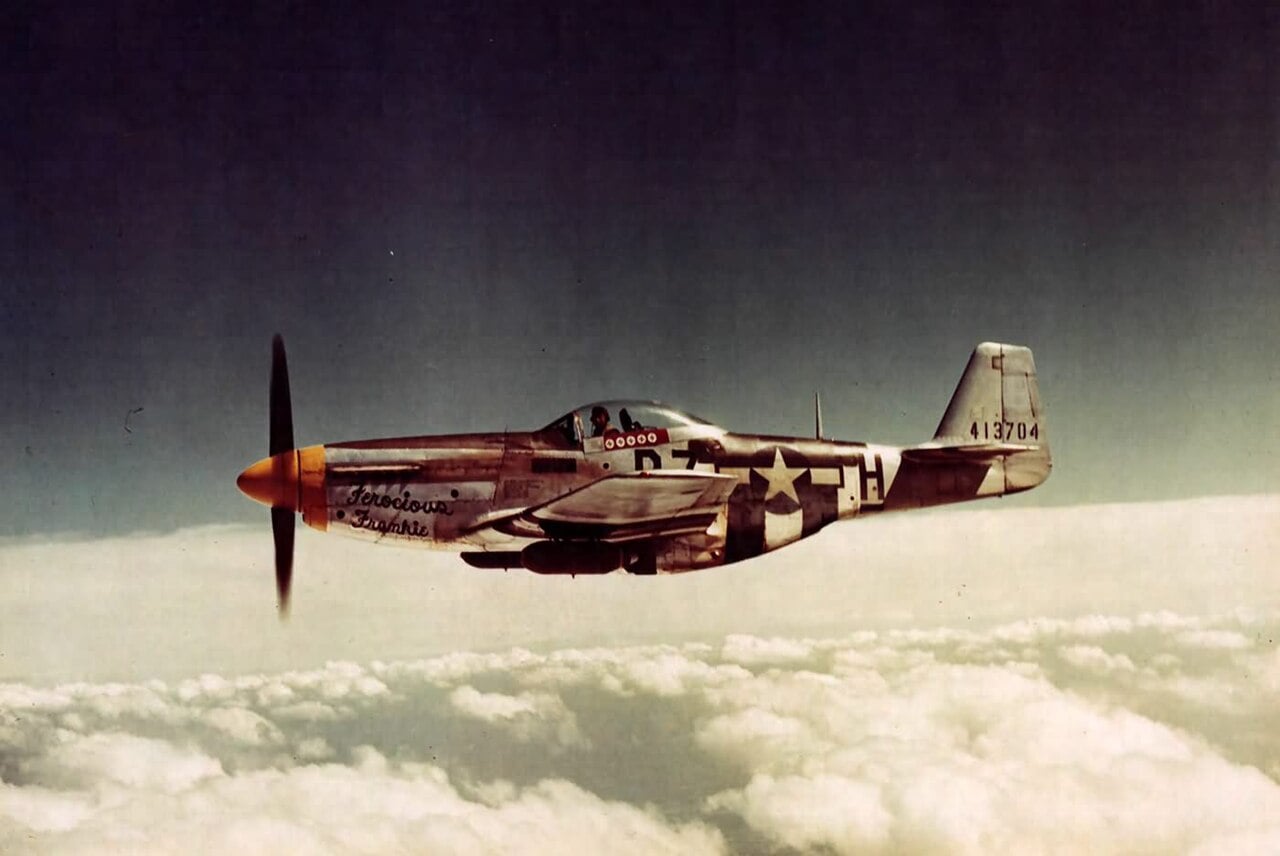
The Mustang started life as an American design for the RAF with an Allison engine that ran out of breath at altitude. Fitting the two-stage Rolls-Royce Merlin, built in the United States by Packard, turned it into something special. With extra internal fuel and drop tanks, the P-51 could escort American heavy bombers deep into Germany and bring them home. The D model, with its bubble canopy and six .50-calibre machine guns, became the definitive version.
One was the ultimate defensive fighter of its family. The other was the long-range escort that changed the daylight air war over Germany.
Speed and Climb
On raw speed, the two were remarkably close. Wikipedia gives the Spitfire XIV a top speed of around 440 to 446 mph at altitude. The Merlin-powered P-51B reached 441 mph at 30,000 feet, and the D was in the same class. At some altitudes one had the edge, at others the other did.
Climb was a clearer win for the Spitfire. The Griffon's power in a lighter airframe gave the Mk XIV a climb rate few piston fighters could match, which is exactly what you want when you are trying to intercept something. It made the Mk XIV the most successful Spitfire mark against V-1 flying bombs in 1944.
Turning was the Spitfire's traditional strength too. Captain Eric "Winkle" Brown, the Royal Navy test pilot who flew more types of aircraft than anyone in history, tested both the Mustang and the Spitfire.
Warbirds compares the P-51D Mustang and the Spitfire, viewed nearly 400,000 times.
Range: Where the Mustang Wins
Brown's verdict came with a catch. He said he would not want to fight near Berlin in a Spitfire, because he could never get back to Britain in one. That sums up the comparison. The Spitfire XIV carried about 460 miles' worth of internal fuel, later extended on some aircraft with an extra fuselage tank. The P-51 was designed around long range from the start.
That range mattered more than any other number in the air war over Germany. American bombers suffered terrible losses on deep raids in 1943 because their escorts had to turn back. When Mustangs could stay with them all the way to the target, the Luftwaffe's fighters had to fight American fighters over their own territory, and they lost. A remark widely attributed to Hermann Göring captures the effect: "When I saw Mustangs over Berlin, I knew the jig was up."
German pilots who fought them respected the Mustang. The ace Heinz Bär called it "perhaps the most difficult of all Allied aircraft to meet in combat."
So Which Was Better?
If the question is which aircraft you would rather be in for a dogfight over southern England at 25,000 feet, many pilots, Brown among them, would pick the Spitfire. It climbed faster, turned tighter and hit harder with its 20mm cannon.
If the question is which aircraft did more to win the war in Europe, the answer is almost certainly the Mustang. It was built in vastly greater numbers, 8,102 P-51Ds against 957 Spitfire XIVs, and it did a job no Spitfire could: protecting bombers all the way to Berlin and back.
Both were the products of the Merlin and Griffon engines from Rolls-Royce, and examples of both still fly at airshows today. That may be the best answer of all: the argument is still going, and you can still hear both of them settle it in the sky.
History's Back Pages compares the P-51 Mustang and the Spitfire Mk XIV.
The Merlin and Griffon Spitfires side by side: which engine sounds better?
Sources: Wikipedia (Supermarine Spitfire (Griffon-powered variants); North American P-51 Mustang; North American P-51 Mustang variants); Jeffrey Quill, Spitfire: A Test Pilot's Story (1983); Eric Brown, as quoted on Wikipedia.
0 Comments