

Shortly before 22:00 local time on 14 October, the missile alert sounded over the Voronezh region. A few minutes later residents of Borisoglebsk heard explosions, and a large fire lit up the military airfield east of town. By morning, Ukraine’s Navy was claiming one of the most damaging single strikes on Russian tactical aviation of the war: six Su-34M fighter-bombers hit by Neptune missiles.
Satellite images shared the next day by the Ukrainian monitoring channel AviVector appear to back the claim up. They show four Su-34s burned out on their parking spots and two more badly damaged. President Volodymyr Zelensky gave the same split on X: four destroyed, two hit, all of them, he said, loaded with bombs and ready for new attacks.
Russia has not acknowledged any damage at the base. Independent outlets such as The Moscow Times say they cannot verify the losses. But if the imagery holds, it is a painful blow to the jet Russia relies on most to drop glide bombs on Ukrainian towns.
Informazioni rapide
- Bersaglio: Borisoglebsk military airfield, Voronezh region, Russia (about 6 km east of the town)
- Quando: Night of 14–15 October 2026
- Claimed by: Ukrainian Navy
- Arma: Neptune (RK-360MC) missile system
- Navy claim: Six Su-34M bombers destroyed, plus flight-support equipment
- Satellite imagery (AviVector): Four Su-34s destroyed, two badly damaged
- Risposta russa: No comment on the airfield; Voronezh governor reported 33 drones and “several jet-powered aerial targets” shot down
What Ukraine Says It Hit
The Navy’s statement, posted on its Facebook page on the morning of 15 October, was short. It said the strike used the Neptune coastal missile system, that six Su-34M bombers were destroyed, and that equipment supporting flight operations was hit too. It also reported secondary explosions and a fire, and added that the full results were still being assessed.
The Su-34M is the modernised version of the Su-34 Fullback, the two-seat strike jet that replaced the old Su-24 in Russian service. Its crew sits side by side in an armoured cockpit, and it carries a heavy bomb load. Over the past few years it has become the main launch platform for Russia’s guided glide bombs, which can be released tens of kilometres from the target, outside the reach of many Ukrainian air defences.
That is why the Navy called the Su-34M one of Russia’s key tools for glide-bomb strikes on Ukrainian positions and frontline towns. Every Fullback destroyed on the ground is one fewer jet that can throw those bombs at Kharkiv, Sumy or Zaporizhzhia.

What the Satellite Images Show
According to Defence Blog, images taken on 13 October show six Su-34s parked at the spot that was later struck. The post-strike images published by AviVector show four of them completely destroyed and two with significant damage. That matches Zelensky’s account, and it suggests the Navy’s headline figure counts every aircraft hit, not only the total losses.
Russian officials kept quiet about the airfield. On the morning of 15 October, Voronezh governor Aleksandr Gusev said air defences had shot down 33 drones and several jet-powered aerial targets over the region overnight. He did not mention the base. Falling debris damaged several private homes and a car in the regional capital, Voronezh, according to The Moscow Times.
Local residents posted videos of the fire within minutes. The Ukrainian monitoring account Exilenova+ shared one of them the same night:
Borisoglebsk: A Training Base on the Front Line of Glide Bombs
Borisoglebsk is home to Russia’s 783rd training aviation centre, which flies Yak-130 trainers and teaches the next generation of strike pilots. According to Militarnyi, units of the 105th composite aviation division, flying Su-34, Su-35S E Su-30SM jets, have also operated from the field. Euromaidan Press puts it about 400 km from the front line.
It is not the first time the base has been hit. Ukrainian drones struck it in July 2025, and on 8 July 2026 another drone attack set its fuel and lubricants depot on fire. Militarnyi reported over the summer that, based on satellite observation, combat jets were no longer based there permanently and used it mainly to refuel and rearm. If six Fullbacks were parked in the open on 14 October, someone had decided the base was safe again.
From Ship-Killer to Airbase Raider
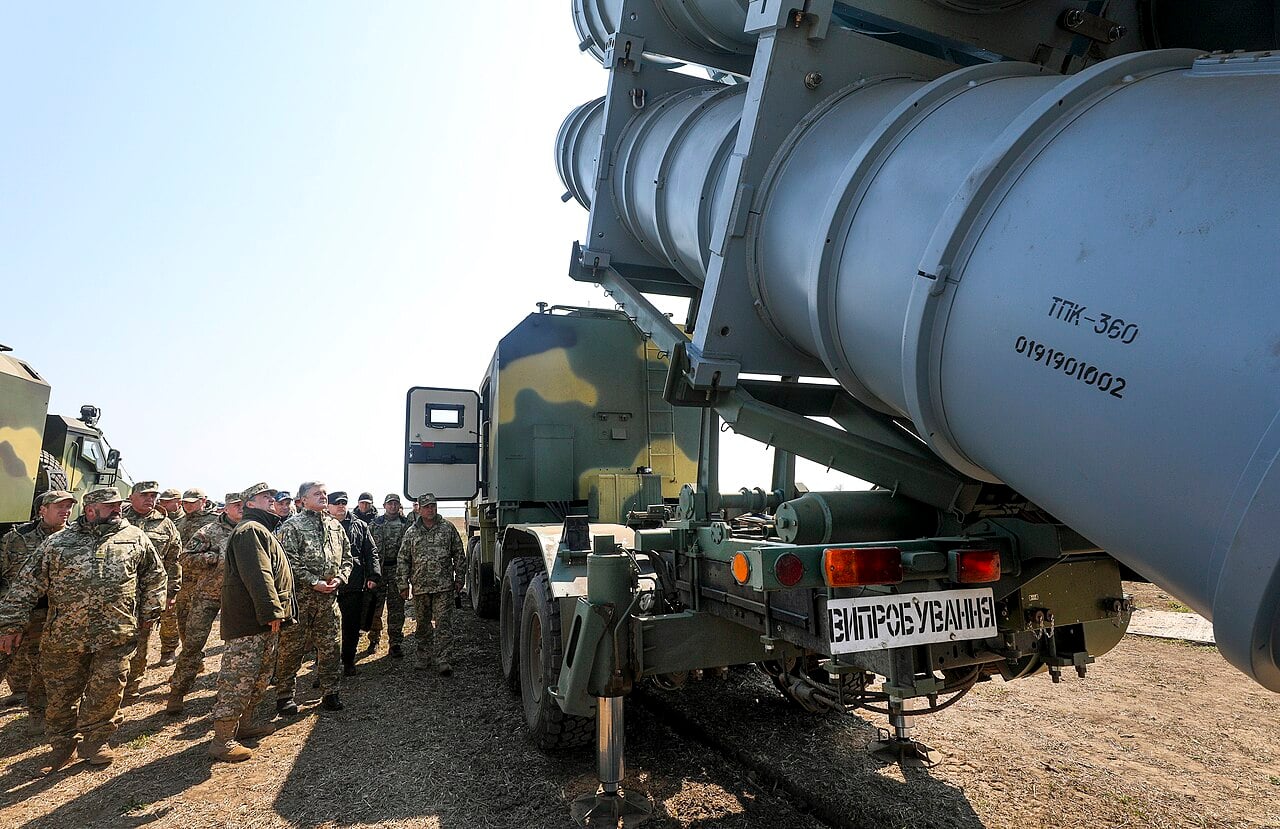
Neptune was designed as a coastal anti-ship missile. It became famous in April 2022, when Ukraine used it to sink the Russian cruiser Moskva, the flagship of the Black Sea Fleet. Since then Ukraine has adapted it to hit targets on land, including a longer-range version that Kyiv says can fly much farther than the original.
A cruise missile is a good tool for this job. It flies low, it is harder to shoot down than a slow drone, and its warhead is big enough to wreck an aircraft parked next to another. Russia still parks many of its jets in the open rather than in hardened shelters. Strikes like this one are the price.
The Su-34 force has already taken heavy losses in this war. Each loss on the ground counts double, because Russia’s factories can only build a limited number of new Fullbacks each year. The strike came only days after the United Aircraft Corporation announced the delivery of a new batch of Su-34s to the Russian Aerospace Forces.
Mirror Now report on the Ukrainian Navy’s claim of a Neptune strike on six Su-34s at Borisoglebsk.
Sources: Ukrainian Navy; Defence Blog; Militarnyi; The Moscow Times; Euromaidan Press; UNITED24 Media; AviVector


0 Comments