
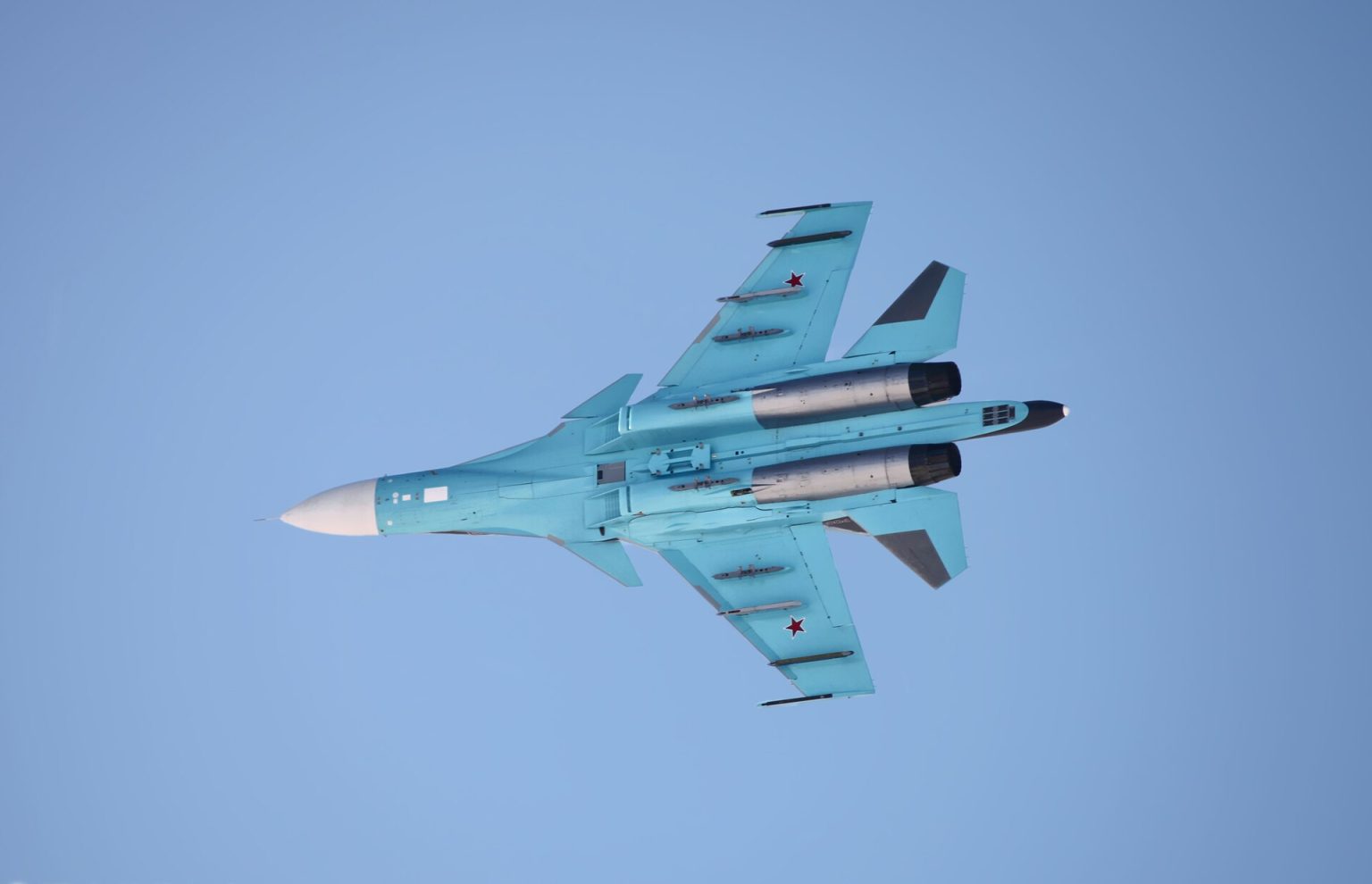
Sukhoi Su-34
“Fullback”
A Flanker rebuilt around a side-by-side armoured cockpit — Russia’s long-range strike bomber, and the workhorse of its glide-bomb campaign over Ukraine. This page presents its capabilities and combat record neutrally, sourced and hedged.
The Flanker that became a bomber
The Su-34 began in the mid-1980s as a Soviet effort to replace the ageing Su-24 “Fencer” swing-wing bomber. Rather than design a clean-sheet aircraft, the Sukhoi bureau took the aerodynamics of the Su-27 “Flanker” air-superiority fighter and grafted on an entirely new forward fuselage: a broad, flattened “duckbill” nose housing two crew side by side inside an armoured tub. Western observers first labelled it the Su-27KU; its real Soviet designation was Su-27IB (istrebitel-bombardirovshchik, fighter-bomber). The prototype first flew on 13 April 1990.
The programme then stalled for two decades. The collapse of the Soviet Union, chronic underfunding and a slow flight-test effort pushed the aircraft’s formal entry into Russian service all the way to 20 March 2014 — nearly a quarter-century after its first flight. By then it had been redesignated Su-34 and re-engineered around modern precision-strike avionics, the V004 radar and the Khibiny electronic-warfare system.
Its distinguishing idea is comfort and protection for long missions: a pressurised, side-by-side cockpit that lets a two-person crew fly extended sorties, reportedly with room to stand, a rudimentary galley and a toilet. Since 2022 the type has become the most visible tool of Russia’s air campaign over Ukraine — a role that has also made it a repeated target for Ukrainian air defences. Those competing sortie and shoot-down claims are presented here with caution: figures from both sides are contested.
01Why the Su-34 took 24 years to reach the front line
Few modern combat aircraft have had as long a gestation as the Su-34. First flown in 1990 as the Su-27IB, it was orphaned almost immediately by the disintegration of the Soviet defence budget. Development crawled through the 1990s on a handful of prototypes; a first production-standard airframe flew in 1994, but full-rate production at Novosibirsk only ramped up in the 2000s, and state trials were not completed until 2011. Formal service entry followed on 20 March 2014. The aircraft that finally emerged was substantially more capable than the 1990 prototype — but the timeline is a reminder that Russian claims about the type should be read against a long record of delay.
What makes the Su-34 special
An armoured, side-by-side cockpit
The Su-34’s crew of two sit shoulder to shoulder inside what Sukhoi describes as a continuous titanium armour capsule (about 17 mm). The cabin is pressurised enough to operate up to ~10,000 m without oxygen masks, and Russian sources say it offers space to stand, a hand-held urinal “toilet” and a vacuum-flask “galley” for long sorties. Crew enter through a hatch and ladder in the nose gear bay. How much the armour actually helps against modern air-defence missiles is unproven.
Heavy ordnance on twelve hardpoints
The Fullback carries its weapons on 12 external hardpoints. Russian figures cite a war load commonly given as ~8,000–12,000 kg (some sources claim up to 14,000 kg), spanning guided and unguided bombs, stand-off missiles and, since 2023, cheap glide bombs fitted with UMPK guidance kits. A single 30 mm GSh-30-1 cannon is fitted. Real-world loads flown in combat are typically far below the theoretical maximum.
Range, engines and self-defence
Two Saturn AL-31FM1 afterburning turbofans (about 132 kN / ~13,500 kgf each) give a top speed near Mach 1.8 and a ferry range around 4,500 km, extendable by in-flight refuelling. For survivability the type carries the Khibiny jamming system as standard; the modernised Su-34M adds a rear-facing radar intended to warn of missiles approaching from behind. Their effectiveness in the Ukraine war is disputed.
02The Su-34’s low-level dilemma: why a strike bomber flew into danger
For the first year of the 2022 invasion the Su-34 lacked large numbers of precision stand-off weapons, so to hit targets accurately it reportedly had to fly low — straight into the reach of Ukrainian man-portable and medium-range surface-to-air missiles. That exposure is widely cited as the reason a well-protected aircraft nonetheless suffered repeated losses. The 2023 arrival of the UMPK glide-bomb kit, which lets the aircraft toss a winged bomb from tens of kilometres away while staying behind its own lines, changed the tactic — though Ukraine has continued to claim shoot-downs. All of these tactical accounts rest heavily on wartime reporting and should be treated as provisional.
03The Su-34’s engines and range: a genuinely long-legged strike aircraft
The Fullback’s two AL-31FM1 turbofans are a modest evolution of the engine that powers the Su-27, tuned for the heavier strike airframe. What sets the Su-34 apart from most tactical bombers is fuel: a large internal capacity plus air-to-air refuelling give a ferry range commonly cited around 4,500 km and a combat radius near 1,100 km with a heavy load. This is what lets the type loiter and strike across the full depth of a theatre. As with all its performance figures, the numbers come largely from the manufacturer and should be read as nominal rather than independently verified.
Full Su-34 specifications
Baseline note: these figures describe the series-production Su-34 as delivered to the Russian Aerospace Forces and as flown over Syria and Ukraine — two crew side by side in an armoured titanium tub, two Saturn AL-31FM1 turbofans, Leninets V004 radar in the flattened "platypus" nose, twelve stations. Deltas for the Su-34M of the 2020 contract, for the Su-34NVO / Sych reconnaissance fit, and for the Su-32 export designations that were marketed for two decades and never sold under that name, are in grey. Figures reflect sources consulted on 3 September 2026. Three warnings belong above the table. First, this is a Su-27 airframe only in the way a lorry is a car: the wing, tails and engines are Flanker, but the forward fuselage, the undercarriage and the maximum take-off weight are not, and nothing on this page should be read across to the Su-27, Su-30 or Su-35, which are separate aircraft with their own pages. Second, the widely copied ordnance figure of 12,000 kg or even 14,000 kg has no Sukhoi document behind it; the manufacturer’s own published number is 8,000 kg, and the difference is the gap between arithmetic on maximum take-off weight and what the pylons are cleared to carry. Third, the tail sting does not contain a rearward-facing radar. It contains an auxiliary power unit. The rear-radar story is the single most repeated error about this aeroplane and it is dealt with in its own row below.
Dimensions & weights
- Crew
- 2, seated side by side — pilot to port, navigator and weapons operator to starboard. The layout is the whole design argument: on a strike sortie of many hours the second crewman must be spoken to, not radioed, and both men must be able to see the same display at the same moment.
- Length
- 23.34 m (76 ft 7 in) including the nose probe, against 21.94 m for a Su-27
- Wingspan
- 14.70 m (48 ft 3 in), unchanged from the Su-27
- Height
- 6.09 m (20 ft 0 in). Jane’s-derived tables give 6.50 m (21 ft 4 in); the discrepancy is almost certainly a measurement taken at a different weight and fin fit, and both numbers circulate widely.
- Wing area
- 62.04 m² (668 sq ft) — the Su-27 wing, carrying half as much weight again
- Cockpit armour
- A welded titanium tub around the whole crew compartment, 17 mm thick, with armoured glass and armour around the engine bay and fuel system. Roughly 1,480 kg of it. This is a Su-25 idea grafted onto a supersonic airframe, and it is why the empty weight is what it is.
- Empty weight
- 22,500 kg (49,604 lb), some 5,900 kg more than a Su-27S
- Normal take-off weight
- 39,000 kg (85,980 lb)
- Maximum take-off weight
- 45,100 kg (99,428 lb), half as much again as the Su-27 it descends from and heavier than an unladen Tu-22M3 is empty by no great margin
- Internal fuel
- about 12,100 kg (26,676 lb) in wing, fuselage and fin tanks. The Flanker family carries no drop tanks, so this is the whole of it; range beyond this comes from the retractable probe.
- Maximum ordnance
- about 8,000 kg (17,640 lb) as published by Sukhoi. Figures of 12,000–14,000 kg appear in online press reporting such as The EurAsian Times (May 2022) and in the many tables that repeat it; no Russian primary source supports them, and the heaviest single store cleared is 4,000 kg.
- Hardpoints
- 12 — eight under the wings, two under the engine nacelles, two under the centre fuselage. The centreline stations take the heavy anti-ship and stand-off rounds; the wingtip rails are given over to the Khibiny jamming pods rather than to missiles on most operational fits.
Performance
- Maximum speed, altitude
- 1,900 km/h (1,180 mph, Mach 1.8) clean and at height. Some Russian tables cap it at Mach 1.6; the inlets are fixed-geometry ramps rather than the Su-27’s variable ones, so genuine high supersonic flight was never part of the specification.
- Maximum speed, sea level
- 1,400 km/h (870 mph, Mach 1.14) clean. With a war load of glide bombs it is a subsonic aeroplane and nothing else.
- Cruising speed
- 1,300 km/h (808 mph) as quoted. That is a dash figure dressed up as a cruise; the fuel-efficient transit speed on an operational profile is far lower and is not published.
- Service ceiling
- 15,000 m (49,200 ft). Sources disagree sharply: 17,000 m (55,800 ft) is quoted as often, and the difference is probably clean against loaded. Glide-bomb release is flown near the top of this band, because every extra thousand metres buys the weapon several kilometres of reach.
- Ferry range
- 4,000–4,500 km (2,485–2,795 miles) on internal fuel, depending on source
- Combat radius
- about 1,100 km (680 miles) with a war load. Unrefuelled, on a high-altitude profile, and without the loiter that a real armed-reconnaissance sortie needs.
- Effective reach with stand-off bombs
- Combat radius plus a further 50–70 km (31–43 miles) of UMPK glide. This is the number that changed the war for the type: from 2023 the Su-34 stopped flying over the target and started throwing at it from behind its own air-defence umbrella.
- Endurance and refuelling
- Sorties of six hours and more are the design case, with a retractable probe behind the port side of the nose for probe-and-drogue refuelling from an Il-78. The galley, the lavatory and the standing-room compartment behind the seats are not luxuries but the logical consequence of that requirement.
- Load factor
- +9 g quoted, though the practical limit at operational weights is far lower. A 39-tonne aeroplane with 8 tonnes hanging off it does not manoeuvre like a Flanker and was never meant to.
- Climb and field performance
- Sukhoi has published neither a rate of climb nor a take-off run for the Su-34, and the figures circulating in Western tables are Su-27 numbers carried across. Russian references quote roughly 2,000 m of runway for take-off and landing roll at heavy weights; the twin-wheel main units and the twin nosewheel exist so that runway can be a rough or damaged one.
- Wing loading
- 629 kg/m² (129 lb/sq ft) at normal take-off weight, against about 400 kg/m² for a Su-27 at its own normal weight
- Thrust-to-weight ratio
- 0.68 at normal take-off weight. Below unity, which for a Flanker derivative is the plainest possible statement of what this aircraft is: a bomber wearing a fighter’s wing.
Propulsion & systems
- Engines
- 2 × Saturn AL-31FM1 afterburning turbofans, 132 kN (29,700 lbf) each with reheat. Early production aircraft flew on the standard AL-31F at 122.6 kN (27,560 lbf), which is why older reference tables and newer ones disagree; the FM1 adds thrust and hot-section life for a heavier aeroplane.
- Dry thrust
- 74.5 kN (16,750 lbf) each for the AL-31F. Saturn has not separately published a military-power rating for the FM1.
- Auxiliary power unit
- Housed in the enlarged tail sting between the engines, with its exhaust grille on the port side. It also balances the weight of the armoured nose, and it is what makes the aircraft independent of ground power at a dispersed strip.
- Rearward-facing radar
- None. This is the correction that matters most. Western sources have asserted for thirty years that the sting carries a rear-looking radar to warn of missiles from behind; the idea was studied and abandoned, and the volume went to the APU. Reports that the Su-34M carries a rearward Kopyo-DL set are claims, not evidence, and no photograph supports them. The aircraft’s actual rear-hemisphere warning comes from the L-150 Pastel receiver and the Khibiny suite.
- Main radar
- Leninets V004, an X-band passive electronically scanned array within the Sh-141 fire-control suite, with terrain-following and terrain-avoidance modes. Quoted at 200–250 km against a large surface ship and about 120 km against a fighter-sized air target. Terrain-following at 50–60 m was the original selling point and is barely used now that stand-off bombing has made low flying pointless.
- Electro-optical and bombing computer
- Platan electro-optical targeting system with laser designation for the Kh-29L and KAB-500L family, and the Gefest & T SVP-24 computing sub-system on many airframes. The SVP-24 matters more than it sounds: it gives unguided iron bombs a release solution good enough to be useful, which is precisely the trick Russia repeated at larger scale with the UMPK kit.
- Electronic warfare
- Khibiny L-175V as standard, in wingtip fairings, with SAP-14 and SAP-518 escort and self-protection pods carried externally and the L-700 Tarantul centreline pod on dedicated aircraft. Russian sources have conceded since 2024 that the jamming algorithms are ageing badly against Ukrainian radars.
- Warning and countermeasures
- L-150 Pastel radar warning receiver, chaff and flare dispensers in the tail boom and wing roots, missile approach warning on later builds
- Cockpit and crew provision
- Two NPP Zvezda K-36DM zero-zero seats side by side, entered by a ladder that folds down from the nosewheel bay and a hatch in the cockpit floor — there is no canopy to climb over. Behind the seats is space for one crewman to stand upright or lie down, a food-heating unit rather than a galley proper, and a sanitary container that Russian crews call a toilet. Cabin pressurisation to a 10,000 m equivalent lets the crew fly without oxygen masks. It is an aeroplane designed for a war of long transits, and Russia has instead flown it in short hops from bases near the border.
- Undercarriage
- Twin-wheel nose unit retracting rearwards; main units in tandem twin-wheel bogies retracting forwards into the fuselage. The whole point is unprepared and semi-prepared strips. A braking parachute in the sting supplements the wheel brakes.
- Manufacture
- Novosibirsk Aircraft Plant named for V. P. Chkalov, part of the United Aircraft Corporation. The same plant built the Su-24 the Su-34 replaced, and it is the single point of failure for the programme: there is no second line.
04The Su-34’s cost: why the price tag is only an estimate
Because the Su-34 is a state product bought by the Russian military on domestic contracts, no audited flyaway price exists in open sources. A figure of roughly $36 million per aircraft is widely repeated, drawn from Russian contract totals divided by aircraft counts and converted at various exchange rates — it should be read as an order-of-magnitude estimate, not a firm number. No reliable public cost-per-flight-hour figure exists either. Export deals, such as Algeria’s reported Su-34ME contract, are quoted with secret pricing, so even the export cost is not independently confirmed.
Armament & payload
The Su-34 was built to carry precision missiles and has spent its war throwing cheap bombs a long way
On paper the Su-34 is the best-armed tactical aircraft Russia has ever fielded: twelve stations, a Sukhoi-published 8,000 kg of stores, a 4,000 kg single-store limit, and a cleared inventory that runs from the Kh-31P anti-radiation missile through the Kh-59MK2 land-attack cruise missile to the Kh-35U and the P-800 Oniks for maritime strike. In practice the war in Ukraine has shown that Russia never bought those weapons in the quantities the aircraft was designed around. By late 2022 the Su-34 force was flying low-level attacks with unguided FAB-500s because the guided inventory had run dry, and it was being shot down for it.
The answer, from January 2023, was the UMPK — a strap-on kit of pop-out wings, a tail unit and a Kometa-M satellite navigation module that turns a Cold War iron bomb into a 50–70 km glide weapon for roughly two million roubles a set. It is crude, its guidance is jammable, and it has repeatedly fallen on Russian towns including Belgorod in April 2023. It is also the most consequential munition of the war, and the Su-34 is its principal carrier: four FAB-500s or two FAB-1500s per sortie, released from altitude from inside Russian-held airspace. The aircraft that was designed to prosecute deep precision strike has instead become a bomb truck operating at arm’s length, and that is the only reason there are still Su-34s flying. Cleared and carried are different things: much of the inventory below is manufacturer-cleared but has never been photographed in Ukrainian or Syrian service, and Algerian Su-34ME weapons fits have not been disclosed at all.
Gun
- 1 × 30 mm Gryazev-Shipunov GSh-30-1 (GSh-301), single-barrel, in the starboard leading-edge root extension
- 180 rounds, roughly 1,500–1,800 rounds per minute
- The same installation as every other Flanker, and on this aircraft essentially decorative — there is no credible account of the Su-34 gun being fired in anger
- Aimed through the head-up display; there is no gunsight provision for the right-hand seat
Air-to-air
- R-73 (AA-11 Archer), infrared, helmet-cued, the standard self-defence round on outboard stations
- R-77 / RVV-AE (AA-12 Adder), active radar homing — the V004 can support it, which the Su-33’s radar cannot
- R-27R and R-27T (AA-10 Alamo) cleared but rarely seen; the family is a Su-27 legacy rather than a Su-34 weapon
- Up to six air-to-air rounds quoted; two R-73 is the usual operational fit, and self-defence is the only role — this aircraft does not go looking for a fight
- Air-to-air missiles were first carried operationally over Syria from 30 November 2015, after Turkey shot down a Russian Su-24M
Air-to-surface guided
- Kh-29L and Kh-29T (AS-14 Kedge), laser and television homing, the standard heavy tactical round over Syria
- Kh-31P and Kh-31A (AS-17 Krypton), supersonic anti-radiation and anti-ship; Kh-58UShK (AS-11 Kilter) for defence suppression
- Kh-59M and Kh-59MK2 (AS-18 Kazoo) stand-off cruise missiles, and the Kh-38 family
- Kh-35U (AS-20 Kayak) and P-800 Oniks for maritime strike; the Kh-41 Moskit appears in Russian marketing and has not been evidenced in service
- The gap between this list and the war is the story: guided missiles were expended faster than they were replaced, and by 2023 the Su-34 force was flying almost entirely with bombs.
Bombs
- FAB-250, FAB-500, FAB-1500 and FAB-3000 fitted with the UMPK glide-and-correction kit — the type’s signature weapon since January 2023
- UMPK-PD with a longer wing and, from October 2025, a Chinese-sourced Swiwin turbojet, pushing quoted reach past 100 km and towards a claimed 200 km
- KAB-500Kr and KAB-500S-E, KAB-1500L and KAB-1500Kr — the proper guided bombs, television, laser and satellite-guided; the KAB-500S made its combat debut from Su-34s over Syria
- ODAB-500PMV thermobaric and RBK-500 cluster bombs, both fitted with UMPK kits from 2023–2024; BETAB-500 concrete-piercing
- Unguided FAB-250 and FAB-500 released through the SVP-24 computing system — the 2015–2022 method, abandoned once low-level delivery became lethal
Rockets
- S-8 80 mm in B-8M1 twenty-round pods
- S-13 122 mm in B-13L five-round pods
- S-25 340 mm heavy rockets in single tubes
- Standard Flanker fit, inherited rather than developed for this aircraft
- Effectively dead as a Su-34 weapon since 2022: rockets demand a low, straight, predictable run-in, which is exactly the profile Ukrainian air defence made unsurvivable
Pods & other stores
- Khibiny L-175V jamming pods on the wingtip rails as standard, which is why the tips do not carry missiles
- SAP-14 escort jammer and SAP-518 self-protection pods; L-700 Tarantul centreline pod on specialist airframes
- Sych reconnaissance pods on the Su-34NVO: UKR-RT for signals intelligence, UKR-OE electro-optical, UKR-RL side-looking radar
- No external fuel tanks — the Flanker family has never used them; extra range comes from the refuelling probe alone
- UPAZ-1A buddy refuelling store, allowing one Su-34 to tank another
Three typical loadouts
- Syria, 2015–2017
- Six FAB-500 or OFAB-250 unguided bombs released through the SVP-24, plus two R-73 for self-defence after November 2015 and a pair of Khibiny tips. A permissive-airspace loadout against an enemy with no air defence worth the name, and the profile that taught Russia the wrong lesson about what its strike force could do.
- Ukraine, glide-bomb sortie, 2023 onward
- Four FAB-500 with UMPK kits, or two FAB-1500 with UMPK, plus two R-73 and full internal fuel. Released from 8,000–10,000 m some 50–70 km short of the target while still over Russian-held ground, then an immediate turn away. This is what the overwhelming majority of Su-34 sorties now look like.
- Defence suppression and maritime strike, as designed
- Two Kh-31P or Kh-58UShK anti-radiation missiles on the nacelle stations, two Kh-31A or Kh-35U on the wings, two R-77, Khibiny tips and centreline jammer. The mission the aircraft was actually built for, flown rarely and in small numbers, because the missiles for it were never stockpiled in the depth the airframe count implied.
Sourcing caveat: weapon clearances are drawn from Sukhoi and Rosoboronexport marketing material and from photographic evidence out of Syria and Ukraine, and the two do not always agree. UMPK range and accuracy figures come from Ukrainian official statements and open-source analysis rather than from any Russian document, and should be read as bracketing rather than as specification. Nothing here should be read across to the Su-24M, Su-30SM, Su-35S or Tu-22M3, which carry overlapping but distinct inventories.
Variants
The Su-34 spent twenty years as a prototype, arrived as a bomber, and is now being rebuilt around the war it is fighting
The programme began in 1986 as the T-10V, a dedicated strike derivative of the Su-27 intended to replace the swing-wing Su-24 Fencer in the Soviet Air Forces. The first prototype flew on 13 April 1990 and was shown to the West as the "Su-27IB", a naval trainer — a cover story nobody believed for long. Then the Soviet Union collapsed. The second machine did not fly until 18 December 1993, the first true production-standard aircraft not until 28 December 1994, and series deliveries not until 2006. State trials were only completed on 19 September 2011 and the type formally entered service in 2014, twenty-four years after its first flight.
Two thin decades of export marketing produced nothing. The Su-32FN maritime patrol version with the Sea Dragon mission suite, shown from 1995, and the multi-role Su-32MF of 1999 were both offered hard and never sold; the Su-32 designation is a marketing artefact, not an aircraft anyone bought. The export finally arrived thirty years later and under a different name: Algeria is reported to have taken delivery of its first four Su-34ME in early 2026 against a contract cut from an original forty to fourteen aircraft, making it the first foreign operator. Neither Rostec, the United Aircraft Corporation nor the Algerian Air Force has confirmed it; the evidence is photographs.
- T-10V-1 / Su-27IB (first flight 13 April 1990, 1 aircraft)
- The prototype, converted from a Su-27UB airframe with the side-by-side armoured nose but Su-27 undercarriage and no tail sting. Presented publicly as a carrier trainer to disguise the strike role.
- T-10V-2 (first flight 18 December 1993)
- The first aircraft to the intended configuration: tandem twin-wheel main undercarriage, the enlarged tail sting for the auxiliary power unit, and the definitive canard-equipped wing.
- Su-32FN (exhibited from 1995, never sold)
- Maritime patrol and anti-submarine proposal with the Sea Dragon mission system, sonobuoys and a magnetic anomaly detector. Shown at Paris, offered widely, ordered by nobody.
- Su-32MF (exhibited from 1999, never sold)
- Multi-function export designation for the same airframe with a Western-compatible avionics fit. The Su-32 label persisted in brochures for two decades and never produced a customer.
- Su-34 (deliveries from 2006, in service 2014, around 130 built to this standard)
- The production bomber, built at Novosibirsk under contracts for 32 aircraft in 2008 and 92 in 2012. V004 radar, Platan targeting system, Khibiny electronic warfare, later airframes with AL-31FM1 engines.
- Su-34M (contract August 2020 for 24, deliveries from 2022, in production)
- The current build standard, which replaced the baseline Su-34 on the line. Reworked radar, sighting and communications, an electro-optical targeting pod, and clearance for the newer stand-off weapons. Claims that it adds a rearward-facing Kopyo-DL radar are unevidenced.
- Su-34NVO / Su-34 Sych (in service from July 2025)
- Armed reconnaissance fit carrying the UKR-RT signals, UKR-OE electro-optical and UKR-RL radar pods. It exists because Russia has no adequate reconnaissance satellite coverage and no survivable large ISR aircraft.
- Su-34E / Su-34ME (Algeria, first four reported delivered early 2026 of 14 ordered)
- The export standard that finally sold, thirty years after the Su-32 was first offered. Weapons package undisclosed. Deliveries are attested by photographs of aircraft in Algerian markings and desert camouflage, not by any official statement.
- Su-34R and Su-34PP (proposed, not confirmed in service)
- Dedicated reconnaissance and stand-off electronic-attack proposals from the 2010s, largely overtaken by the Su-34NVO pod fit.
Fleet, production and losses, as of 3 September 2026. Russia is the only operator of consequence and, until early 2026, was the only operator at all. Something over 150 Su-34s had been built by the end of 2022, including seven prototypes and pre-production machines, against a pre-war operational fleet usually put at 125–140. Production runs at Novosibirsk alone and is slow: the IISS assessed six deliveries in 2023, and Ukrainian analysts put the 2022–2024 average at up to ten airframes a year, handed over in publicised batches of two to four. Against that, Oryx-style visual confirmation lists 42 Su-34s destroyed or damaged since February 2022 — 37 destroyed and 5 damaged — with the most recent catalogued entry dated 31 March 2026; some secondary reporting in mid-2026 gives 43. That is roughly a third of the pre-war fleet, and it is a floor rather than a ceiling, because every entry requires a photograph or a video. Ukrainian claims are far higher: ten to thirteen Su-34s asserted in February 2024 alone, during a run of Patriot ambushes, and further batches claimed at Marinovka in June 2025 and over Zaporizhzhia in September 2025. Claimed and confirmed are not the same thing and this page does not treat them as such. Four aircraft were lost in non-combat accidents, including the Yeysk crash of 17 October 2022 that killed fifteen people on the ground. Netting production against confirmed attrition leaves a current Russian fleet somewhere near 110–130 airframes, a figure no open source states directly and which should be treated as an inference. Unit cost was quoted at about one billion roubles, roughly 36 million US dollars, in the 2012 contract era; Su-34M figures circulating at 85 million dollars and above are unsourced. The Su-24M the type was built to replace has been progressively withdrawn from Russian first-line bomber regiments, leaving the Su-34 as Russia’s principal dedicated strike aircraft by a wide margin.
From Su-27IB prototype to frontline bomber
Programme begins
Sukhoi starts work on the T-10V / Su-27IB, a Flanker-derived side-by-side bomber to replace the Su-24.
First flight
The prototype flies on 13 April 1990 with test pilot Anatoliy Ivanov at the controls.
Production standard
The first production-standard airframe flies; the type is redesignated Su-34, but funding stalls the programme.
Enters service
After long delays and completed state trials, the Su-34 formally enters Russian Aerospace Forces service on 20 March.
Syria deployment
Su-34s deploy to Latakia and fly strikes in Syria — the type’s combat debut. Damage claims varied.
Ukraine invasion
The Su-34 becomes Russia’s principal tactical bomber over Ukraine; both sides make contested loss claims.
Glide bombs
UMPK-kitted glide bombs let the Su-34 strike from stand-off range, reshaping its role in the war.
Losses & export
Modernised Su-34Ms remain in heavy use amid documented combat losses; Algeria reportedly receives its first Su-34ME aircraft.
Twelve stories about the Su-34 Fullback
Replacing the Fencer
The Su-34 was conceived to replace the Su-24 swing-wing bomber with a Flanker-based airframe.
Read the full story
The “duckling” nose
The Su-34’s flattened duckbill nose earned it nicknames like Duckling, Hellduck and Platypus.
Read the full story
An armoured tub for two
The cockpit is built as a continuous titanium armour capsule roughly 17 mm thick.
Read the full story
A galley and a toilet
For long sorties, Russian sources say the Su-34 offers room to stand, a rudimentary galley and a toilet.
Read the full story
Twenty-four years to the front
First flown in 1990, the Su-34 did not formally enter service until 2014.
Read the full story
Combat debut
Su-34s deployed to Syria in 2015 and flew strike missions; battle-damage claims were hard to verify.
Read the full story
The strike workhorse
Since 2022 the Su-34 has been Russia’s most-used tactical bomber over Ukraine.
Read the full story
The glide-bomb turn
From 2023, cheap UMPK glide-bomb kits let the Su-34 strike from behind the front line.
Read the full story
A hard war on the fleet
Multiple independent trackers have documented a significant number of Su-34 losses since 2022.
Read the full story
The modernised Fullback
The upgraded Su-34M added new sensors, including a rear-facing radar to warn of missiles.
Read the full story
Algeria’s Fullbacks
Algeria reportedly ordered the Su-34ME and began receiving its first aircraft.
Read the full story
A costly peacetime record too
Beyond combat, the Su-34 fleet has suffered a string of accidents.
Read the full story
The Su-34 Fullback in pictures
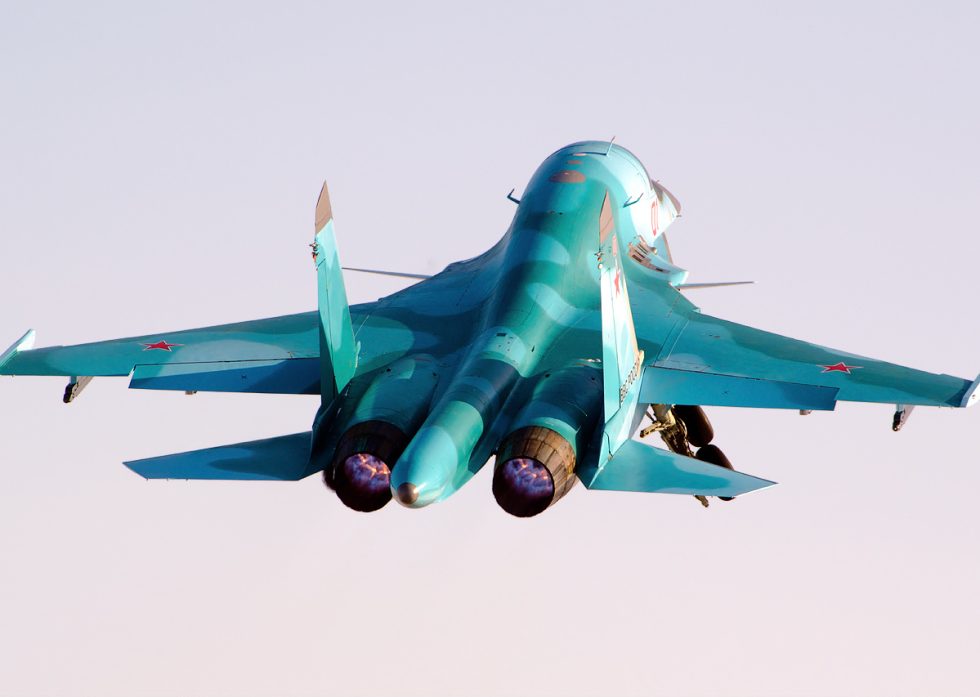
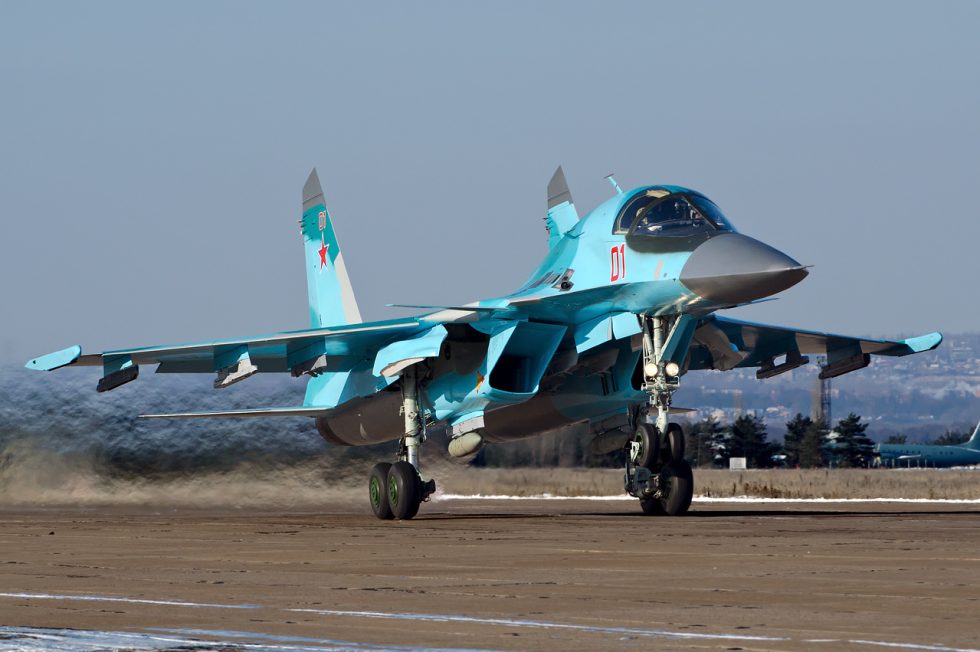
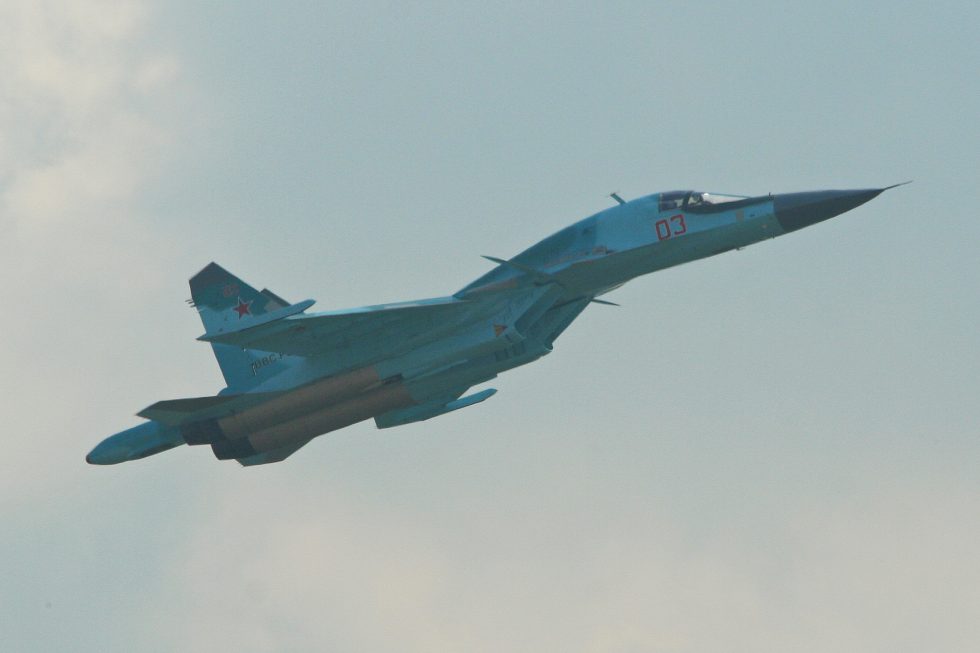
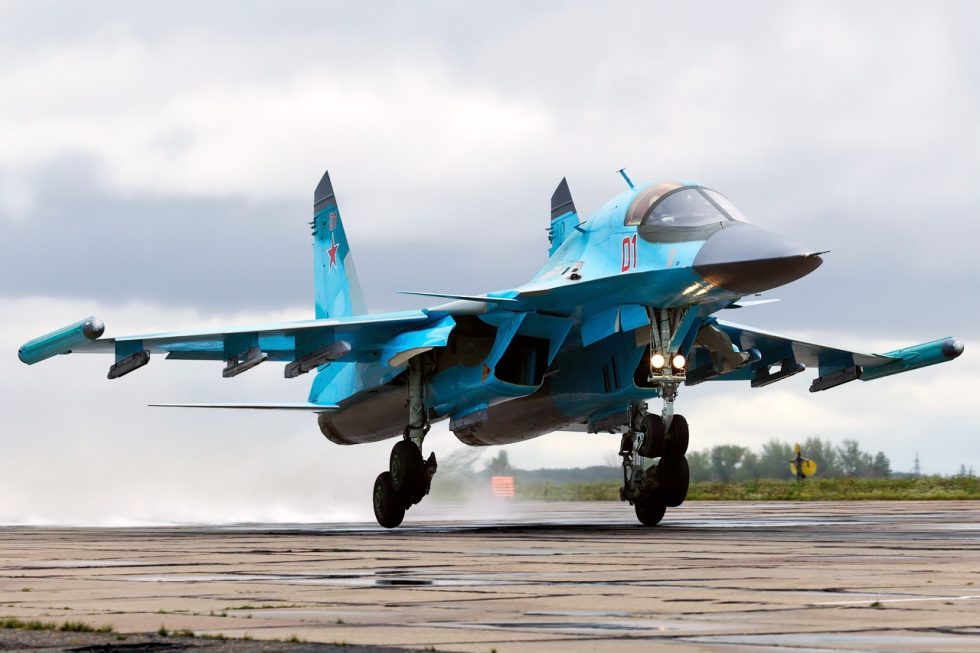
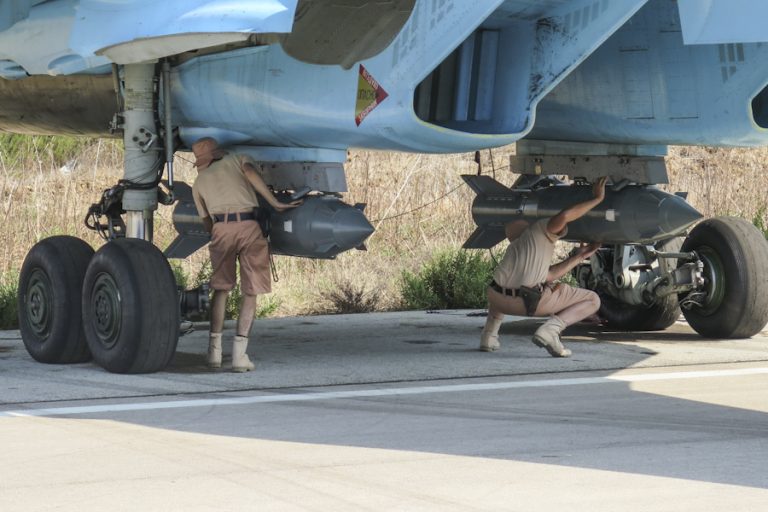
The Su-34 Fullback in motion
A curated Su-34 video is coming soon. In the meantime, explore the gallery above and the full combat and technical record below.
The Su-34 Fullback in motion
Found And Explained — one of the most-watched Su-34 Fullback films on YouTube.
Where the Su-34 Fullback operates
A contested combat record
The Su-34 is an active combat aircraft, and its record is being written in real time in a war where both sides publish figures that serve their own narratives. Russia emphasises the scale of its strike sorties and glide-bomb campaign; Ukraine emphasises the number of Fullbacks it has shot down. The claims below are therefore hedged deliberately — treat every tally, from either side, as contested.
Independent trackers that count only visually confirmed cases have logged losses in the mid-tens since February 2022; Ukrainian official claims run higher and Russian acknowledgements lower. Compare the combat record of every military aircraft. Figures as of July 2026 and subject to change.
Everything people ask about the Su-34
Can I fly in a Su-34?
What is the Su-34?
How much can the Su-34 carry?
Is the Su-34 really armoured?
How many Su-34s has Russia lost in Ukraine?
What are the glide bombs the Su-34 drops?
Who operates the Su-34?
Is the Su-34 still in production and service?
You can’t fly the Su-34.
These, you can.
Some legends only live in museums — others are fuelled and waiting. MiGFlug has put civilians in real military jet cockpits since 2004.
 Fly the L-39 AlbatrosThe world’s most-flown jet trainer — aerobatics included
 Fly the F-104 Starfighter“The missile with a man in it”
 Fly the MiG-21The Cold War’s most-produced jet
 Fly the T-33 Shooting StarAmerica’s first jet trainer
 Fly the DH VampireA piece of early jet history
 Fly the S.211Agile Italian jet trainer
 Fly the MB-326The classic Aermacchi jet
 Fly the MiG-15The Soviet legend of the Korean War
Continue the tour
Every fact, checked
- Airforce Technology — Su-34 (Su-32) FullbackTechnical overview of the airframe, systems and armament.
- Military Factory — Sukhoi Su-34Specifications, development history and variants.
- Oryx — visually-confirmed loss documentationOpen-source tracking of confirmed Russian equipment losses, including Su-34s.
- National Security JournalAnalysis of Su-34 losses and the type’s vulnerabilities over Ukraine.
- Military Watch MagazineReporting on Algeria’s reported Su-34ME deliveries and export status.
- Defense ExpressUkrainian defence outlet on Su-34 combat use and Algerian deliveries (read alongside Russian sources).
- 19FortyFiveCoverage of Su-34 production, modernisation and wartime attrition.
- AeroCorner — Su-34 / Su-32Reference specifications and photographs.