
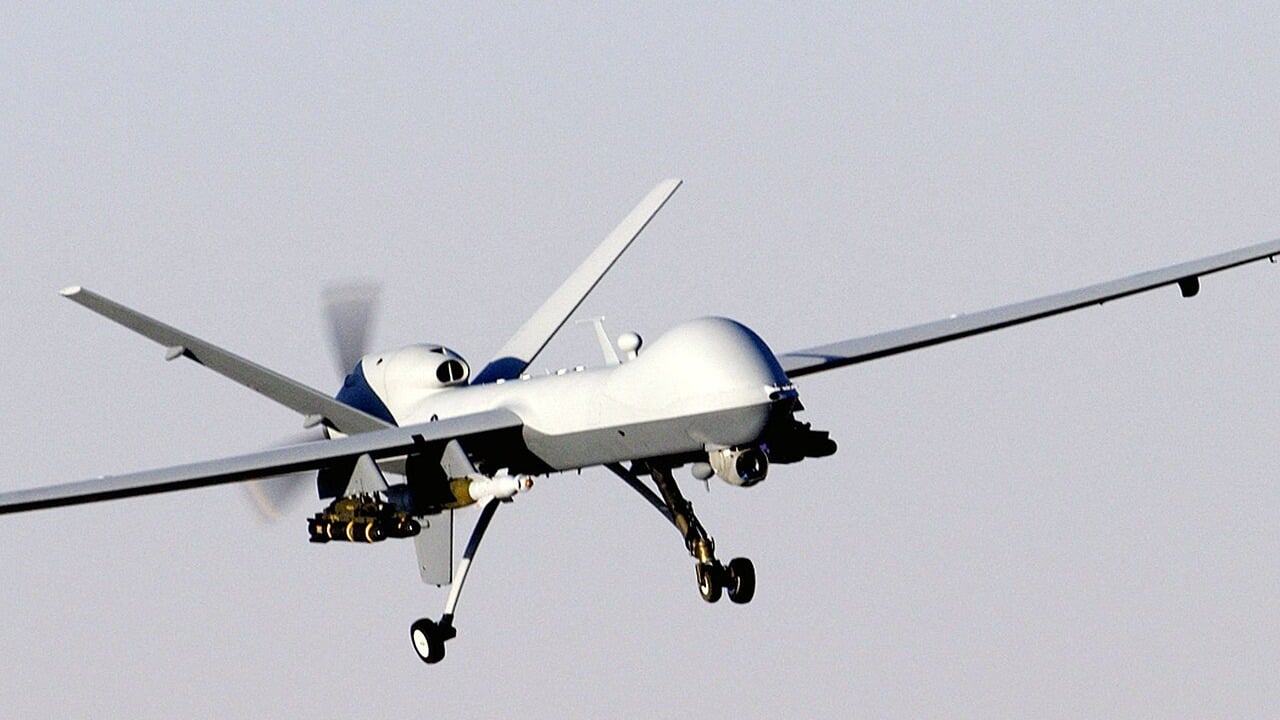
A Reaper does not sneak. It orbits. For twenty hours at a stretch it flies long, patient racetracks over somebody else’s country at the speed of a fast train, hauling a sensor turret and a pair of Hellfires, in full view of anything with a radar antenna and a reason to look.
That is not a flaw in the design. That È the design.
This magazine recently explained why radar has so much trouble finding a quadcopter: a hobby drone is small enough that the physics stop cooperating, and the clutter filter throws it out with the pigeons. The MQ-9 Reaper has the exact opposite problem, and it is worth understanding, because it explains something that confuses a lot of people: how a militia with improvised surface-to-air missiles can knock down an aircraft that costs as much as a small airliner.
Quick Facts: General Atomics MQ-9A Reaper
Apertura alare: 66 feet (20.1 metres)
Lunghezza: 36 feet (11 metres)
Peso massimo al decollo: 10,500 pounds (4,760 kilograms)
Centrale elettrica: One Honeywell TPE331-10GD turboprop, 900 shaft horsepower
Velocità di crociera: Around 230 mph (200 knots); General Atomics quotes speeds of 240 KTAS
Soffitto: Up to 50,000 feet
Resistenza: Over 27 hours (General Atomics)
Equipaggio: One pilot and one sensor operator, flying it from somewhere else
US Air Force inventory: 351 aircraft in FY2022; 135 remaining as of congressional testimony in May 2026
The opposite problem from a quadcopter
Radar struggles with very small objects because of a scale problem. When a target is much smaller than the radar’s wavelength, the energy it sends back collapses away to almost nothing, and what little comes back looks a great deal like a bird. That is the regime a consumer drone lives in, and it is genuinely hard.
A Reaper lives nowhere near that regime. Its wing spans 66 feet, or 20.1 metres, according to the US Air Force’s own fact sheet. That is an aircraft you could not hide behind a house. The Pentagon files it as a Group 5 uncrewed aircraft system, the category the Congressional Research Service describes as covering “the largest and highest-flying drones”. At that size, radar returns behave the way they do for any other aeroplane: the target is far bigger than the wavelength, the return scales with geometry rather than vanishing into the noise, and the question stops being “can we see it” and becomes “how early”.
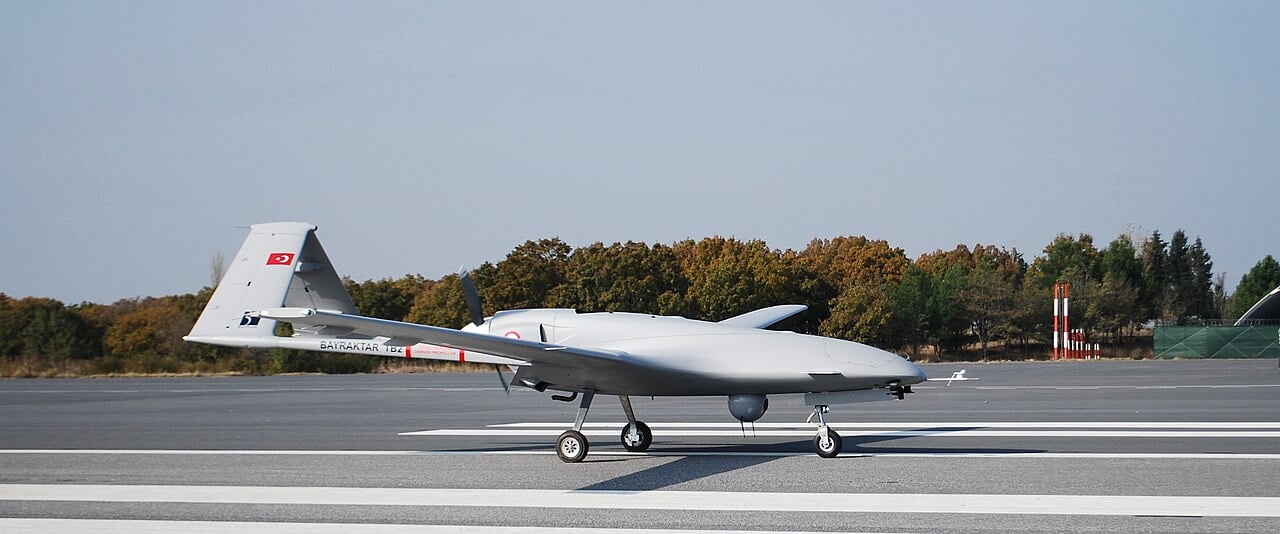
Even the smaller end of the military fleet is not small. The Bayraktar TB2 that made Baykar famous has a 12-metre wingspan and a 700-kilogram maximum takeoff weight, on the manufacturer’s own published figures. It is a light aircraft that happens to have nobody in it.
Nothing about a Reaper is trying to hide
Size is only half of it. The other half is shape, and the Reaper’s shape was never asked to do anything about radar.
Walk around one. There is a bulbous forward fuselage housing the satellite antenna. There is a sensor ball hanging underneath on a gimbal. There is a Y-shaped tail with large flat surfaces meeting the fuselage at exactly the sort of angles that make a corner reflector. There is a pusher propeller turning behind the wing, which is a rotating metal object and therefore a gift to anything looking for a Doppler signature. There are weapons and their pylons hanging in the airflow. Nothing is faceted, nothing is edge-aligned, nothing is buried, and no part of the airframe appears to have been shaped with a radar in mind.
That is not an accusation. It is the design brief. The Reaper was built to loiter for a day at a time over places where nobody was shooting back, carrying the best sensors that weight budget allowed. Low observability costs money, range, payload and maintenance hours, and for the mission the aircraft was bought to fly, it would have bought nothing. The Air Force has been unusually direct about this.
A working primer on how radar actually builds a picture, from a channel run by an electronic-warfare practitioner. The section on detection ranges is the one that matters here.
Slow, straight and extremely patient
Then there is the flying. The Air Force fact sheet gives a cruise speed of around 230 mph, about 200 knots. General Atomics quotes speeds of 240 KTAS. Either way, it is slow, and slow is the least of it. The aircraft’s whole value is that it stays in one piece of sky for most of a day, watching. It flies predictable orbits, at medium altitude, for hours.
Every one of those qualities helps the radar operator. A long dwell over the same patch of sky gives a tracking radar an enormous amount of time to accumulate returns and refine a track. A steady, repeatable orbit makes the track trivial to predict. And medium altitude puts the aircraft inside the engagement envelope of a great deal of ordinary air defence equipment rather than above it.
Compare that with the RQ-4 Global Hawk, which answers the same problem by flying very high for a very long time. Altitude is not stealth, but it is a form of protection, and it is the one the Reaper mostly does without.
What the record actually shows
None of this was abstract in 2026. The Reaper was heavily used in Operation Epic Fury, the US military operation against Iran, and the Air Force Chief of Staff told Congress in May what he thought of it.
In the same testimony cycle, another Air Force official said the service was “concerned about how they’ve attrited”. The Air Force has not officially disclosed how many Reapers it lost in the operation. An August 2026 news report, citing US government sources, put the figure at 45 aircraft; that number is a press report rather than an Air Force statement and is worth treating as such. What is documented in the budget papers is the trend: an inventory of 351 MQ-9As in FY2022, and an Air Force official telling Congress in May 2026 that 135 remained in service.
Those two facts sit together uncomfortably and honestly. The aircraft was the most useful thing in the theatre, and it was also the thing being shot down, because it was doing its most useful work inside the range of people who could see it coming.
The shape that does hide
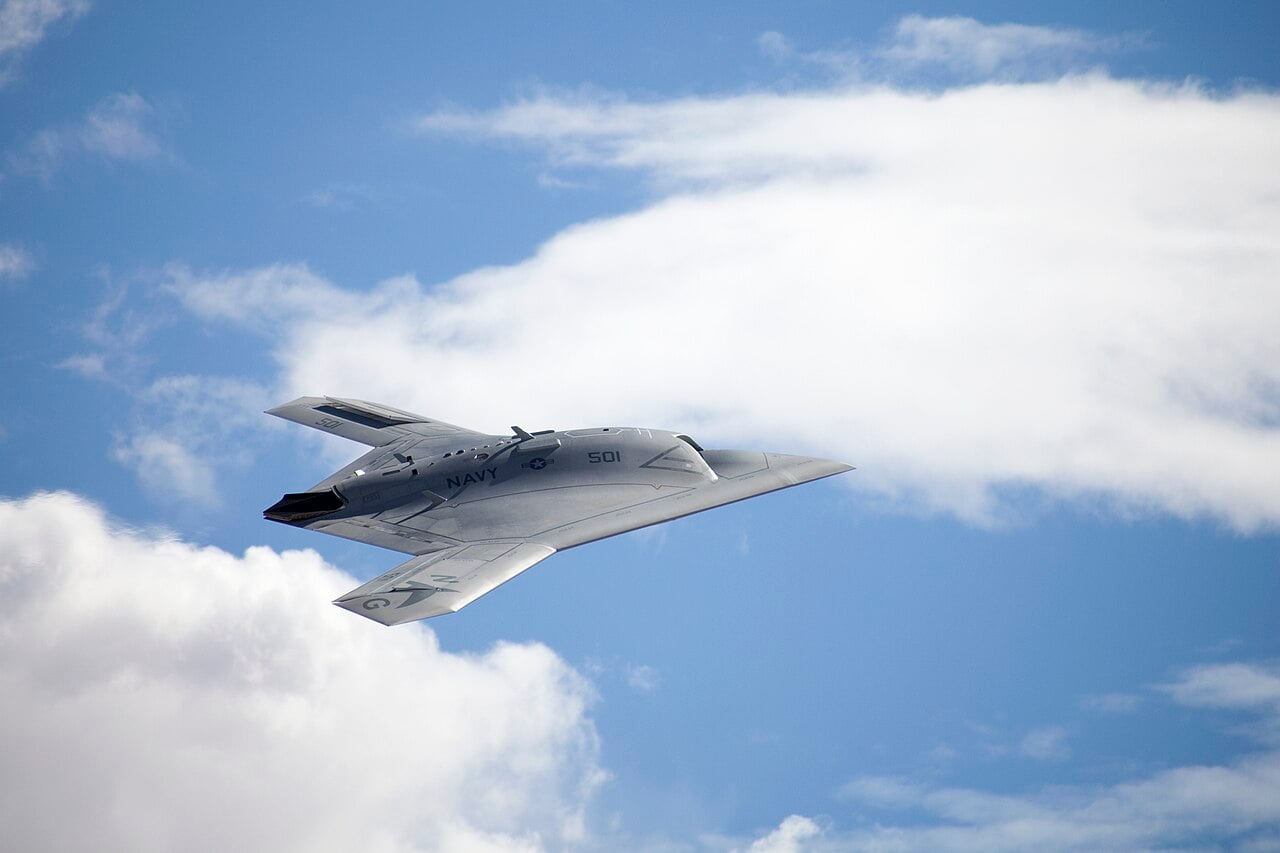
The contrast is the point. Put a Reaper next to an X-47B and you are looking at two completely different answers to the question of what an uncrewed aircraft is for.
The X-47B is a tailless flying wing. It has no fin to form a corner reflector with the fuselage, its leading and trailing edges are swept to a small number of repeated angles so that returns are thrown into a few narrow directions rather than scattered everywhere, its engine inlet is buried on top, and its weapons go inside. It is a demonstrator rather than a fielded combat aircraft, and it never entered service, but it shows what the design looks like when survivability is written into the requirement instead of assumed away.
It also shows why that choice is rare. Shaping of that kind constrains the wing, the inlet, the exhaust and the payload bay all at once, and the aircraft that results is expensive. The reason most of the world’s armed drones look like Reapers and TB2s rather than flying wings is not that nobody thought of it. It is that the mission did not pay for it.
A clear walkthrough of what actually makes an airframe stealthy, and why shaping does most of the work.
When a stealth drone does come down
Low observability is also not a cloak. In December 2011 Iran displayed an intact Lockheed Martin RQ-170 Sentinel, a tailless stealth reconnaissance aircraft, on television. The circumstances of how it came down are still disputed and the Iranian account has never been independently verified, but the aircraft on the table was real, and it was not a Reaper.
Iranian state television displays the captured RQ-170 Sentinel, December 2011. Contemporary news footage of the airframe itself.
Which is why the replacement is cheap, not stealthy
The most revealing thing about this whole argument is what the Air Force decided to do next. It did not ask for a stealthy Reaper. It asked for a cheaper one.
The service approved a successor concept in May 2026 and released it in July, called the Massed Modular Aircraft. The CRS summary describes a Group 5 aircraft that costs less than the Reaper while retaining “the ability … to execute missions that the MQ-9A performs today”, reportedly at around 10 million dollars a unit against a Reaper’s 30 to 50 million, with a goal of 500 aircraft in service by 2032. General Atomics has publicly questioned whether that cost target is realistic.
Read that as an answer to the detectability problem and it makes complete sense. If you cannot stop the enemy seeing your drone, and you cannot afford to make it invisible, the remaining option is to make losing it hurt less. That is a real strategy. It is just not a comfortable one, and it is a long way from the decade when a Reaper orbit was something only one side in a war got to have.
Sources: US Air Force MQ-9 Reaper fact sheet (AFSOC); General Atomics Aeronautical Systems MQ-9A product page; Congressional Research Service, “Air Force MQ-9A Reaper: Background and Issues for Congress” (IF13318, 23 September 2026); Baykar Bayraktar TB2 published specifications.


0 Comments