
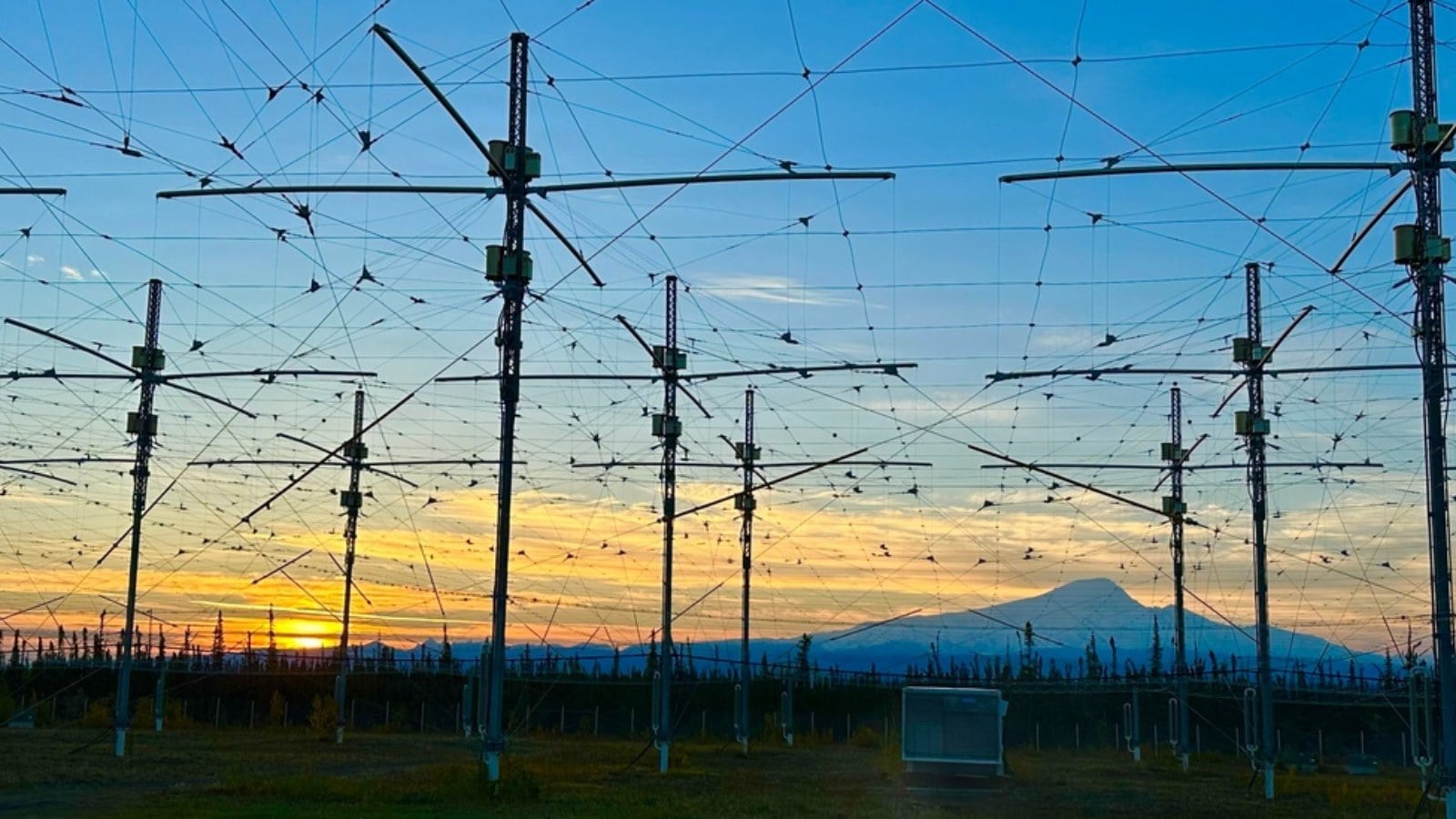
For three decades, the antenna field outside Gakona, Alaska, has been the most misunderstood radio transmitter in the world. Now the US military has given it a job conspiracy theorists never predicted: lighting up aircraft far beyond the horizon so that a receiver at the far end of the Alaska Peninsula can hear the echoes.
In a release published on 19 October 2026, Alaskan Command said live-fly trials from 7 to 11 September used the High Frequency Active Auroral Research Program, better known as HAARP, as the transmitter half of an experimental bistatic over-the-horizon radar. A low-cost receiver array built by MITRE at Cold Bay did the listening. The result, according to the command: “full skywave (beyond line of sight) detections of aircraft.”
The HAARP over-the-horizon radar trial closed out a three-year Arctic air domain awareness experiment series. It is still an experiment, not a programme of record, but it shows how Washington is thinking about the surveillance gap in the High North.
Informazioni rapide
Che cosa: Bistatic over-the-horizon (OTH) radar experiment
Transmitter: HAARP, Gakona, Alaska (University of Alaska Fairbanks)
Receiver: MITRE 16-element HF array, Cold Bay, Alaska
Live-fly trials: 7–11 September 2026
Release: 19 October 2026, Alaskan NORAD Region/Alaskan Command/11th Air Force
Test targets: E-3 Sentry, HC-130J Combat King II, KC-135 Stratotanker
Partner: ALCOM, NORTHCOM, AFRL, Defence Research and Development Canada, MITRE
Stato: Initial results positive; data analysis ongoing
What was actually tested
The question was simple to state and hard to answer: could an existing high-frequency transmitter, paired with a newly developed, low-cost receiver, detect aircraft beyond the reach of Alaska’s long-range radar sites? The test area covered the Gulf of Alaska and the Bering Sea, where distances are vast, weather is brutal and infrastructure is thin.
Three types flew as cooperative targets: an E-3 Sentry from the 962nd Airborne Air Control Squadron, HC-130J Combat King II rescue aircraft from the 211th Rescue Squadron and KC-135 Stratotankers from the 168th Air Refueling Wing. Their positions were known throughout, so researchers could check every radar return against the truth.
The release says the team met or exceeded its test execution objectives and correlated its skywave detections with those truth flights. Detailed analysis is still under way, and no detection ranges, track accuracies or frequencies have been published.
How a bistatic skywave radar works
A conventional radar sees only to the horizon, because microwaves travel in straight lines and the Earth curves away beneath them. High-frequency radio, in the 3 to 30 MHz band, behaves differently: the ionosphere bends it back towards the ground, so a signal can come down hundreds or even thousands of kilometres from its source. That is the skywave mode the release refers to.
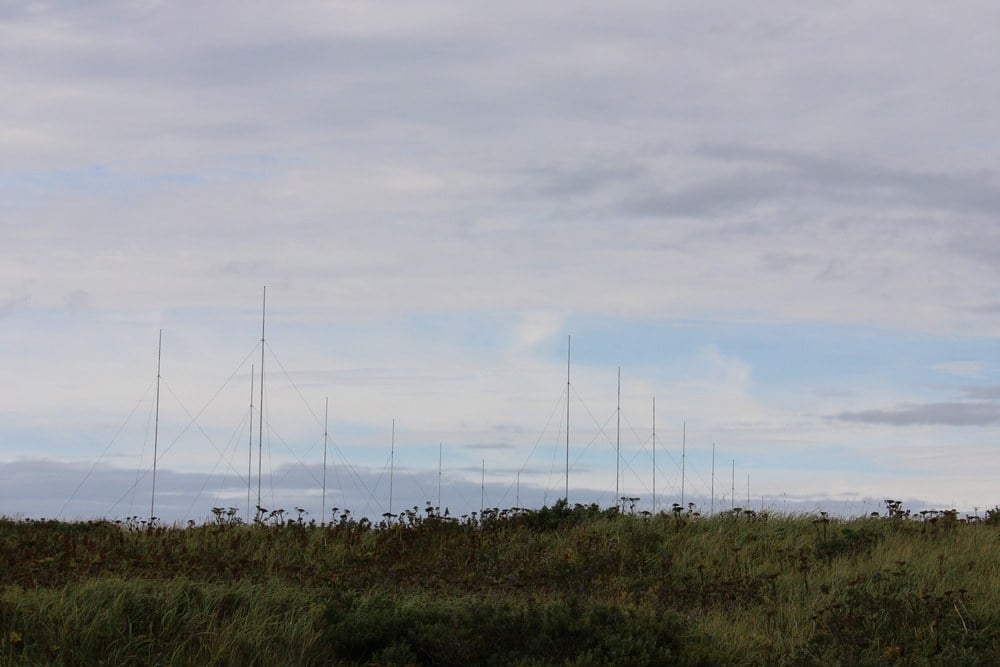
In a bistatic set-up, the transmitter and receiver sit at different sites. HAARP beamed energy up into the ionosphere; it came down over the maritime approaches, struck aircraft, and a fraction of the scattered energy found its way to Cold Bay. Gakona and Cold Bay are roughly 1,280 km (about 800 miles) apart in a straight line, which gives a sense of the geometry involved.
The difficulty is the signal-to-noise ratio. The ionosphere moves, the sea surface returns enormous clutter and an aircraft echo is tiny by comparison. Making a cheap, 16-element receiver work at all is the most interesting engineering result of the HAARP over-the-horizon radar trial, since it suggests receive sites could be scattered across Alaska without the cost of a full radar station.
Why HAARP is suddenly useful
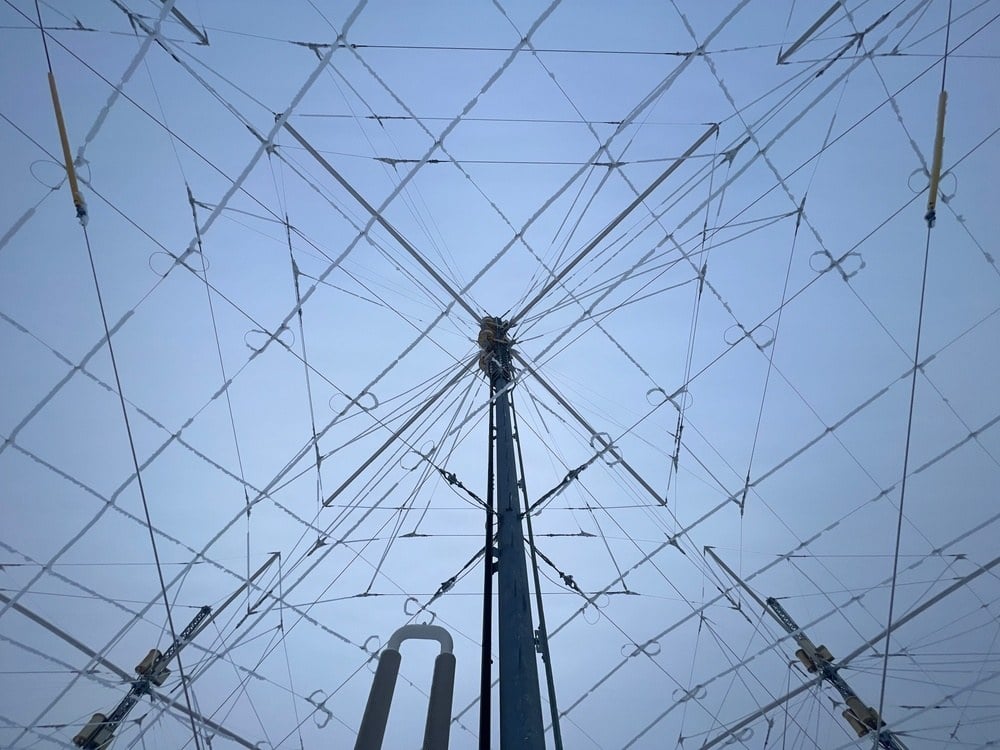
HAARP was built as an ionospheric research instrument, funded by the US Air Force, the US Navy and DARPA. Its Ionospheric Research Instrument consists of 180 crossed-dipole antennas spread over 33 acres (about 14 hectares), capable of transmitting 3.6 megawatts of radio-frequency energy. The phased array can be steered electronically by adjusting the phase and power of each element.
The Air Force planned to dismantle the site in 2014. Instead, the University of Alaska Fairbanks took it over in August 2015 and has run it as a research facility since. That history matters: a ready-made, high-power, steerable HF transmitter in the right corner of North America is exactly what an over-the-horizon experiment needs, and it already existed.
None of this has anything to do with weather control or mind games. HAARP has been a magnet for such theories since the 1990s; its new role is a far more ordinary one, borrowed from a radar principle that dates back to the Cold War.
The Arctic surveillance gap
NORAD’s current northern radar chain, the North Warning System, was designed to watch for Soviet bombers coming over the pole. Its radars see to their own horizon and no further. Long-range cruise missiles and threats approaching from the Pacific do not fit that Cold War picture.
Canada is already buying a solution. As part of NORAD modernisation, Ottawa is acquiring a multibillion-dollar Arctic over-the-horizon radar, working with Australia, whose Jindalee Operational Radar Network is the best-known operational skywave system in the West. Defence Research and Development Canada was a partner in the Alaskan trials.
The US has a long, uneven history with this technology. Britain and the US built the giant Cobra Mist radar at Orford Ness in the late 1960s and abandoned it in 1973; the Soviet Duga radars filled shortwave bands with their infamous “woodpecker” tapping for more than a decade. Digital signal processing has changed the economics since then.
Cosa succederà dopo?
Alaskan Command has not said whether the concept will become an operational system, and the release is careful to describe it as an experiment that could complement existing surveillance. The data from September is still being analysed.
Still, the logic of a HAARP over-the-horizon radar is hard to ignore. One powerful transmitter that already exists, a handful of cheap receive sites, and coverage over waters that today are largely dark to ground radar. If the numbers hold up, the most notorious antenna farm in Alaska may end up doing exactly what its critics feared least: keeping watch.
Sources: Alaskan Command / DVIDS, U.S. Department of War, TWZ, Defence Blog, SOFX, Times of Defence, University of Alaska Fairbanks


0 Comments