
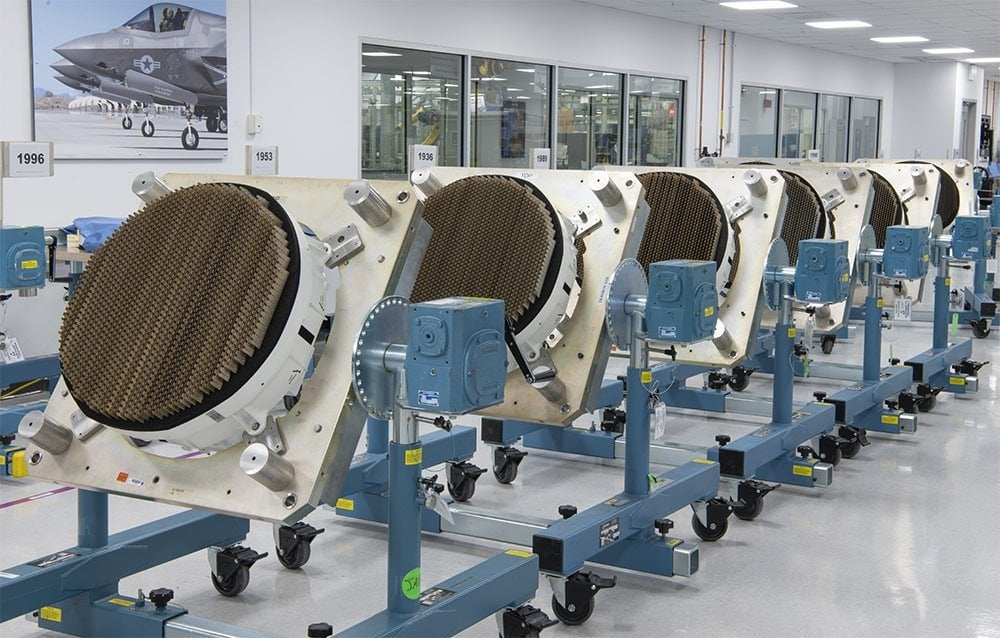
Open the nose of an F-22 Raptor and you will not find a dish nodding from side to side. You will find a flat, fixed plate carrying 1,956 transmit/receive modules, each about the size of a stick of gum. The beam it produces can jump from one part of the sky to another in tens of nanoseconds, according to published descriptions of the AN/APG-77.
That plate is an active electronically scanned array, or AESA. It is one of the biggest changes in fighter radar since radar went into fighters, and it now equips everything from the newest stealth jets to upgraded F-16s.
This is AESA radar explained from the antenna outwards: how a radar that never moves can still point, why it is so hard to detect and jam, and what it still cannot do.
Informazioni rapide
- Stands for: Active electronically scanned array
- Core idea: Beam steered by timing each element's signal, not by moving the antenna
- Active vs passive: AESA: a transmit/receive module per element; PESA: one transmitter, many phase shifters
- Example: F-22 AN/APG-77: 1,956 transmit/receive modules
- Key advantages: Multiple beams, frequency hopping, low probability of intercept, jamming resistance
- Main limit: Flat array steers about 60 degrees either side at best
- First on a combat jet: J/APG-1, Mitsubishi F-2, 1995
- Production scale: Over 1,000 APG-81s by December 2022 (Northrop Grumman)
The Old Way: A Dish on a Motor
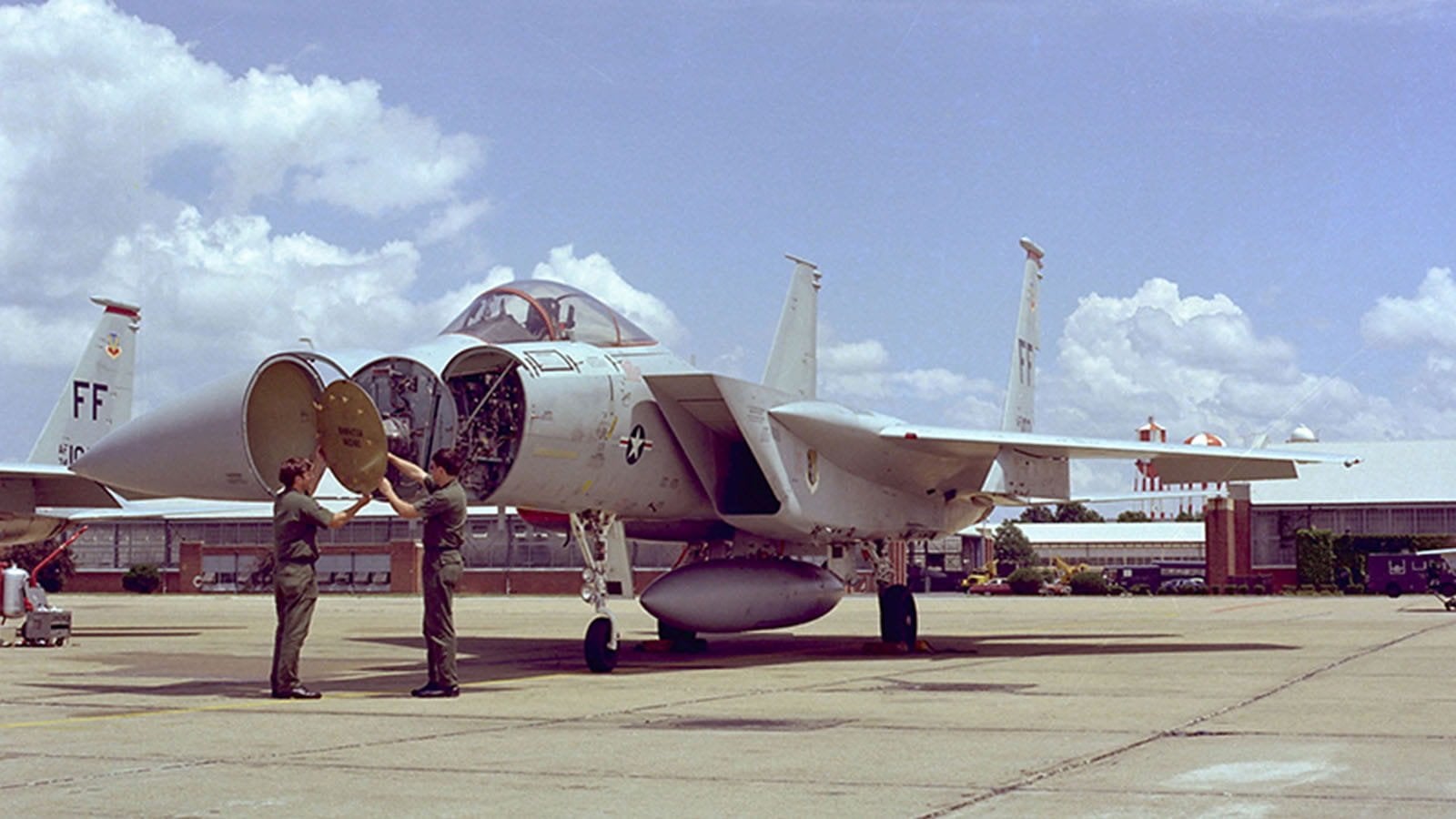
A classic fighter radar works like a torch on a swivel. A single powerful transmitter, typically a klystron or travelling-wave tube, feeds a dish or flat-plate antenna. To look somewhere else, motors physically swing the antenna across the sky in a scan pattern, back and forth, bar by bar.
That design has served for decades. The F-15 Eagle's original APG-63 was a mechanically scanned radar, and Raytheon's own history credits its successor, the APG-70, with the first software-programmable signal processor in the late 1970s. But a moving antenna has inertia. It can only look in one direction at a time, it takes time to sweep, and the gimbals and drive motors are among the things that break most often.
The basics of pulse, echo and Doppler are covered in our explainer on how radar works. The AESA keeps all of that physics. What it changes is how the beam is aimed.
Steering a Beam With Timing
Imagine hundreds of small antennas laid out in a grid, all transmitting the same signal. If they all fire at exactly the same instant, their waves add up straight ahead. Delay the signal slightly at one edge of the grid and progressively less towards the other, and the combined wavefront tilts. The beam now points off to one side, and nothing has moved.
That is the phased array principle. The interference between the individual signals is controlled so that they reinforce each other in one direction and cancel in all others. Because the delays are set electronically, the beam can be repositioned almost instantly, and the radar can interleave search, tracking and other jobs from one moment to the next.
The first generation of this idea, the passive electronically scanned array or PESA, still used one big transmitter. Its signal was split into hundreds of paths, each passed through a phase shifter, and sent to individual antenna elements. It could steer electronically, but it still had a single point of failure and a single signal source.
An animated introduction to how phased arrays steer a beam by timing the signal at each element.
Active Means Every Element Is a Radar
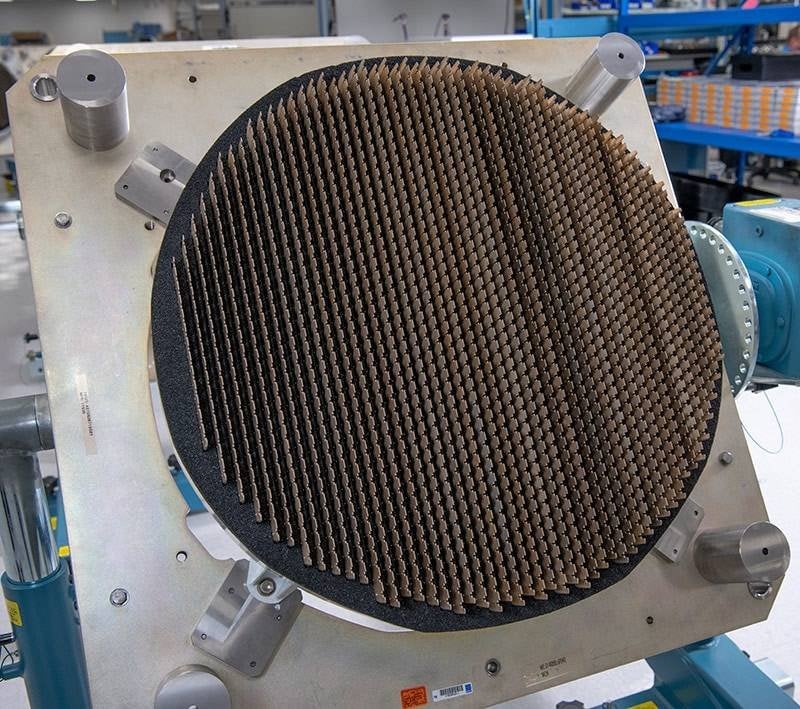
An AESA goes one step further. Each antenna element gets its own small solid-state transmit/receive module under computer control. Every module generates, amplifies and receives its own signal. There is no single transmitter tube at all.
That only became practical with gallium arsenide microelectronics in the 1980s, which shrank receiver electronics to a few cubic centimetres, and with solid-state transistors that did the same for the transmit side. Individually the modules run at low power, perhaps 40 to 60 watts each according to published estimates, so the large high-voltage supply of a tube radar disappears.
Newer arrays are moving to gallium nitride. Raytheon says the GaN version of its APG-79, the APG-79(V)4 chosen by the US Marine Corps to upgrade its Hornets, lets aircrews see further and more clearly. Raytheon's newest lightweight AESA, PhantomStrike, weighs under 100 pounds, according to the company.
Many Beams, Many Frequencies
Because each module is independent, an AESA can split its face into groups doing different jobs at once. One part of the array can search while another tracks, maps the ground or listens. It can also form several beams on different frequencies simultaneously, something a single-transmitter PESA cannot do without extra hardware.
The radar can also change frequency from pulse to pulse, and it usually does so in a pseudo-random sequence. That one trick changes the whole contest between the radar and the people trying to detect or jam it.
The array is also a receiver of extraordinary sensitivity. Northrop Grumman says the F-35's AN/APG-81 can operate as an electronic warfare aperture, supporting electronic protection, electronic attack and electronic support. In a 2007 test, Northrop Grumman, Lockheed Martin and L-3 Communications used an F-22's AESA as a high-speed data link, transmitting at 548 megabits per second.
Why AESAs Are Hard to Detect
Radar has a built-in weakness. The radar's own echo has to travel out and back, so the received energy falls with the fourth power of distance. A target's radar warning receiver only needs the one-way signal, which falls with the square of distance. In principle, the target can always hear the radar long before the radar sees the target.
Traditional warning receivers exploit that by recognising a radar's fixed frequency and pulse pattern against a library of known emitters. An AESA undermines the method by hopping frequency at random, varying its pulse repetition frequency and stretching its pulses to lower peak power. The total energy on target stays the same, but there is no steady pattern to lock on to.
This is why AESAs are described as low probability of intercept radars, and why older-generation warning receivers struggle against them. Modern receivers have had to become far more sensitive and add time-frequency processing to keep up.
Northrop Grumman on the AN/APG-81 AESA radar built for the F-35.
Why AESAs Are Hard to Jam
Classic noise jamming works by finding the radar's operating frequency and flooding it. Against an old tube radar with only a handful of frequencies, that was manageable. Against a radar that changes frequency with every pulse, the jammer must spread its energy across the whole band, leaving less power on any single frequency.
An AESA can also emit a single broadband pulse, a chirp, which is harder still to jam. And it can switch to a receive-only mode and use the jamming signal itself to track the jammer. The techniques jammers use in return, from noise to digital deception, are covered in our guide to radar jamming techniques.
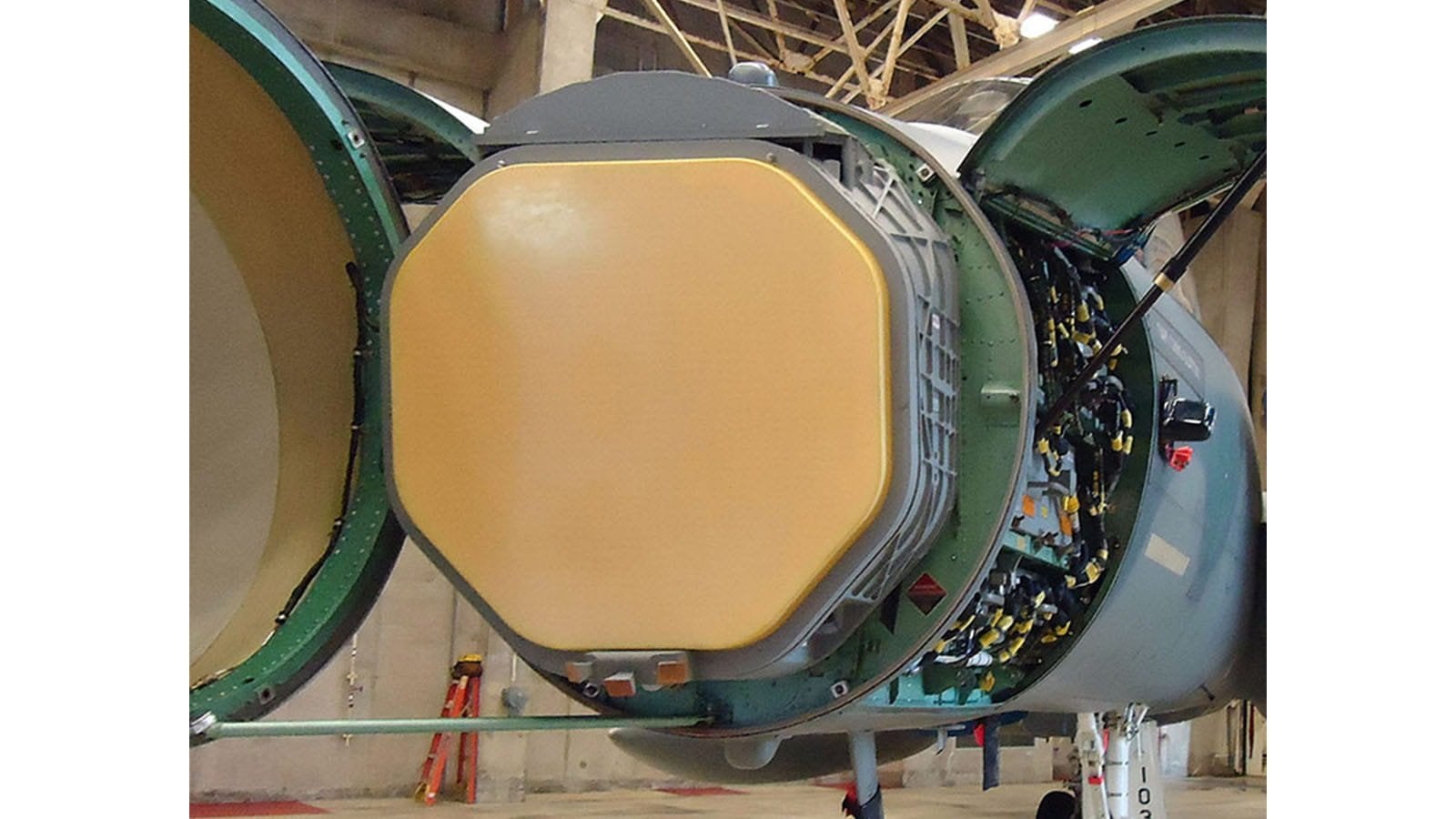
Reliability is the less glamorous advantage, and possibly the one maintainers value most. Because the modules work independently, losing a few degrades the radar slightly rather than switching it off. Northrop Grumman says its APG-81 arrays have almost twice the expected life of the airframe, with operational readiness above 99 per cent and flight-line repair times under 30 minutes.
The Limits of a Fixed Plate
An AESA is not magic. A flat array can only steer its beam so far off its face. With elements spaced at half a wavelength, the practical limit is about 45 degrees either side, and the best flat arrays reach about 60 degrees, a 120-degree field of view in total.
Designers deal with that in two ways. A fixed array, as on the F/A-18E/F Super Hornet, can help reduce the aircraft's overall radar cross-section. The Eurofighter Typhoon and Saab's Gripen NG take the opposite approach and mount the array on a mechanical repositioner, combining electronic steering with mechanical pointing to look much further to the side.
That wider field matters in a fight. A pilot can turn away from a threat to deny it closing speed while still keeping the target inside the radar's coverage, a tactic known as beaming.
From Japan to Everywhere
The first AESA on a combat aircraft was Japan's J/APG-1, introduced on the Mitsubishi F-2 in 1995. A year earlier, the first series-production airborne AESA, the EL/M-2075 Phalcon, had entered service on a Chilean Air Force Boeing 707, the aircraft profiled in our story on the Cóndor. In the United States, Raytheon's APG-63(V)2 first flew in December 2000 from Elmendorf Air Force Base in Alaska, retrofitted to F-15Cs.
Production has since gone industrial. Northrop Grumman says more than 1,000 APG-81 radars had been produced and delivered by December 2022, while Raytheon says it has delivered over 700 APG-79 systems to Super Hornet and EA-18G Growler squadrons. Upgrades such as Northrop Grumman's APG-83 for the F-16 are now bringing the technology to older airframes as well.
Aviation Week on AESA radar for the Super Hornet.
The torch on a swivel had a good run of half a century. Its replacement does not move at all, and that is precisely why it sees more.
Sources: Northrop Grumman (AN/APG-81 product page), Raytheon (APG-79 product page and radar history), Wikipedia (Active electronically scanned array, AN/APG-77, Passive electronically scanned array)



0 Comments