
Boeing EA-18G Growler
Electronic Attack
A Super Hornet turned flying jammer, the Growler blinds enemy radars and communications for every US carrier air wing and the RAAF, and it is the only American tactical jet built for electronic attack.
The EA-18G Growler: how a Super Hornet learned to jam
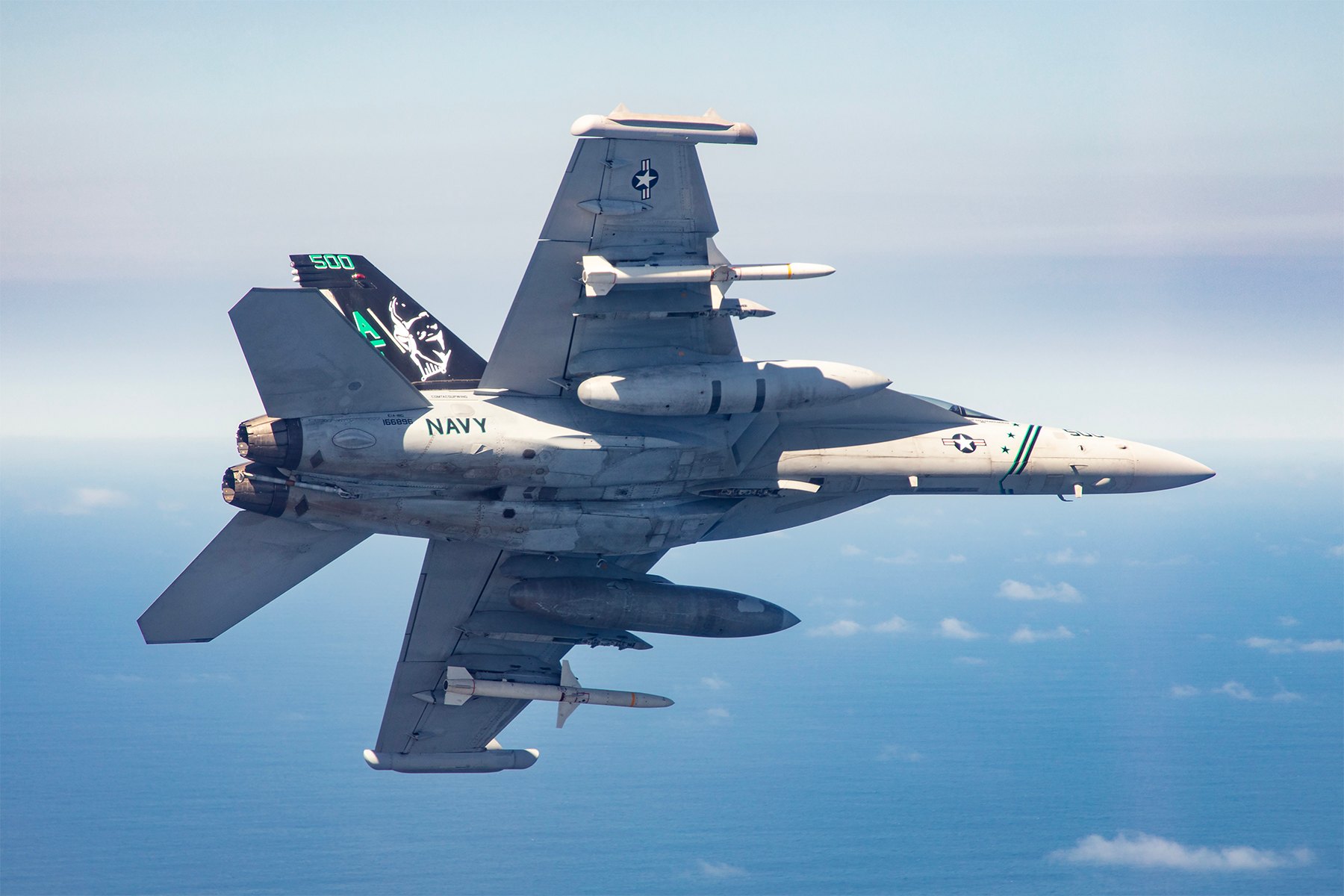
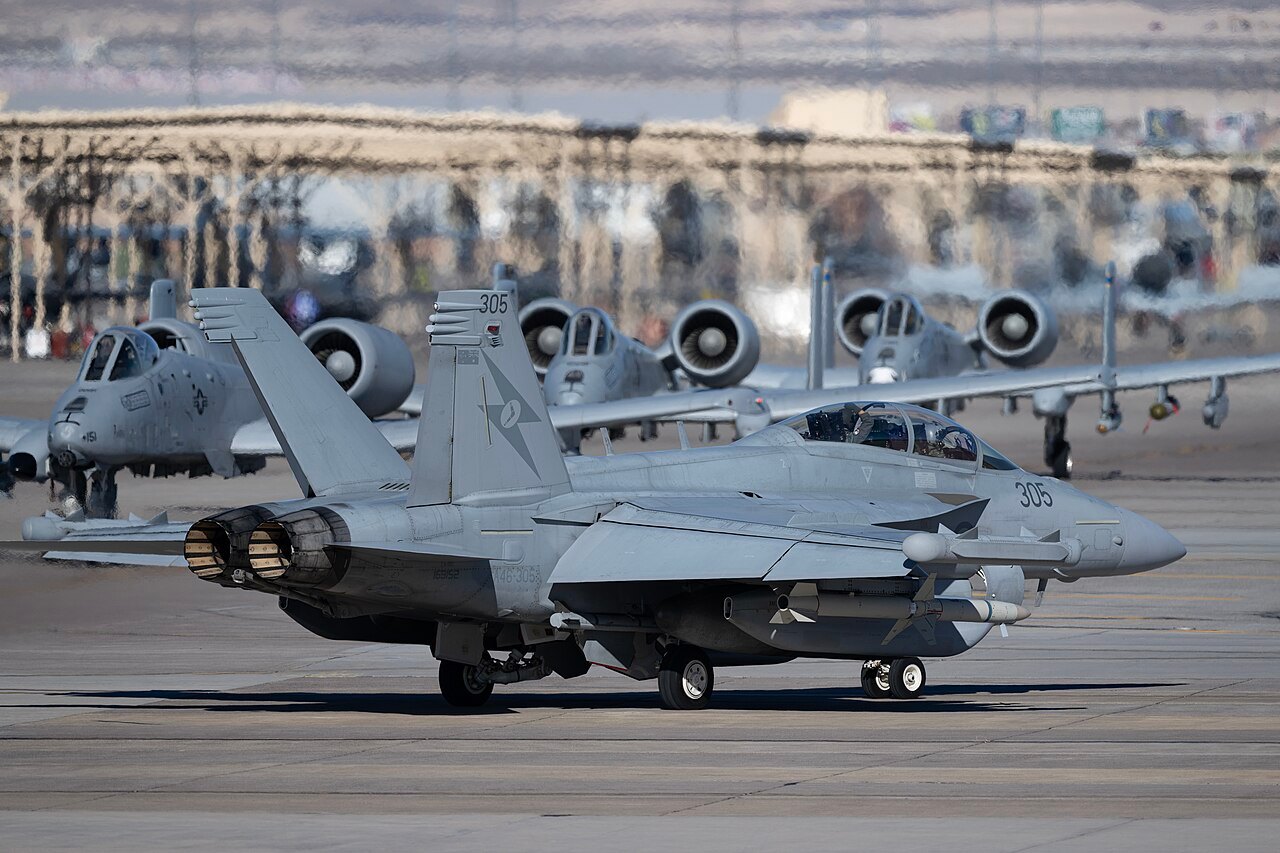
Strike packages over defended territory have a quiet member that rarely drops a bomb. Its pilot flies a two-seat Super Hornet; the officer in the back watches a screen full of enemy radar signals and decides which to jam, which to deceive and which to destroy with a missile. Under the wings hang long pods that pour out radio energy, and at the wingtips, where a fighter would carry missiles, sit receiver pods listening to everything around. The Boeing EA-18G Growler is the US Navy’s airborne electronic attack aircraft, and since the Prowler retired it has been the only American tactical jet designed to blind an enemy’s air defences and communications in combat.
The Growler was born from the need to replace the EA-6B Prowler, a four-seat jammer derived from the A-6 Intruder that had served since the early 1970s. In December 2003 the Navy awarded Boeing a contract to develop a jamming version of the two-seat F/A-18F Super Hornet. It kept most of the fighter’s airframe, engines and cockpit, removed the gun, and added the AN/ALQ-218 receiver system in wingtip pods, communications jammers and the Prowler’s proven AN/ALQ-99 jamming pods. The first aircraft flew on 15 August 2006, the first fleet aircraft reached VAQ-129 at NAS Whidbey Island on 3 June 2008, and VAQ-132 became operational in 2009, deploying first to Iraq as an expeditionary land-based squadron.
Unlike the subsonic Prowler, the Growler can keep up with the fighters it escorts and defend itself with AIM-120 AMRAAM missiles, while AGM-88 HARM and AARGM missiles let it destroy the radars it detects. It first saw combat over Libya in 2011, has flown against Islamic State and over the Red Sea, and is now flying with the new Next Generation Jammer pods. Australia bought 12, becoming the only export operator, and the RAAF flies them from Amberley. More than 170 have been built, nearly all for Whidbey Island squadrons that deploy aboard every US carrier and to land bases worldwide in support of the US Air Force and allies.
01The EA-18G Growler’s inheritance: from Prowler to Growler
The US armed forces learned the value of tactical jamming over North Vietnam, where radar-guided missiles and guns took a heavy toll. The Navy’s answer was the EA-6B Prowler, a stretched A-6 Intruder with a pilot and three electronic countermeasures officers, which served from the early 1970s through Grenada, Libya, the Gulf War, Kosovo, Afghanistan and Iraq. When the US Air Force retired its EF-111A Ravens in the late 1990s, the Prowler became the only dedicated tactical jammer in the US inventory, flown by Navy and Marine Corps squadrons on behalf of all the services.
By the early 2000s the Prowlers were old, slow and expensive to keep flying. Boeing had flight-tested a Super Hornet carrying ALQ-99 pods in the early 2000s, and in December 2003 the Navy chose that route. The Growler reused the jamming pods and much of the Prowler’s improved electronics in a fast, modern airframe, with a crew of two instead of four thanks to automation. The Navy flew its last Prowler mission in 2015 and the Marine Corps followed in 2019.
02The EA-18G Growler in Australia: the only export customer
Australia already flew F/A-18F Super Hornets when it decided to convert part of its order to Growler standard and then to buy a dedicated fleet. It ordered 12 EA-18Gs, which the RAAF now operates with No. 6 Squadron at RAAF Base Amberley in Queensland. The aircraft arrived in Australia in 2017 and reached initial operating capability in April 2019. Australia is the only country outside the United States to fly the type, and its Growlers are cooperatively supported with the US Navy.
Australian Growlers are equipped much like US Navy aircraft, but the RAAF added changes based on US experience over Libya, including the ability to carry a targeting pod for identifying targets visually, according to USNI News. In January 2018 one Australian Growler was written off after a fire at Nellis Air Force Base, Nevada; the US State Department approved the sale of a replacement in 2021.
What makes the EA-18G Growler special
Hearing everything
The Growler’s wingtip pods house the AN/ALQ-218 receiver, which detects, identifies and locates enemy radars and other emitters across a wide frequency range. Because it can listen while its own jammers transmit, the crew can see whether a jamming technique is working. The aircraft also carries a communications countermeasures system and an interference cancellation system that lets the crew talk on their radios while jamming nearby frequencies. The result is an aircraft that can find a threat, identify it and decide how to defeat it in seconds.
Jamming pods, old and new
For most of its career the Growler has carried the AN/ALQ-99 jamming pods inherited from the Prowler, each powered by a ram-air turbine in its nose. They are being replaced by the Raytheon AN/ALQ-249 Next Generation Jammer, whose electronically steered arrays can aim jamming beams at several targets at once. In late 2024 VAQ-133, aboard USS Abraham Lincoln, became the first squadron to deploy with the new mid-band pod, the first new US tactical jammer in decades.
A fighter that jams
Because the Growler shares around 90 per cent of its airframe with the F/A-18F, it can fly at the same speed and altitude as the strike fighters it protects, refuel from the same tankers and operate from the same carriers. The RAAF lists a ceiling of 50,000 ft and a fully armed range of 1,570 km. With AIM-120 missiles it can defend itself against fighters, and with HARM and AARGM it can attack radars directly, something the Prowler could not do in air combat.
03The EA-18G Growler’s cockpit: one pilot, one electronic warfare officer
The Growler’s front cockpit is essentially a Super Hornet’s, with the pilot flying the aircraft and managing weapons. The rear seat belongs to the electronic warfare officer (EWO), who manages the receivers, jammers and anti-radiation missiles through large touch displays. Much of what took three officers in the Prowler is automated: the system can identify threats and propose jamming responses, leaving the EWO to make decisions rather than tune equipment.
To avoid confusion with the Prowler over the radio, US crews used the callsign-style nickname Grizzly for the aircraft during the transition years. Upgrades continue: the Growler Block II programme is developing improved receivers and avionics, and the Next Generation Jammer is being introduced in mid-band and low-band versions to cover more of the spectrum. The aircraft also has a growing role in networked operations, passing the location of enemy emitters to other aircraft and ships.
Boeing EA-18G Growler specifications
Specifications
- Crew
- 2 (pilot and electronic warfare officer)
- Length
- 18.31 m (60 ft 1 in)
- Wingspan
- 13.7 m (44 ft 11 in) including wingtip pods
- Height
- 4.9 m (16 ft)
- Empty weight
- 15,011 kg (33,094 lb)
- Max take-off weight
- 29,964 kg (66,000 lb)
- Powerplant
- 2 × General Electric F414-GE-400 afterburning turbofans, about 98 kN (22,000 lbf) each with afterburner
- Maximum speed
- Mach 1.8 (Boeing); the RAAF quotes Mach 1.6
- Range
- about 2,350 km (1,275 nmi) clean; 1,570 km fully armed (RAAF)
- Combat radius
- about 722 km (390 nmi)
- Service ceiling
- 15,000 m (50,000 ft)
- Hardpoints
- 9
- Armament
- AGM-88 HARM / AGM-88E AARGM anti-radiation missiles, AIM-120 AMRAAM; AN/ALQ-99 or AN/ALQ-249 jamming pods; no internal gun
Costs & production
- Unit cost
- US$68 million (US Navy NAVAIR figure)
- Cost per flight hour
- Hedged estimate: GlobalSecurity cites an older Navy figure of about US$7,400 per hour, against about US$17,000 for the Prowler; full-cost measures including maintenance, personnel and depot work are considerably higher, likely in the low tens of thousands of US dollars
- Production
- More than 170 built; about 160 for the US Navy and 12 for Australia, plus one replacement
- Programme
- Development contract 2003; first flight 2006; initial operating capability 2009
04The EA-18G Growler’s equipment: what changed from the Super Hornet
- Removed: the M61 cannon, to make room for electronics.
- Wingtips: AN/ALQ-218 receiver pods replace the missile rails.
- Jammers: up to three AN/ALQ-99 pods, now being replaced by AN/ALQ-249 Next Generation Jammer pods.
- Communications: AN/ALQ-227 communications countermeasures and an interference cancellation system.
- Weapons: AGM-88 HARM and AARGM, AIM-120 AMRAAM.
- RAAF additions: targeting pod capability and national modifications.
05The EA-18G Growler’s operating costs: cheaper than the Prowler
One of the strongest arguments for the Growler was commonality. It shares engines, most of its structure, training and spare parts with the Super Hornets that fill US carrier decks, which cuts support costs compared with a separate fleet of ageing Prowlers. GlobalSecurity, citing an older Navy estimate, put its operating cost at about US$7,400 per hour against about US$17,000 for the EA-6B.
Those figures are narrow measures. Electronic warfare equipment is expensive to maintain and upgrade, and the Next Generation Jammer adds significant cost. The estimate given in the table is therefore a hedged range rather than an official figure.
The EA-18G Growler from Prowler replacement to Red Sea combat
Development contract
In December the US Navy awards Boeing a contract to develop an electronic attack Super Hornet.
First flight
The first EA-18G flies on 15 August.
To the fleet
VAQ-129 at NAS Whidbey Island accepts its first Growler on 3 June.
Operational
VAQ-132 becomes the first deployable Growler squadron; IOC is declared in September.
Libya
Growlers fly their first combat missions in Operation Odyssey Dawn.
Last Navy Prowler
The US Navy retires the EA-6B, leaving the Growler as its only electronic attack jet.
Australia
RAAF Growlers arrive at Amberley.
Fire at Nellis
An Australian Growler is destroyed after an engine failure during an aborted take-off in Nevada.
RAAF capability
Australia declares initial operating capability in April; the Marine Corps retires its last Prowlers.
Red Sea and the new jammer
Growlers see combat against the Houthis; VAQ-133 deploys with the Next Generation Jammer. Two crew die in a crash near Mount Rainier in October.
Venezuela
Growlers reportedly jam Venezuelan air defences during the January operation to capture Nicolás Maduro.
Stories & eyewitnesses: the EA-18G Growler in action
Libya, 2011: first combat
Growlers flew from Iraq to help open the air war over Libya.
Read the full story
Red Sea: a Hind destroyed
A jammer scored a rare kill against a helicopter on the ground.
Read the full story
The Growler’s first air-to-air kill
Over the Red Sea, a jammer shot down a drone.
Read the full story
Venezuela, 2026
Growlers were part of the US operation that captured Nicolás Maduro.
Read the full story
Northern Edge: the Raptor silhouette
A Growler crew reportedly scored a simulated kill on an F-22.
Read the full story
Fire at Nellis, 2018
An Australian Growler was lost before it ever saw combat.
Read the full story
Mount Rainier, 2024
Two aviators were lost on a low-level training flight.
Read the full story
Whidbey Island: home of the jammers
Almost every Growler in the US Navy lives on one island.
Read the full story
Grizzly, not Growler
Why crews avoided their own aircraft’s name on the radio.
Read the full story
The new jammer goes to sea
In 2024 the Next Generation Jammer made its first deployment.
Read the full story
The EA-18G Growler in pictures
Where the EA-18G Growler flies and flew
The EA-18G Growler’s record
The Growler has flown combat missions over Libya, Iraq, Syria, Yemen and, reportedly, Venezuela, mostly jamming and suppressing air defences for other aircraft. Over the Red Sea it destroyed a helicopter on the ground and shot down a drone. Its losses have come in accidents rather than combat.
See how training and combat types compare in the military aircraft statistics database. Figures are approximate.
Everything people ask about the EA-18G Growler
Can I fly in a Boeing EA-18G Growler?
What is the difference between the Growler and the Super Hornet?
What does the EA-18G Growler do?
Who flies the Growler?
What did the Growler replace?
Has the Growler been in combat?
Does the Growler have a gun?
You can’t fly the EA-18G Growler.
These, you can.
Most of this museum you can only look at. These genuine military jets you can fly yourself with MiGFlug — with aerobatics and time on the controls.
 Fly the L-39 AlbatrosThe world’s most-flown jet trainer — aerobatics included
 Fly the F-104 Starfighter“The missile with a man in it”
 Fly the MiG-21The Cold War’s most-produced jet
 Fly the T-33 Shooting StarAmerica’s first jet trainer
 Fly the DH VampireA piece of early jet history
 Fly the S.211Agile Italian jet trainer
 Fly the MB-326The classic Aermacchi jet
 Fly the MiG-15The Soviet legend of the Korean War
Continue the tour
Every fact, checked
- EA-18G GrowlerUS Navy NAVAIR: role, timeline, unit cost and Block II
- F/A-18 Super Hornet and EA-18 GrowlerManufacturer: operators, dimensions, performance and Next Generation Jammer
- EA-18G GrowlerRoyal Australian Air Force: squadron, base, IOC and specifications
- EA-18G GrowlerProgramme history, contract values and operating cost compared with the Prowler
- U.S. Navy lessons from Libya informed Australian EA-18G Growler modificationsUSNI News, 2015, on Odyssey Dawn and RAAF changes
- In combat debut, Navy jammer targets Libyan tanksWired (Spencer Ackerman, 21 March 2011) on the Growler’s first combat
- EA-18G Growler killed a Houthi Mi-24 Hind with an AGM-88E anti-radiation missileThe War Zone (Altman and Rogoway, June 2024)
- EA-18G Growler scored its first air-to-air killThe War Zone (Joseph Trevithick, July 2024)
- VAQ-133 EA-18Gs become first in the Navy to tactically employ the Next Generation JammerThe Aviationist (David Cenciotti, December 2024)
- Growler mishap near Mt. Rainier updatesUS Navy Region Northwest on the October 2024 crash
- How US Navy EA-18G Growlers broke Venezuela’s air defencesAerospace Global News (Khalem Chapman, January 2026)
- Growler full fleet arrive in AustraliaAustralian Minister for Defence media release, 2017