
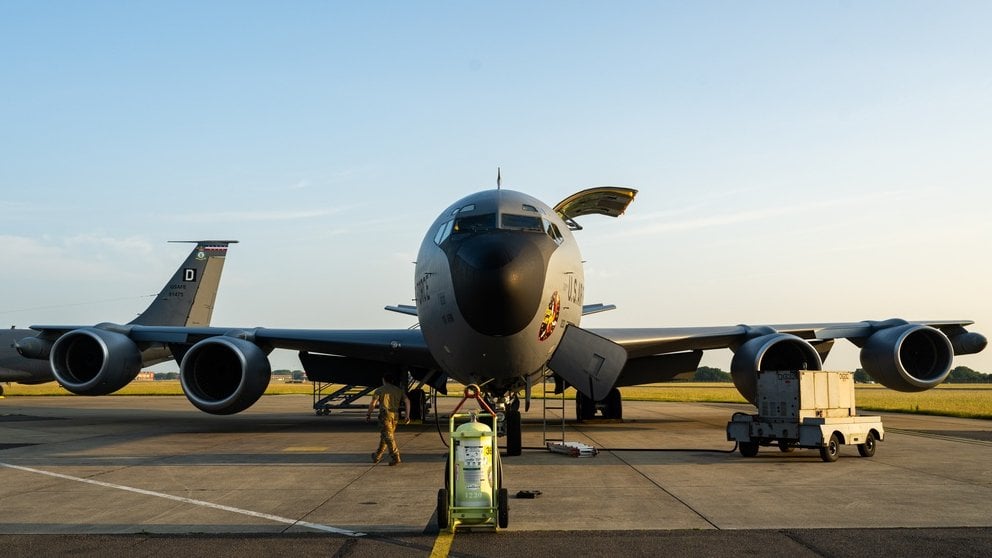
Drive up to the main gate of almost any American military base and, somewhere near the guard post, there is a sign carrying a single word. Most days, at most bases, that word is BRAVO. According to The Wall Street Journal, at RAF Lakenheath and RAF Mildenhall in Suffolk the word became CHARLIE in November 2026, and nobody in uniform would say so on the record.
That gap, between a sign anyone can read and a rulebook almost nobody can, is the whole story of FPCON, the Force Protection Condition system. The five FPCON levels are public. Their definitions are public. What a base actually does at each one is not, and that is entirely deliberate.
When Afterburner covered the security rise at Lakenheath and Mildenhall, FPCON Charlie had to be explained in a parenthesis. Here is the full version: what the levels mean, who turns the dial, what the public record says changes at the gate and on the flight line, and why reporters keep having to write “sources say”.
Informazioni rapide
- Che cos'è: Force Protection Condition (FPCON), the US Department of Defense’s antiterrorism alert system for installations and personnel
- The levels: Normal, Alpha, Bravo, Charlie and Delta; Delta is the highest and is usually declared as a localized condition
- Old name: THREATCON, replaced under DoD Instruction 2000.16 of 14 June 2001; the levels carried over
- Who sets it: Commanders, not intelligence agencies; according to public military explainers, combatant commanders set the regional baseline and local commanders may raise it
- Where to find it: Posted at installation gates, and on many installation websites and official social media channels
- The measures: Set out in Volume 2 of DoD Instruction O-2000.16, “DoD Force Protection Condition System”, which is not released to the public
- Recent case: The Wall Street Journal reported FPCON Charlie at RAF Lakenheath and RAF Mildenhall in November 2026; the US Air Force has only confirmed “enhanced force protection measures”
Five FPCON levels, from Normal to Delta
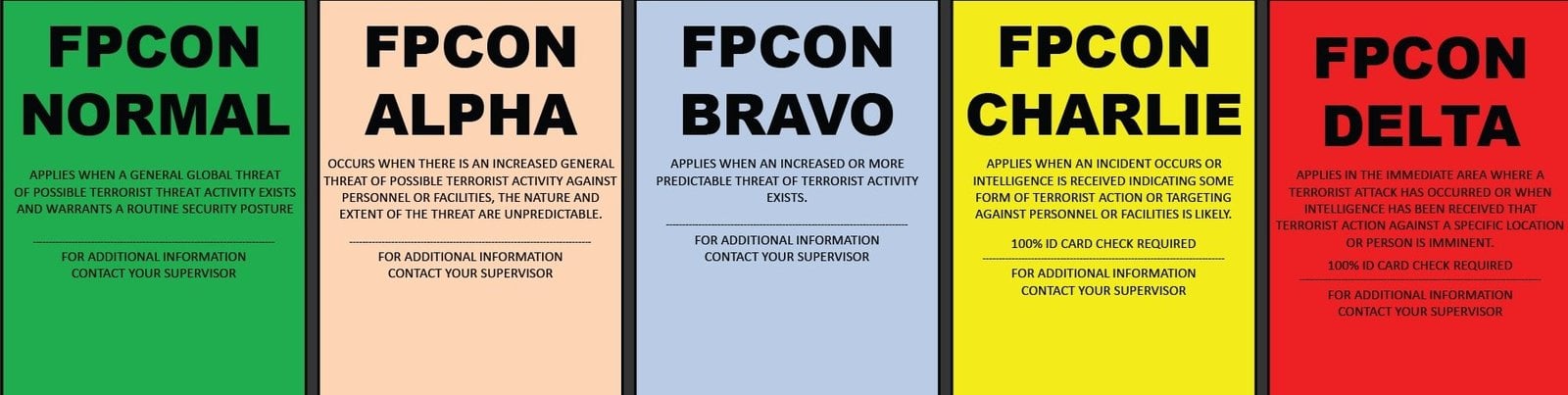
The definitions come from the Department of Defense and are reproduced almost word for word on Army garrison websites such as Fort Lee in Virginia and Fort Gordon in Georgia. FPCON Normal applies when a general global threat of possible terrorist activity exists and warrants a routine security posture. Even then, the garrisons note, access control is conducted at all DoD installations as a minimum.
FPCON Alpha covers an increased general threat whose nature and extent are unpredictable. FPCON Bravo applies when that threat becomes increased or more predictable. FPCON Charlie follows an incident, or intelligence indicating that some form of terrorist action or targeting against personnel or facilities is likely.
FPCON Delta, the highest level, applies in the immediate area where a terrorist attack has occurred, or when intelligence says action against a specific location or person is imminent. It is usually declared as a localized condition. Each level builds on the ones below it, and a base does not have to climb the ladder one rung at a time: public explainers from Military.com and MyBaseGuide note that it can jump straight to a higher level, and that a “plus” suffix, as in Bravo+, signals extra measures on top.
The real tell is time. The 1990s public version of the doctrine said Alpha measures “must be capable of being maintained indefinitely”, Bravo for weeks, while Charlie for more than a short period “probably will create hardship”. That is why Bravo, not Normal, is the everyday setting for much of the force. Hanscom Air Force Base’s antiterrorism officer has written that Normal has not applied there since 9/11, and Army garrisons in Germany say they have sat at Bravo or higher since 2001.
Who sets the FPCON, and at what level
FPCON is a commander’s decision, not an intelligence agency’s. The old joint doctrine put it bluntly: the declaration, reduction and cancellation of a condition “remain the exclusive responsibility of the commanders specified in the order.” It also warned that there is no direct correlation between intelligence reports and a given level. Analysts inform; commanders decide.
In practice it works like a ratchet. According to public explainers from Military.com and GovFacts, combatant commanders set the floor for their region, with US Northern Command doing so for bases in the continental United States, and commanders below them can raise their own installation’s level but not drop beneath that floor. Hanscom Air Force Base’s antiterrorism office adds that once a level is declared, its measures are implemented immediately unless waived in writing by the geographic combatant commander or a delegated representative.
Europe shows the layers. The commander of US Army Europe and Africa delegates force protection to general officers; for the garrisons in Bavaria and Ansbach that is the commander of 7th Army Training Command, and garrison commanders start carrying out a change as soon as they are notified. A 2025 Pentagon instruction, DoDI 2000.12, also requires commanders to pass a changed FPCON through the chain of command and to inform the State Department, US embassies or the Department of Homeland Security as soon as possible.
What changes at the gate
This is where the official record goes quiet, though not completely. Army garrisons in Germany say publicly that Charlie and Delta bring 100 percent ID card checks, that Charlie triggers curtailment plans for non-essential personnel, and that Delta limits installation access to mission-essential personnel and others the commander approves. The Fort Lee signs say the same about ID checks.
For anything more specific you have to go back a generation. Appendix J of Joint Publication 3-07.2, the 1990s antiterrorism doctrine, is still online at the Federation of American Scientists, and it lists numbered measures. At Bravo, cars and objects such as crates and bins were to be moved at least 25 metres from buildings and visitors physically inspected. At Charlie, access points were cut to “the absolute minimum”, vehicles randomly searched, weapons issued to guards and barriers erected to control traffic.
At Delta, every vehicle and its contents was to be searched before entry, all bags searched, and positive identification enforced for all personnel, “no exceptions”. One caveat matters. When THREATCON became FPCON in 2001, the Federation of American Scientists noted that the measures stayed the same, but today’s list sits in a restricted instruction and has been rewritten since. Read the old list as a guide to the logic, not as a checklist for tonight.
What changes on the flight line
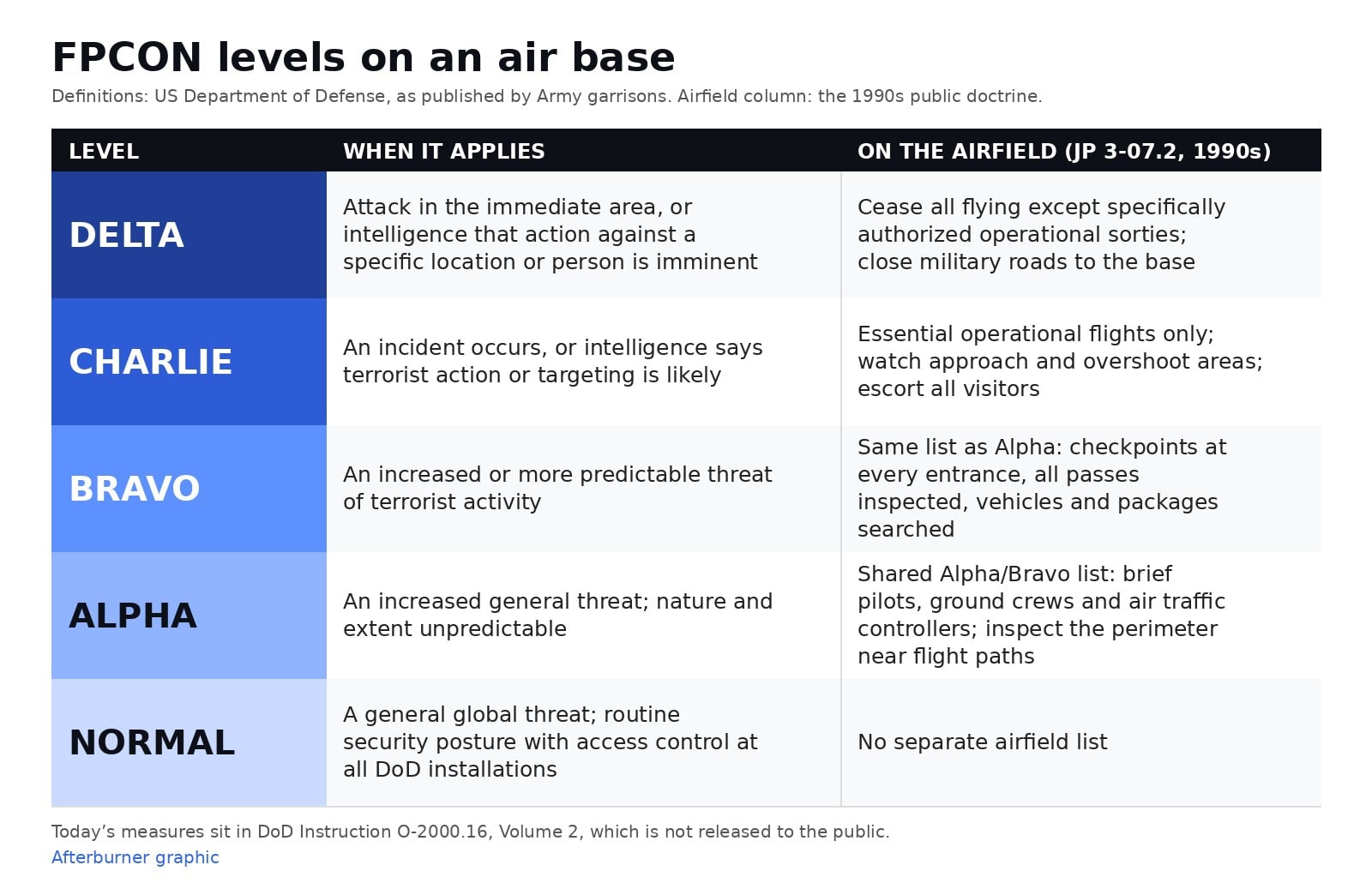
The same appendix carried a separate section for aviation facilities, which is the closest the public record gets to an air base playbook. At Alpha and Bravo, pilots, ground crews and air traffic controllers were to be briefed, local police asked to help safeguard flight paths, and aircrews told to report anything unusual near the approach and overshoot areas.
Charlie also called for continuous observation of the approach and overshoot areas, escorts for every visitor and troops to help local police search the approaches outside the fence. At Delta the instruction was to “cease all flying except for specifically authorized operational sorties”, be ready to accept aircraft diverted from other stations and close military roads leading to the base.
The Navy section of the same document contains the best line in it: “The simple solution to THREATCON CHARLIE or DELTA is to get under way, but this option may not always be available.” An airfield cannot sail. Its aircraft can leave, though, and parking, sheltering and dispersing aircraft is exactly the problem air base defence planners worry about, as defence analyst Perun lays out below.
Why reporters can only say “sources say Charlie”
A published measure list is a planning aid for an attacker, so the military keeps it out of public view. Army garrisons in Germany state that specific FPCON measures are not released for security reasons. Bases also run Random Antiterrorism Measures, unannounced checks chosen to keep anyone watching guessing, so heavier security at a gate does not necessarily mean the level has risen.
RAF Mildenhall in November 2026 is the textbook case. A US official told The War Zone on 9 November that “enhanced force protection measures” were in place at Mildenhall and Lakenheath. That night The Wall Street Journal, citing its sources, reported that both bases had gone to FPCON Charlie after an unspecified threat from Iran. The War Zone said it could not independently confirm that, and the Air Force did not either.
Meanwhile, The War Zone counted at least 15 aircraft leaving Mildenhall over two days, among them a stream of KC-135 tankers and three CV-22 Osprey tiltrotors that hopped to Lakenheath. Open-source trackers such as DefenceGeek watched the transponders, which is not the same thing as knowing why. Nobody official has linked the departures to any FPCON measure.
From THREATCON to FPCON, and the days it went to Delta
Before 2001 the system was called THREATCON. A 1996 Washington Headquarters Services circular shows the Pentagon posting its THREATCON level on the police desks at every building entrance, a level set by the chief of the Defense Protective Service. DoD Instruction 2000.16 of 14 June 2001 replaced the term with FPCON, and public explainers say one aim was to avoid confusion with the State Department’s own threat system.
Three months later the new name got its sternest test. On 11 September 2001, according to a Naval Education and Training Command account, Goodfellow Air Force Base in Texas went to FPCON Delta, with a lockdown about an hour later. Since then Charlie has surfaced in public mostly through leaks and community alerts. In February 2025, an alert to US Army Garrison Bavaria families, reproduced by MyBaseGuide, announced Charlie at all its installations, barred uniforms off post and restricted access to essential personnel and housing residents.
Britain has supplied the most recent chapters. After the arrests near RAF Fairford in late September 2026, a US Air Force spokesperson declined to discuss force protection measures, and within days the base’s B-1B Lancer bombers had gone home, as Afterburner reported at the time.
So when a headline says a base has gone to Charlie, read it as what it is: one word, usually from an anonymous source, describing a document the public will never see. The sign at the gate tells you how worried the commander is. It will never tell you what the guards have been told to do about it.
Sources: US Department of Defense Instruction 2000.12, Joint Publication 3-07.2, Appendix J (via the Federation of American Scientists), Washington Headquarters Services circular 97-01, US Army Garrison Fort Lee, US Army Garrison Fort Gordon, IMCOM-Europe and US Army Garrison Bavaria on Army.mil, Hanscom Air Force Base, Naval Education and Training Command, The War Zone, The Wall Street Journal, Military.com, GovFacts, MyBaseGuide.
Header photo: US Air Force photo by Senior Airman Christopher Campbell (KC-135 of the 100th Air Refueling Wing at RAF Mildenhall, June 2025)
0 Comments