
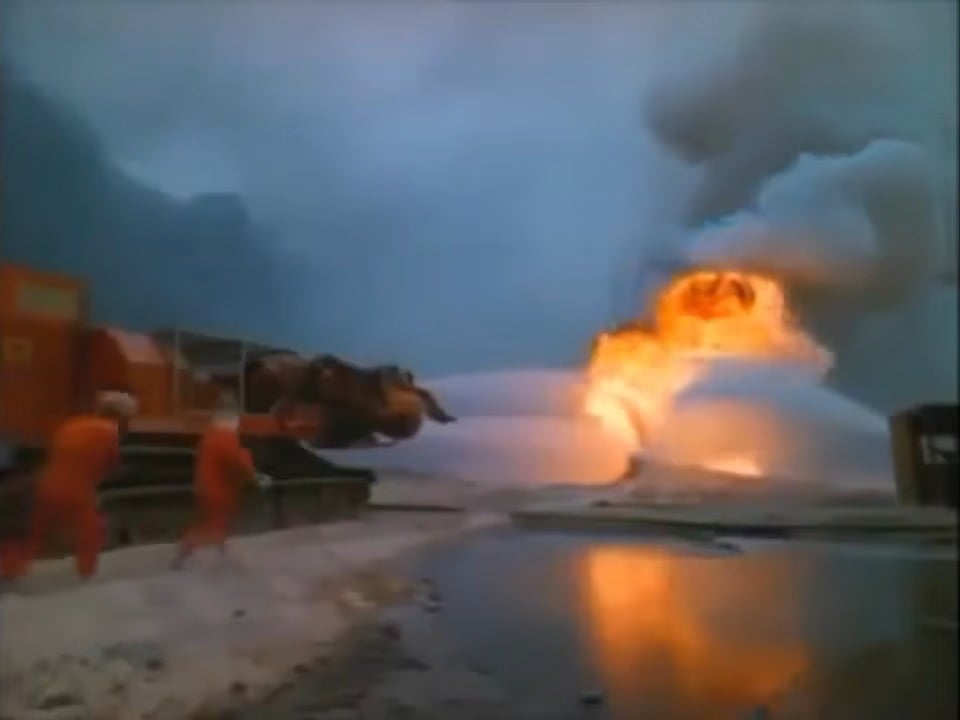
It is the second half of September 1991, in the Burgan oil field of southern Kuwait. A turretless tank sits a few metres from a burning wellhead, its hull wet from the cooling sprays. Inside, the driver, Sándor Rózsa, sits facing the fire. About thirty metres behind him a Hungarian fire colonel, Imre Vecsernyés, holds a control box on a cable. On top of the tank, where the gun turret used to be, two jet engines from MiG-21 fighters are pointing straight at the flames.
Someone gives the signal, and the engines wind up to full power. Two blasts of exhaust, each laced with sprayed water, hit the base of the fire. According to György Haász, the oil engineer who commanded the crew, it usually took a few minutes. Then the fire was simply gone, blown off the well like a candle. The machine had been designed in Hungary as a “tracked fire-fighting vehicle”. In Kuwait, everyone called it Big Wind.
Informazioni rapide
- Nome: Big Wind (official Hungarian designation: tracked fire-fighting vehicle; nickname at home: “Imperial Walker”)
- Realizzato da: Hungarian People’s Army Central Aircraft Repair Plant, Kecskemét, with the Budapest Technical University and the Szolnok oil exploration company
- Decision to build: 9 October 1984
- Assembly: Started 2 March 1989; commissioning record dated 3 August 1991
- Chassis: Soviet T-34 medium tank hull, turret removed (rebuilt on a VT-55A recovery vehicle in the mid-1990s)
- Motori: Two Tumansky R-11F-300 turbojets taken from Hungarian MiG-21s
- Mass: About 38 to 40 tonnes, depending on the source
- Carburante: About 6,000 litres of kerosene per hour, from a 3,000-litre tank
- Kuwait deployment: Flown in by An-124 on 13 September 1991; worked in the Burgan field into October 1991
- Wells extinguished: Nine according to the builders; ten in another participant’s account (see below)
- Oggi: Kept operational by Hungary’s oil industry blowout-control unit at Szolnok
Seven hundred wells on fire
When Iraqi forces withdrew from Kuwait at the end of February 1991, they left behind the worst oilfield disaster the industry had ever seen. Hundreds of wellheads had been blown open with explosives. Most of them were burning, some were gushing oil into the sand, and the smoke turned day into dusk over large parts of the country. Hungarian press accounts later summarised expert estimates that between four and six million barrels of oil burned every day, and that some 300 “oil lakes” formed in the desert.
Exactly how many wells were hit is still disputed, because every organisation counted differently. The Kuwait Oil Company told the Oil & Gas Journal in October 1991 that 697 wells had been damaged and 607 set on fire. Bechtel, the project management contractor, counted 749 damaged and more than 650 ablaze. When the last fire went out, the White House used yet another set of figures.
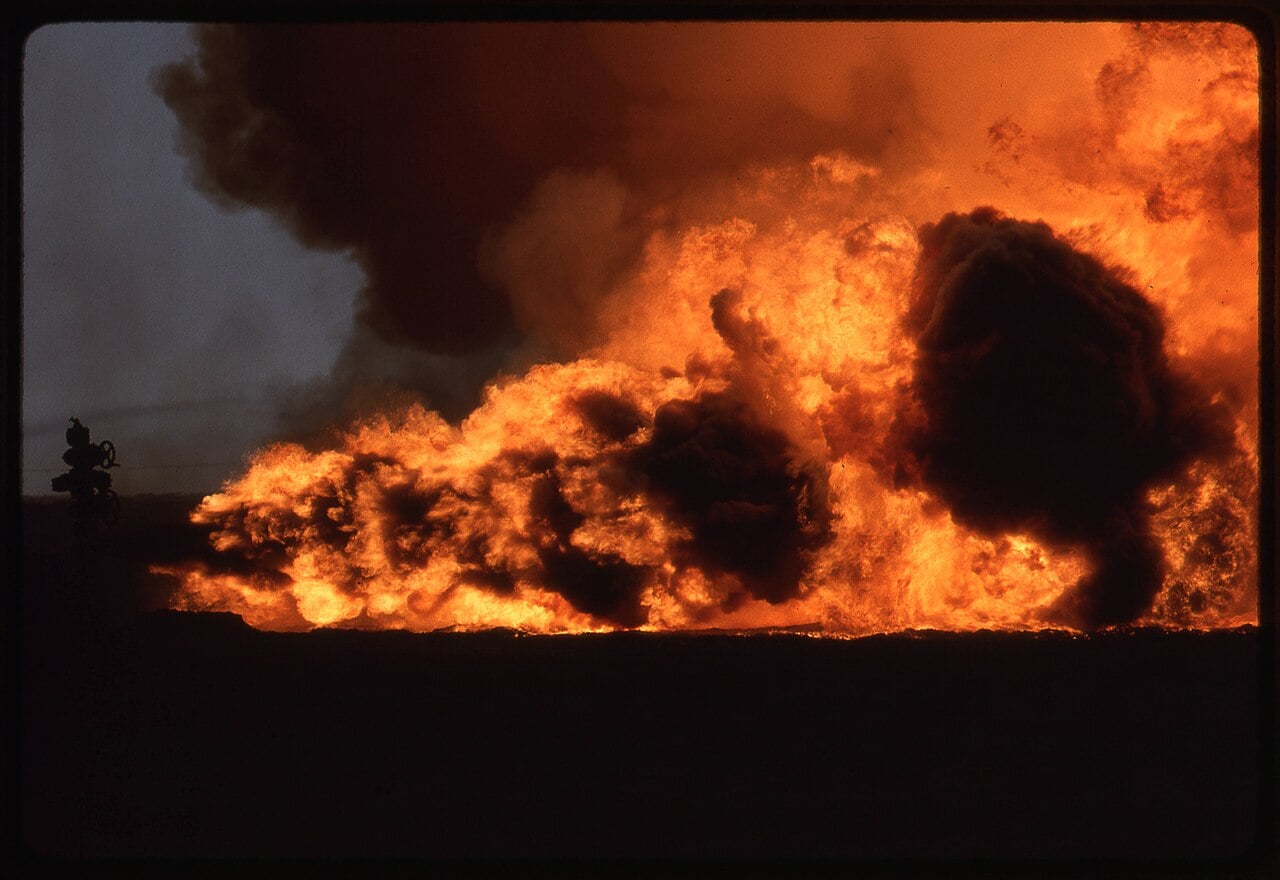
According to the US Department of Defense, planners had expected a worst case of 100 to 125 wells destroyed. The real damage was seven to eight times greater. The first firefighters to arrive, from 11 March 1991, were the “Big Four” of the trade: Red Adair, Boots and Coots, and Wild Well Control from the United States, and Safety Boss from Canada. Their method was the classic one. They cleared the debris, cooled the area with huge volumes of water, snuffed out the flame with water cannon or explosives, and then fitted a new valve onto the wellhead.
Water was the bottleneck. Converted oil pipelines were reversed to pump seawater from the Gulf into hundreds of plastic-lined lagoons near the wells. The work also had to wait for mine clearance at every site. At first only about one well a day was brought under control, and the Kuwaiti authorities began to look for more teams. By September 1991, 27 firefighting teams were at work, and more than 10,000 people from 37 countries took part in the well-control effort as a whole. One of the newcomers came from Hungary, and it brought a machine nobody else had.
A fire engine from Novosibirsk
The idea of fighting fire with an aircraft engine was not new, and Hungarians had a long claim to it. In the 1920s the Hungarian engineer and fire officer Kornél Szilvay patented a “dry extinguisher” that cooled and compressed the exhaust of an aircraft piston engine and used it to blow powder onto a fire. One of his machines entered service with the Budapest fire brigade in 1927. The development ended with his death and the destruction of his workshop in the Second World War.
The jet age gave the idea new life. In December 1961 the Hungarian magazine Magyar Tűzoltó reported that firefighters in Novosibirsk were trying to turn a jet engine into a fire extinguisher. Their first problem was that the exhaust still contained combustible gases, which weakened the effect. Their solution was to spray water into the jet. Soviet engineers went on to build truck-mounted “gas-water” extinguishers, later known under designations such as AGVT-100 and AGVT-150, to fight the blowout fires that plagued their oil and gas fields.
Hungary received two of the early vehicles. Each carried the centrifugal-flow Klimov engine of a MiG-15 on a ZIL-157 off-road truck. According to the fire-protection researcher Rajmund Kuti, it was a Hungarian improvement to fix three water nozzles around the jet pipe. The machines proved themselves at a gas blowout fire at Algyő near Szeged in the late 1960s (1968 or 1969, depending on the account). They were later moved onto ZIL-131 trucks and used again at Zsana in 1979, where it took almost a month and several attempts to kill the fire. Both are still kept by the fire service in Szeged.
Zsana and a blowout at Sávoly in 1984 convinced the Hungarian authorities that a single engine was no longer enough. Hungarian wells were being drilled deeper, and a blowout from a deep well would come out with far more energy. In 1984 the decision was taken to build something much bigger.
Why a jet engine blows a fire out
A turbojet is, at heart, a machine for making a very large amount of very fast, very hot gas. In a fighter, that gas leaves the nozzle and pushes the aircraft forward. Bolted to the ground, the same engine becomes something else. Tamás Székely Szabó, who went to Kuwait with the Hungarian team and in 2021 headed blowout control at the Hungarian oil company MOL, put it neatly to the news site Index in 2021: the machine “works in reverse mode” compared with a fighter. It does not fly and does not use the thrust. It uses the exhaust.
Hungarian fire-engineering literature lists four effects that work at the same time. The first is the blast itself. Exhaust leaves a jet engine at around 600 metres per second, and even 15 to 20 metres away it is still about as fast as the oil and gas shooting out of a damaged well. Where the two streams meet, the flame front is pushed off the wellhead and downwind, faster than it can burn its way back. The fire is literally lifted off the well.
The second effect is smothering. Jet exhaust has already burned much of its oxygen, so the gas blown into the fire is oxygen-poor. Measurements on Soviet gas-water machines published in 2016 found the oxygen content at the nozzle at or below 14 percent, against about 21 percent in normal air. The third effect is cooling. The water sprayed into the jet is shattered into fine mist, and as it turns to steam it absorbs heat from the flame and the red-hot steel of the wellhead. Without that cooling, the glowing metal would simply relight the oil a moment later. The fourth is expansion: water expands about 1,650 times when it becomes steam, and the steam cloud pushes still more air away from the fire.
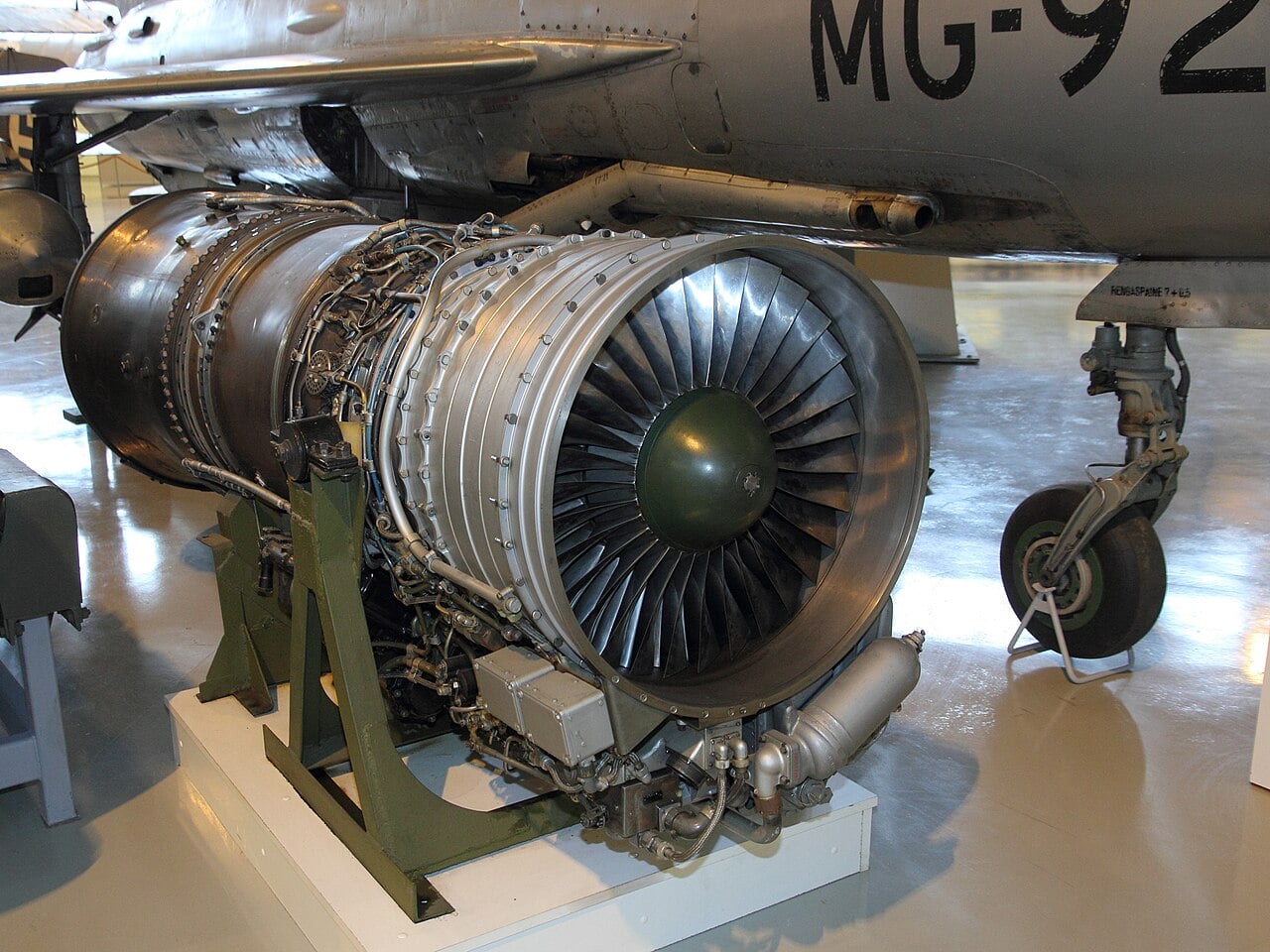
The engines chosen for Big Wind were Tumansky R-11F-300s, the twin-spool afterburning turbojet of the early MiG-21 versions such as the MiG-21F-13. The R-11 family descended from the engine of the MiG-19 and also powered the Yak-28. According to the Smithsonian’s National Air and Space Museum, about 20,000 R-11s were built before production ended in 1966. In a fighter, an R-11F-300 gives roughly 38 kN of thrust without afterburner, close to four tonnes, and helps push the delta-winged MiG-21 to twice the speed of sound. Hungary had flown the type since the early 1960s. Big Wind had two of these engines, and its job was to point all that energy at a fire.
Two MiG-21 engines and a T-34
The contract for the new machine was signed after a decision on 9 October 1984. The partners were the national fire service command, the air force command of the Hungarian People’s Army, the Szolnok oil exploration company, the national oil and gas trust and the Budapest Technical University. The design and assembly went to the army’s Central Aircraft Repair Plant in Kecskemét, a workshop that normally overhauled fighters. Its commander, Colonel Károly Egri, later remembered the moment he was told.
The problem, Egri explained, was that his engineers knew how sensitive a jet engine is. Now they were being asked to mount two of them on a tank that would drive through mud and puddles. To make matters worse, the original order was for two vehicles, because the plan was to hire them out to neighbouring countries as well.
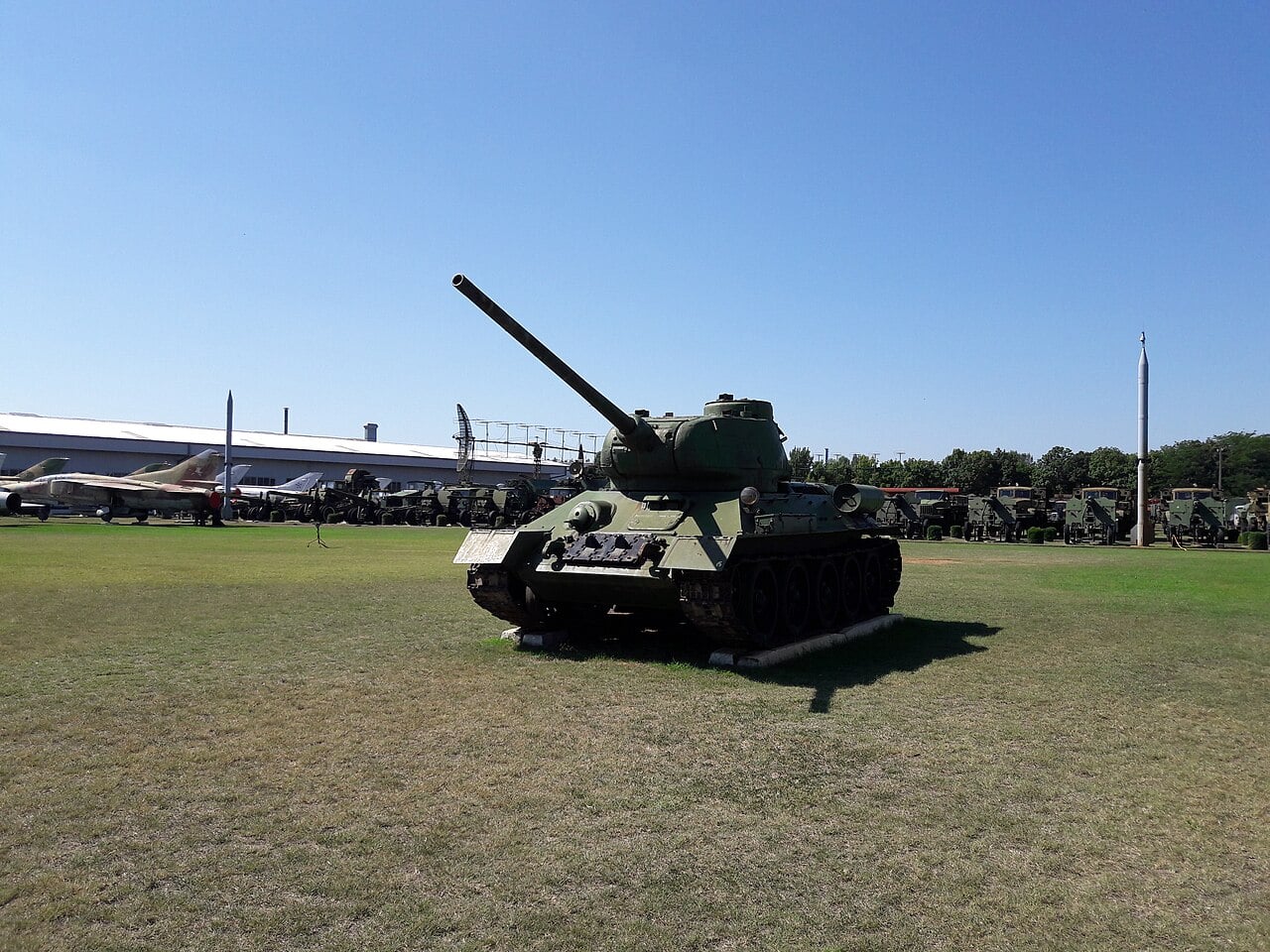
The carrier was the most famous tank of the Second World War. The oil company bought two T-34 medium tanks from the army at Szabadszállás in the autumn of 1985. The turrets came off at the army’s machine works in Gödöllő. The bridge that carried the engines and the cradles that let them swing were designed at the Technical University under Dr András Pásztor and Dr György Czédli. The two engines could be moved independently, up and down and from side to side.
The aircraft men had to learn tank engineering fast. The chief engineer, Tivadar Avramucz, recalled sealing the escape hatch in the hull floor, widening the driver’s hatch so a man in a heat suit could get through, and limiting the tank to 5 km/h. An external brake release was fitted at the back. In front of a burning well the driver set the brakes and kept pressing an alertness button to show he was all right. If he collapsed, the crew needed a way to drag the braked tank back out of the fire.
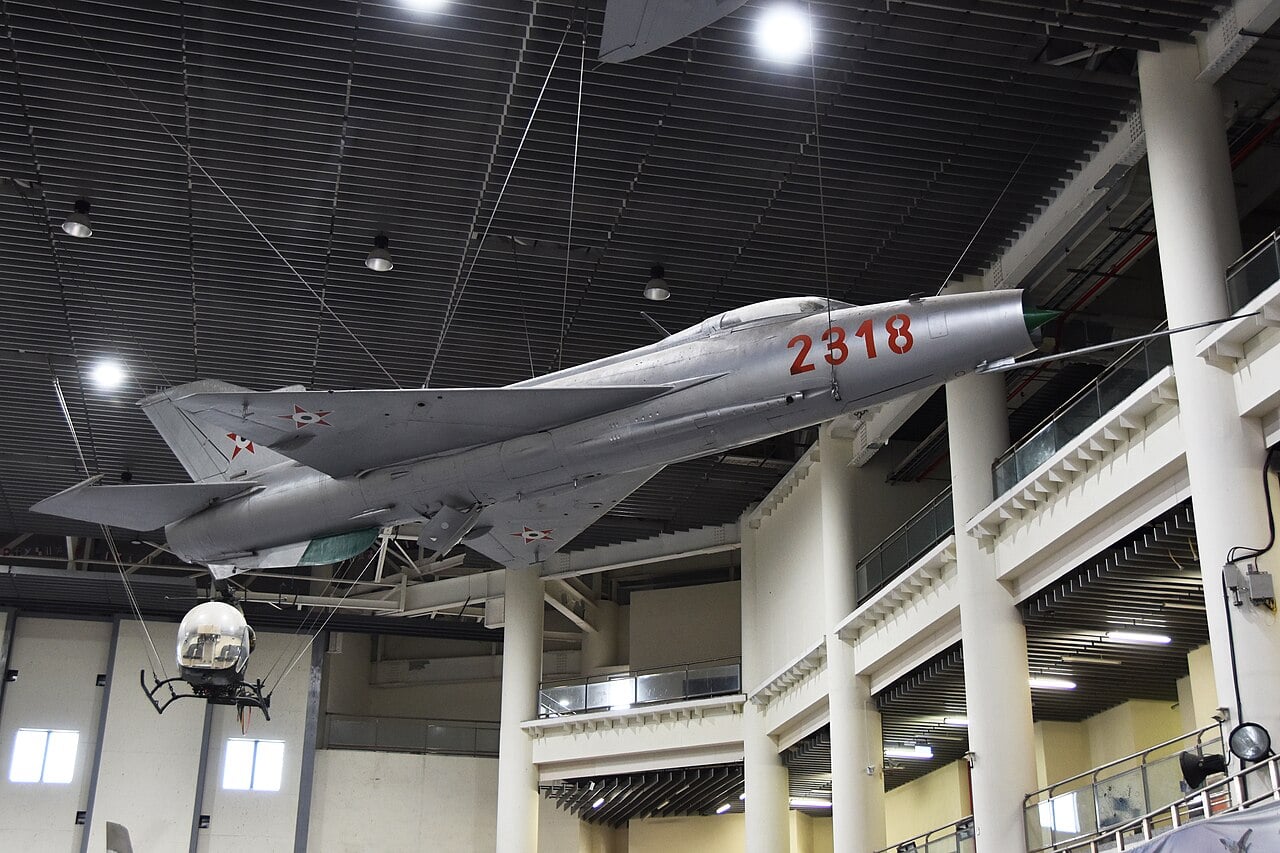
The “soul” of the machine, in the builders’ words, was a pair of R-11F-300 engines that had reached the end of their service lives. According to the plant’s own account, the right-hand engine came from a MiG-21 with the serial 1817 of the 31st Fighter Regiment at Taszár, and the left-hand one from MiG-21 serial 1419 of the 59th Fighter Regiment at Kecskemét. Most other parts were also taken from retired MiG-21s, and even helicopter parts went in. “It was as if we had built a new aircraft around them,” Avramucz said (in translation).
There were lessons only an aircraft workshop could have learned. At the first test run, the wire-mesh guards that were meant to keep debris out of the intakes turned out to be too small. They starved the engines of air, and one surged and flamed out, something the engine fitter Tibor Kurilla said even the oldest technicians had only read about in textbooks. Bigger guards fixed it. A wired remote control was added so that a firefighter standing about 30 metres from the tank could aim the engines, in radio contact with the driver and with the vehicle commander, who set engine power from a control cab on the bridge.
Assembly began in Kecskemét on 2 March 1989. Then work slowed down. The Soviet-led economic bloc was collapsing and the Hungarian gas industry was being reorganised, and for a while nobody was sure who would pay. The plans came out of the drawer again when Kuwait began to burn. In the end only one vehicle was completed, and its commissioning record is dated 3 August 1991. Official trials were held at the fire service base at Üllés, near Szeged.
Into the Burgan field
Hungary’s way into Kuwait was commercial, not military. The country had a volunteer blowout-control team drawn from the Szolnok oil exploration company and the Rotary drilling company, specialists who killed wild wells alongside their regular jobs. Under the name Hungarian Blowout Specialist, they offered their services to the Kuwait Oil Company. György Haász, who had worked in Iraq for years, said the delegation flew to Kuwait on 7 July 1991 and spent six weeks negotiating before the contract was signed on 20 August.
Then came the transport problem. With the turbine bridge, the machine weighed about 40 tonnes, and Kuwait’s war-damaged airport had at first been unable to receive large flights at all. On 13 September 1991 Big Wind was flown to Kuwait aboard a giant Antonov An-124 transport. Two members of the build team, the electrical engineer Pál Acsai and the engine fitter Tibor Kurilla, went with it, taking a month and a half of unpaid leave to do so.
Archive footage of Big Wind in Kuwait in 1991, showing the two jet engines on their bridge above the tank hull and the crew in the desert. Video: Q8 All In One Blog.
According to Haász, who held the title “Turbo Crew Chief”, the crew put out its fires between 16 September and 20 October. Each well followed the same routine. First the team put out the “stubble fires” burning in the oil-soaked sand around the wellhead, sometimes over an area the size of a football pitch, at first by shovelling sand from the back of a pick-up. A lined lagoon holding several hundred cubic metres of seawater was dug near the well. Pumps and water cannon cooled the area. Only then did Big Wind move in, to within six to eight metres of the fire, and open up.
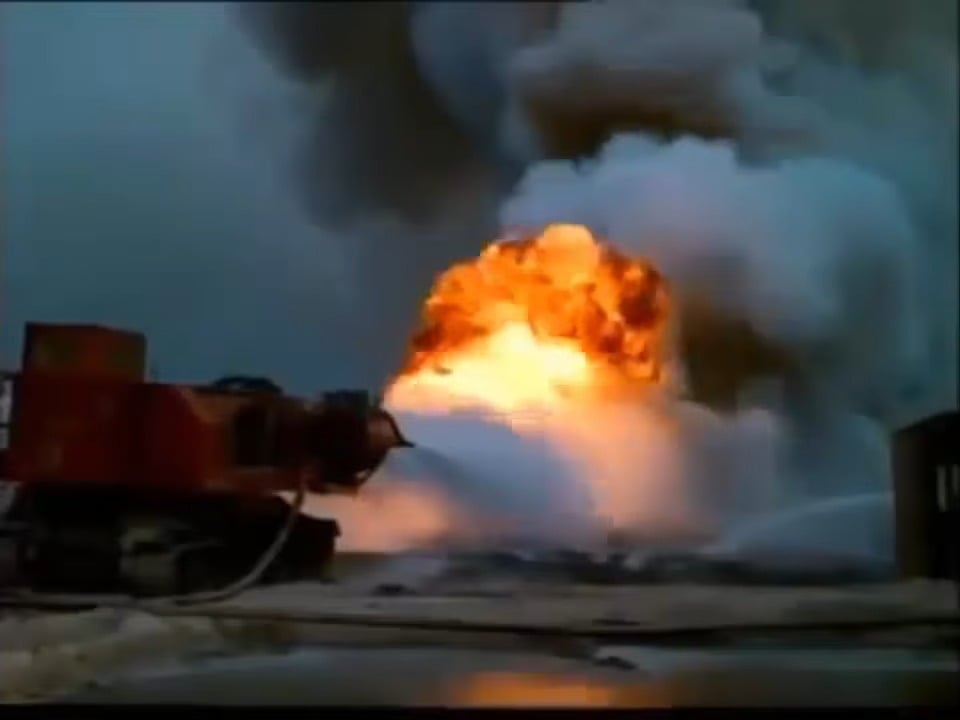
Once the fire was out, the real work began. A long crane boom called “Goliath” lowered a tall steel pipe, the “chimney”, over the jet of oil so that the specialists could work beneath it. They dug the wellhead out of a crust of burned sand and coke, removed the wrecked fittings and fitted a blowout preventer or a large gate valve. Each well took three to four days, and the equipment for each one filled 15 to 20 lorries.
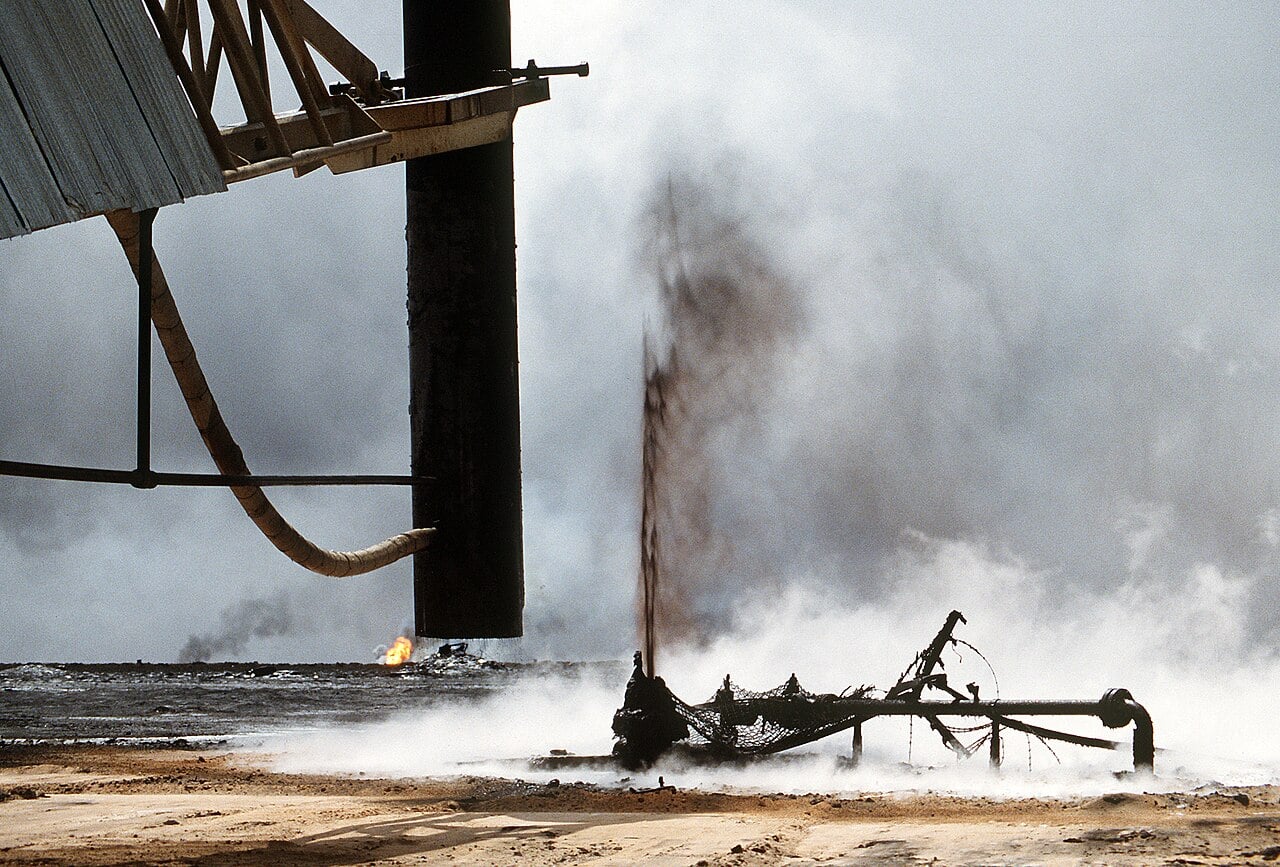
Putting the fire out did not end the danger. Haász recalled one fire the Hungarians extinguished for the American Bill Abel’s team. Local television asked the two crews to pose in front of the well and shake hands. A minute after they walked away, a small tongue of flame crept across an oil slick floating on the water about 20 metres away, reached the well and relit it with a huge explosion. Big Wind was started up again and blew it out a second time.
The machine impressed the industry. In October 1991 the president of Santa Fe International, one of the main contractors, told the Oil & Gas Journal that the Kuwait Oil Company had turned down more than 1,000 proposed methods, most of them because they misunderstood the problem. Then he singled out the Hungarians.
Nine wells, or ten, and a name with three fathers
How many fires did Big Wind put out? The builders at Kecskemét say the Hungarian team extinguished nine wells in all. Székely Szabó told Index that the Hungarian teams put out and restored ten wells in the Burgan field. Haász counted five fires for his own crew, plus one for Bill Abel’s team, before he was relieved after five weeks; the replacement crew, he said, dealt with a few more in the following three weeks. Taken together, nine or ten is the best figure available. Popular articles often add that it took 42 or 53 days, or that one fire went out in 34 seconds. We could not trace any of those numbers to a primary source.
Even the name has more than one father. Haász says he coined “Big Wind” himself and introduced the machine to the other teams and the world press under that name. Székely Szabó says the journalists in Kuwait christened it. A Hungarian conference paper from 2023 credits the firefighters of the other nations. At home it had a different nickname altogether: the “birodalmi lépegető”, the Imperial Walker from Star Wars. “Nagy Szél”, the literal Hungarian translation, was never its name.
Perspective matters, too. Big Wind put out perhaps one or two percent of Kuwait’s fires. The bulk of the work was done by the American and Canadian companies and by teams from many other countries, with conventional water cannon, explosives and enormous logistics. When the last well was capped on 6 November 1991, the job had taken less than nine months. Earlier in the year Kuwaiti officials had forecast completion by March 1992, and many of the more than 1,000 proposals sent to the Kuwait Oil Company had assumed a campaign lasting years. At the closing ceremony, the Kecskemét veterans say, the Hungarian team marched past the Emir directly behind the American main contractor’s group. Haász remembered Red Adair coming over to congratulate them with a remark he quoted in Hungarian: “You stole the show, but we got the money.”
After Kuwait: rust, a new chassis and a standby crew
The homecoming was less glamorous. After the fires were out, Big Wind waited for weeks in a seaport, where almost every part of it rusted, and it was badly damaged when it was lifted into a ship. It was repaired at Kecskemét. In the mid-1990s it was rebuilt using the lessons from Kuwait. The worn-out T-34 was replaced by a converted VT-55A armoured recovery vehicle, built on the hull of the T-55 tank, and the controls and heat protection were improved. The work was done at the Danube Aircraft Factory at Tököl.
The rebuilt machine is still in service. A 2006 paper in the Hungarian journal Repüléstudományi Közlemények located it at the aircraft repair plant in Tököl. In 2019 it was on permanent standby at Szolnok with a crew of three, and a 2023 study by Rajmund Kuti describes it as owned by MOL and used by the company’s blowout-control unit, which runs an exercise with it every year. According to that study, each engine can take 6,000 litres of water per minute from an external supply, or foam in its place, and the combined jet reaches 80 to 100 metres.
A Totalcar.hu report from a Big Wind exercise in Hungary, showing the rebuilt machine, now painted red and running on a VT-55A chassis (in Hungarian). Video: Totalcar.hu.
Big Wind also had a German echo. In August 1991 the Oil & Gas Journal reported a German proposal to mount engines from mothballed former East German MiG-21s on T-55 chassis for Kuwait. Kuti and his co-authors write that East German engineers had planned a tracked jet extinguisher in the late 1980s, inspired by the Hungarian machine. After Kuwait one was built in unified Germany, on a T-55 with a single R-13-300 engine from a MiG-21MF. Called “Hurricane”, it never fought a real fire and is now in the German Fire Brigade Museum at Fulda. The GDR had already used MiG-17 engines on fire trucks at a power plant since 1984.
What a fighter engine taught the firefighters
The figures for Big Wind are not all consistent, and it is worth saying so. Its mass is given as 38 tonnes by one study and 40 by a team member; popular articles say 42 or even 46. Water flow is quoted as 6,000 litres per minute per engine in the technical literature and as 25,000 to 30,000 litres per minute by Székely Szabó. The widely repeated “830 litres per second” does not appear in any Hungarian technical source we found. Even a US Department of Defense report on the oil fires describes the Hungarian machines as MiG-21 engines on T-62 tanks. The builders’ own records say T-34.
None of that changes what the machine proved. A jet engine that had flown its last sortie in a MiG-21 still had enough energy in its exhaust to lift a burning oil well’s flame clean off the wellhead. Hungarian engineers had learned how to use that energy from Soviet experiments in the 1960s and two blowout fires at home, and an aircraft repair plant that had never built a tank turned it into something the rest of the industry had not seen.
The MiG-21s that gave up their engines are long gone, but the machine they powered is still ready to start at Szolnok. In a sense its engines never stopped doing what a turbojet does best: pushing a great deal of hot, fast gas in one direction. In 1991 that direction happened to be a burning oil well in Kuwait.
Sources: Imre József Hadnagy, A repülőgép sugárhajtómű, mint tűzoltószer, Repüléstudományi Közlemények 2006/1 (Zrínyi Miklós National Defence University); Rajmund Kuti, Hungarian developments of fire extinguishing equipment using aircraft engines, Szilvay Kornél Tűzvédelmi Konferencia 2023 (Óbuda University, 2023); Rajmund Kuti, Géza Zólyomi and Csenge Papp, Development Directions of Fire-Fighting Equipment Using Aircraft Engines Abroad, Műszaki Katonai Közlöny 34 (2024) 2; Sándor Galambos, Birodalmi lépegető – 30 éve készült egy magyar csodafegyver, honvedelem.hu, republished by Háború Művészete (4 March 2019); Gábor Károly, Étolajjal mosták az arcukat a kuvaiti pokolban a magyarok, Index.hu (10 April 2021); Erzsébet Bakonyi, Olajkúttüzek oltása 1991-ben, Kuvaitban (interview with György Haász), Kanizsa Médiaház (10 May 2021); Oil & Gas Journal, Kuwait summons more fire fighting teams (5 August 1991), More nations join Kuwait well fire campaign (19 August 1991) and Kuwaiti well fire battle expected to end soon (21 October 1991); Statement by Press Secretary Fitzwater on the extinguishing of the last of Kuwait’s burning oil wells (6 November 1991), George H.W. Bush Presidential Library; US Department of Defense, GulfLINK, Environmental Exposure Report: Oil Well Fires, Tab C, Fighting the Oil Well Fires; S. A. Vinogradov et al., Approaches to extinguish gas blowout fires: world experience and potential for development, Safety & Fire Technology 41 (2016); Smithsonian National Air and Space Museum, Tumansky R-11 Turbojet Engine (A19930355000); mig-21.de, Technical data: engines; MOL Group, Big Wind archive footage (header image and Kuwait still).


0 Comments