
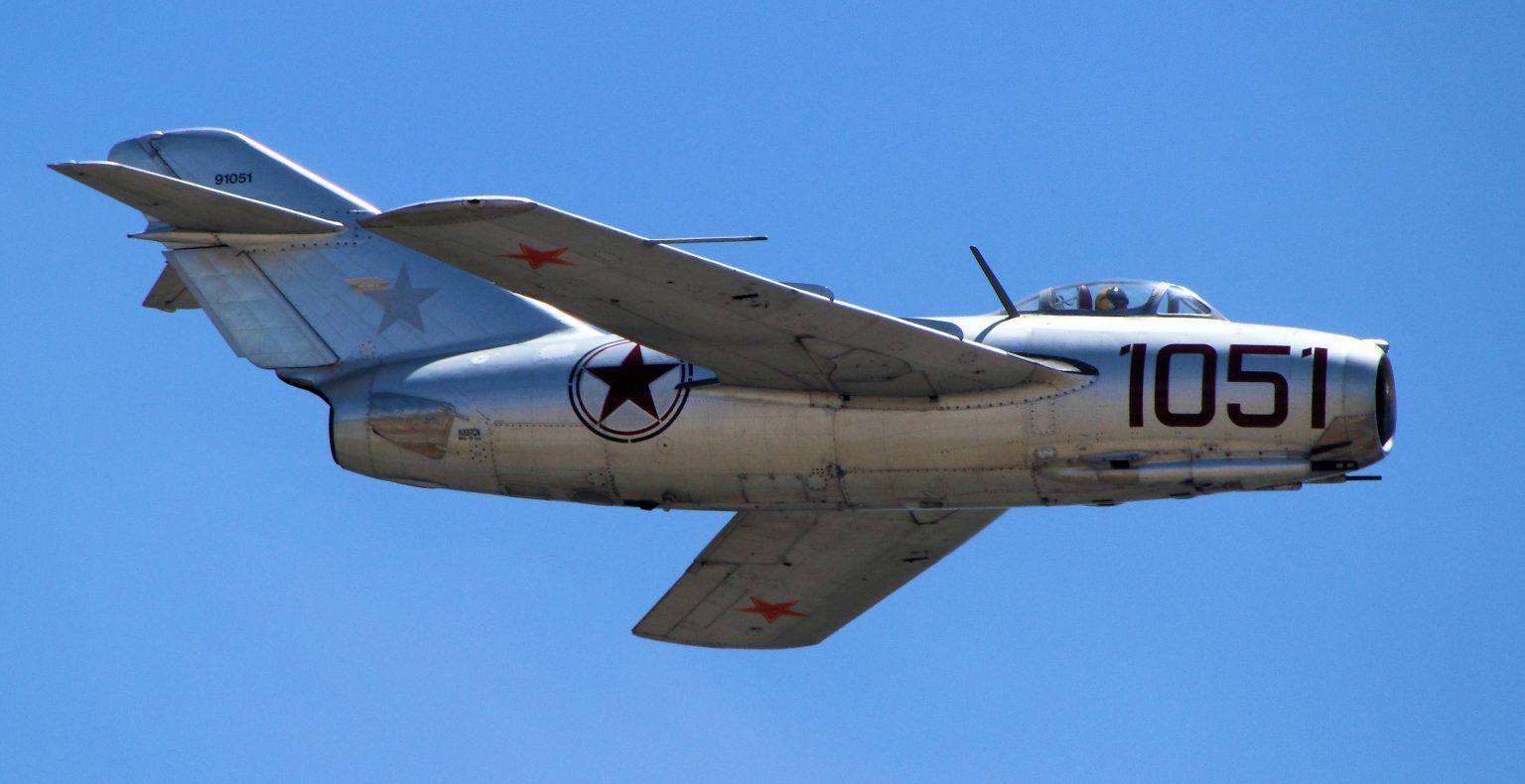
Mikoyan-Gurevich MiG-15
“Fagot”
The first successful Soviet swept-wing jet fighter — the silver shock of “MiG Alley” that made the B-29 abandon daylight bombing, forced the F-86 Sabre into the fight, and today is a genuine Korean-War jet you can actually ride with MiGFlug.
The jet that shocked the West
The MiG-15 was the first successful Soviet swept-wing jet fighter and one of the defining aircraft of the early jet age. It grew from a 1946 Mikoyan-Gurevich requirement for a high-altitude day interceptor, backed personally by Stalin. The decisive break came from Britain: in a 1946–47 trade gesture the UK sold the USSR the advanced Rolls-Royce Nene turbojet, which the Klimov bureau reverse-engineered into the RD-45 and later the more powerful VK-1. Married to a 35-degree swept wing, a pressurized cockpit and an ejection seat, the prototype S-1 flew on 30 December 1947 and the type entered service in 1949.
When silver, swept-wing MiG-15s knifed into the skies over the Yalu River in November 1950, they stunned the United Nations air forces. Overnight the straight-wing jets and propeller fighters over Korea were obsolete: the MiG could out-climb, out-turn at altitude and outrun almost everything, and its heavy cannon shredded the B-29 Superfortress so badly the Americans abandoned daylight bombing. The region became legend as “MiG Alley.” The shock forced Washington to rush its best fighter — the swept-wing F-86 Sabre — into theatre, igniting the first great jet-versus-jet duel in history.
The MiG kept its deepest secret for decades: many were flown by combat-hardened Soviet pilots masquerading as Koreans and Chinese. It became one of the most-produced jet aircraft in history — totals commonly cited between ~13,000 and ~18,000 airframes — and served worldwide. And uniquely, you can still climb into a genuine two-seat Fagot today and fly.
01The MiG-15’s numbers: how a British engine and a swept wing built one of history’s most-produced jets
Production totals for the MiG-15 are enormous and hard to pin down — Soviet plus licensed foreign output is commonly cited between about 13,000 and 18,000 airframes, with some sources giving Soviet-only figures nearer 11,000–13,000. The exact global total is genuinely uncertain; treat any single number as approximate.
Key variants tell the story of its spread: the definitive MiG-15bis with the VK-1 engine; the two-seat UTI trainer (“Midget”); the Chinese-built J-2 / JJ-2; the Polish Lim-1 / Lim-2; and the Czechoslovak S-102 / S-103. A rugged, simple, mass-producible design could be sold and sustained almost anywhere — which is why roughly 40 nations flew it.
What makes the MiG-15 special
The 35-degree swept wing
The MiG-15 carried the first swept wing on a production Soviet aircraft, informed by captured German aerodynamic research. The sweep gave a dramatic edge in high-subsonic speed and high-altitude performance, while distinctive twin boundary-layer wing fences controlled airflow across the span — the signature detail of the Fagot’s planform.
The Klimov VK-1 — a British engine’s Soviet life
At its heart sat the Klimov VK-1, a robust, easily maintained development of the licensed Rolls-Royce Nene. Its simplicity made the MiG-15 rugged and mass-producible — though the centrifugal-flow architecture ultimately capped growth versus the axial engines the West was adopting.
A heavy anti-bomber battery
The nose carried two NR-23 23 mm cannon plus one N-37 37 mm cannon on a lowerable tray. This slow-firing, hard-hitting battery was optimized to destroy bombers — devastating against the B-29 — if less ideal for fast fighter-versus-fighter gunnery.
02The MiG-15’s wing: the German research and British engine behind a Soviet fighter
Two foreign ingredients shaped the MiG-15. Captured German high-speed aerodynamic data pointed Mikoyan-Gurevich toward a 35-degree swept wing at a time when most fighters were still straight-winged. And Britain’s 1946–47 sale of the Rolls-Royce Nene handed the Klimov bureau a world-class centrifugal turbojet to copy into the RD-45 and VK-1. Together they produced a fighter that briefly out-classed everything the West could put over Korea — arguably the most consequential technology transfer of the early Cold War.
03The MiG-15’s guns: built to kill bombers, not fighters
The MiG-15’s cannon fit — one 37 mm and two 23 mm guns — threw a heavy, slow-firing punch designed to bring down large bombers in a single pass. Against the B-29 Superfortress it worked so well the USAF pulled the bomber out of daylight raids by late 1951. Against nimble jets like the F-86, however, the low muzzle velocity and slow rate of fire made hits harder to score — a weapon optimized for the wrong opponent in the dogfight.
Full MiG-15 specifications
Figures below are anchored on the MiG-15bis — the Klimov VK-1 mark that entered service in early 1950, was built in far greater numbers than any other version, and is the aircraft most people mean when they say "MiG-15". Where the original RD-45F-powered MiG-15 or the two-seat MiG-15UTI trainer differ materially, the delta is given in grey. Soviet-era published figures were rounded, revised and occasionally massaged, and Western reconstructions disagree with each other, so treat single-decimal precision with suspicion.
Dimensions & weights
- Crew
- 1 (pilot) — 2 in tandem under a long glazed canopy in the MiG-15UTI trainer
- Length
- 10.10 m (33 ft 2 in) — essentially unchanged across every single-seat mark and the UTI
- Wingspan
- 10.08 m (33 ft 1 in) — 35-degree sweep, with two boundary-layer fences on each wing
- Height
- 3.70 m (12 ft 2 in)
- Wing area
- 20.6 m² (222 sq ft) — a small, thick, deeply swept wing; wing loading about 296 kg/m² (61 lb/sq ft) at gross weight
- Empty weight
- 3,681 kg (8,115 lb) — the lighter original MiG-15 came in near 3,380 kg (7,450 lb); the UTI sits close to 3,720 kg (8,200 lb)
- Loaded weight
- 5,044 kg (11,120 lb) clean, full internal fuel and a full ammunition load
- Max takeoff weight
- 6,106 kg (13,461 lb) with two 600 L drop tanks
- Internal fuel
- ~1,420 L (~375 US gal / ~312 imp gal) — plus two jettisonable underwing tanks of 300 L or 600 L each. Short legs were the type's standing limitation.
Performance
- Max speed
- 1,076 km/h at sea level (581 kn / 669 mph), Mach 0.87 — 1,107 km/h (598 kn / 688 mph) at 3,000 m. In practice the airframe was Mach-limited near 0.92 and became unpleasant well before that.
- Cruise speed
- 850 km/h (459 kn / 528 mph), about Mach 0.69 at high altitude
- Rate of climb
- 51.2 m/s (10,080 ft/min) at sea level — about 2,800 m/min, better than the F-86A and F-86E and one of the MiG's real advantages
- Service ceiling
- 15,500 m (50,850 ft) — above every Sabre mark flown in Korea, which is why a MiG in trouble could simply climb away
- Combat radius
- ~500 km (~270 nmi) with drop tanks on a typical interception profile; a good deal less clean, and less again if the fight went to full throttle
- Ferry range
- ~2,520 km (~1,360 nmi) at 12,000 m with two 600 L tanks; roughly 2,220 km (~1,200 nmi) on one tank
- Takeoff run
- 475 m (1,560 ft) at normal weight on a hard runway; civilian operators today want 1,500 m (5,000 ft) of runway at sea level and considerably more when it is hot or high
- Landing run
- 670 m (2,200 ft) — no brake parachute on standard aircraft, and pneumatic brakes that needed nitrogen replenishment
- Load factor
- +8 g manoeuvring limit (12 g ultimate) — the structure was never the problem; controls that stiffened badly at high indicated airspeed were
Propulsion & systems
- Engine
- Klimov VK-1 single centrifugal-flow turbojet, developed from the Rolls-Royce Nene. In 1946 the Attlee government, with Board of Trade president Sir Stafford Cripps, agreed to sell the USSR sample Nene engines together with drawings and a manufacturing licence; the engines were delivered in 1947. The Soviets tooled them for mass production as the Klimov RD-45 and then developed the higher-rated VK-1 — a developed copy, not a Soviet design. The sale is widely regarded afterwards, in Britain and in Washington, as a serious strategic mistake: within four years British-derived engines were powering the fighters shooting at UN aircraft over Korea.
- Thrust
- 26.5 kN (5,950 lbf) dry, no afterburner — the original MiG-15 used the RD-45F at about 22.3 kN (5,004 lbf)
- Armament
- 1 × 37 mm N-37, 2 × 23 mm NR-23 40 rounds for the N-37 and 80 per gun for the NR-23s. Early MiG-15s carried the slower-firing NS-23. Two underwing hardpoints for ~100 kg bombs, unguided rockets or drop tanks.
- Gunsight
- ASP-3N gyro sight (ASP-1N on the original MiG-15) — a wartime-generation optical gyro sight with manual ranging. The F-86E and F-86F carried the A-1CM coupled to AN/APG-30 ranging radar, and that gap in fire control mattered more than any performance figure here.
- Ejection seat
- Cartridge-fired seat fitted from the outset, which was ahead of much of the West — but without leg restraints, with a jettisonable canopy that had to go first, and with a usable envelope that effectively excluded low and slow ejections
- Airbrakes
- Two rear-fuselage panels hydraulically actuated, perforated, enlarged on the bis with a horizontal upper edge after dive and gun-firing trials on the original showed the first set was too small
- First flight
- 30 December 1947 (I-310 "S-1" prototype, on an imported Rolls-Royce Nene) — about two months after the F-86 Sabre
- Service entry
- 1949 with the Soviet Air Forces; the VK-1-engined bis followed in early 1950 and reached Korea in November of that year
- Built
- ~18,000 including licence production — 13,130 in the USSR (1,344 MiG-15, 8,352 MiG-15bis, 3,434 two-seaters) plus at least 4,180 built in Czechoslovakia, Poland and China. That makes it one of the most-produced jet aircraft ever built, on a par with the MiG-21 and the F-86.
- Unit cost
- ~USD 100,000–400,000 today for a flyable civil-registered airframe, condition and remaining engine life driving most of the spread; tired or project-grade two-seaters have changed hands for well under USD 100,000. No meaningful original unit price exists — Soviet-bloc aircraft were costed internally in roubles at state prices that do not convert into anything comparable.
- Cost per flight hour
- ~USD 4,000–6,000 all-in for a privately operated example, of which roughly USD 1,800–2,200 is fuel alone: the VK-1 and its Polish Lis-2 and Czech M-06 derivatives burn on the order of 1,100 L (~300 US gal) an hour at low level. Direct hourly cost can be quoted lower, but owners typically fly only 20–40 hours a year, so fixed costs — hangarage, insurance, annual inspection, engine and airframe reserves — dominate the true figure. Parts are the wild card: common items are plentiful from Warsaw Pact stocks, specific ones are not.
04The MiG-15’s cost: why no reliable price exists
Firm dollar figures for the MiG-15 do not reliably exist in open sources. It was a Soviet state product built and exported across a planned economy, so per-unit costs were not calculated or published the way Western programmes were. Export prices varied enormously by variant, buyer and year, and no credible cost-per-flight-hour figure survives either. What is certain is the design intent: rugged, simple and cheap enough to build in the many thousands and hand to some 40 air forces.
Armament & payload
The MiG-15 was built to kill bombers, and its guns say so
Almost everything about the MiG-15's armament follows from one requirement: stop American strategic bombers. That produced a battery of one 37 mm and two 23 mm cannon devastating against a B-29 and awkward against anything that could turn — slow-firing, short of ammunition, and firing two calibres whose shells did not go to the same place. Everything else was secondary: the bomb and rocket load was token, the drop tanks were there to buy a few minutes of a very short endurance, and the gunsight was a wartime optical unit facing an opponent with ranging radar. Cannon fit, sight and stores clearances all varied by mark and by operator; what follows describes the MiG-15bis unless stated otherwise.
Cannon
- One 37 mm Nudelman N-37 on the right side of the nose with 40 rounds, and two 23 mm Nudelman-Rikhter NR-23 on the left with 80 rounds per gun. Early MiG-15s carried the NS-23 instead; the NR-23 roughly doubled the rate of fire.
- This was a bomber-killer's battery. A single 37 mm hit could take a B-29 apart, and the October 1951 attacks on the Namsi raids — "Black Tuesday" to the USAF — ended daylight Superfortress operations over the north.
- Against a fighter it was much less convincing. The N-37 fired at roughly 400 rounds per minute and the NR-23 at about 850, and the two shells had markedly different ballistic trajectories: heavy 37 mm rounds dropped away while the lighter 23 mm rounds flew flatter. UN pilots described 23 mm shells passing above them while 37 mm shells went underneath.
- Ammunition was also thin. Forty rounds of 37 mm is a few seconds of firing, and there was no radar ranging to make them count.
Gun pack & servicing
- All three guns and their ammunition sat in a single pack winched down out of the bottom of the nose on rails — a genuinely good piece of engineering.
- A pre-loaded pack could be swapped straight in, so rearming and gun servicing did not tie the aircraft up on the flight line. Turnaround times in the Yalu-river regiments benefited accordingly.
- The layout also kept the guns clear of the nose intake and made harmonisation checks straightforward on unimproved airfields, which mattered a great deal in Manchuria and later across the developing-world air forces that flew the type.
- On the bis the two 23 mm guns were repositioned closer together, tightening the pattern slightly.
Bombs & rockets
- Two underwing hardpoints, normally occupied by drop tanks. When used for stores they typically took two 50 kg or 100 kg bombs; some bis aircraft were cleared to 250 kg per station.
- Maximum practical ordnance was ~200 kg in normal service and ~500 kg on the dedicated fighter-bomber conversions — trivial next to a contemporary F-84 or the later MiG-17.
- About 150 bis airframes were rebuilt to SD-21 standard in 1953–54 to carry ARS-212 / S-21 unguided rockets, intended primarily as a stand-off weapon against bomber formations rather than for ground attack.
- Czechoslovakia went furthest: the MiG-15SB and MiG-15bisSB added four extra pylons for six in total, with rocket-assisted takeoff and a drag chute on the SB.
Fuel tanks
- Internal capacity of about 1,420 L gave short endurance — realistically under an hour on a working profile, and far less at full throttle low down.
- Two jettisonable underwing tanks of 300 L or 600 L each were near-standard. With 600 L tanks, maximum takeoff weight rose to 6,106 kg and ferry range to about 2,520 km at altitude.
- Tanks were dropped at the first sign of contact, which is why so many combat sorties over Korea ended with the MiGs bingo on fuel and disengaging north across the Yalu.
- Short legs constrained the whole Soviet operation: the MiG regiments could only cover a corridor near their Manchurian bases, which is precisely what created "MiG Alley".
Gunsight & fire control
- The bis used the ASP-3N gyroscopic sight (ASP-1N on the earlier MiG-15) — a competent late-war-generation optical sight requiring the pilot to set target wingspan and frame the target manually to get range.
- The F-86E and F-86F carried the A-1CM sight coupled to AN/APG-30 ranging radar, which solved the range problem automatically and continuously. Against a manoeuvring target that is a large advantage, and it partly offsets the Sabre's much lighter six-gun 12.7 mm battery.
- Combined with the two-calibre trajectory split, the practical result was that MiG pilots needed to be closer and steadier than Sabre pilots to score — and their guns gave them less time to get there.
- Later bis production added the OSP-48 instrument landing system and improved radio, but nothing was done about ranging.
Trainer & export fits
- The MiG-15UTI two-seater was built in enormous numbers — 3,434 in the USSR and 2,012 more as the Czechoslovak CS-102 — and became the standard jet conversion trainer across the Warsaw Pact and its clients for decades.
- Armament was cut to a single 12.7 mm UBK-E machine gun or one NR-23 with reduced ammunition, enough for gunnery familiarisation and no more.
- Poland never built new two-seaters: the SB Lim-1 and SB Lim-2 were remanufactured from hundreds of existing Polish-, Czech- and Soviet-built single-seaters.
- It was a MiG-15UTI that killed Yuri Gagarin and instructor Vladimir Seryogin in March 1968 — a reminder that the type stayed unforgiving right to the end of its service life.
Three typical MiG-15 fits
- Bomber interception, 1951
- Clean airframe, full internal fuel, full gun pack: 40 rounds of 37 mm and 160 of 23 mm. Climb above the escort to 11,000–12,000 m, accept one high-speed diving pass through the B-29 stream and keep going. The fit that produced "Black Tuesday" on 23 October 1951, when eight B-29s were shot down or written off in a single engagement.
- Fighter sweep over the Yalu
- Two 300 L or 600 L drop tanks, full ammunition, tanks jettisoned on contact. Cross the river high, use the ceiling and climb advantage to enter and leave the fight vertically, avoid a turning engagement below 8,000 m where the Sabre held the edge. Endurance, not ammunition, usually ended the sortie.
- Advanced training, MiG-15UTI
- Dual controls, no external stores, a single 12.7 mm UBK-E machine gun or one NR-23 with a token ammunition load. The Warsaw Pact's standard route onto fast jets, and still the configuration most surviving airworthy examples fly in today.
Fits varied by mark far more than the type's reputation suggests. The original MiG-15 carried NS-23 cannon and the ASP-1N sight; the bis brought the NR-23, the ASP-3N, enlarged airbrakes and later the OSP-48 landing aid; the SD-21 conversions carried heavy unguided rockets; the Czechoslovak SB variants were reworked into genuine fighter-bombers with six pylons; and the UTI was barely armed at all. Quoting one weapons fit as "the MiG-15" is a mistake — and ordnance figures for the fighter-bomber conversions in particular are poorly documented in Western sources.
Variants
MiG-15 variants, and the Korean reckoning that made the aircraft famous
When MiG-15s appeared over the Yalu in November 1950 the shock was real. They outclassed every straight-wing jet the UN had in theatre — the F-80, the F-84, the Meteor F.8 — and they forced the United States to rush F-86 Sabre wings to Korea within weeks. On paper the MiG had the better of the Sabre in three places that count: it climbed harder, it flew about 1,500 m higher, and it carried cannon rather than machine guns. Against that it handled badly at high indicated airspeed as the controls stiffened, it would spin readily off a stall with little warning and often would not recover — the North Korean air force simply told pilots to eject after three turns — and its optical gunsight had no answer to the Sabre's ranging radar. Chuck Yeager, who flew the type after it fell into American hands, called it a flying booby trap.
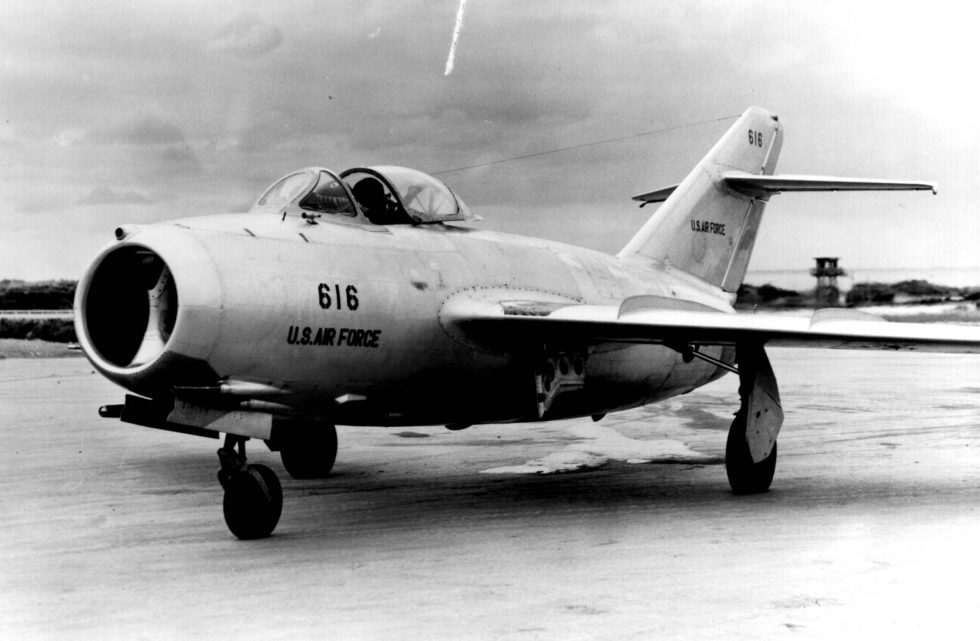
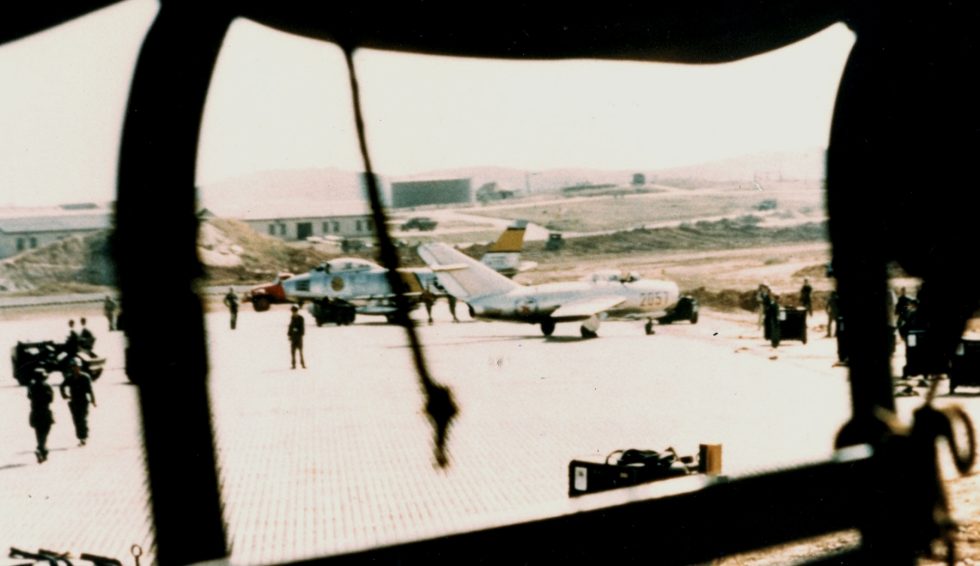
Two things about Korea need saying plainly. First, a large proportion of the MiG-15s fought by UN pilots were flown by Soviet pilots of the 64th Fighter Aviation Corps, in Chinese or North Korean markings, wearing North Korean uniforms or civilian clothes and issued cards of Korean flying terms spelled out phonetically in Cyrillic. The subterfuge did not survive contact — UN crews heard Russian on the radio and knew perfectly well who the "honchos" were — but the USSR denied it officially for forty years and only acknowledged it after the Cold War ended. Second, the kill ratio is genuinely contested. The wartime USAF figure of roughly 10:1 in the Sabre's favour rested on 792 claimed MiGs against 78 F-86s lost in air combat, and it has been revised down substantially: a 2008 RAND study, drawing on post-Soviet archives, put the F-86 at about 1.8:1 overall and closer to 1.3:1 against Soviet-flown MiGs, while Dorr, Lake and Thompson argue for something near 2:1. Soviet records admit 335 MiG-15s lost, China 224 and North Korea perhaps 100, while Soviet claims of over 600 Sabres destroyed are just as clearly inflated in the other direction. Analysts also note that American losses were sometimes booked to "landing accidents" or "other causes". The honest summary is that the Sabre came out ahead, that the margin was nothing like 10:1, and that a large part of the difference where the margin was widest came down to pilot quality — Soviet units flew close to parity, whereas the less experienced Chinese and North Korean regiments took heavy losses. On 21 September 1953, North Korean pilot No Kum-sok defected to Kimpo in a MiG-15bis, handing the United States its first intact example; it was test-flown at Okinawa and Wright-Patterson and is on display today at the National Museum of the USAF in Dayton.
- MiG-15
- The original production fighter, RD-45F engine of about 22.3 kN and NS-23 cannon. 1,344 built in the USSR from 1949. Fast, high-flying and clearly ahead of the straight-wing jets it met, but under-powered next to what followed.
- MiG-15bis
- The definitive mark: Klimov VK-1 at 26.5 kN, NR-23 cannon, enlarged airbrakes, ASP-3N sight, later OSP-48 ILS. 8,352 built from 1950. This is the aircraft of MiG Alley and of essentially every published MiG-15 specification, including the one above.
- MiG-15UTI
- Tandem two-seat conversion trainer, one machine gun or cannon, dual controls. 3,434 built in the USSR. The Warsaw Pact's standard jet trainer for thirty years, still flying in North Korea long after the fighters had gone, and the version that killed Gagarin in 1968.
- Lim-1 / Lim-2 (Poland)
- Licence production at WSK-Mielec: 227 Lim-1 (MiG-15, Lis-1 engine, 1952–54) and 500 Lim-2 (MiG-15bis, Lis-2, 1954–56). No new-build two-seaters — the SB Lim-1 and SB Lim-2 trainers were remanufactured from existing single-seat airframes, and it is these that supply much of the flying warbird fleet today.
- S-102 / S-103 (Czechoslovakia)
- Aero and Motorlet built 821 S-102 (MiG-15, M-05 engine), 620 S-103 (MiG-15bis, M-06) and 2,012 CS-102 trainers — making Czechoslovakia the largest licence producer of all, and the CS-102 the single most numerous two-seat MiG-15 variant anywhere.
- J-2 (China)
- Service designation for the several hundred MiG-15bis delivered from the USSR in the early 1950s, not a Chinese-built aircraft: Shenyang repaired battle damage during the war and then skipped to the MiG-17. The only Chinese licence production was the two-seat JJ-2 trainer, of which somewhere between 120 and 500 were built — the records do not settle it.
The MiG-15 is long gone from front-line service — North Korea is the last holdout, and only as a trainer — but a substantial number survive. It is one of the more commonly flown jet warbirds in private hands, largely because Poland and Czechoslovakia built so many airframes that surplus SB Lim-2 and CS-102 two-seaters reached civilian owners in quantity from the 1990s onward, and because the VK-1 family is simple, robust and reasonably well supplied with parts. Several dozen are airworthy worldwide, mostly in the United States, and static examples run into the hundreds across the former Eastern Bloc, China, the Middle East, Africa and the museums of the countries that once fought it. Airworthy totals move around constantly as airframes change hands or come off the register, so treat any precise count with caution.
The MiG-15 through the years
Design begins
The MiG bureau starts its swept-wing interceptor; the USSR acquires Rolls-Royce Nene engines from Britain.
First flight
The prototype S-1 flies with test pilot Viktor Yuganov at the controls.
Production authorized
Series production is approved just months after the first flight.
Enters service
The MiG-15 joins the Soviet Air Force as a high-altitude day interceptor.
Combat debut over Korea
Among the first jet-versus-jet engagements in history — the birth of “MiG Alley.”
The MiG-15bis & the Sabre
The improved VK-1-powered bis is introduced; the F-86 Sabre is rushed to Korea in response.
“Year of the Honcho”
Soviet-flown MiG pressure ends untenable daylight B-29 raids.
The defection
North Korean Lt. No Kum-sok lands an intact MiG-15 at Kimpo — the prize the West had chased for years.
Licensed worldwide
China (J-2), Poland (Lim-1/2) and Czechoslovakia (S-102/103) build the type; today it flies as a warbird.
From MiG Alley to the warbird circuit: twelve MiG-15 stories
The shock of MiG Alley
The jet that made UN commanders panic.
Read the full story
No Kum-sok and the $100,000 he didn’t know existed
A 21-year-old lieutenant flew to freedom by accident of history.
Read the full story
The Honcho pilots
The MiG’s best-kept secret wore a disguise.
Read the full story
The B-29 killer
Cannon that ended daylight bombing.
Read the full story
MiG-15 vs F-86 Sabre
The first great jet duel — and a disputed scoreboard.
Read the full story
A British engine’s Soviet second life
The heart of the MiG came from Rolls-Royce.
Read the full story
The Chinese J-2
The Fagot goes east.
Read the full story
The two-seat UTI “Midget”
How a generation learned to fly jets.
Read the full story
Fly a Fagot today
A genuine Korean-War jet you can ride.
Read the full story
One of the most-produced jets ever
Built by the thousands.
Read the full story
Operation Moolah
The plot to buy a MiG.
Read the full story
The prize at Wright-Patterson
No Kum-sok’s MiG still stands guard.
Read the full story
The MiG-15 in pictures
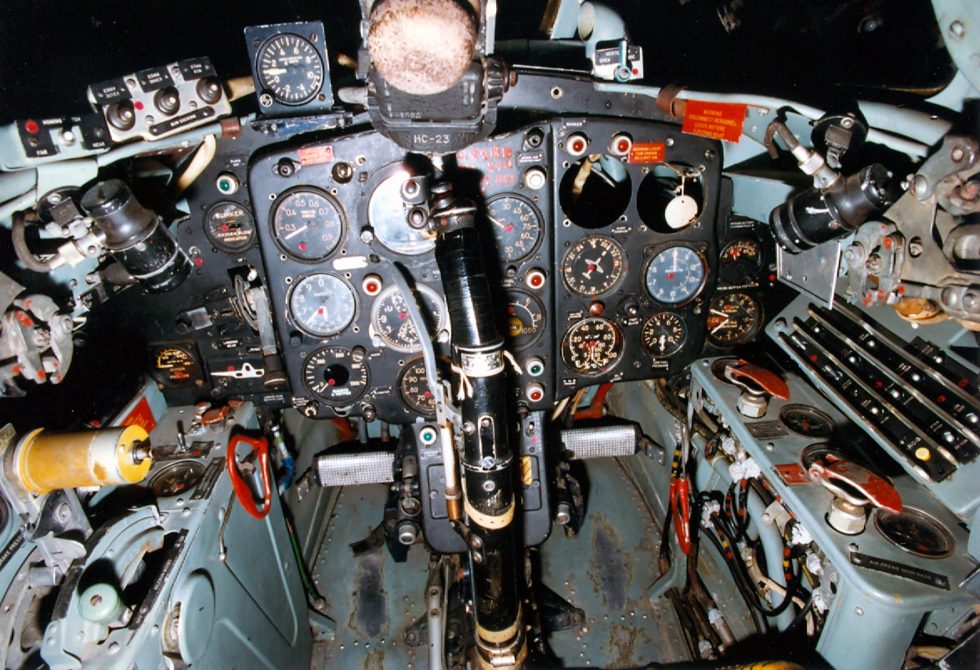
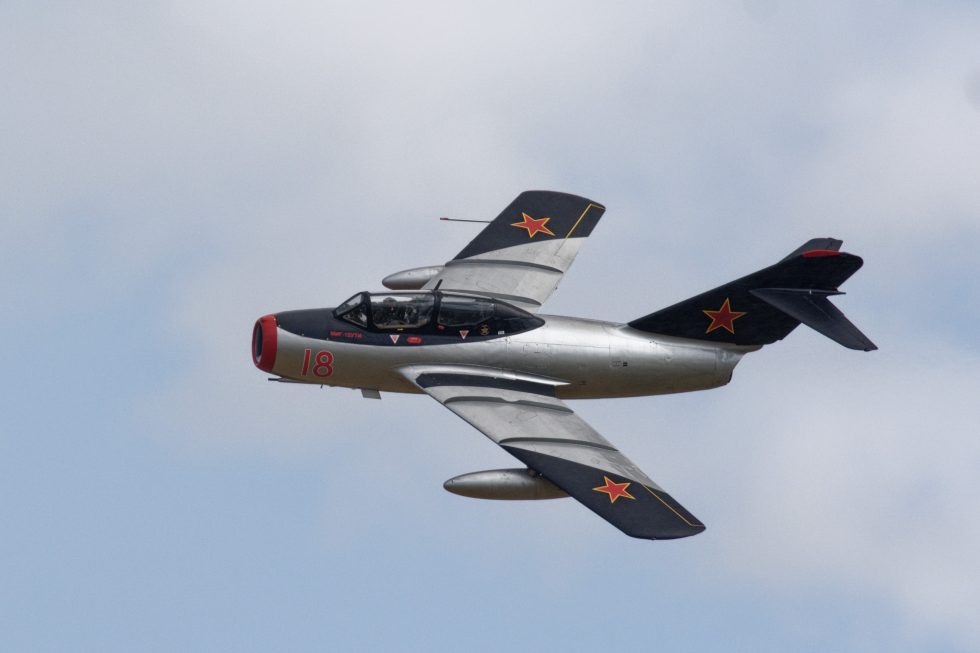
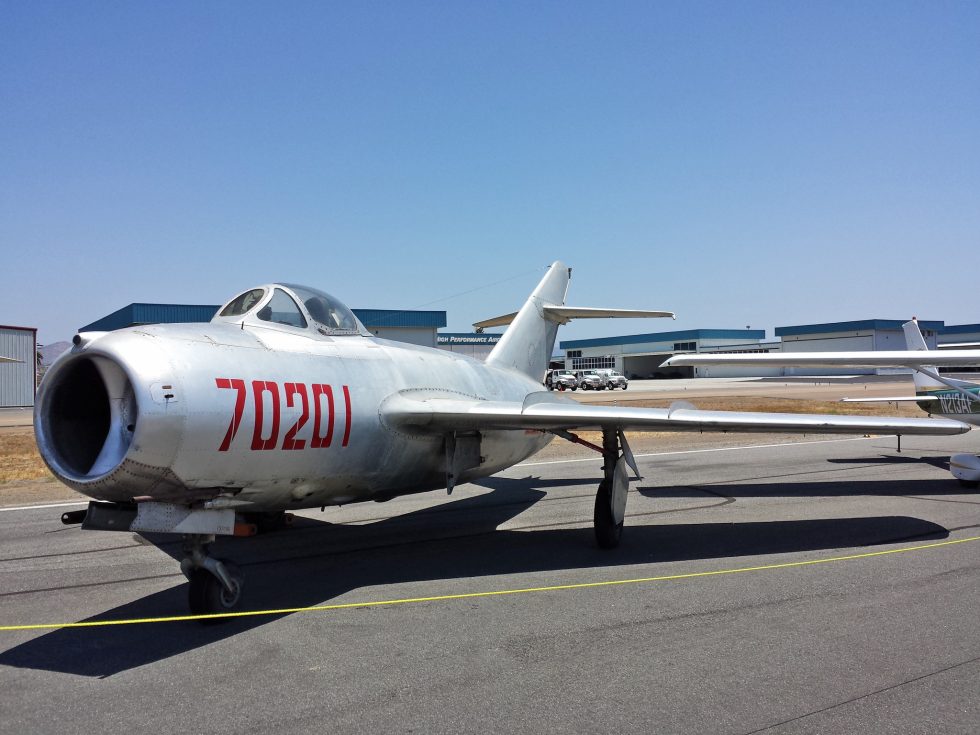
The MiG-15 in motion
A documentary feature on the MiG-15 is coming soon.
The MiG-15 Fagot in motion
Yarnhub — one of the most-watched MiG-15 Fagot films on YouTube.
Where the MiG-15 flew
The defining jet of the Korean War
The MiG-15’s defining war was Korea, where it drove piston-engined types and straight-wing jets from contested airspace and forced the deployment of the F-86 Sabre. The two swept-wing fighters were closely matched: the MiG had a higher ceiling and heavier guns, the Sabre better handling, gunsight and gun-platform stability. Its guns also made daylight B-29 raids untenable by late 1951, and it later saw action across the Middle East, China and the Warsaw Pact.
The kill-ratio dispute: The USAF long claimed a roughly 10:1 Sabre-to-MiG victory ratio over Korea. Post-Cold-War access to Soviet records and later analysis (e.g. historian Walter Boyne) put the real figure far lower — closer to parity in some periods such as 1951, the “Year of the Honcho.” The true ratio remains genuinely contested; the honest answer is a disputed range somewhere between near-parity and the old 10:1 claim, not a settled number.
Compare the combat record of every military aircraft. Figures as of July 2026.
Everything people ask about the MiG-15
Can I fly a MiG-15?
How fast is the MiG-15?
Could the MiG-15 break the sound barrier?
MiG-15 vs F-86 Sabre — who won?
How many MiG-15s were built?
How do I fly one?
What is the MiG-15UTI?
You can actually fly the MiG-15.
Pick your cockpit.
Some legends only live in museums — others are fuelled and waiting. MiGFlug has put civilians in real military jet cockpits since 2004.
 Fly the L-39 AlbatrosThe world’s most-flown jet trainer — aerobatics included
 Fly the F-104 Starfighter“The missile with a man in it”
 Fly the MiG-21The Cold War’s most-produced jet
 Fly the T-33 Shooting StarAmerica’s first jet trainer
 Fly the DH VampireA piece of early jet history
 Fly the S.211Agile Italian jet trainer
 Fly the MB-326The classic Aermacchi jet
 Fly the MiG-15The Soviet legend of the Korean War
Continue the tour
Every fact, checked
- Smithsonian National Air and Space MuseumMiG-15 collection object — provenance and specifications.
- Military.comThe years-long effort to capture a MiG-15 — and No Kum-sok’s delivery of one.
- Vintage Aviation NewsFirst flight of the Mikoyan-Gurevich MiG-15.
- The Aviation Geek ClubWalter J. Boyne on the disputed 10:1 F-86/MiG-15 ratio.
- MilitaryFactoryMikoyan-Gurevich MiG-15 (Fagot) specifications and history.
- Southern Museum of FlightThe MiG-15, the Korean War and No Kum-sok’s flight to freedom.
- PsyWarriorOperation Moolah — the plot to steal a MiG-15.
- MiGFlugThe MiG-15 Fagot flight experience in the Czech Republic.