
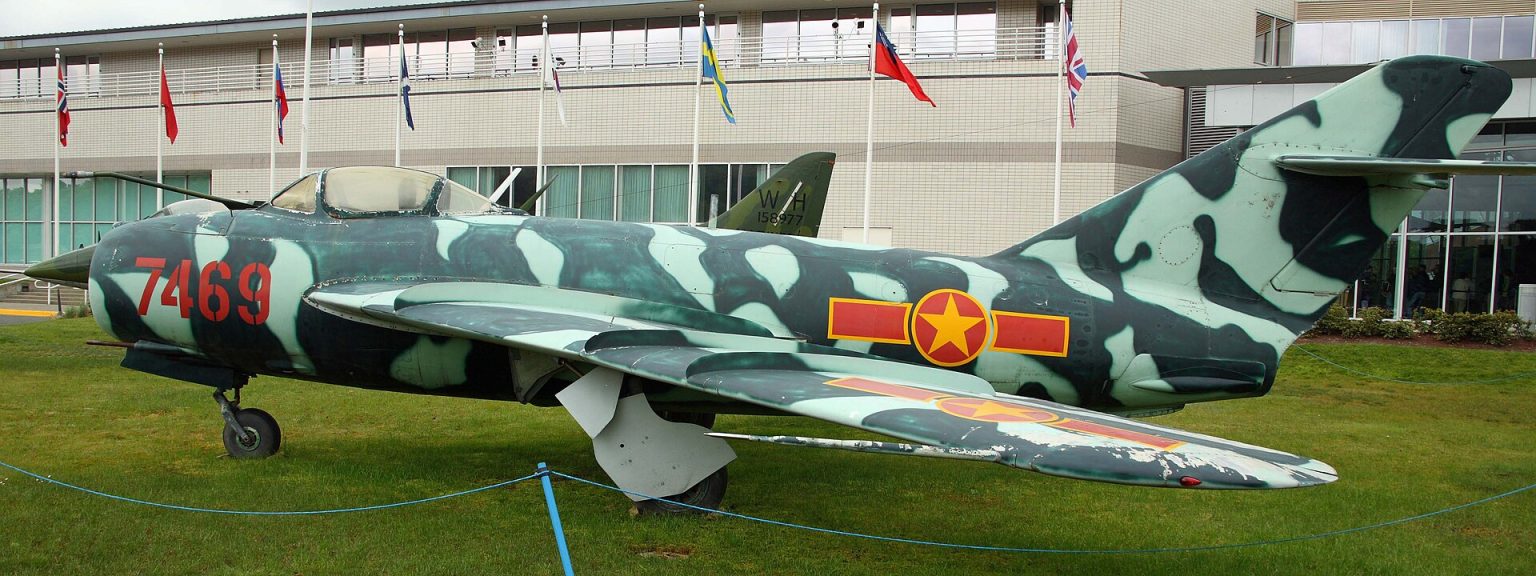
Mikoyan-Gurevich MiG-17
“Fresco”
The subsonic Soviet gun-fighter that humbled Mach-2 American jets over Hanoi, armed dozens of air forces across three continents, and — more than any other aircraft — is the reason the U.S. Navy founded “Top Gun.”
The gun-fighter that outlived the missile age it warned against
The MiG-17 was Mikoyan-Gurevich’s answer to the shortcomings its own MiG-15 exposed over Korea. Where the MiG-15 was a revolutionary but twitchy transonic fighter that could snake and depart controlled flight near its limit, the MiG-17 (bureau designation I-330 / SI) was a refinement rather than a revolution: a new, thinner and more sharply swept wing, a longer fuselage and a redesigned tail meant to tame transonic handling and push the useful speed envelope closer to Mach 1.
The prototype first flew on 1 February 1950, serial production was ordered in August 1951, and the type entered Soviet service in October 1952 — too late for the war it was born from. The definitive day-fighter MiG-17F added the afterburning Klimov VK-1F; radar variants (PF, then the missile-armed PFU) followed. Total production is usually cited at ~10,000+ (commonly 10,367) across the USSR and licensees, making it one of the most widely built jet fighters in history.
Its legend was made over Vietnam. Subsonic, radar-less and armed only with cannon, the little Fresco dragged Mach-2 F-4 Phantoms and F-105 Thunderchiefs down into slow turning fights where speed meant nothing and guns meant everything — a humiliation that drove the U.S. Navy to found its Fighter Weapons School, “Top Gun,” in 1969. China built it as the Shenyang J-5 and Poland as the Lim-5; today it survives in North Korean inventories and thrives on the civilian warbird circuit.
01How many MiG-17s were built — and why the total is so hard to pin down
The MiG-17’s production total is usually given as ~10,000+, with 10,367 the most-cited round figure — but the number varies by source. Roughly 8,000 were Soviet-built, with several thousand more produced under licence: China’s Shenyang J-5 (export F-5) and its two-seat JJ-5/FT-5 trainer, and Poland’s Lim-5 (plus locally developed Lim-6 attack derivatives).
That scale is why the Fresco ended up in the service of dozens of air forces from the 1950s well into the 1980s. Simple, rugged and cheap to keep flying from rough strips, it became a backbone of Soviet-aligned air arms and a Cold-War workhorse across Asia, the Middle East and Africa — present as a range, not a precise figure, because the licensed lines blur the count.
What makes the MiG-17 special
The refined swept wing — with fences
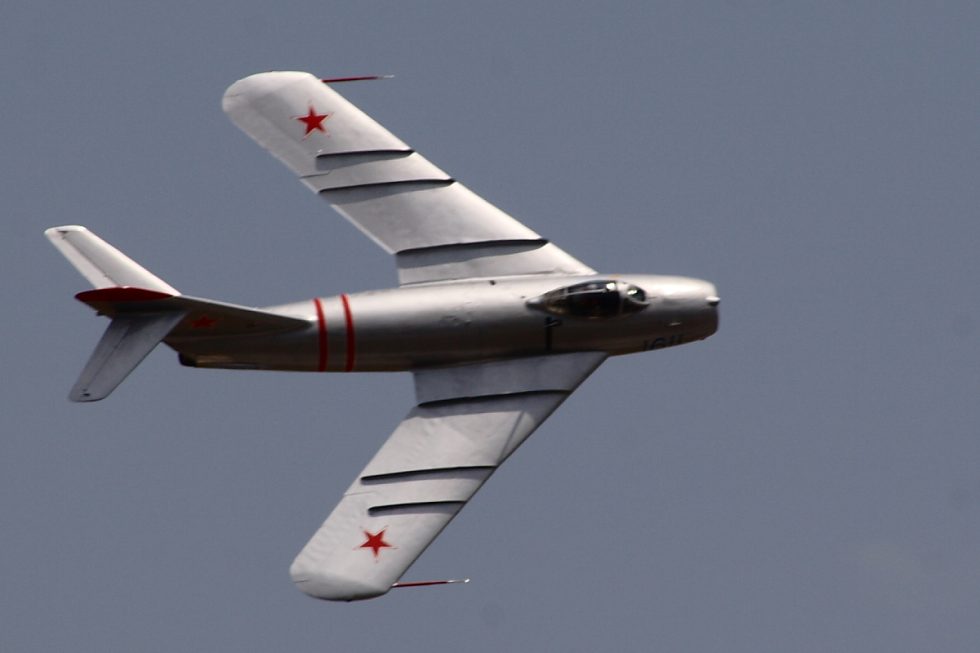
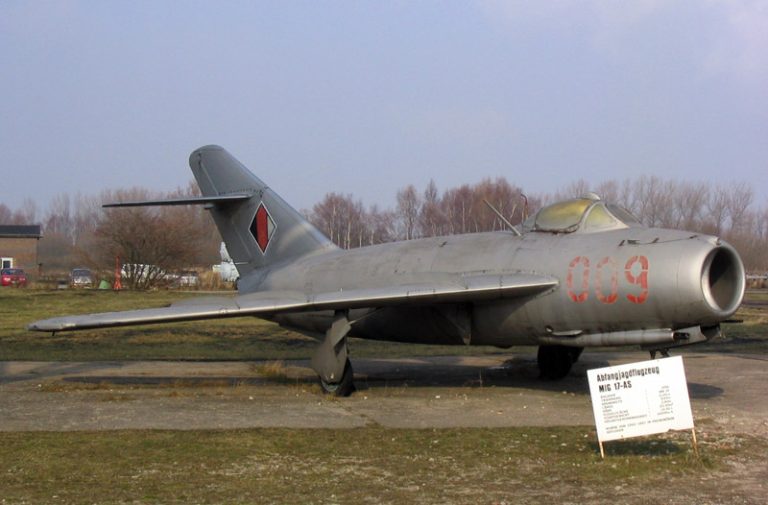
The MiG-17’s thinner, more sharply swept wing (a distinctive compound-sweep planform) carried prominent boundary-layer fences that checked spanwise airflow, delaying tip stall and improving handling right up to the transonic edge. They cured much of the MiG-15’s high-speed misbehaviour — and they are the quickest way to tell a Fresco from its predecessor at a glance.
The rugged Klimov VK-1F
A centrifugal-flow turbojet descended from the British Nene, the VK-1F added a straightforward afterburner — about 26.5 kN dry and 33.8 kN in reheat. It was tolerant of rough fields and unsophisticated maintenance, a decisive virtue for the developing-world air forces that flew the type for decades.
A heavy close-range nose battery
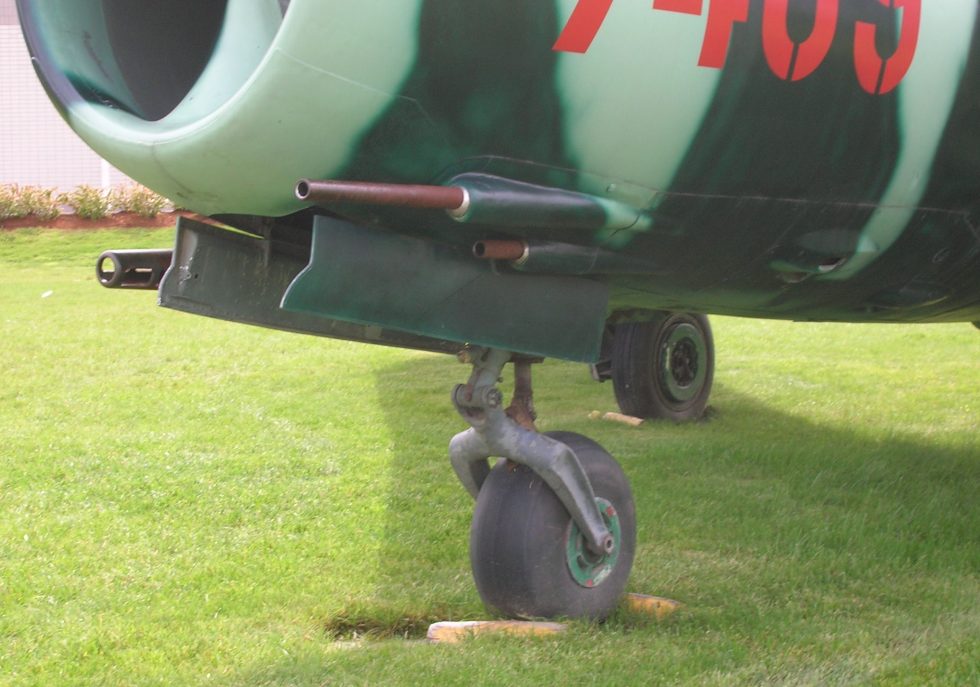
The concentrated one 37 mm N-37 plus two 23 mm NR-23 cannon package, tightly grouped in the nose, delivered a devastating short-burst punch. Slow-firing but heavy-hitting, it out-classed the gun-less early F-4 Phantom — and, dragged into a slow turning fight over Vietnam, it proved lethal against fighters twice its size.
02The MiG-17’s wing fences: little fins that fixed a dangerous habit
Those small metal fins running fore-and-aft along the MiG-17’s wing are not decoration. On a swept wing, air tends to slide outward toward the tips, thickening the boundary layer there and triggering an early, asymmetric tip stall — exactly the kind of vicious high-speed behaviour that made the MiG-15 twitchy near its limit. The fences act as dams, stopping that spanwise flow and keeping the outer wing flying longer. The result is crisper control and a more forgiving transonic edge, from an elegantly cheap piece of sheet metal rather than a costly redesign. Some sources describe the whole wing as an all-new design, others as a heavily reworked MiG-15 wing; either framing is defensible.
03The MiG-17’s guns vs. the missile age: why the Fresco was right
By the early 1960s Western doctrine had declared the dogfight obsolete: the future was radar and beyond-visual-range missiles, and the first F-4 Phantoms carried no gun at all. The MiG-17 was built on the opposite bet — a slow-firing but hard-hitting three-cannon nose for close-range work. Over Vietnam that bet paid off. Early U.S. missiles were unreliable in a low, slow turning fight, and a Phantom with empty missile rails and no cannon was defenceless against a Fresco that had slid inside its turn. The lesson forced the U.S. to bolt gun pods onto Phantoms, build the internal-gun F-4E, and rethink air-combat training from the ground up.
Full MiG-17F specifications
Figures below are anchored on the MiG-17F — the afterburning VK-1F mark that entered service in 1953, was the most widely exported version, and is the aircraft almost everyone means when they say "MiG-17". Where the radar-equipped MiG-17PF interceptor, the missile-armed MiG-17PM/PFU or the Chinese Shenyang J-5 differ materially, the delta is given in grey. The J-5 was a licence copy of the MiG-17F and is dimensionally identical; the PF carried a radar in the intake, was heavier, and lost performance accordingly. Soviet-era published figures were rounded and revised, and Western reconstructions disagree with one another, so treat single-decimal precision with suspicion.
Dimensions & weights
- Crew
- 1 (pilot) — the MiG-17 was never built as a two-seater in the USSR. Conversion training was done on the MiG-15UTI, and the only purpose-built two-seat derivative was the Chinese JJ-5, which married a MiG-17F airframe to a stretched two-seat MiG-15UTI-style forward fuselage.
- Length
- 11.26 m (36 ft 11 in) excluding the pitot boom — about 1.2 m longer than the MiG-15bis, most of it an extended rear fuselage to house the afterburner
- Wingspan
- 9.63 m (31 ft 7 in) — slightly shorter span than the MiG-15 despite the larger aircraft, a direct consequence of the thinner, more sharply swept wing
- Height
- 3.80 m (12 ft 6 in)
- Wing area
- 22.6 m² (243 sq ft) — wing loading about 236 kg/m² (48 lb/sq ft) at normal loaded weight, low by the standards of anything it met over Vietnam and the single most important number on this page
- Empty weight
- 3,919 kg (8,640 lb) — the radar-equipped MiG-17PF runs roughly 100–150 kg heavier
- Loaded weight
- 5,340 kg (11,773 lb) clean, full internal fuel, full ammunition
- Max takeoff weight
- 6,069 kg (13,380 lb) with two 400 L drop tanks or a full external stores load
- Internal fuel
- ~1,415 L (~374 US gal / ~311 imp gal, about 1,140 kg) in two fuselage tanks and six wing cells — plus two jettisonable 400 L underwing tanks. Sources give anything from 1,140 to 1,150 kg of internal fuel; endurance was still the type's standing weakness.
Performance
- Max speed
- 1,145 km/h at 3,000 m (618 kn / 711 mph), Mach 0.93 with reheat; 1,100 km/h (594 kn / 684 mph) at sea level. The MiG-17 was a high-subsonic aircraft that could exceed Mach 1 only in a dive — but unlike the MiG-15 it stayed controllable while doing it, which was the entire point of the redesign.
- Cruise speed
- 800 km/h (432 kn / 497 mph) at altitude on a normal-power setting; reheat was good for only a few minutes at a time and drank fuel at roughly double the dry rate
- Rate of climb
- 65 m/s (12,800 ft/min) at sea level with afterburner — about 3,900 m/min, and 5,000 m reached in roughly 2 min 36 s. The non-afterburning early MiG-17 was markedly slower to height.
- Service ceiling
- 16,600 m (54,500 ft) — higher than the MiG-15bis and higher than most of what it faced, though the thin air made it a poor place to fight
- Combat radius
- ~700 km (~380 nmi) with two 400 L drop tanks on a gentle profile; realistically 350–450 km (~190–240 nmi) clean, and far less once the fight went to full throttle. North Vietnamese MiG-17s typically flew short, ground-controlled sorties of 30–40 minutes.
- Ferry range
- ~2,020 km (~1,090 nmi) at 12,000 m with drop tanks; about 1,290–1,400 km (~700–760 nmi) on internal fuel alone
- Takeoff run
- 590 m (1,935 ft) at normal weight on a hard runway using reheat; appreciably longer dry, at high weight, or on the unpaved and pierced-steel strips the type habitually used. Civilian operators today plan on 1,500–1,800 m (5,000–6,000 ft).
- Landing run
- 850 m (2,790 ft) — a tail-mounted brake parachute was fitted, without which the roll is a good deal longer. Published figures vary widely with weight, surface and whether the chute is counted.
- Load factor
- +8 g manoeuvring limit — and, crucially, a machine that remained honest and predictable right up to it. The MiG-15's vices at high indicated airspeed and near the stall were exactly what the MiG-17 was built to cure.
Propulsion & systems
- Engine
- Klimov VK-1F single centrifugal-flow turbojet with a simple afterburner and a two-position variable nozzle — the same VK-1 lineage as the MiG-15bis, itself developed from the Rolls-Royce Nene sold to the USSR in 1947. The afterburner was the F mark's defining addition; the original MiG-17 and the MiG-17P used the non-afterburning VK-1A. This was old technology by the mid-1950s, and the MiG-17 got its reputation from its wing rather than its engine.
- Thrust
- 26.5 kN dry / 33.8 kN reheat (5,950 lbf dry / 7,600 lbf with afterburner) — a thrust-to-weight ratio of roughly 0.65 at normal loaded weight in reheat
- Wing
- Thinner, compound-swept, extra fences This is the whole aircraft. The MiG-15's wing was thick and swept at a constant 35 degrees, and at high indicated airspeed it produced control stiffening, a vicious wing drop and a spin that pilots were often told simply to eject from. The MiG-17 replaced it with a thinner wing of compound sweep — about 45 degrees inboard and 42 degrees outboard, greater span-wise taper, and three boundary-layer fences per side instead of two, together with a taller, more sharply swept fin and a redesigned tailplane. The result was an aircraft that could be flown hard to its limits without biting. The MiG-17 was not a new fighter so much as the MiG-15 done properly — and that is precisely why it was still dangerous fifteen years later.
- Armament
- 1 × 37 mm N-37, 2 × 23 mm NR-23 40 rounds for the N-37 and 80 per gun for the NR-23s, all on a winch-down gun pack in the lower nose. Radar-equipped MiG-17P and MiG-17PF marks deleted the heavy N-37 and carried three NR-23 instead; the MiG-17PM/PFU deleted the guns entirely for four K-5 missiles. Two underwing pylons took up to 500 kg of bombs, rocket pods or drop tanks.
- Radar
- RP-1 / RP-5 Izumrud on the P and PF marks only — a two-antenna set with a search radome in the intake upper lip and a tracking radome on the intake splitter, giving detection at roughly 12 km and lock-on near 2 km. It was crude, short-ranged and demanding for a single pilot, but it made the MiG-17PF a usable night and bad-weather interceptor, which the MiG-15 never was. Day-fighter F marks carried only an SRD-1/SRD-3 ranging radar feeding an ASP-4N gyro gunsight.
- Ejection seat
- Cartridge-fired seat with jettisonable canopy, later fitted with a protective face blind and improved restraints. It was not a zero-zero seat by any stretch: low and slow ejections — exactly the regime the MiG-17 fought in over Vietnam — were frequently fatal.
- First flight
- 14 January 1950 prototype I-330 "SI", flown by Ivan Ivashchenko. The programme paid for its thin wing early: on 17 March 1950 the prototype lost its horizontal tail to flutter and Ivashchenko was killed. Development continued with modified and stiffened surfaces.
- Service entry
- 1952 with the Soviet Air Forces — October 1952 for the initial mark, with the afterburning MiG-17F following in 1953 and the radar-equipped MiG-17PF in 1955. Soviet production ran to 1958.
- Built
- ~10,000+ including licence production — roughly 8,000 in the USSR (about 5,470 MiG-17, 1,685 MiG-17F, 225 MiG-17P and 668 MiG-17PF), some 770 in Poland as the Lim-5 and Lim-6 family, and about 2,100 in China as the Shenyang J-5, J-5A and JJ-5. Totals of 10,000 to 11,000 are all defensible depending on what is counted; nobody has a clean number. Czechoslovakia operated the type as the S-104 but, contrary to a common claim, did not build it under licence.
- Unit cost
- ~USD 150,000–500,000 today for a flyable civil-registered airframe, with condition and remaining engine life driving most of the spread; a fully sorted, airshow-standard example can ask well over USD 500,000, and rare radar-nosed PF airframes more again. No meaningful original unit price exists — Soviet-bloc aircraft were costed internally in roubles at state prices that do not convert into anything comparable.
- Cost per flight hour
- ~USD 5,000–8,000 all-in for a privately operated example, of which fuel is the largest single line: the VK-1F burns on the order of 1,200–1,400 L (~320–370 US gal) an hour at low level in dry power and roughly double that in reheat, which is why civilian operators barely use the afterburner. Direct hourly cost is sometimes quoted lower, but owners typically fly only 20–40 hours a year, so fixed costs — hangarage, insurance, annual inspection, engine and airframe reserves — dominate the real figure. Parts are the wild card: common VK-1 items remain available from Warsaw Pact and Chinese stocks, mark-specific ones are not.
04The MiG-17’s cost: why there is no honest price tag
Ask what a MiG-17 cost and you hit a wall. It was a product of the Soviet planned economy, where aircraft were not really “priced” the way Western jets were, and export deals were bartered, subsidised or bundled into political packages that varied wildly by year and buyer. No credible unit-cost figure exists in open sources, and no reliable cost-per-flight-hour number either. What is certain is the design intent: the Fresco was built to be cheap, simple and mass-producible — a fighter sold and sustained more like a rifle than a luxury weapon system, which is precisely how a jet designed in 1950 ended up flying for developing-world air forces into the 21st century. The specs above are for the MiG-17F day fighter; the radar PF and missile PFU variants differ in weight, intake and armament.
Armament & payload
The MiG-17 kept the MiG-15's guns and gave them an aircraft that could aim
The MiG-17 carried almost exactly the MiG-15's guns, and for almost exactly the same reason: it was conceived as a bomber-killer, and a battery of one 37 mm and two 23 mm cannon was what the Soviet Air Forces thought a bomber-killer needed. That fit was heavy, slow-firing, short of ammunition and split across two calibres whose shells did not fly to the same place — genuine drawbacks against a manoeuvring fighter. What changed everything was the aircraft carrying them. A wing that could be pulled to its limits without misbehaving turned an awkward anti-bomber armament into something an American pilot over Hanoi had every reason to fear at close range. Cannon fit, sight, radar and stores clearances all varied by mark and by operator; what follows describes the MiG-17F unless stated otherwise.
Cannon
- One 37 mm Nudelman N-37 with 40 rounds and two 23 mm Nudelman-Rikhter NR-23 with 80 rounds each, all mounted in a single pack that winched down out of the lower nose on rails for rearming — a genuinely good piece of engineering inherited from the MiG-15.
- It was built to break up bomber formations. A 37 mm hit was structurally catastrophic to almost anything; US aircrew over Vietnam repeatedly described losing large pieces of airframe to single rounds.
- The old objections still applied. The N-37 fired at roughly 400 rounds per minute and the NR-23 at about 850, and the heavy 37 mm shells dropped away while the lighter 23 mm rounds flew flatter, so the two calibres did not converge cleanly. Forty rounds of 37 mm is a handful of short bursts.
- Against a fighter in a turning fight, none of that mattered as much as being able to point the nose. The MiG-17 could, and that is the whole story of its combat record.
Air-to-air missiles
- The MiG-17PM (service designation MiG-17PFU) was the Soviet Union's first missile-armed fighter in squadron service, carrying four K-5 / RS-2-US missiles — NATO AA-1 Alkali — on underwing rails from about 1957.
- The guns were removed entirely to make room and save weight. In hindsight this was the same mistake the United States made with the early F-4, made earlier and with worse missiles.
- The K-5 was beam-riding: the pilot had to hold the target inside the radar beam for the whole flight while the missile flew up the beam. Range was 2–6 km, the 13 kg warhead was small, and beam accuracy degraded with distance. In a single-seat fighter it was close to unusable against anything that manoeuvred.
- Only a small number of airframes were converted, and they were rapidly overtaken by the MiG-19PM and Su-9. The K-5 is a useful reminder that early guided air-to-air weapons were poor on both sides of the Cold War.
Bombs & rockets
- Two underwing pylons, normally carrying drop tanks, cleared for up to ~500 kg of external stores in total — typically two 100 kg or 250 kg bombs, or rocket pods.
- Standard unguided rocket fits were UB-16-57 pods of 16 × 57 mm S-5 rockets, and on some marks heavier ARS-212 / S-21 rockets. Napalm tanks were carried by several operators.
- Poland took the ground-attack role furthest with the Lim-6bis, which added extra underwing pylons, a braking parachute and provision for rocket-assisted takeoff, and served as a dedicated fighter-bomber into the 1990s.
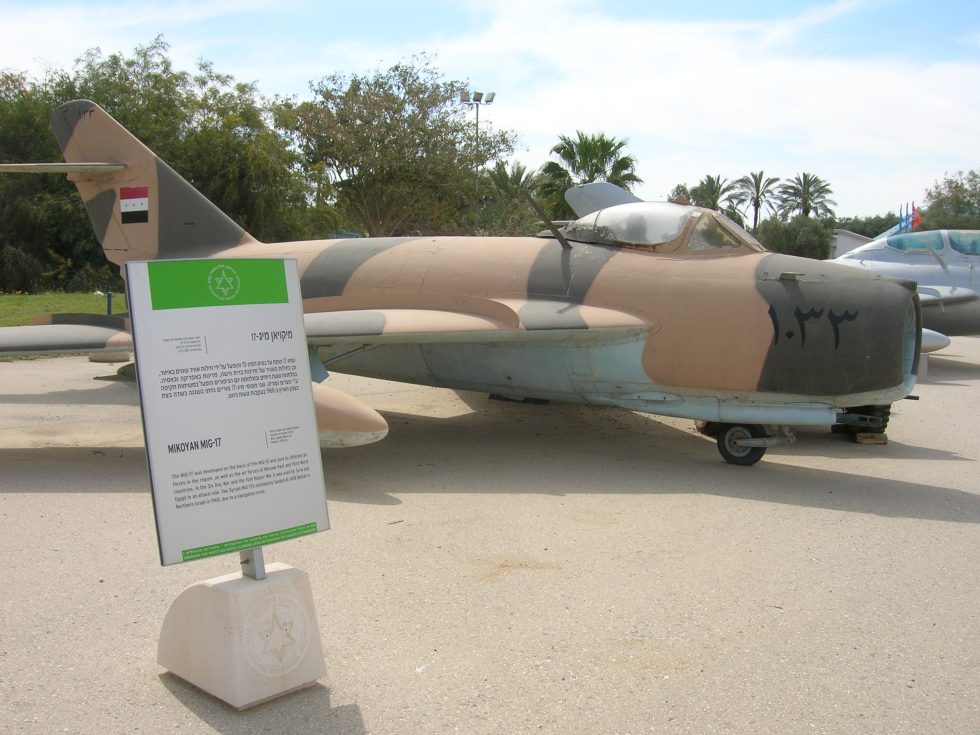
- Egyptian and Syrian MiG-17s flew large numbers of ground-attack sorties in 1967 and 1973, by which point the type was hopelessly exposed to modern air defences and losses were heavy.
Fuel tanks
- Internal capacity of about 1,415 L in two fuselage tanks and six wing cells — better than the MiG-15, still short by any Western standard, and worse again once the afterburner was lit.
- Two jettisonable underwing tanks of 400 L each were the normal fit, raising maximum takeoff weight to about 6,069 kg and ferry range to roughly 2,020 km at altitude. Smaller 333 L tanks were used on early aircraft.
- Tanks came off at the first sign of contact, so the fighting radius was always far shorter than the ferry figures suggest. Reheat could be sustained for only a few minutes at a time.
- Over North Vietnam this was largely irrelevant: MiG-17s operated from bases minutes away from the targets they defended, under close ground control, with no requirement to loiter. The type's worst weakness was neutralised by the way it was used.
Radar-equipped marks
- The MiG-17P and the far more numerous MiG-17PF carried the RP-1 and RP-5 Izumrud radar in a two-part installation: a search antenna in the upper lip of the nose intake and a tracking antenna in the intake splitter, giving the mark its unmistakable double-bulge nose.
- Detection ran to roughly 12 km with lock-on near 2 km — short-ranged, crude and a heavy workload for a single pilot, but it gave Soviet air defence its first genuinely usable all-weather day-and-night fighter below the big interceptors.
- Armament changed with the radar: the bulky 37 mm N-37 was deleted and replaced by a third 23 mm NR-23, giving three guns of one calibre and a much more coherent gunnery solution.
- The PF was heavier and slower than the F, and the radar demanded maintenance that many export operators could not sustain. Most air forces flew far more day fighters than interceptors.
Export & licence fits
- China built the MiG-17F as the Shenyang J-5 from 1956, the radar-equipped J-5A from 1964 and the two-seat JJ-5 from 1968 to 1986 — roughly 2,100 aircraft in total, exported as the F-5 and FT-5. The JJ-5 outlived every other member of the family in service.
- Poland built the Lim-5 (MiG-17F) and Lim-5P (MiG-17PF) at WSK-Mielec, then developed its own attack derivatives — the Lim-5M, Lim-6 and Lim-6bis — with strengthened undercarriage, brake chutes and additional pylons.
- Roughly thirty air forces flew the type, from the Warsaw Pact and China to Egypt, Syria, Iraq, Cuba, Nigeria, Somalia, Indonesia, Mali and North Korea. It was the developing world's standard jet fighter for a generation.
- Local fits varied a great deal. Weapons clearances, radios, IFF and sights were changed by operators, and many airframes were rebuilt more than once, which is why single-source armament tables for "the MiG-17" are usually wrong for any particular aircraft.
Three typical MiG-17 fits
- Day fighter, MiG-17F
- Clean airframe or two 400 L drop tanks, full gun pack: 40 rounds of 37 mm and 160 of 23 mm. Scrambled under close ground control, climbing to meet an inbound strike, tanks jettisoned on contact, fighting low and slow where the wing paid. This is the configuration that made the type's reputation over the Red River valley.
- Ground attack, Lim-6bis / MiG-17F
- Two UB-16-57 pods of 57 mm S-5 rockets, or two 250 kg bombs, or napalm tanks, guns loaded, no drop tanks and a short radius. The role that consumed most MiG-17s in Egyptian, Syrian, Polish and African service — and the one in which the type was most vulnerable, because it had to fly straight and level at low altitude over defended ground.
- All-weather intercept, MiG-17PF
- RP-5 Izumrud radar, three 23 mm NR-23 with reduced total ammunition, usually clean or with tanks. Ground-controlled interception at night or in weather, closing to gun range on radar and finishing visually. On the MiG-17PM/PFU conversions the guns came out altogether for four K-5 beam-riding missiles, which was a step backwards in everything but headlines.
Fits varied by mark far more than the type's reputation suggests. The original MiG-17 had no afterburner; the F added one and became the standard day fighter; the P and PF traded the 37 mm cannon for radar and a third 23 mm gun; the PM/PFU gave up guns entirely for early missiles; the Polish Lim-6bis was a genuine fighter-bomber with extra pylons; and the Chinese JJ-5 was a two-seat trainer with a single 23 mm gun. Quoting one weapons fit as "the MiG-17" is a mistake. Ordnance clearances for export and licence-built aircraft in particular are poorly documented in Western sources, and several commonly repeated figures trace back to a single Cold War intelligence estimate.
Variants
MiG-17 variants, and the Vietnam lesson that changed American fighter design
The MiG-17 was obsolete on paper by 1965. It was subsonic, it had no useful radar in its common marks, its guns were a decade out of date and its endurance was measured in minutes. It then spent seven years being a serious problem for the fastest and most expensive fighters in the world. That is worth explaining properly, because the reasons have almost nothing to do with the MiG-17 being secretly good and almost everything to do with what its opponents had been designed to do.
The F-4 Phantom II and the F-105 Thunderchief were built for a specific war: high-speed interception of bombers, and high-speed nuclear strike. Both were superb at that. Neither was built to turn with a light day fighter at 400 knots and 3,000 feet. Four things then dragged them into exactly that fight. First, American air-to-air missiles were unreliable: of 612 AIM-7 Sparrows fired in Southeast Asia only about 97 hit and roughly 56 produced kills — under a 10 per cent kill rate — and the AIM-9 did better but was still far from a certainty, with both weapons badly served by tropical humidity, flight-line handling and minimum-range limits. Second, the early F-4C and F-4D had no gun at all, on the doctrine that missiles had made guns obsolete; crews got podded SUU-16/SUU-23 20 mm cannon from 1967 and an internal gun only with the F-4E from late 1968. Third, rules of engagement generally required visual identification before firing, which threw away the Phantom's radar and the Sparrow's reach and guaranteed the merge. Fourth, North Vietnamese MiG-17s were flown under tight ground control from bases minutes away, committed only on favourable terms, and often ambushed heavily loaded strike packages that had to keep flying straight to their targets.
Put those together and a subsonic 1952 fighter with three cannon and a very good wing found itself repeatedly handed the one engagement it could win. MiG-17s opened their account on 4 April 1965, shooting down two F-105s over the Thanh Hoa bridge on the type's first real engagement of the war. Two US A-1 Skyraiders — piston-engined attack aircraft — also shot down MiG-17s, in June 1965 and October 1966, which says something about how low and slow these fights could get. The VPAF's 921st and 923rd Fighter Regiments flew the type throughout, and a defensive tactic of interlocking low-level turning circles made a formation of MiG-17s genuinely awkward to attack.
The numbers on both sides should be read sceptically. North Vietnamese sources credit MiG-17s with about 71 aerial victories between 1965 and 1972 against 63 lost in air combat; some Russian accounts claim as many as 143 aircraft and helicopters downed by MiG-17s. United States sources credit far fewer VPAF successes and claim considerably more MiGs destroyed — the VPAF total for US claims runs to roughly 195 aircraft, against 134 losses acknowledged by Hanoi. Both sets of figures are inflated in the normal way of air combat: pilots in a fast, confusing, multi-aircraft fight genuinely believe they saw an aircraft go down, two people claim the same kill, and damaged aircraft that later crash or are written off are counted differently by each side. There is also documented pressure inside the US services to reattribute air-to-air losses to surface-to-air missiles, which were considered less embarrassing. Treat any precise exchange ratio for the MiG-17 in Vietnam as an argument rather than a fact.
What is not in dispute is the response. Overall US-to-VPAF exchange ratios of roughly 2:1 to 2.4:1 were far below expectations and far below Korea. The US Navy commissioned the Ault Report in 1968, which examined the whole missile-and-training chain rather than blaming aircrew, and in March 1969 stood up the Navy Fighter Weapons School — Topgun — to teach dissimilar air combat manoeuvring against the aircraft crews would actually meet. Navy performance in 1972 improved sharply, though the size of the improvement is disputed and other factors, better tactics, better radar warning and better intelligence among them, contributed. The Air Force added the internally gunned F-4E and later built Red Flag. Guns came back to American fighters and never left again. The lesson is not that the MiG-17 was a great aeroplane. It is that designing to a doctrine, and then meeting a war that doctrine did not describe, is expensive — and that the cheapest, oldest aircraft in the sky can be the most dangerous one if it is flown where its strengths lie.
- MiG-17 (Fresco-A)
- The original 1952 production aircraft with the non-afterburning Klimov VK-1A, the new thin compound-swept wing and the redesigned tail. About 5,470 built. Fast and honest for its day but short of thrust, and largely superseded once the afterburning mark arrived.
- MiG-17F (Fresco-C)
- The definitive day fighter: VK-1F with afterburner, 33.8 kN in reheat, better climb and acceleration. About 1,685 built in the USSR plus the great majority of licence production. This is the MiG-17 of Vietnam, of the Middle East, and of nearly every surviving airworthy example.
- MiG-17P / MiG-17PF (Fresco-B/D)
- All-weather interceptors with RP-1 or RP-5 Izumrud radar in a double-bulge nose, the 37 mm cannon deleted in favour of a third 23 mm NR-23. About 225 P and 668 PF built; the PF added the afterburning engine. Heavier, slower, and demanding to maintain, but the family's first genuine night fighter.
- MiG-17PM / MiG-17PFU (Fresco-E)
- PF airframes converted from about 1957 with guns removed and four K-5 / RS-2-US (AA-1 Alkali) beam-riding missiles. A small conversion run only. The USSR's first missile-armed fighter in service, and a cautionary tale — the missiles were poor and the aircraft had nothing to fall back on.
- Lim-5 / Lim-6 (Poland)
- WSK-Mielec licence production: 477 Lim-5 (MiG-17F) from 1956 and 129 Lim-5P (MiG-17PF). Poland then went its own way with the Lim-5M (60 built), Lim-6 (40) and the successful Lim-6bis attack version (about 70 new plus many conversions), which served into the 1990s.
- S-104 (Czechoslovakia)
- The Czechoslovak service designation for the MiG-17PF interceptor, operated from the late 1950s. Unlike the MiG-15, which Czechoslovakia built in quantity as the S-102 and S-103, the MiG-17 was not licence-produced there — the S-104s were Soviet-built aircraft. Sources claiming Czechoslovak MiG-17 licence production are repeating an old error.
- J-5 / JJ-5 (China)
- Shenyang licence production of the MiG-17F as the J-5 from 1956 (767 built), the radar-equipped J-5A from 1964 (300+), and the two-seat JJ-5 trainer from 1968 to 1986 (1,061 built) — a Chinese design pairing a MiG-17F airframe with a two-seat forward fuselage. Exported as the F-5 and FT-5 to Pakistan, North Korea, Albania, Bangladesh, Tanzania, Zimbabwe and others.
Military service has essentially ended. North Korea is among the very few states that may still hold MiG-17 or J-5 airframes on strength, and its inventory is poorly documented; no other air force is credibly operating the type as a combat aircraft. A modest number fly on as privately owned civilian warbirds, chiefly in the United States and increasingly in Europe, and a good many of those are not Soviet-built at all but Polish Lim-5 or Chinese J-5 and JJ-5 airframes, which came onto the market later and in better condition. Static examples are common worldwide — the MiG-17 is one of the most widely preserved jet fighters ever built, and most large aviation museums have one.
From drawing board to warbird: the MiG-17 story
Design begins
Work starts on an improved swept-wing successor to the MiG-15, the I-330/SI, aimed at curing the earlier jet’s transonic handling.
Prototype first flight
The SI prototype flies; development is slowed by a fatal prototype loss and MiG-15 wartime production demands.
Serial production ordered
The refined fighter is cleared for mass production after the handling improvements are proven.
Enters Soviet service
The MiG-17 joins the Soviet Air Force — too late for the Korean War it was designed to fight.
The definitive MiG-17F
The afterburning VK-1F and prominent wing fences make the F the definitive day-fighter version.
Radar and missile variants
The MiG-17PF adds Izumrud radar; the MiG-17PFU trades all guns for four AA-1 “Alkali” missiles.
Licensed abroad
China builds the Shenyang J-5 and Poland the Lim-5/6, spreading the type across the Soviet-aligned world.
Peak over Vietnam
North Vietnamese MiG-17s drag U.S. supersonic fighters into low, slow turning fights and score cannon kills.
“Top Gun” is founded
Embarrassed by its kill ratios, the U.S. Navy establishes its Fighter Weapons School in direct response.
Retirement and afterlife
Widely withdrawn from front-line service; survives in North Korea and thrives as a civilian warbird worldwide.
From the flight line: twelve Fresco stories
The subsonic giant-killer
How a pre-Korea design beat Mach-2 jets over Hanoi.
Read the full story
Why Top Gun exists
The Fresco, more than any jet, is the reason the school — and the movie — exist.
Read the full story
Fresco on the airshow circuit
Dozens of MiG-17s and Polish Lim-5s fly today in private hands.
Read the full story
The last airworthy MiG-17PF
The rare radar-nosed interceptor is far scarcer in flying condition than the F.
Read the full story
The Chinese copy that outlived the original
China’s Shenyang J-5 kept the airframe in service long after Soviet lines closed.
Read the full story
Gulf of Tonkin era
The Fresco was the fighter North Vietnam scrambled as the escalation began.
Read the full story
The gun the F-4 forgot
Early Phantoms carried missiles but no cannon. The MiG-17 proved that wrong.
Read the full story
Fences on the wing
Those little metal fins fixed the MiG-15’s nastiest transonic habits.
Read the full story
Desert Frescos
Egyptian and Syrian MiG-17s fought Israel from 1956 to 1973.
Read the full story
Africa’s Cold-War workhorse
Cheap and rugged, the Fresco armed a dozen newly independent air forces.
Read the full story
The ace who never was
“Colonel Tomb,” the 13-kill red-star ace, was almost certainly propaganda.
Read the full story
The gunless PFU experiment
The MiG-17PFU deleted all cannon for four AA-1 “Alkali” missiles.
Read the full story
The Fresco in pictures
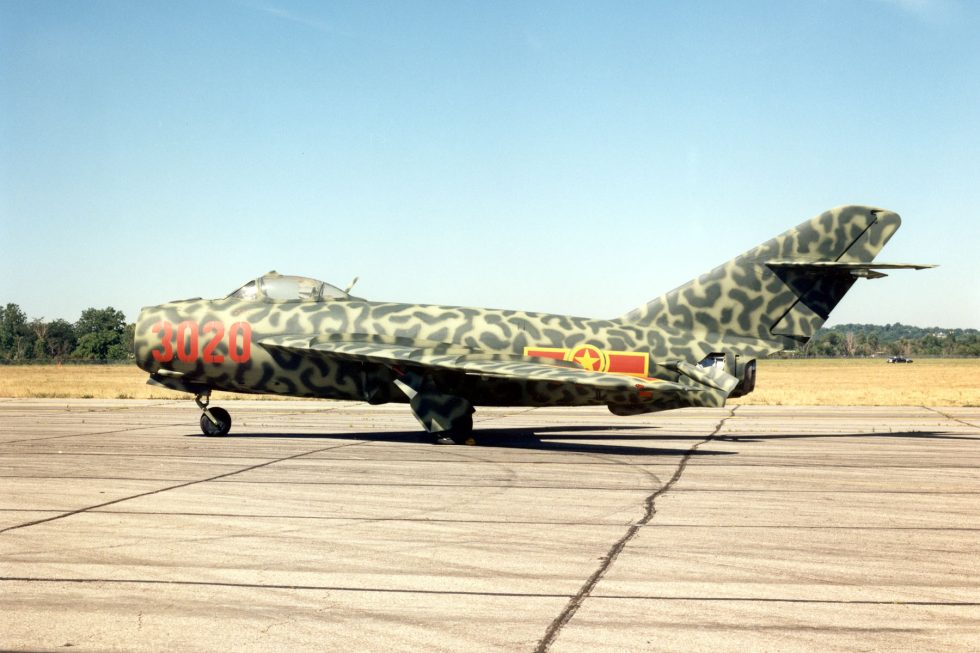
The Fresco in motion
A flying, afterburning privately-owned MiG-17 warbird clip is being verified for embedding — the type is a spectacular airshow performer.
The MiG-17 Fresco in motion
Not A Pound For Air To Ground — one of the most-watched MiG-17 Fresco films on YouTube.
Where the Fresco flew
The jet that humbled the missile age
The MiG-17 fought from Vietnam to the Middle East to Africa, and its published kill/loss records are among aviation’s most politically contested — always cite them as claims, not settled scores. Over Vietnam between 10 July 1965 and 14 February 1968, USAF F-105s and F-4s downed 61 MiG-17s; across the war U.S. forces claimed about 196 MiG kills of all types against roughly 83 U.S. aircraft lost to MiGs (an overall ~2.36:1 U.S. exchange ratio). Vietnamese and Soviet accounts claim a far more favourable balance for the MiG-17 in specific periods; the tallies are disputed.
Compare the combat record of every military aircraft. Figures as of July 2026 and widely contested.
Everything people ask about the MiG-17
Can I fly in a MiG-17?
Is the MiG-17 fast?
Is the MiG-17 still flying?
MiG-17 vs. F-4 in Vietnam — who won?
How many MiG-17s were built?
How does the J-5 relate to the MiG-17?
Why is the MiG-17 linked to “Top Gun”?
What were the MiG-17’s weapons?
You can’t fly the MiG-17.
These, you can.
Some legends only live in museums — others are fuelled and waiting. MiGFlug has put civilians in real military jet cockpits since 2004.
 Fly the L-39 AlbatrosThe world’s most-flown jet trainer — aerobatics included
 Fly the F-104 Starfighter“The missile with a man in it”
 Fly the MiG-21The Cold War’s most-produced jet
 Fly the T-33 Shooting StarAmerica’s first jet trainer
 Fly the DH VampireA piece of early jet history
 Fly the S.211Agile Italian jet trainer
 Fly the MB-326The classic Aermacchi jet
 Fly the MiG-15The Soviet legend of the Korean War
Continue the tour
Every fact, checked
- Military Factory — Mikoyan-Gurevich MiG-17 (Fresco)Development history, variants and specification overview.
- PlaneHistoria — MiG-17 FrescoHigh-subsonic performance, wing design and service background.
- GlobalSecurity.org — MiG-17 in ActionCombat use and operator overview.
- Air & Space Forces Magazine — Against the MiGs in VietnamVietnam air-combat context and the contested kill tallies.
- National Museum of the U.S. Air Force — MiG-17F fact sheetAirframe details and the public-domain museum photographs.
- Smithsonian (Air & Space) — Return of the MiG-17Warbird restoration and the civilian survivors.
- Skies Magazine — The last airworthy MiG-17PF for saleThe rarity of flying radar-nosed PF examples.
- Britannica — MiG-17Concise reference summary of the type.