
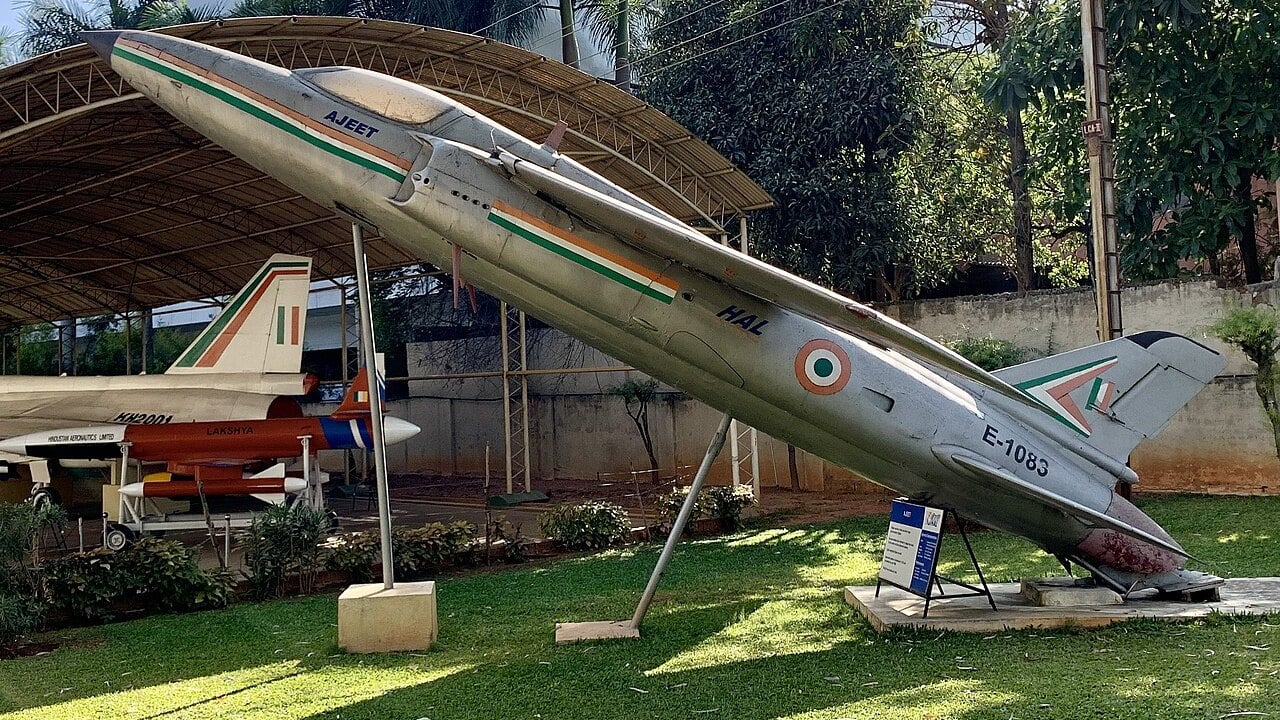
At a glance, you would swear it was a Gnat. The same tiny swept wing, the same shark-like nose, the same cockpit perched on a fuselage barely nine metres long. Walk underneath, though, and you count four pylons instead of two. Look at the tail and the whole horizontal surface moves as one slab. This is the HAL Ajeet, the aircraft India built when it decided the little “Sabre Slayer” could be made better.
Its name is Sanskrit for “invincible” or “unconquered”. It flew with the Aeronautica militare indiana from 1977 to 1991, never went to war, and is mostly remembered today as a footnote to its famous parent. That undersells it. The Ajeet was one of the first serious attempts by Hindustan Aeronautics Limited to take a licence-built foreign fighter and re-engineer it into something of its own.
Informazioni rapide
- Tipo: Single-seat light fighter and ground-attack aircraft
- Developed from: Folland Gnat, licence-built by HAL
- Requirement: Indian Air Force, 1972
- First production flight: 30 September 1976
- In servizio: 1977 to March 1991, Indian Air Force
- Costruito: 79, plus ten Gnats upgraded to Ajeet standard (per Greg Goebel)
- Motore: One HAL/Bristol Siddeley Orpheus 701 turbojet, about 20 kN
- Armamento: Two 30 mm ADEN cannon; four pylons, about 900 kg
- Trainer: Two-seat version; three built, two served 1987 to 1991
The Gnat India loved
IL Folland Gnat was Teddy Petter’s answer to ever bigger, ever costlier fighters: the smallest jet that could still do the job. The Royal Air Force bought it only as a trainer. India bought it as a fighter, flew it from 1958, and had HAL licence-build more than 200 of them. In the wars of 1965 and 1971 it proved deadly against Pakistani Sabres at low level, a story told in Folland Gnat: il piccolo sterminatore di tigri dai denti a sciabola.
But the Gnat had problems. Its hydraulics and some of its control systems were unreliable, and its small size meant that the jet had to carry drop tanks on its only two pylons to get any useful range, leaving nothing but its cannon for weapons. In 1972 the IAF issued a requirement for an improved Gnat, first as an interceptor and then with a secondary ground-attack role.
What HAL changed
HAL converted the last two Gnats off its production line into prototypes, and both flew in 1975. The first production Ajeet followed on 30 September 1976, and deliveries to the IAF began in 1977. The changes were mostly invisible from the outside, but they went deep.
The biggest was the wing. HAL turned it into a wet wing, with integral fuel tanks holding 250 litres on each side. That freed the pylons from drop-tank duty, and HAL added a second pair, giving four stores stations able to carry about 900 kg between them, typically rocket pods or two 250 kg bombs. With the two 30 mm ADEN cannon kept, the Ajeet was a far more useful ground-attack aircraft than the Gnat had ever been.
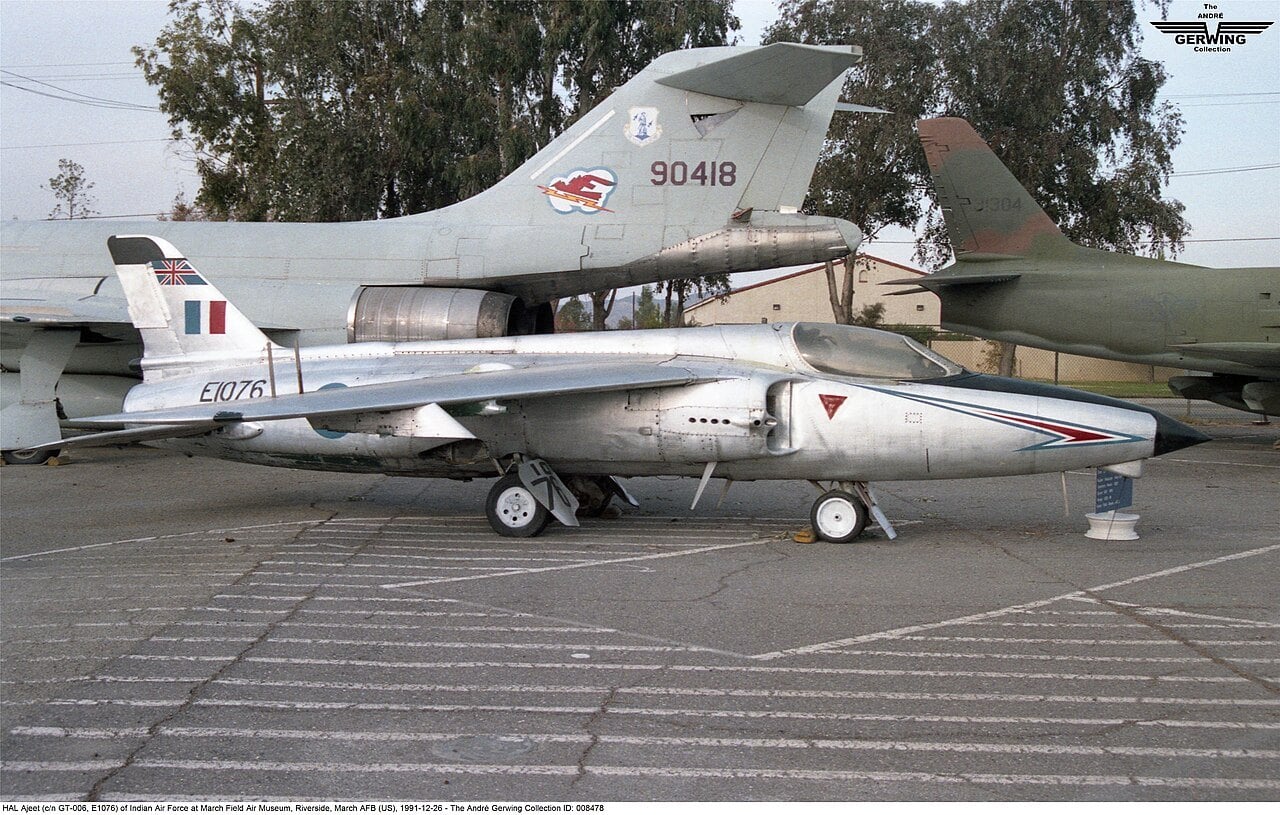
Behind the skin, HAL fitted improved hydraulics and controls, new avionics and an all-moving slab tailplane. The Folland Type 2G ejection seat gave way to a Martin-Baker GF4. The engine stayed the same: a single licence-built Bristol Siddeley Orpheus 701 turbojet of about 20 kN (4,500 lbf), pushing the Ajeet to around 1,100 km/h at sea level, according to Jane’s All the World’s Aircraft.
Aircrew Interview talks to former IAF pilot Anil Golani about flying the Ajeet.
There was a price. All that extra fuel, equipment and capability added weight, and pilots who flew both types agreed the Ajeet was the less nimble machine. Wing Commander A. K. “Lui” Gupta, who logged nearly 860 hours on Gnats and Ajeets, wrote for the Indian military history site Bharat Rakshak that a clean Gnat was significantly more agile and manoeuvrable than a clean Ajeet.
A short career in squadron service
According to aviation writer Greg Goebel, 79 Ajeets were built by the time production ended in 1982, and ten existing Gnats were upgraded to Ajeet standard. Bharat Rakshak puts the production total at the same 79. The type served with several IAF squadrons, among them No. 2, No. 18 and No. 22, and it was a day fighter only, without the instruments and lighting for night flying.
Timing worked against it. The Ajeet arrived after the 1971 war and was gone before Kargil, so it never fought in a major war. Through the 1980s the IAF was moving to supersonic, more capable fighters, and in 1986 it agreed to withdraw the Ajeet. No. 2 Squadron at Kalaikunda was the last unit to fly it, and the Ajeets were finally phased out in March 1991.
The trainer that came too late
The strangest chapter is the two-seater. For almost its entire Indian career, the Gnat family had no type trainer. New pilots flew dual checks in a Cacciatore di Hawker trainer, simulating the Gnat’s shallow approach, and then went solo in the single-seater. HAL proposed a trainer version of the Ajeet in June 1975, and the government approved its development in February 1976.
The Ajeet trainer had a fuselage 1.4 metres longer, with two seats in tandem and the rear cockpit stepped up so the instructor could see forward. Two internal fuel tanks were removed to make room, but the cannon and four pylons were kept. In April 1980 the government sanctioned 12 of them. Then the first prototype was lost in a crash on 30 December 1982, killing its pilot, Squadron Leader D. K. Powar. A second prototype flew in 1983.
Air Commodore T. K. “Tiku” Sen on the Gnat years of the Indian Air Force, the background against which the Ajeet was born.
The programme was revived in 1984 and stalled again in 1986, when the decision to retire the Ajeet itself left the trainer order in limbo. In the end, just two two-seaters reached the IAF in late 1987 and early 1988, first with No. 18 Squadron at Bagdogra and then with No. 2 Squadron at Kalaikunda. According to an Indian audit report quoted by Bharat Rakshak, they flew only between 0.15 and 5.30 hours a month from January 1988 to May 1990.
Invincible, briefly
Those who flew it remember it fondly. The trainer finally gave young pilots, including Indian Navy aviators heading for carrier jets, a taste of the single-seater’s acceleration and fast landings with an instructor behind them. When the Ajeets left service in March 1991, the two trainers were still serviceable and were flown to a base repair depot at Sulur.
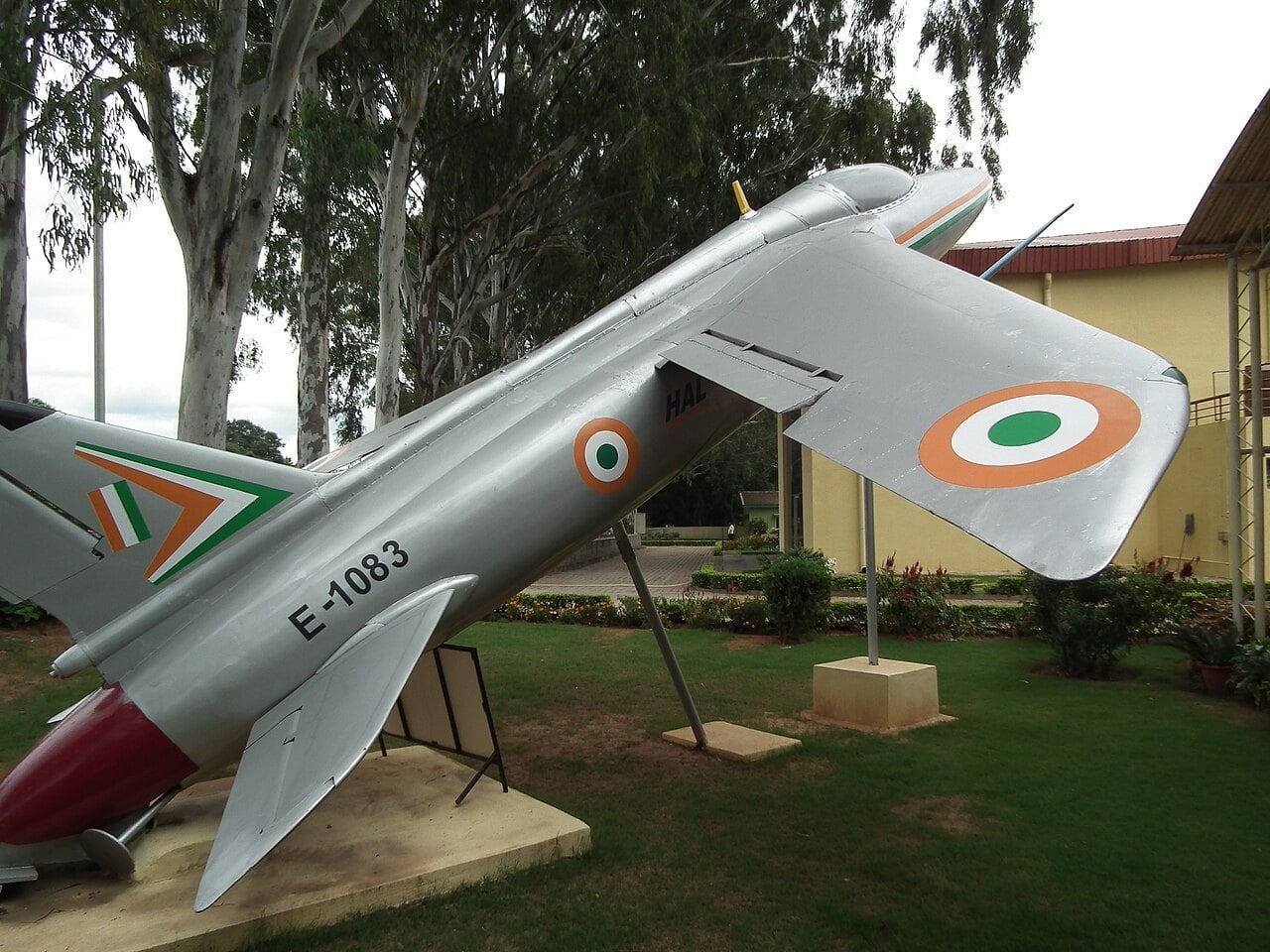
The Ajeet never matched the Gnat’s combat legend, and it was never meant to replace it as a symbol. What it did was teach HAL how to redesign a fighter rather than simply assemble one. A preserved Ajeet still stands, nose pointed skyward, at the HAL Aerospace Museum in Bengaluru, the city where HAL is headquartered.
Archive footage of the 1989 Vayu Shakti firepower demonstration, with the Ajeet flying alongside Canberras, MiGs, Hunters and Mirage 2000s.
It is a fitting pose for an aircraft named “invincible”. It was never beaten in the air, mostly because history never gave it the chance to fight.
Sources: Bharat Rakshak (Wg Cdr A. K. Gupta, “The Ajeet Trainer”), Comptroller and Auditor General of India report (via Bharat Rakshak), Greg Goebel (Air Vectors, “The Folland Gnat / HAL Ajeet”), Jane’s All the World’s Aircraft 1982–83

0 Comments