

Three point two kilometres of water sit on top of the only object that can explain what happened to K2 Airways Flight 1732. The Pakistan Navy says it has found it.
The announcement came on 29 and 30 September 2026, almost three months after the Boeing 737-400 freighter vanished on a routine night cargo run from Sharjah to Karachi. Navy vessels, using detection equipment developed by Pakistan’s National Engineering and Scientific Commission, identified the wreckage and the aircraft’s flight recorder at a depth of roughly 3,200 metres in the Arabian Sea.
That is a genuinely difficult piece of work, and it is worth being precise about what has and has not happened. The recorder has been located. Nothing in the reporting says it has been brought to the surface.
Informazioni rapide
Il volo — K2 Airways 1732, a Boeing 737-400 converted freighter registered AP-BOI, Sharjah to Karachi, lost on 7 July 2026 with five crew aboard.
The find — Pakistan Navy vessels located the aircraft’s flight recorder at a depth of roughly 3,200 metres in the Arabian Sea, announced on 29 and 30 September 2026.
The kit — detection equipment developed by Pakistan’s National Engineering and Scientific Commission (NESCOM), aboard Pakistan Navy ships.
Stato — reporting describes the recorder as located, not confirmed as physically recovered. Bringing it up from 3,200 metres is a separate operation.
Who reads it — Pakistan’s Bureau of Air Safety Investigation, which is leading the inquiry.
For comparison — the Air France 447 recorders were found at 3,980 metres in April and May 2011, almost two years after that aircraft went down.
What was lost, and where
AP-BOI left Sharjah on the evening of 7 July 2026 with five people aboard: two pilots, a loadmaster and two engineers. About 155 nautical miles out from Karachi the crew reported a problem with the navigation system. Controllers began working the issue with them. Three minutes later the radar picture showed the aircraft descending fast and swinging off heading, and then there was nothing.
Debris was found within roughly twelve hours, some 53 nautical miles south of Ormara. That is the easy part of a maritime accident: floating wreckage drifts, and it tells you roughly where to look. What it does not give you is a cockpit voice recorder.

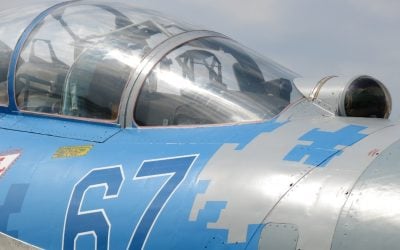
The 737 had been converted from a passenger aircraft to a freighter, a second career that thousands of Classic-generation 737s have had. It wore the registration VP-CFG when the photographs above and at the top of this article were taken, and became AP-BOI when K2 Airways put it on the Pakistani register.
Why finding it took until September
The flight recorders on an airliner carry an underwater locator beacon that starts pinging on contact with water. It is a 37.5 kHz tone, it is audible to the right sonar at a useful range, and it runs for about thirty days. After that the recorder is simply a bright orange box on a dark seabed.
By the time the Pakistan Navy was working the deep search, that window had closed months earlier. Locating the recorder therefore meant mapping the debris field with sonar and working through it, rather than following a sound. At 3,200 metres there is no diver option at all: the pressure is around 320 atmospheres, and everything that happens down there happens through a vehicle on a cable or an autonomous one with a sonar head.

The Air France 447 yardstick
Every deep-ocean recorder search is measured against Air France 447, and for good reason. The Airbus A330 went into the Atlantic on 1 June 2009. Its recorders were not located until April 2011 and not lifted until May, from 3,980 metres, after four separate search phases involving a French nuclear submarine, autonomous underwater vehicles and finally a Remora 6000 remotely operated vehicle working from a recovery ship.
Against that, under three months is quick. It is also a reminder of what still lies ahead. AF447 proved that the recorders survive: after nearly two years in salt water at four kilometres down, both memory units were readable, and the data they held rewrote how the industry trains pilots for high-altitude stall.
The CBS report above, with Chesley Sullenberger walking through the AF447 findings, is the clearest short account of what a recovered recorder can tell you, and of how long the wait can be.
What the recorder could settle
The known facts of 1732 are thin and, read together, odd. A navigation system fault reported calmly. Controllers helping. Then, within three minutes, a descent steep enough that a published figure for it is 22,400 feet per minute, together with a large heading change. A navigation fault on its own does not do that to a serviceable 737.
Flight data would show the control inputs, the engine parameters, the autopilot modes and whether the aircraft was still answering normally. The voice recorder would show what the crew were dealing with in those last minutes. Neither exists as evidence until the box is on a bench at an accredited laboratory, which is why the distinction between located and recovered matters so much.
For the families of Captain Muhammed Rizwan Idrees, First Officer Faisal Jatoi, loadmaster Towfiq Khan and engineers Arif Siddiqui and Mohammed Hamid, that distinction is the difference between a headline and an answer. They have been waiting since July, and they have been publicly critical of how little they have been told. A box on the seabed at 3,200 metres is not yet an explanation. It is the first thing in three months that could become one.
Sources: ProPakistani, 30 September 2026; 24NewsHD, 29 September 2026; AirlineRatings reporting on the July search; CNN and Aviation Week, July 2026; Bureau of Air Safety Investigation and Pakistan Civil Aviation Authority statements as reported; BEA final report on Air France 447. Quotations are reproduced as published by the outlets named.

0 Comments