
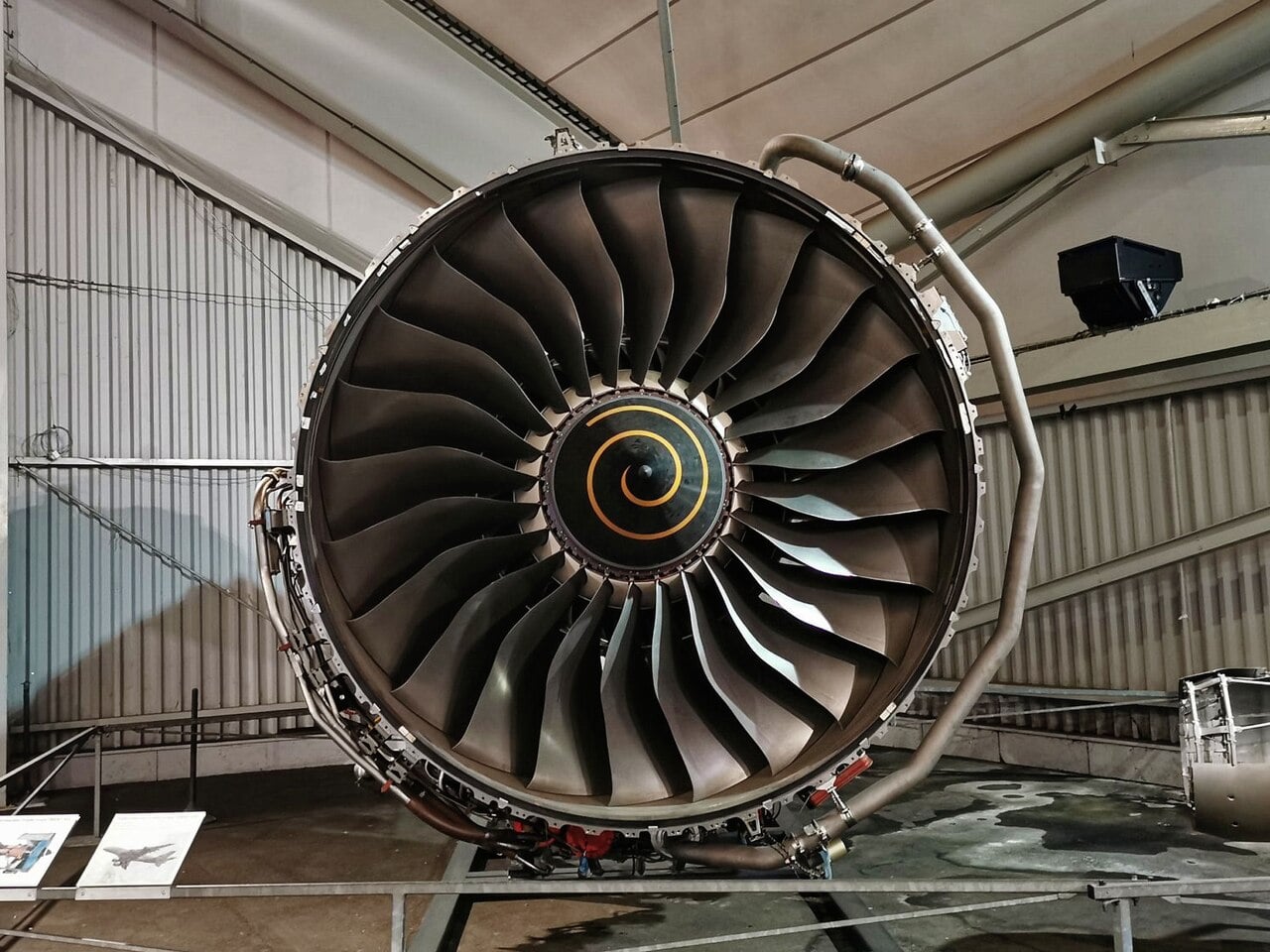
The most violent test an airliner engine ever faces happens on the ground. With the engine running at its maximum permitted speed, a small explosive charge at the root of one fan blade cuts it loose. The blade must be stopped by the engine casing, and the engine must not catch fire or tear off its mounts. Rolls-Royce did exactly that with the Trent 900 before the Airbus A380 carried its first passengers.
Informazioni rapide
- Motore: Rolls-Royce Trent 900, for the Airbus A380
- Thrust: Up to about 76,500 lb
- Fan diameter: 116 inches (2.95 m), with swept fan blades
- Containment: Ribbed titanium fan case
- Blade-off test: Derby, UK, completed by early 2004
- Regola: 14 CFR 33.94 (FAA) and EASA CS-E
- Pass criteria: Blade contained; no fire and mounts intact for at least 15 seconds
What the Rules Demand
Under the US rule, 14 CFR 33.94, and its European equivalent, an engine maker must show by test that the engine contains the failure of a fan or compressor blade released at the outermost retention groove at maximum permissible rotor speed, and of the most critical turbine blade. After the event the engine must run for at least 15 seconds without catching fire and without its mounting attachments failing, unless the damage shuts it down on its own. It does not have to keep producing thrust; it has to stay a contained, non-burning piece of hardware on the wing.
The Trent 900 Test
Rolls-Royce first proved its lightweight fan containment concept on a rig in 2002, using a Trent 500-sized fan and casing as a scaled-down stand-in for the larger engine. The full Trent 900 blade-off test followed on a special rig at Derby. An explosive charge at the root released a fan blade at maximum speed, and the blade was held inside the armoured titanium containment system that surrounds the engine in flight. The film of the test shows the blade going, a burst of debris inside the case and the fan winding down, still enclosed.
The case has to absorb the released blade and also the heavy imbalance of the remaining fan, which can shake the engine violently as it runs down. That is why the test checks the mounts as well as the case.
Why QF32 Was Different
The Trent 900 is also the engine of the most famous uncontained failure of recent times. On 4 November 2010, an intermediate-pressure turbine disc burst on Qantas Flight 32, an A380 climbing out of Singapore, and debris pierced the wing. That was not a fan blade. The Australian Transport Safety Bureau traced it to an oil fire caused by a misaligned oil feed stub pipe, which led to the turbine disc separating and overspeeding. A spinning disc carries far more energy than a single blade, and engines are not designed to contain disc bursts; instead, the industry relies on design, inspection and life limits to prevent them. The crew landed safely and nobody was hurt. We tell that story in Qantas 32.
What the Popular Clip Gets Right
The usual description of the footage is accurate: it shows a Rolls-Royce Trent 900 blade-off test carried out during A380 development, with a fan blade deliberately released at high speed and contained by the titanium casing, as required before the engine could enter service.
Sources: Aircraft Engineering and Aerospace Technology, “Blade containment test” (February 2004); FlightGlobal (3 December 2002 and 19 July 2004); University of Cambridge, Trent 900 engine information sheet; US Code of Federal Regulations, 14 CFR 33.94; Australian Transport Safety Bureau, investigation AO-2010-089, final report (2013).


0 Comments