
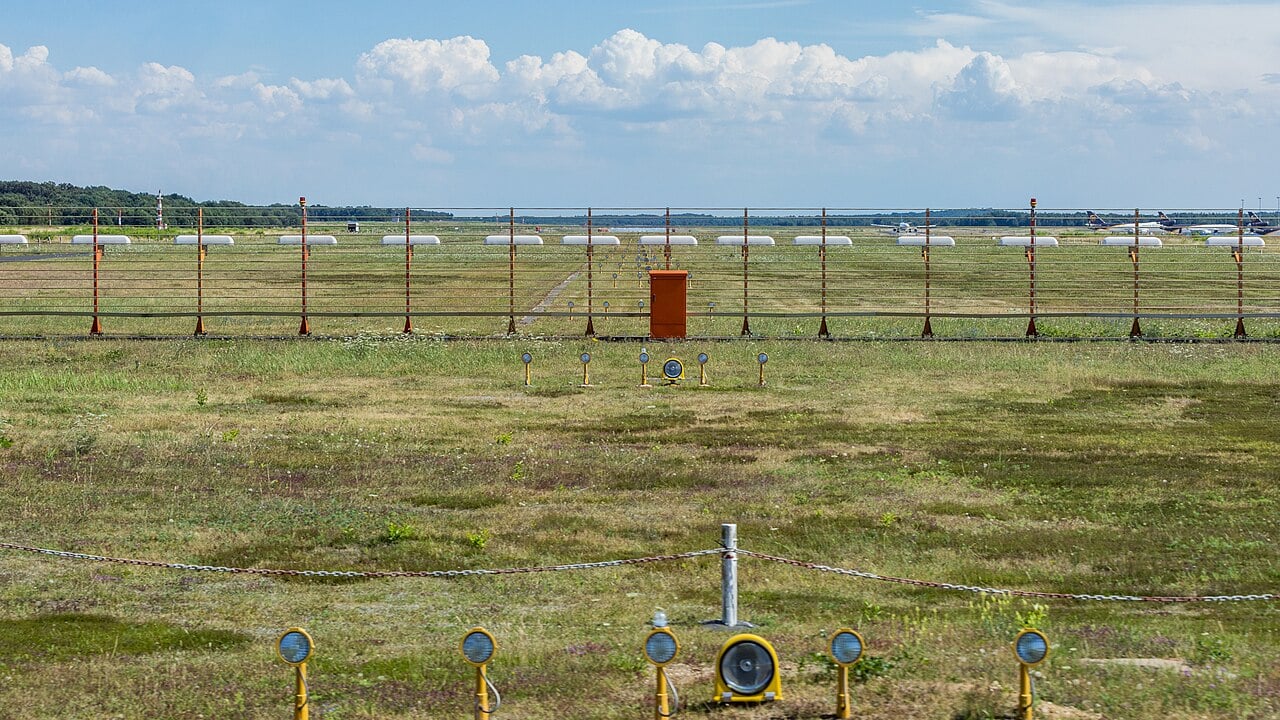
At 18:31 on 28 October 2006, five minutes after sunset, a Continental Boeing 757 with 154 people aboard touched down at Newark at about 140 knots. It was a routine arrival in every respect but one. The aeroplane was not on runway 29. It was on taxiway Zulu, 75 feet wide, parallel and to the right.
Nobody was hurt and nothing was bent, so the file is thin. But read the National Transportation Safety Board’s factual report and a specific picture assembles itself. The runway’s high-intensity edge lights were set to step 1 of 5. The taxiway’s green centreline lights were set to step 3 of 5. The crew saw four white lights on the PAPI, pitched down to catch the slope, and then concluded that the PAPI must be on the left of the runway, because that is where PAPIs normally live. At Newark, runway 29’s PAPI is on the right.
Six aircraft flew the same approach within ten minutes and landed on the runway. The difference was not competence. It was that one crew read an airfield lighting system that is, in fact, a dense and extremely literal language — and misread two words of it.
Here is the whole vocabulary.
Informazioni rapide
Runway edge lights: white, turning yellow (the FAA handbook says amber) over the last 2,000 ft or half the runway, whichever is less
Runway centreline lights: white, alternating red and white from 3,000 ft to 1,000 ft remaining, all red for the last 1,000 ft
Threshold lights: green outward to arrivals, red inward to departures, usually from a single bidirectional fixture
Taxiway edge: blue · taxiway centreline: green · stop bar: red · runway guard lights: flashing yellow
PAPI on slope: two white, two red, at a nominal 3 degrees
Brightest fixture: an L-862 runway edge light, 10,000 candela white · dimmest: a taxiway edge light, 2 candela minimum
Standby power, CAT II/III: one second to restore threshold, end, centreline, touchdown zone and all stop bars
Pilot-controlled lighting: 7, 5 or 3 clicks of the microphone within 5 seconds; 15-minute timer
The Runway Tells You How Much Is Left
Every colour on a runway is a distance measurement in disguise.
IL edge lights are white. On an instrument runway, yellow replaces white over the last 2,000 feet (610 m), or half the runway length if that is shorter, to form what the Aeronautical Information Manual calls a caution zone. The fixtures in that zone are directional: they show yellow to a pilot landing toward the far end and white to one rolling the other way. Spacing is at most 200 feet. The International Civil Aviation Organization writes the same idea in metric and makes it optional: 600 metres or one third of the runway, and the lights “may” show yellow, at spacing of no more than 60 metres on an instrument runway.
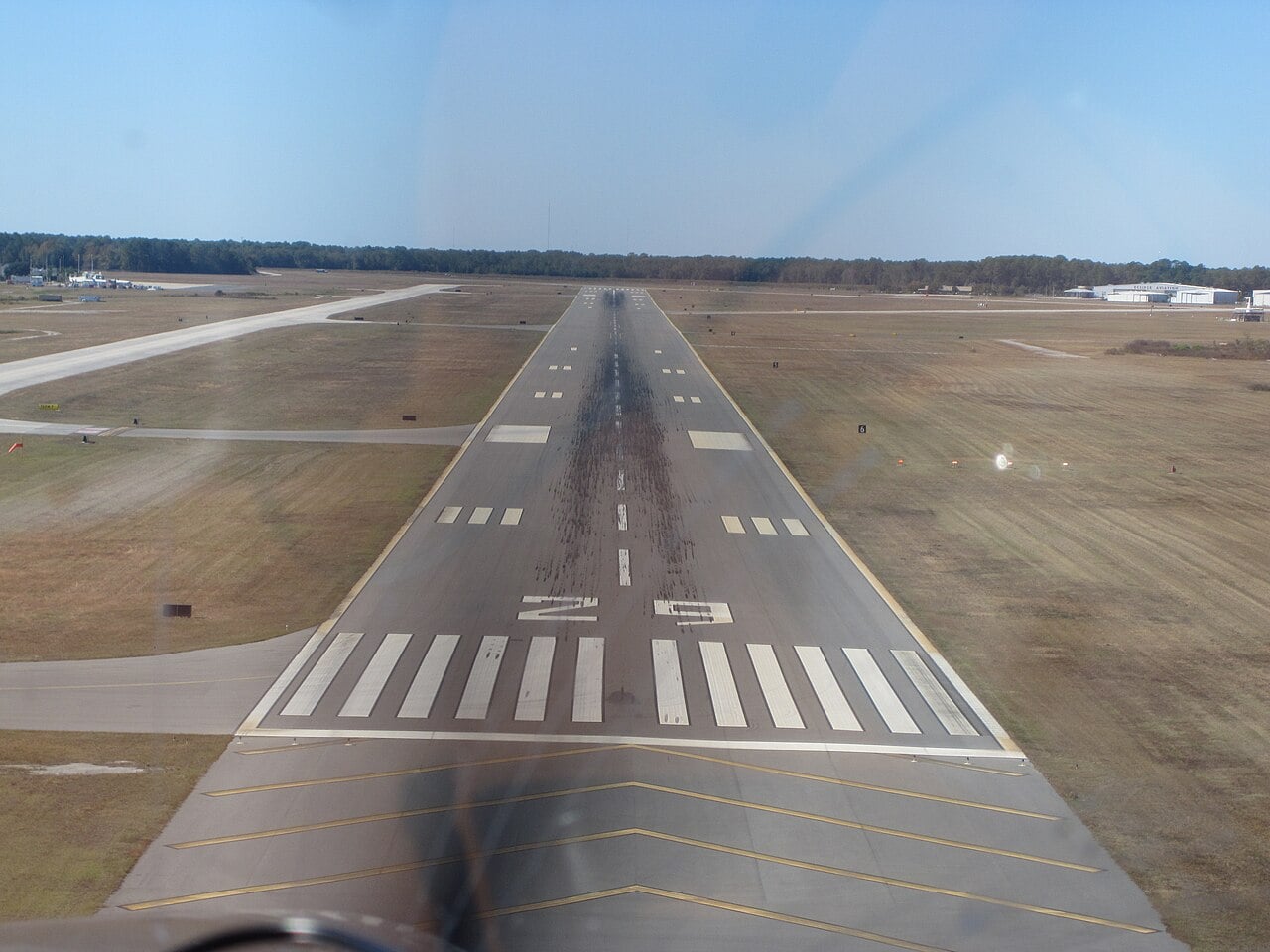
IL centreline lights are the better clock, and they are in the pavement rather than beside it. White from the threshold until 3,000 feet remain. Then alternating red and white, starting with red, for 2,000 feet. Then solid red for the last 1,000 feet. ICAO sets the same sequence at 900, 600 and 300 metres, with one wrinkle worth knowing: on a runway shorter than 1,800 metres the red-and-white band starts at the midpoint instead. Spacing is 50 feet, which means a 757 at 140 knots crosses one about every quarter of a second.
IL threshold lights are the neatest piece of engineering on the airfield. They are green when you look at them from the approach and red when you look at them from the runway. Most of the time that is not two sets of lights but one: the FAA’s own installation advisory circular says the red and green are “usually combined into one fixture and special lenses or filters are used to emit the desired light in the appropriate direction.” ICAO, characteristically, prefers two separate unidirectional systems and only permits the shared fitting.
Touchdown zone lights are the two rows of short white bars that straddle the centreline for the first 3,000 feet. Each bar is three lights, five feet apart. The bars sit 100 feet apart, 30 of them, with the rows 72 feet apart overall, and each light is toed four degrees inward toward the centreline. ICAO allows those pairs at 30 or 60 metres and calls them barrettes. They are required for Category II and III operations, and in the United Kingdom their length does a second job: the 900 metres of touchdown zone lighting defines the length of the obstacle free zone, which is why a go-around started beyond the last bar is, in the Civil Aviation Authority’s dry phrasing, unlikely to be contained within it.
PAPI: Four Boxes, Five Answers
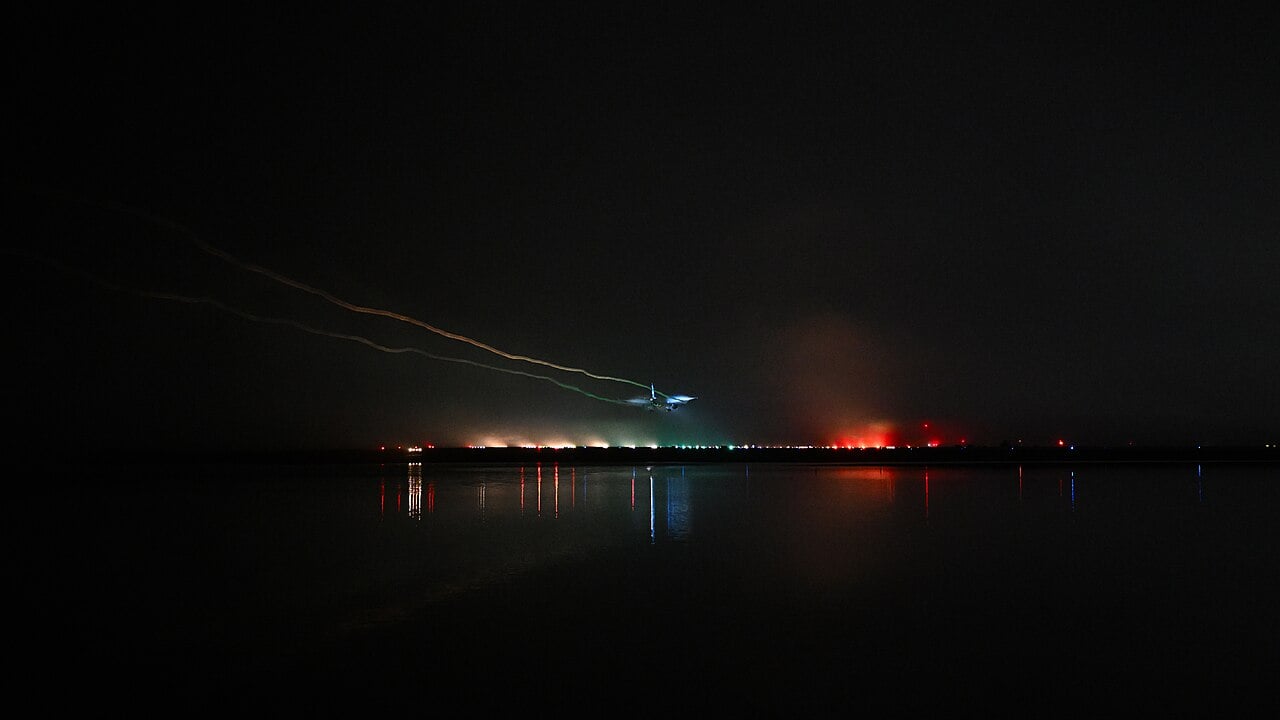
The precision approach path indicator is a row of four light units beside the touchdown zone, each projecting white above a sharp transition and red below it. The transition is fierce by design: at 300 metres it has to look like it happens inside three minutes of arc.
Read left to right from the runway outward, the four answers are: all white, you are well above; three white and one red, slightly above; two and two, on slope; one white and three red, slightly below; all red, well below. On a standard three-degree path the four units are aimed at 3°30′, 3°10′, 2°50′ and 2°30′. The FAA’s own Pilot’s Handbook gives the same thing in decimals: more than 3.5 degrees, 3.2, 3.0, 2.8, and less than 2.5.
Three degrees is the standard. Non-jet runways may be raised to four for obstacle clearance, and a PAPI steeper than its published angle has to be issued as a NOTAM. A PAPI is visible from about five miles by day and up to twenty at night, and it is installed on the left side of the runway unless something makes that impossible. When it is on the right, the FAA’s installation manual carries a warning in bold terms: the units nearest the runway must still read red and the two farthest must still read white. The signal does not flip to match the side.
One piece of folklore deserves killing here. “Red over white, you’re all right; white over white, check your height; red over red, you’re dead” appears in no FAA or ICAO publication. A search of the Aeronautical Information Manual, the Pilot’s Handbook, the Pilot/Controller Glossary, AC 150/5340-30J, FAA Order JO 6850.2C, ICAO Annex 14 Volume I and two UK CAA publications returns zero hits for any phrase in it. It is a two-bar VASI mnemonic anyway, not a PAPI one, and the VASI is no longer installed as a new facility in the United States. An Air Mobility Command article on the subject went further and argued that on a KC-10 short final at one red and three white, the wheel path can actually penetrate the obstacle clearance surface. Two red and two white is a glide path indication, not a guarantee.
Blue Is for Edges, Green Is for Going
Taxiway edge lights are blue. Taxiway centreline lights are green. Everybody who has ever looked out of a window at night knows this, and almost nobody knows why, including the documents.
No primary FAA or ICAO text gives a rationale for the choice. What the standards do give is the constraint. Only six colours are defined for aeronautical ground lights — red, variable white, white, green, yellow and blue — each pinned to a chromaticity region, and ICAO opens that appendix with an admission of unusual candour.
There is one documented operational reason to be careful with green: ICAO notes that the distribution of green lights on or near a runway must be limited to avoid confusion with threshold lights. And there is a practical reason blue works for edges. A taxiway edge light has a minimum intensity of 2 candela. A high-intensity runway edge light is specified at 10,000. Blue is not merely a different colour from white; it is five thousand times dimmer, which is a fairly emphatic way of saying do not land here.
Between those two sit the yellow lights, and they are the ones that save lives. A clearance bar is three steady yellow lights in the pavement at a low-visibility hold point. Runway guard lights — a pair of flashing yellow lights either side of the taxiway, or a row of them across it — mark a taxiway/runway intersection and may be used in any weather. The nickname is in the primary literature: the UK CAA’s CAP 637 says they are “often referred to as ‘Wig Wags’.” The in-pavement version pulses at 30 to 32 flashes a minute and the elevated version at 45 to 50; ICAO allows anything from 30 to 60 cycles.
And then there is the stop bar, which is the only light on an airfield that overrides a human being.
The One Rule You Do Not Break
A stop bar is a row of red, unidirectional, steady in-pavement lights across the full width of the taxiway at the runway holding position, with elevated red lights on each side. It is interlocked with the green lead-on lights beyond it, so that when the bar is lit the lead-on lights are dark and vice versa. CAP 637 puts it as plainly as anyone: the two act in the same sense as traffic lights.
Read that twice. The lights outrank the controller.
ICAO is stricter than the FAA about when they must exist. Stop bars are required at every runway-holding position on a runway used below 550 metres RVR, only one may be illuminated at a time at an intersection, and when a stop bar is on, the taxiway centreline lights beyond it have to be extinguished for at least 90 metres. ICAO also notes, in a line that reads differently after 2024, that runway incursions take place in all visibility and weather conditions, and that using stop bars at night and in good visibility can form part of effective prevention.
The Rabbit, and What It Is Worth
An approach lighting system runs from the threshold out into the approach for 2,400 to 3,000 feet on a precision runway, or 1,400 to 1,500 on a non-precision one. The high-intensity Category II and III version, the ALSF-2, is a serious installation: 24 centreline bars at 100-foot spacing out to 2,400 feet, a 21-light crossbar 100 feet wide at the 1,000-foot mark, four-light bars either side at 500 feet, nine red side-row bars in the inner 900 feet aligned with the touchdown zone lights, and a green threshold bar extending 45 feet beyond each runway edge. The FAA counts it at 247 steady lights plus 15 strobes, on 2,600 by 400 feet of land.
Those 15 strobes are the famous part. Officially they are sequenced flashing lights, or runway alignment indicator lights where they form the outer extension of a shortened system. They emit a bluish-white flash, fire in sequence toward the threshold twice a second, and the FAA’s own description of the effect is better than the slang: they “appear as a ball of light traveling toward the runway threshold.” Pilots call it the rabbit. That word appears in none of the primary documents.
Here is the counter-intuitive bit. Lose the rabbit and an ILS approach loses nothing. The FAA’s inoperative components table carries an explicit exception: with the sequenced flashing lights out, or an ALSF running as an SSALR, there is no effect on visibility minima for ILS lines of minima. Lose the whole approach lighting system and an ILS goes from RVR 1,800 or 2,000 to RVR 4,000, and a non-precision approach gives up half a statute mile. Lose the touchdown zone or centreline lights and the ILS stops at RVR 2,400. Those two in-pavement systems are what buy the last step down to RVR 1,800.
The Beacon, and Clicking the Microphone
Two more pieces, both of which are American conventions rather than global ones.
An airport’s rotating beacon flashes 24 to 30 times a minute and the colours are a code. White and green is a lighted land airport. White and yellow is a water airport. Green, yellow and white is a heliport. And a military airfield flashes white and green like a civil one but slips in two quick white flashes between the greens. The civil beacon is usually not two lamps at all but one rotating assembly with a green lens on one side and a clear lens on the other. Burning in daylight inside Class B, C, D or E surface airspace, a beacon often means the ceiling is below 1,000 feet or the visibility below three miles — but the AIM is careful to say there is no regulatory requirement for it, and that pilots should not rely on it.
ICAO sets 20 to 30 flashes a minute, allows white-only beacons, has no military code and no three-colour heliport beacon in Volume I, and adds an identification beacon that flashes the aerodrome’s two-letter identifier in Morse at six to eight words a minute. In the United Kingdom, a government aerodrome’s identification beacon is red.
At a field with no tower on duty, the lights are yours. Seven clicks of the microphone within five seconds on the published frequency gives the highest intensity available, five gives medium, three gives the lowest, and everything stays on for 15 minutes from the last activation. The AIM’s advice is to always key seven first and dim afterwards, and to key again on final even if the lights are already on, because the receivers are deliberately insensitive and you may not have been close enough to restart the clock. One correction to the common version of this: the frequency is not always the CTAF. The AIM says so explicitly, and the right frequency is in the Chart Supplement, not on the sectional.
One Second, and Why LEDs Are Not Free
Airfield lighting has a failure budget measured in seconds. ICAO’s Table 8-1 sets the maximum switch-over time for a secondary power supply, defined as the interval during which the light’s intensity falls below half and recovers. For a Category I precision runway it is 15 seconds. For Category II and III it is one second for the inner 300 metres of the approach lights, the threshold, the runway end, the centreline, the touchdown zone and every stop bar, with 15 seconds allowed for the outer approach lights, the runway edge and essential taxiway lighting. FAA Order 8400.13F says the same thing in different words: standby power with a one-second transfer, and remote monitoring so crews can be told immediately if a system has failed.
The current upheaval is the LED conversion, and the FAA has been unusually frank about its costs. A 2022 Civil Aerospace Medical Institute review sets out two problems. The first is heat. Incandescent lamps were inefficient, and that waste heat melted snow and ice off the fixture; LEDs do not produce enough, so cold-climate airports need an added heater circuit. The second is stranger. Enhanced and night vision systems that look for infrared point sources may simply not see an LED. The report’s conclusion is blunt: the lack of heat makes LEDs incompatible with some flight deck vision systems.
The FAA’s own EFVS newsletter of March 2026 goes further, confirming that there are currently no plans to add infrared emitters to LED bulbs, that heaters fitted for snow are not intended as emitters and may not be warm enough to serve as them, and that the official way crews are told which runways have converted is a standard remark in the chart supplement. It publishes a rolling list of airports due for conversion. There is also a quieter maintenance problem: an incandescent lamp fails completely and obviously, while an LED fades, which means somebody has to go out and measure brightness on a schedule.
Three Times the Lights Told the Wrong Story
Newark in 2006 is the small version. The large version is Taipei, 31 October 2000, in typhoon Xangsane. Singapore Airlines flight 006, a Boeing 747-412, was cleared for runway 05L and taxied onto the partially closed 05R instead. Eighty-three people died.
Taiwan’s Aviation Safety Council listed what the crew had in front of them, and the list is almost entirely made of the systems described above: taxiway N1 centreline lights leading to 05L, the green centreline lights on 05R, the 05R edge lights most likely not illuminated, the width difference between the two runways, the lighting configuration difference between them.
Four days after the accident, investigators found that a green centreline light just past the 05R entry point on the correct route to 05L was unserviceable and the next one was dim. The lights that led to the wrong runway were more visible than the ones that led to the right one, because they were more densely spaced: there should have been 16 centreline lights at 7.5-metre intervals along that straight segment of N1. There were four, at 30, 55, 116 and 138 metres. The airport had no runway guard lights, no stop bars, no green-and-yellow coding of the ILS sensitive area, and no interlock to prevent the runway lighting and the taxiway centreline lighting being on at the same time. The ASC was careful to say that the absence of all this was not sufficient to have caused the loss of situational awareness. It is still the most complete list ever published of what airfield lighting is for.
The third case is the most recent and the most uncomfortable. On 2 January 2024 a Japan Airlines A350 landed on runway 34R at Tokyo Haneda and struck a Japan Coast Guard Dash 8 that had entered the runway without clearance. The Japan Transport Safety Board’s interim report has a section heading that says everything: aerodrome lights not in operation at the time of the accident.
The stop bars on that runway existed and worked. They had been taken out of service for a project to replace the ageing control system, and Japanese policy only turned them on below 600 metres visibility in any case. The visibility that evening was good. And the JTSB found something else that no stop bar would have fixed: the Dash 8 was stopped over illuminated white centreline and touchdown zone lights, and the only external lights visible from behind it were a white strobe and two white position lights, roughly in line with the row of white runway centreline lights. The aircraft was camouflaged by the runway it was standing on.
EASA issued a safety information bulletin in October 2025 citing Haneda by name and recommending that stop bars be used at any time of day regardless of visibility, noting that in practice this is only occasionally done.
There is one more case that is often miscast, and it is worth getting right. When an Air Canada A320 descended over four aircraft on taxiway C at San Francisco in July 2017, the NTSB stated flatly that airport lighting, which met US regulations, was not a factor. What the board did find was that the flashing white X marking the closed parallel runway was never designed to catch the eye of a crew aligned with something else, and did not. The human detail in the report is the one that stays with you.
A pilot on the ground turned his landing lights up at an airliner. In a system built entirely out of coloured light, that is the oldest instruction there is, and it worked.
Sources: FAA Aeronautical Information Manual chapter 2 section 1; FAA AC 150/5340-30J; FAA AC 150/5345-46F and 150/5345-51B; FAA Order JO 6850.2C; FAA Order 8400.13F CHG 1; FAA Pilot’s Handbook of Aeronautical Knowledge chapter 14; FAA Pilot/Controller Glossary; ICAO Annex 14 Volume I; UK CAA CAP 637 and CAP 168; NTSB NYC07IA015 and NTSB/AIR-18/01; Aviation Safety Council Taiwan final report on SQ006; Japan Transport Safety Board interim report of 25 December 2024; EASA SIB 2025-07; DOT/FAA/AM-22/08; FAA EFVS newsletter, March 2026.


0 Comments