

It had three engines, a great ugly hump on its back, and a name its own crews spat out with grim affection: il gobbo maledetto — the damned hunchback. Yet the Savoia-Marchetti SM.79 Sparviero was, for a time, one of the finest torpedo bombers of the Second World War, and the aircraft Allied sailors in the Mediterranean learned to fear.
Before the war it had been a record-breaking racer and a symbol of Fascist Italy’s modernity. In war it became a ship-killer. Few aircraft carried such a strange double life.
Quick Facts
| Aircraft | Savoia-Marchetti SM.79 Sparviero (“Sparrowhawk”) |
| Layout | Three-engine (trimotor) monoplane |
| First flight | 1934; designer Alessandro Marchetti |
| Nickname | Il gobbo maledetto — “the damned hunchback” |
| Crew | Five (six in the bomber version) |
| Built | Roughly 1,300 |
| Records | 26 world records set 1937–1939 |
| Service life | Into the 1950s (Lebanon flew it until 1959) |
A racer with a hump
The SM.79 began life as a fast civil transport and air racer, designed by Alessandro Marchetti and first flown in 1934. Its trimotor layout — two engines on the wings, one on the nose — was chosen for reliability, and the fuselage carried a distinctive raised hump behind the cockpit that housed a gun position and gave the aircraft its unflattering nickname. Crews loved it anyway.

In the late 1930s the Sparviero set twenty-six world records for speed, altitude and distance, and Italy paraded its racing crews — the famous Sorci Verdi, the “Green Mice” — as proof of national prowess. Then came Spain, where the SM.79 flew its first combat missions in the civil war, relying on its speed to survive.
The ship-killer of the Mediterranean
The SM.79’s real fame came with the Aerosiluranti — Italy’s torpedo-bomber squadrons. Roaring in low over the sea to drop their torpedoes, SM.79 crews became some of the most effective anti-shipping fliers of the war, harrying British convoys and warships across the Mediterranean. Aces like Carlo Emanuele Buscaglia built fearsome reputations at the controls of the hunchback.
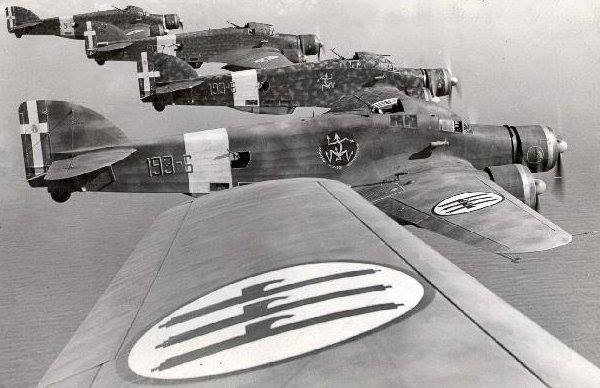
It was dangerous work. Attacking well-defended ships at wave-top height, torpedo crews suffered brutal losses, and the SM.79 was slow and vulnerable to modern fighters. But in skilled hands it kept scoring hits long after Italy’s bomber fleet had otherwise been outclassed.
A long afterlife
Around 1,300 SM.79s were built, and they served far beyond Italy — in Spain, Yugoslavia and Romania, the last of which built its own versions. The type outlived the war by years: Italy retired it in 1952, and Lebanon flew SM.79 transports until 1959. Two complete examples survive, both returned to Italy from Lebanon.
For all the jokes about its hump, the SM.79 was the rare aircraft that was both a pre-war celebrity and a genuinely dangerous weapon. The damned hunchback earned its keep.
Frequently Asked Questions
What was the Savoia-Marchetti SM.79 Sparviero?
Why was it called the damned hunchback?
Why did it have three engines?
Was the SM.79 actually any good?
How long did the SM.79 remain in service?
Sources: Marco Mattioli, “Savoia-Marchetti S.79 Sparviero Torpedo-Bomber Units”; Wikipedia.


0 Comments