
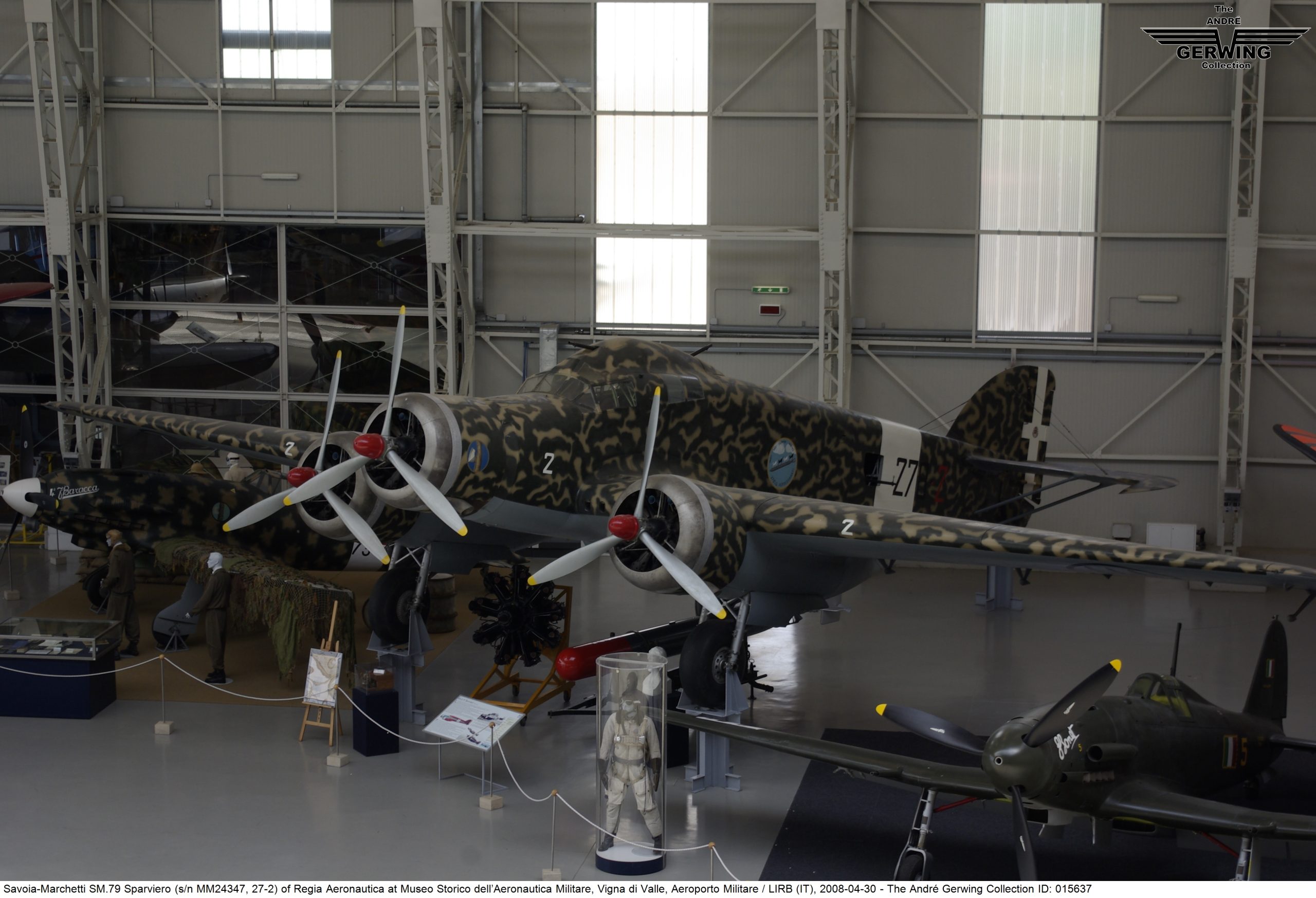
Savoia-Marchetti SM.79 Sparviero
Fast, tough and unmistakable, the Savoia-Marchetti SM.79 Sparviero was the most important Italian bomber of the Second World War — a three-engined "damned hunchback" that began as a record-breaking airliner and became the most feared torpedo bomber in the Mediterranean.
The Savoia-Marchetti SM.79 Sparviero: the record-breaking airliner that became Italy’s deadliest torpedo bomber
Begin with a fast, elegant civil transport that shattered world speed and distance records in the mid-1930s, give it a military nose, a bomb bay and a distinctive humped back, and you arrive at the Savoia-Marchetti SM.79 Sparviero — the three-engined "Sparrowhawk" that became the single most important, and most feared, Italian aircraft of the Second World War.
The SM.79 did not start life as a weapon. In the autumn of 1934 Alessandro Marchetti’s design bureau at Savoia-Marchetti flew a sleek, low-wing, three-engined monoplane intended as a fast eight-passenger airliner and mail carrier. It was a product of the golden age of Italian aviation, when Italo Balbo’s mass formation flights across the Atlantic had made Italian air power a matter of national pride, and speed records were pursued as instruments of prestige. The little transport delivered handsomely: through 1935, 1936 and beyond, specially prepared SM.79s set a string of recognised world records for speed over distance carrying commercial payloads, and Italian crews flew them on long-distance demonstration flights that made headlines around the world.
The most famous of these triumphs came in August 1937, when a team of military SM.79s painted with a cartoon "Sorci Verdi" (green mice) badge swept the first three places in the gruelling Istres–Damascus–Paris air race, beating aircraft from across Europe over thousands of kilometres. For a fascist regime that treated aviation as propaganda, it was a gift: proof, seemingly, that Italian industry could build aircraft that were not merely beautiful but genuinely fast and reliable over enormous distances. That reputation for speed and endurance was no accident of tuning — it was built into the airframe, and it would shape the Sparviero’s whole military career.
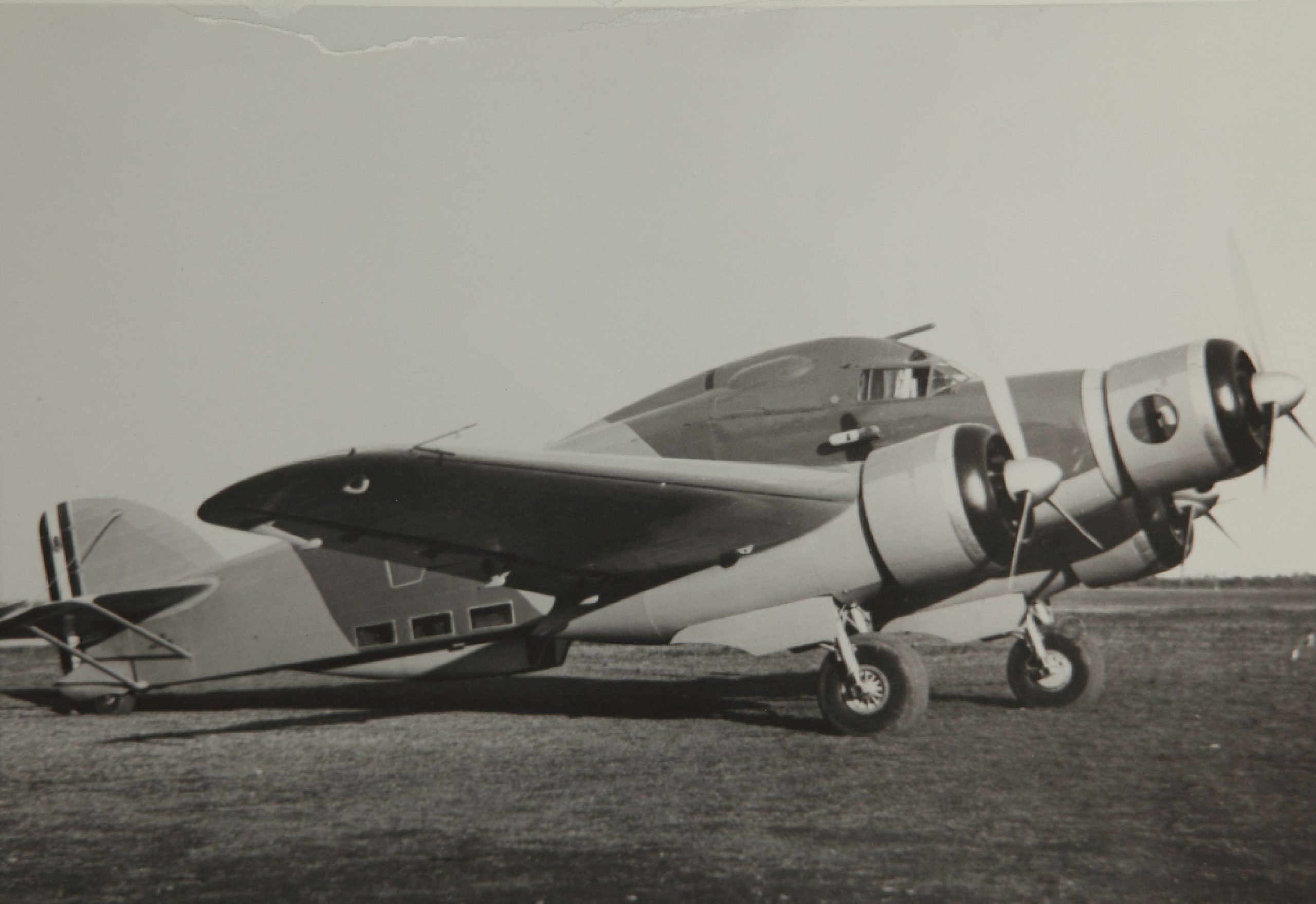
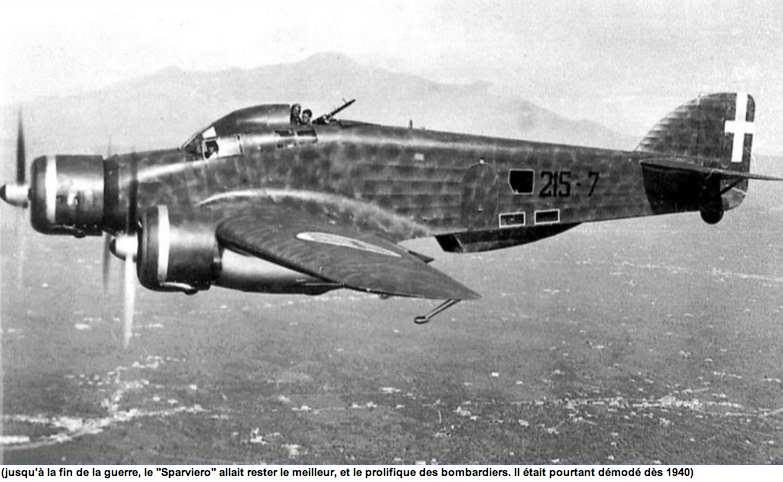
Turning the record-breaker into a bomber meant adding a bomb bay, defensive guns and a crew station for a bomb-aimer, and it was here that the aircraft acquired its unmistakable silhouette. Behind and above the cockpit, Savoia-Marchetti added a raised dorsal position — a hump housing a fixed, forward-firing 12.7 mm Breda-SAFAT heavy machine gun that the pilot aimed by pointing the whole aeroplane. That bulging dorsal gondola gave the SM.79 the humpbacked profile that Italian crews affectionately turned into a nickname: il gobbo maledetto, "the damned hunchback," or simply il gobbo, "the hunchback." Few aircraft have ever worn an insult so proudly.
A record-breaking airliner turned bomber, humpbacked and trimotored, that Italian crews nicknamed il gobbo maledetto — the damned hunchback — and flew straight down the throats of the Royal Navy.
Under the skin the Sparviero was a period piece in the best sense: a mixed-construction machine of wood and metal, with a wooden wing and a fuselage of welded steel tube covered in a patchwork of duralumin, plywood and fabric. That construction was cheap, forgiving and easy to repair in the field, and combined with three engines it made the SM.79 famously tough — able to absorb battle damage, fly home on two engines and put down on rough desert strips that would have wrecked a more delicate aircraft. Powered by three radial engines (early SM.79-I aircraft used roughly 780-horsepower Alfa Romeo 126 radials; the definitive SM.79-II adopted more powerful Piaggio or Alfa Romeo units of around 860 to 1,000 hp, though figures vary between sources and sub-types), it was fast for a bomber of its generation and, crucially, hard to catch at low level.
The Sparviero first went to war not over the Mediterranean but over Spain. From 1937 the Aviazione Legionaria — the Italian expeditionary air arm supporting Franco’s Nationalists — flew SM.79s as fast bombers in the Spanish Civil War, where their speed made them difficult targets and confirmed the type as the backbone of Italy’s bomber force. By the time Italy entered the Second World War in June 1940, the SM.79 was the most numerous bomber in the Regia Aeronautica and the aircraft on which Italian bombing doctrine was built.
Numbers tell part of the story. When Italy went to war in June 1940 the Regia Aeronautica had more SM.79s than any other bomber, and the type served on every front the Italians fought: over Malta and the French Riviera in the opening days, across the Western Desert of Libya and Egypt, in the mountains of Greece and Albania, over Yugoslavia, and from the far-flung airfields of Italian East Africa in Ethiopia, Eritrea and Somalia. Wherever the Regia Aeronautica appeared between 1940 and 1943, the humpbacked trimotor was likely to be there — which is precisely why so much of Italy’s air war is, in effect, the story of the Sparviero.
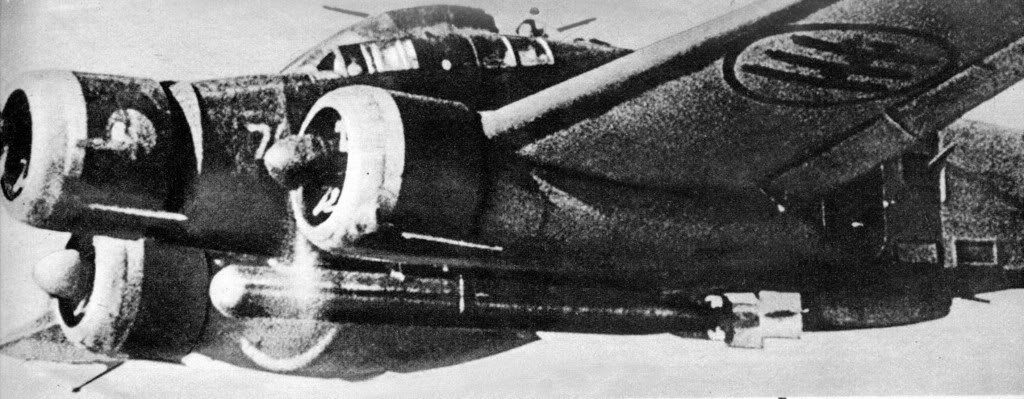
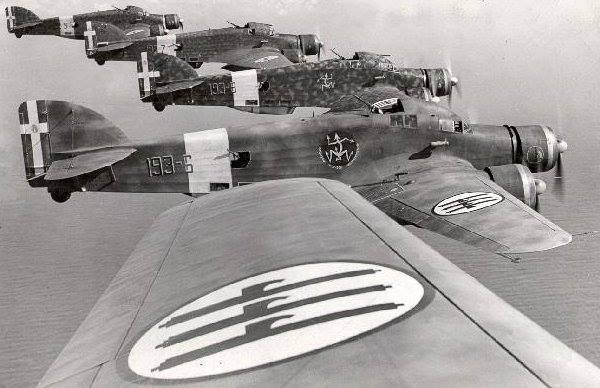
But it was one particular mission that made the Sparviero legendary. As a conventional high-level bomber the SM.79 was competent but unremarkable — like every medium bomber of its day, dangerous to the enemy only when escorted, and vulnerable to fighters when not. What transformed its reputation was the aerial torpedo. From 1940 the Regia Aeronautica developed specialist torpedo-bomber squadrons, the reparti aerosiluranti, and the strong, fast, low-flying SM.79 proved the ideal mount. Skimming the waves toward British convoys and Royal Navy warships in the teeth of anti-aircraft fire, the SM.79 crews pressed home attacks with a determination that won the grudging respect of their enemies. Through the convoy battles for Malta, off the North African coast and across the central Mediterranean from 1940 to 1943, the aerosiluranti damaged and sank merchant ships and warships and made the Sparviero the most respected Italian aircraft of the war.
The armistice of 8 September 1943 split Italy in two, and the Sparviero with it. In the German-occupied north, torpedo units of Mussolini’s fascist Aeronautica Nazionale Repubblicana (ANR) flew on against Allied shipping; in the Allied south, SM.79s served the Italian Co-Belligerent Air Force, mostly in transport and maritime roles. Like several Italian aircraft of its generation, the Sparviero thus ended the war flying, in effect, on both sides of a divided nation. Abroad, export and licence versions had already spread the design well beyond Italy: Yugoslavia, Romania and Iraq all operated Sparvieros, several in twin-engined export forms with different engines, and after the war Lebanon and Spain flew surviving aircraft on as transports well into the 1950s.
Roughly 1,300 to 1,350 SM.79s were built in all — the exact total is disputed between sources — making it by a wide margin the most-produced Italian bomber of the war and one of the most numerous trimotor combat aircraft ever built. That production run, its long record-breaking prelude and its deadly torpedo-bomber career together explain why the Sparviero, alone among Italian bombers, is remembered as a genuinely important aircraft rather than a footnote.
Today only a handful survive, all of them static museum exhibits — there is no airworthy SM.79 anywhere in the world. The pages that follow trace how a fast airliner became a bomber, how the humpbacked "Gobbo" was designed and armed, the low-level torpedo war that made its name, the way it came to fly on both sides after 1943, and where the last few Sparvieros can be seen today.
01The Savoia-Marchetti SM.79’s origins: the airliner that broke world records
The SM.79 was born as a commercial aircraft. Its direct ancestor was a fast passenger transport that Savoia-Marchetti flew in 1934, developed from the company’s line of trimotor airliners. The prototype was conceived to carry a handful of passengers at high speed, and from the outset it was pitched as a record-breaker as much as a workhorse — a way of demonstrating Italian aeronautical prowess to the world.
It succeeded spectacularly. Between 1935 and 1938 specially prepared SM.79s set a long series of internationally recognised records for speed carrying payloads over set distances, and Italian crews flew widely publicised long-distance flights. The showpiece was the August 1937 Istres–Damascus–Paris race, in which the "Sorci Verdi" SM.79s took the first three places against strong international competition. These achievements were not just propaganda: they proved the airframe had genuine speed and long-range endurance, qualities that carried straight over into its military career. When the Regia Aeronautica needed a modern fast bomber, the record-breaking transport was the obvious starting point.
02Why the Savoia-Marchetti SM.79 was called il gobbo — the hunchback
The Sparviero’s most famous feature is the reason for its nickname. To turn the clean airliner into a bomber, the designers added a raised structure immediately behind the cockpit: a dorsal "hump" or gondola that housed a fixed, forward-firing 12.7 mm Breda-SAFAT machine gun aimed by the pilot, and above the bomb-aimer’s and gunners’ stations. Viewed from the side this bulge broke the smooth line of the fuselage and gave the aircraft a distinctly humpbacked, almost hunched profile.
Italian crews, with the dark affection soldiers reserve for the machines that carry them, christened it il gobbo maledetto — "the damned hunchback" — usually shortened to il gobbo, "the hunchback." The official name was far grander: Sparviero, "sparrowhawk," in keeping with the Regia Aeronautica’s taste for birds and mythological titles. But it was the affectionate insult that stuck, and it remains the name by which the SM.79 is best known to this day. The hump was not mere ballast, either: that forward-firing gun turned the bomber into a machine that could shoot its way onto a target, and it became one of the type’s signature features.
03The Savoia-Marchetti SM.79’s three engines and mixed wood-and-metal construction
Two features defined the Sparviero’s character: its trimotor layout and its mixed construction. Three radial engines — one in the nose and one on each wing — gave the SM.79 both good performance and a valuable margin of safety. A crew could lose an engine to flak or mechanical failure and still fly home, a genuine advantage on long over-water torpedo sorties and desert operations far from base. The trimotor arrangement was, by the late 1930s, going out of fashion elsewhere in favour of twin-engined bombers, which is part of why the SM.79’s silhouette looks so distinctively of its era.
The airframe was equally characteristic of Italian practice of the period: a wooden wing, and a fuselage built up from a welded steel-tube framework clad in a mixture of light alloy (duralumin) panels forward, plywood and fabric further aft. Purists sometimes sneer at "wood-and-fabric" aircraft, but the mix was deliberate and effective. It economised on scarce strategic metals, it was simple to build and, above all, it was easy to repair: battle damage could be patched by field workshops with basic materials, keeping serviceability high in the primitive conditions of North African and Mediterranean airfields. Combined with three engines, that toughness gave the Sparviero a reputation for bringing its crews home that its pilots valued more than any performance figure.
04Who designed and built the Savoia-Marchetti SM.79 Sparviero?
The SM.79 was designed by Alessandro Marchetti, the technical director of the Società Italiana Aeroplani Idrovolanti Savoia-Marchetti (SIAI-Savoia-Marchetti), one of Italy’s leading aircraft manufacturers of the interwar years. Marchetti had made his name with a series of fast, clean trimotor transports and flying boats, and the SM.79 was the culmination of that line — the "SM" and the number denoting a Savoia-Marchetti design in the company’s sequence.
Because the type was needed in large numbers, production was not confined to Savoia-Marchetti’s own factories. The SM.79 was built under licence by other Italian firms as well, and export and licence-built versions were produced or assembled abroad, notably the twin-engined variants for Romania. This broad industrial base is one reason the Sparviero reached production totals — commonly cited at roughly 1,300 to 1,350 aircraft — far beyond any other Italian bomber, even as more modern designs struggled to leave the drawing board. Marchetti’s airliner-turned-bomber had become the workhorse of the Regia Aeronautica.
What made the Savoia-Marchetti SM.79 so effective
Three things defined the Sparviero as a fighting machine: a fast, record-bred trimotor airframe, a rugged mixed-construction body that shrugged off damage, and — the making of its legend — the ability to carry and deliver an aerial torpedo at wave-top height.
Speed bred from a record-breaker
The Sparviero inherited the aerodynamics of an airliner built to break records. Fast for a bomber of the late 1930s (roughly 430–460 km/h depending on variant), it was hard to intercept, especially at low level over the sea, where its torpedo crews made their attacks.
Rugged trimotor toughness
Three radial engines and a wood-and-metal airframe made the SM.79 famously survivable. Crews brought battle-damaged aircraft home on two engines, and field workshops patched wood and fabric that would have grounded an all-metal type — keeping serviceability high in desert conditions.
A torpedo under the belly
The Sparviero’s defining weapon was the 450 mm aerial torpedo. Strong enough to carry it and fast and low enough to deliver it, the SM.79 became the mount of the Regia Aeronautica’s specialist aerosiluranti — the most feared Italian strike aircraft of the Mediterranean war.
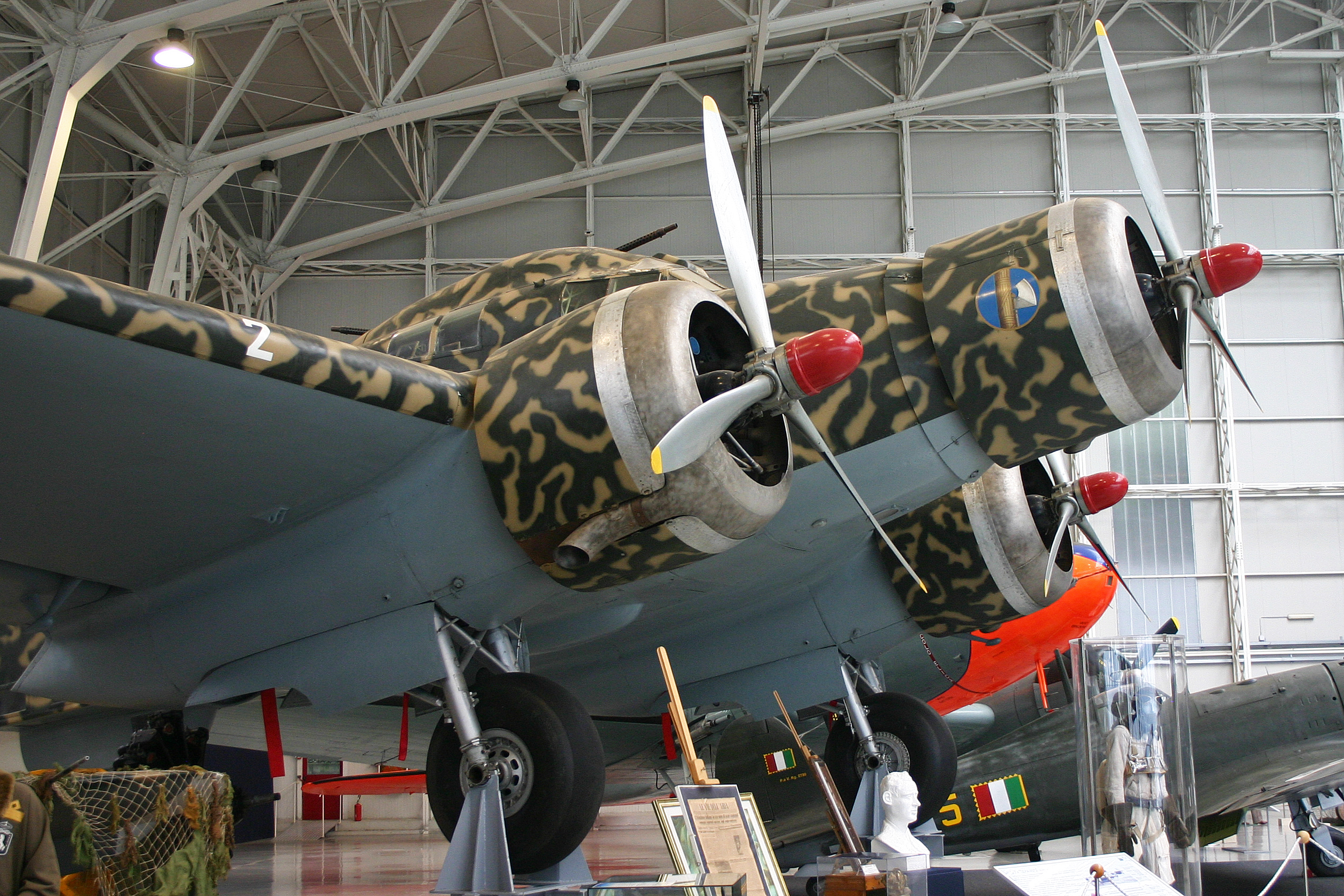
05The Savoia-Marchetti SM.79’s armament: guns, the "hunchback" gondola and the torpedo
The Sparviero’s gun armament was arranged around its humped profile. The signature weapon was a fixed 12.7 mm Breda-SAFAT heavy machine gun mounted in the dorsal hump, firing forward over the cockpit and aimed by the pilot — an offensive gun that let the bomber shoot at what it was attacking. Rearward defence came from a second 12.7 mm gun in a dorsal position firing aft over the tail, and a third 12.7 mm gun in a ventral gondola covering the underside and rear, supplemented on many aircraft by a hand-held 7.7 mm lateral gun that could be moved between beam windows. Exact fits varied between variants and over time.
For strike work the SM.79 could carry up to around 1,250 kg of bombs internally as a level bomber. But its most important load was slung externally: the torpedo version carried one 450 mm aerial torpedo (the aircraft was capable of carrying two, though a single torpedo was the normal operational load) on an offset rack beneath the fuselage. This combination — heavy defensive machine guns, a forward-firing gun in the hump, and an externally carried torpedo — is what made the humpbacked Sparviero both instantly recognisable and genuinely dangerous.
06How the Savoia-Marchetti SM.79 aerosilurante attacked ships
Torpedo bombing was among the most dangerous forms of air attack in the Second World War, and the SM.79 crews practised it with exceptional determination. To deliver a torpedo, the aircraft had to descend to just a few dozen metres above the sea, fly straight and level directly toward its target to release the weapon at the correct range and height, and then break away — all through the concentrated anti-aircraft fire of an alerted convoy or warship. There was no jinking on the run-in; the attack demanded nerve, precise flying and a strong airframe.
The Sparviero suited the task perfectly. It was fast and low-sitting, its three engines gave it a margin against battle damage, and its wooden structure absorbed punishment. Italian torpedo crews developed tactics of attacking in loose groups from several directions to split a ship’s defensive fire, pressing in to short range before releasing. British sailors who faced them came to respect the aerosiluranti as skilled and courageous opponents — a reputation earned the hard way, in repeated low-level attacks against some of the best-defended targets afloat.
07The Savoia-Marchetti SM.79 as a level bomber: competent, but not the legend
It is worth being honest about the Sparviero’s ordinary bombing role, because it is a very different story from the torpedo legend. As a conventional level bomber the SM.79 was a solid, average medium bomber of its generation — reasonably fast, adequately armed, able to carry a useful bomb load, but no more revolutionary than the German, British or Soviet twin-engined bombers it flew alongside and against. Its bombsight, bomb load and accuracy were unremarkable, and like every medium bomber of the era it was dangerously exposed to enemy fighters when it flew without escort.
The SM.79 dropped a great many bombs in Spain, over Malta, in the Balkans, in North and East Africa and elsewhere, and in that role it was a workhorse rather than a war-winner. What lifted the Sparviero above the ruck of competent medium bombers was not level bombing at all but the specialist torpedo mission — a role that played directly to the airframe’s strengths of speed, toughness and low-level handling, and in which its crews achieved results and a reputation out of all proportion to the aircraft’s otherwise middling qualities.
08The Savoia-Marchetti SM.79’s variants: SM.79-I, SM.79-II, the twin-engined SM.79B and beyond
The Sparviero was produced in a number of forms. The initial military bomber was the SM.79-I, powered by three Alfa Romeo 126 RC.34 radials of roughly 780 hp each. The definitive wartime version was the SM.79-II, re-engined with more powerful radials — commonly the Piaggio P.XI RC.40 of around 1,000 hp or the Alfa Romeo 128 of around 860 hp, figures varying between sources — and it was this version that equipped most of the torpedo units. A late, cleaned-up development, sometimes designated SM.79-III, dispensed with the ventral gondola and added a forward-firing 20 mm cannon.
For export, Savoia-Marchetti also built a distinctly different twin-engined version, the SM.79B, which replaced the three-engine layout with two more powerful engines and a fully glazed "greenhouse" nose in place of the trimotor’s stepped cockpit. This twin-engined line was tailored to customers who wanted specific powerplants: it was supplied to Iraq and, most significantly, formed the basis of the aircraft licence-built in Romania (as the JRS-79B / JIS-79B) with in-line engines. Yugoslavia bought a version known as the SM.79K. These export and licence variants spread the Sparviero’s basic design well beyond Italy and account for the type’s appearance in air arms across the Balkans and the Middle East.
The Savoia-Marchetti SM.79’s war: Spain, the Malta convoys and the Mediterranean torpedo battle
From its combat debut in Spain to the desperate convoy battles for Malta and its service on both sides after the 1943 armistice, the Sparviero was at the centre of Italy’s air war — above all as the low-level torpedo bomber that made the Mediterranean deadly for Allied shipping.
The SM.79 went into action for the first time over Spain. From 1937 the Aviazione Legionaria, Italy’s expeditionary force fighting for Franco’s Nationalists, operated Sparvieros as fast day bombers. Their speed made them hard for Republican fighters to catch, and the Spanish experience confirmed the type as the Regia Aeronautica’s standard bomber and shaped the tactics and confidence its crews carried into the wider war that followed.
When Italy entered the Second World War in June 1940, the SM.79 was the most numerous bomber in Italian service, deployed from Italy, Sicily, Sardinia, Libya and the Italian East African empire. In the war’s opening phase it flew conventional bombing raids: against Malta, against French targets, and in the East African campaign against British forces in Sudan, Kenya and the Horn of Africa. In these operations the Sparviero performed like any competent medium bomber of 1940 — effective against undefended targets, but increasingly vulnerable as British fighter strength grew, and unable on its own to force a decision.
The turning point was the aerial torpedo. Italy had experimented with air-dropped torpedoes before the war, and in the summer of 1940 the Regia Aeronautica stood up its first specialist torpedo-bomber unit. The strong, fast, low-flying SM.79 proved an almost ideal torpedo aircraft, and over 1940–41 the reparti aerosiluranti grew into the most effective strike force Italy possessed. Their hunting ground was the central Mediterranean, and their quarry was the lifeline of British sea power there: the convoys fighting through to the besieged island of Malta, and the Royal Navy warships that escorted them.
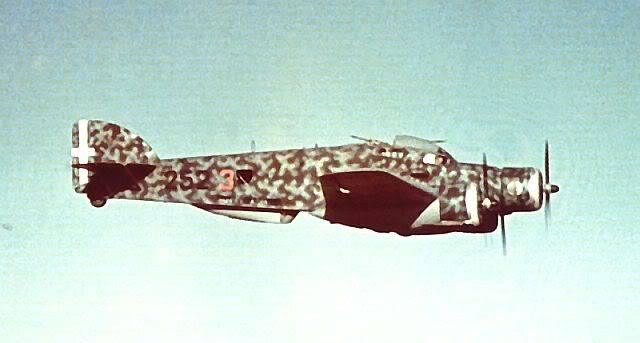
The mechanics of the campaign were unforgiving. Italy and the Axis needed to run fuel, tanks and men across the Mediterranean to sustain Rommel’s army in North Africa, while starving the British garrison on Malta; Britain needed to do the reverse, and to keep Malta alive as a base from which to attack the Axis convoys. The sea between Sicily and Tunisia became one of the most contested stretches of water in the world, and the SM.79 aerosiluranti were among the sharpest instruments either side possessed for closing it. Operating from Sardinia, Sicily and North African strips, they could reach far out to sea, and their speed and low-level approach gave defenders little warning.
The convoy battles that followed were among the hardest-fought sea-air actions of the war. Time and again through 1941 and 1942, formations of SM.79s bored in at wave-top height against convoys ringed with anti-aircraft guns and covered by carrier fighters, releasing their torpedoes at close range and breaking away through a wall of fire. The great Malta convoy operations — including the climactic August 1942 battle known to the British as Operation Pedestal — saw the aerosiluranti, alongside German aircraft, Italian and German submarines and motor torpedo boats, inflict heavy losses on merchant ships and their escorts. Italian torpedo crews damaged and sank a range of Allied vessels across the campaign, and though claims and confirmed results (as always in air-sea warfare) must be treated with caution, there is no doubt the Sparviero units were a serious and sustained threat that the Royal Navy had to plan around.
It was in this role that the SM.79 earned something rare for an Axis aircraft: the respect of its enemies. British accounts of the Mediterranean war repeatedly acknowledge the skill and courage of the Italian torpedo-bomber crews, who attacked with a persistence that cost them dearly. Individual Italian aces of the aerosiluranti, such as Carlo Emanuele Buscaglia, became national figures. For all Italy’s wider difficulties in the air, the torpedo-armed Sparviero was a weapon the Allies genuinely feared.
Then came the armistice. On 8 September 1943 Italy signed a ceasefire with the Allies, and the country — and its air force — split. In the German-occupied north, the fascist Aeronautica Nazionale Repubblicana re-formed torpedo units around surviving SM.79s and continued to attack Allied shipping into 1944, a bitter continuation of the Mediterranean torpedo war now fought against former allies. In the Allied-aligned south, the Italian Co-Belligerent Air Force flew its SM.79s mainly in transport and maritime-patrol roles. As with several Italian types, the Sparviero thus finished the war serving, in effect, on both sides of a divided nation.
The SM.79’s story did not end in 1945. Export customers had operated the type before and during the war — Yugoslavia, Romania and Iraq among them — and a number of aircraft survived the conflict in foreign hands or were passed on afterwards. Lebanon flew ex-Italian Sparvieros as transports into the 1950s, and Spain, which had operated the type since the civil war, kept SM.79s in service in secondary roles for years after the war. It was a quiet, unglamorous coda for an aircraft that had been, for three years, the sharpest edge of Italian air power at sea.
09The Savoia-Marchetti SM.79 and the Malta convoys: Operation Pedestal and the torpedo war
The struggle to supply Malta was one of the decisive campaigns of the Mediterranean war, and the SM.79 was central to the Axis effort to strangle it. Malta sat astride the convoy routes between Italy and North Africa; so long as it held, its aircraft, submarines and ships savaged the convoys carrying fuel and supplies to Rommel’s army. The Axis response was to besiege the island from the air and to attack every British convoy that tried to relieve it — and torpedo-armed Sparvieros were a principal weapon in those attacks.
The best-known of these battles was Operation Pedestal in August 1942, a maximum-effort British attempt to fight a large convoy through to Malta. Attacked relentlessly for days by Axis aircraft — including Italian torpedo bombers — submarines and light surface craft, the convoy lost most of its merchant ships, though just enough got through (most famously the tanker Ohio) to keep Malta alive. The Sparviero units were part of a combined Axis assault rather than acting alone, and untangling exactly which ship fell to which weapon is notoriously difficult. But Pedestal stands as the archetype of the war the aerosiluranti fought: repeated, costly, low-level torpedo attacks against a heavily defended convoy, pressed home with a determination that even their opponents acknowledged.
10The Savoia-Marchetti SM.79 after the 1943 armistice: flying on both sides
Italy’s armistice with the Allies on 8 September 1943 tore the country and its armed forces in two, and the SM.79 fleet split with them. In the north, occupied by Germany, Mussolini’s puppet Italian Social Republic raised a new air arm, the Aeronautica Nazionale Repubblicana (ANR). Its torpedo squadrons flew surviving Sparvieros against Allied shipping and landings — including operations against the Anzio beachhead in 1944 — continuing the low-level torpedo war, now against the very Allies with whom the south had made peace.
South of the line, the Italian Co-Belligerent Air Force, fighting alongside the Allies, operated its SM.79s largely in transport, liaison and maritime roles, their bombing and torpedo days mostly behind them. This division — the same type of aircraft flown by Italians on opposite sides of a civil war within a world war — is one of the poignant features of the SM.79’s late history, shared with other Italian aircraft such as the Macchi fighters. By 1945 the Sparviero’s front-line combat career was effectively over, but its service was not: transport and second-line flying would keep the type in the air, at home and abroad, for years to come.
11Why the Savoia-Marchetti SM.79 is remembered when other Italian bombers are forgotten
Italy built many bombers in the Second World War, most of which are now remembered — if at all — only by specialists. The SM.79 is the exception, and there are clear reasons why. It was built in far larger numbers than any other Italian bomber, so it was everywhere the Regia Aeronautica fought. It had a long and genuinely glamorous prelude as a record-breaking airliner, which gave it fame before the war even began. And it had an instantly recognisable shape — three engines and a humped back — that made it a symbol of Italian aviation.
Above all, it had the torpedo war. In an air force whose overall wartime record was mixed, the aerosiluranti and their Sparvieros were a real success story: a weapon that seriously threatened Allied sea power in the Mediterranean and won the respect of a formidable enemy. That combination — ubiquity, a record-breaking backstory, a unique silhouette and a single role in which it genuinely excelled — is why the "damned hunchback" is the one Italian bomber of the war that non-specialists still remember, and why it earns a place in a museum devoted to the most significant aircraft ever flown.
12The Savoia-Marchetti SM.79’s torpedo aces: Buscaglia and the aerosiluranti
The reputation of the SM.79 is inseparable from the men who flew it against ships. The Regia Aeronautica’s torpedo-bomber squadrons — the reparti aerosiluranti — attracted some of Italy’s most determined airmen, and a handful became national heroes. The best known is Carlo Emanuele Buscaglia, whose name became a byword for the Italian torpedo arm; his unit was later renamed in his honour. Other pioneers, including Carlo Faggioni and Guido Robone, helped develop and prove the low-level torpedo tactics that made the SM.79 so dangerous.
What these men and their crews did was extraordinarily hazardous. Attacking a defended convoy meant flying straight and level at wave-top height into concentrated anti-aircraft fire, often against warships bristling with guns and covered by carrier-borne fighters. Losses were heavy and casualties among the small, elite torpedo units were severe. Yet they pressed their attacks with a persistence that their British opponents openly admired — a rare tribute paid to an enemy in the bitter Mediterranean war. The aerosiluranti and their Sparvieros were, by common consent, the most effective offensive weapon the wartime Regia Aeronautica ever wielded.
13The Savoia-Marchetti SM.79 compared to the Heinkel He 111 and other WWII medium bombers
Set against the medium bombers of the other major powers, the SM.79 was a broadly comparable but distinctive machine. In speed, bomb load and defensive armament it sat in the same class as the German Heinkel He 111, the British Vickers Wellington and the various twin-engined bombers of the period — competent, useful, but none of them war-winners on their own, and all vulnerable to modern fighters without escort. Where the Sparviero differed was its layout: three engines where almost every rival used two, and mixed wood-and-metal construction where others were increasingly all-metal.
Those differences cut both ways. The trimotor arrangement gave the SM.79 an extra margin of safety and reliability, valuable on long over-water and desert sorties, at the cost of the drag and complexity of a third engine. The wooden structure was easy to repair but limited the airframe’s development potential. In the level-bombing role, then, the Sparviero was neither better nor worse than its foreign contemporaries — it was simply Italian, and idiosyncratic. Its real edge lay elsewhere: no other nation made such effective, sustained use of the air-launched torpedo, and it was that speciality, rather than any advantage as a conventional bomber, that set the SM.79 apart from the He 111 and the rest.
Savoia-Marchetti SM.79 Sparviero full specifications
Figures are broadly representative of the definitive wartime SM.79-II and are drawn from established reference sources. Many values differ between references, variants and sub-types — especially engine power, speed and production totals — so contested figures are flagged.
Baseline: the Savoia-Marchetti S.M.79-II as it flew with the aerosiluranti over the central Mediterranean in 1941 and 1942 — three Piaggio P.XI RC.40 radials, armour for the pilots, the bomb bay stripped out and a single 450 mm Whitehead torpedo hung under the belly — because that is the aeroplane the Royal Navy actually met and the version on which the type's reputation rests. Deltas for the prototype S.79P, the S.79-I bomber of Spain, the late S.79-III and S.79bis, the twin-engined S.79B family, the Yugoslav S.79K and the Romanian JIS-79B and JRS-79B are in grey. Three warnings before the figures. First, almost no English-language source separates the S.79-I from the S.79-II cleanly, and the published dimensions genuinely disagree: length appears as 15.62 m and as 16.20 m, height as 4.10 m and as 4.60 m, service ceiling as 6,500, 7,000 and 7,500 m, and maximum take-off weight as 10,480, 11,325 and 12,500 kg depending on which national reference work you open. Where a figure is well attested for one mark only, the row says so. Second, production totals are looser still. Second-hand accounts of about 1,370 aircraft are not supported by any factory breakdown that can be checked; the defensible reading is roughly 1,220 to 1,230 machines built in Italy up to June 1943 plus 72 built under licence in Romania, giving a total near 1,300, and the figures printed in reputable works run from 1,240 to about 1,330. Third, and most useful when reading any of it: every performance number below is a clean-airframe figure. With a torpedo slung off the centre-line, the ventral gondola hanging in the airflow and five men and full fuel aboard, the S.79 was a considerably slower aeroplane than the record-breaker of 1937, and it was flown into the guns of a fleet at between forty and a hundred metres. Deltas for other marks in grey.
Dimensions & weights
- Crew
- 5 — first pilot, second pilot, flight engineer, radio operator/gunner and bomb-aimer who doubled as ventral gunner Four on many sorties. The layout carried a designed-in flaw that no mark ever cured: the bomb-aiming instruments sat at the front of the ventral gondola and the rearward-firing ventral machine gun at the back of it, so one man could aim the load or defend the belly but never both at once. The S.79-III deleted the gondola altogether and dropped a crewman with it; the Romanian JRS-79B1 went the other way and enlarged the cockpit for a fifth man
- Length
- 15.62 m (51 ft 3 in) German references give 16.20 m (53 ft 2 in) for the S.79-II specifically, and the twin-engined S.79B is separately recorded at 16.22 m (53 ft 3 in). The three published lengths are close enough that they may reflect different marks, different tail attitudes or simple copying between reference works; they are not reconcilable from open sources
- Wingspan
- 21.20 m (69 ft 7 in) Unchanged from the civil prototype of 1934 to the last Romanian-built JRS-79B1 of 1946. Every extra gun, every kilogram of armour, the torpedo gear and the long-range tanks were hung on a wing drawn in 1933 for an eight-passenger fast transport
- Height
- 4.10 m (13 ft 5 in) 4.40 m and 4.60 m are also widely printed. The variation is larger than measurement error and is best treated as unresolved
- Wing area
- 61.00 m2 (656.6 sq ft), aspect ratio 7.4 Handley Page-type leading-edge slats and trailing-edge flaps on a thick section gave the S.79 landing manners that were exceptionally good for a ten-tonne aeroplane, which mattered more than it sounds: torpedo crews came home damaged, at night, onto short desert and island strips
- Empty weight
- 7,610 kg (16,777 lb) S.79-I: about 6,800 kg (14,991 lb). The 800 kg the -II put on is armour plate, self-sealing tank protection, torpedo gear and heavier engines — a fair summary of what the war did to the design
- Normal loaded weight
- 11,325 kg (24,967 lb) S.79-I: about 10,480 kg (23,104 lb)
- Maximum take-off weight
- 12,500 kg (27,558 lb) This is the highest figure in print and represents the overloaded case — two torpedoes, or a torpedo plus the auxiliary fuel of a long-range sortie. Italian crews report that with two torpedoes aboard the aeroplane was only moderately stable and that one weapon was carried operationally almost without exception
- Wing loading
- 186 kg/m2 (38 lb/sq ft) at normal loaded weight
- Power loading
- 3.8 kg/CV (8.3 lb/hp) at normal loaded weight on three 1,000 CV Piaggio radials
- Fuselage structure
- welded steel-tube framework; light alloy skin over the nose and forward fuselage, plywood over the dorsal decking, fabric over the sides and rear Mixed wood-and-metal construction was a deliberate Italian choice, not a shortage-driven compromise, and in Spain it worked: an S.79 could absorb a remarkable quantity of rifle-calibre fire and be patched in the field by a carpenter. Against 20 mm cannon and naval anti-aircraft fire in 1942 the same structure burned, and the fabric-and-plywood aft fuselage was a poor place to be standing when tracer came through it
- Wing structure
- three-spar wooden wing, poplar and spruce ribbing, plywood and fabric covering The wooden wing is why no S.79 has ever been restored to flight and why so little of the type survives: fabric, plywood and casein glue do not wait patiently in a scrapyard the way an aluminium wing does
- Undercarriage
- retractable tailwheel type, main units folding rearwards into the outboard nacelles; take-off run about 300 m (985 ft), landing run about 200 m (655 ft)
Performance
- Maximum speed
- 460 km/h (286 mph) at 4,000 m (13,100 ft) S.79-I on Alfa Romeo 126 RC.34: 430 km/h (267 mph) at the same height. S.79-III on Alfa Romeo 128: 475 km/h (295 mph). Twin-engined S.79B: about 420 km/h (261 mph). For scale, the record aircraft of 1937 had touched 472 km/h and the type was routinely described as the fastest medium bomber in the world; by 1940 the French LeO 451 was doing 495 km/h and a Hurricane could catch an S.79 at will
- Maximum speed at sea level
- 359 km/h (223 mph) The number that actually governed a torpedo attack, because torpedo runs were flown on the deck. Add a torpedo and the drag of the ventral gondola and the run-in was made at something close to 300 km/h
- Cruising speed
- 360 km/h (224 mph) Sources also give 373 km/h (232 mph) at 4,000 m for the economical cruise. Either way the S.79 cruised faster than any other Italian bomber of its generation and faster than the Heinkel He 111, which is the fairest single statement of what the design was good at
- Rate of climb
- 335 m/min (1,100 ft/min) initial Adequate rather than good. Three moderate radials driving a heavy, draggy airframe gave the S.79 no vertical reserve at all when loaded, and Italian crews attacked at low level partly by choice and partly because climbing away from trouble was not an option
- Time to height
- 5,000 m (16,400 ft) in 16 minutes 7 seconds, S.79-III This is the only precisely published climb time in the common references, and it belongs to the last and most powerful mark. Read against the rate-of-climb figure above, the -I and -II are on the order of nineteen to twenty minutes to the same height, but that is a reading of the numbers rather than a quoted source figure and should be treated as such
- Service ceiling
- 7,000 m (22,970 ft) 6,500 m (21,325 ft) and 7,500 m (24,600 ft) are both in print. The argument is close to academic. Loaded with a torpedo the practical ceiling was far lower, and it did not matter, because the entire tactical repertoire of the aerosiluranti was flown between 40 and 120 m above the sea
- Range with bomb load
- 1,900 km (1,180 miles) Sometimes printed with false precision as 1,899 km. This was genuine strategic reach for a 1936 medium bomber and it is why the S.79 could threaten convoys anywhere between Sardinia, Sicily, Pantelleria, Rhodes and the Libyan coast
- Maximum range
- about 3,300 km (2,050 miles) ferry The S.79GA Grande Autonomia and S.79bis pushed this further with a bomb-bay tank
- Longest operational mission
- 2,700 km (1,680 miles) round trip, Istres to Gibraltar and back, 5 June 1944 Twelve S.79bis of the Aeronautica Nazionale Repubblicana flew the longest Italian strike of the war, carrying about 5,000 litres of fuel. It was a genuine feat of navigation and endurance and, on the British records, it sank nothing whatever
- Torpedo release parameters
- 40 to 120 m (130 to 395 ft) altitude at up to 300 km/h (186 mph), released 800 to 1,000 m (875 to 1,095 yards) from the target These are the numbers that killed Italian aircrew. Holding a straight, level, unaccelerating run at that height and that range through the massed close-range armament of a Pedestal-sized escort is close to the most dangerous thing anyone did in an aeroplane in the Second World War, and by 1943 the Regia Aeronautica calculated that an S.79 crew could expect roughly three missions
- Combat radius
- roughly 700 km (435 miles) on a torpedo sortie with a reserve for search A derived figure, not a quoted one. What is quoted, and is more revealing, is that the experimental unit's first operation on 15 August 1940 — five aircraft from El Adem against Alexandria — ended with three of them jettisoning their torpedoes and force-landing in the desert
Propulsion & systems
- Engines
- 3 × Piaggio P.XI RC.40, 14-cylinder two-row air-cooled radial The type changed engines almost as often as the Do 17. Prototype S.79P: Piaggio Stella P.IX of 610 CV. S.79-I: Alfa Romeo 126 RC.34 nine-cylinder radials of 780 CV, a licence-built Bristol Pegasus derivative. S.79-III and S.79bis: Alfa Romeo 128 RC.18 of about 860 to 1,000 CV. Racing S.79CS: Piaggio P.XI RC.40. Twin-engined S.79B: Fiat A.80 RC.41 for Iraq, Gnome-Rhône 14K Mistral Major for Romania, and Alfa Romeo 128 usually cited for the three Brazilian machines. JIS-79B and JRS-79B: two Junkers Jumo 211Da inverted-V12 inlines of 1,200 PS. JRS-79B1: Jumo 211F of 1,380 PS
- Take-off power
- 1,000 CV (986 hp; 736 kW) each, 3,000 CV total Alfa Romeo 126 RC.34 in the -I: 780 CV (769 hp; 574 kW) at 3,400 m. The whole three-engine layout exists because Italy had no reliable single engine of 1,200 CV and upwards when the design was frozen. Three medium radials were the only way to get the power, and the price was a nose full of engine
- Propellers
- three-blade metal, hydraulically operated variable pitch
- Fuel
- 3,320 litres (730 imp gal) — eight main wing tanks totalling 2,500 litres plus two 410-litre auxiliary tanks, with S.E.M.A.P.E. self-sealing rubber protection The S.79-III, S.79bis and S.79GA added a 1,000-litre tank in the vacated bomb bay; the Gibraltar aircraft of June 1944 are recorded carrying about 5,000 litres, which is well beyond the standard installation
- Fixed forward gun installation
- one 12.7 mm Breda-SAFAT in the dorsal fairing, firing forward over the propeller arc, fired by the pilot from a thumb button on the control column This is the reason for the hump. With a third engine occupying the nose there was nowhere else to put a forward-firing gun and its ammunition, so Alessandro Marchetti built a fairing over the top of the cockpit to hold it and the rear-facing dorsal position behind it. Italian crews called the aeroplane il gobbo maledetto, the damned hunchback, with more affection than the name suggests
- Defensive mountings
- dorsal position at the rear of the hump, ventral position firing aft from the gondola, and one gun carried by hand between two beam hatches No powered turret was ever fitted to any mark, by any operator, at any point in twelve years of production. In 1936 that was normal; in 1942 it was not, and the fields of fire left a wide cone dead astern and below that Beaufighter and Hurricane pilots learned to use
- Bomb bay
- internal cells with the bombs stowed vertically, nose-down Vertical stowage is inherited straight from the civil transport, whose fuselage cross-section it suited, and it is the single worst feature of the design as a bomber. It capped the calibre that could be carried, it made mixed loads awkward, and it explains why the S.79-II simply deleted the bay when the torpedo took over. The S.79 could not carry a single large blast bomb of the sort every other air force adopted after 1941
- Torpedo installation
- a rack under the fuselage, offset from the centre-line to clear the ventral gondola; two racks could be fitted, one weapon was normally carried The asymmetry is characteristic of the whole aeroplane: a first-class weapon bolted onto an airframe that had no proper place for it. Crews compensated with rudder trim on the run-in
- Bombsight and aiming
- a bomb sight at the forward end of the ventral gondola, worked by a prone bomb-aimer; torpedo attacks were aimed by the pilot by eye There was no torpedo director worth the name. An S.79 attack was a matter of a pilot judging the target's course and speed, setting a lead angle in his head, holding it and pressing the release. That the aerosiluranti hit anything at all under those conditions is the strongest argument for the quality of the crews
- Radio and navigation
- a single high-frequency set worked by the radio operator; no airborne radar of any kind at any stage Night attacks were made by the light of parachute flares dropped by accompanying aircraft and by the moon path on the water. The Germans put radar into their He 111 and Ju 88 torpedo units; the Italians never did, and after 1942 the difference between finding a convoy at night and not finding it was decisive
- Armour and protection
- armour for the pilots and self-sealing tank protection from the S.79-II; the S.79-III added armoured glass and armoured shields for the beam gunners Armour arrived late and grudgingly. It was added because the experimental torpedo unit's losses in 1940 and 1941 made the case unanswerable, not because anyone designed for it
Values marked "estimate," "varies" or "approximate" should be treated with caution. Engine type and power, top speed, weights, range and total production in particular differ between references and between the many SM.79 sub-variants (SM.79-I, SM.79-II, SM.79-III, the twin-engined SM.79B and licence-built versions).
14The Savoia-Marchetti SM.79’s world records: the speed-and-distance flights of the 1930s
Before it dropped a single bomb, the SM.79 was famous as a record-breaker. In the mid-to-late 1930s specially prepared examples set a long series of internationally recognised records for speed carrying commercial payloads over measured distances — the kind of records that demonstrated an aircraft’s combination of speed, load and endurance rather than raw dash. Italian crews also flew widely publicised long-distance demonstration flights that kept the type in the world’s newspapers.
The showpiece was the Istres–Damascus–Paris race of August 1937, over roughly 6,200 km, in which SM.79s of the "Sorci Verdi" team took the first three places against strong international competition. For the fascist regime it was priceless propaganda; for the aircraft it was proof of genuine capability. Those record flights were not a sideshow to the SM.79’s military career but its foundation: the speed and long-range endurance that won the races were exactly the qualities that later made the bomber hard to catch and the torpedo aircraft able to range far out to sea.
15The Savoia-Marchetti SM.79’s export and licence versions: Yugoslavia, Romania, Iraq and Brazil
The Sparviero was widely exported, often in forms quite different from the standard Italian trimotor. Yugoslavia bought a batch known as the SM.79K in the late 1930s. Iraq received the twin-engined SM.79B export version. Most significant of all, Romania adopted the twin-engined line and built it under licence as the JRS-79B (and related JIS-79B), powered by in-line engines — Romanian-built Sparvieros served on the Eastern Front alongside Germany. A number of SM.79s were also supplied for civil use, including examples that reached Brazil as fast transports.
These exports matter for two reasons. First, they make the SM.79 a genuinely international aircraft, flown by air arms across the Balkans and the Middle East, not just an Italian curiosity. Second, they are a frequent source of confusion: a "SM.79" in Romanian, Iraqi or Yugoslav service may be a twin-engined machine with a glazed nose and entirely different engines, looking quite unlike the humpbacked Italian trimotor. When you see a photograph captioned "SM.79," it is always worth checking whether it shows the classic three-engined Regia Aeronautica bomber or one of these distinctive export variants.
16The Savoia-Marchetti SM.79’s operating costs: why there is no cost-per-hour figure
Unlike the modern jets in the MiGFlug fleet, the Sparviero has no meaningful operating-cost figure. Wartime unit costs for Italian aircraft were not reliably or consistently recorded, and the economic disruption of 1940s Italy — followed by the chaos of the armistice and occupation — makes any single production-cost number misleading. The honest entry in the specifications table is simply "not reliably recorded."
More fundamentally, there is no airworthy Savoia-Marchetti SM.79 anywhere in the world. Every surviving original is a static museum exhibit, so there is no fuel bill, no maintenance programme and no cost-per-flight-hour to quote — hence "not applicable" in the table. If you want to know what operating and flying a genuine military aircraft actually costs today, the jets MiGFlug flies are a far better guide than a bomber that has not flown for more than half a century.
17How to recognise a Savoia-Marchetti SM.79: three engines, a hump and a low stance
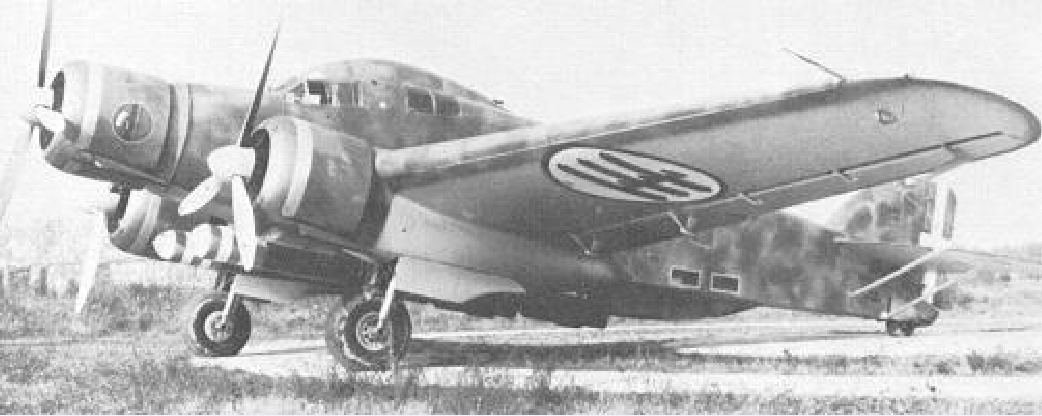
The classic Italian SM.79 is one of the easier wartime aircraft to identify once you know the tells. It is a large, low-wing monoplane with three radial engines — one in the nose, one on each wing — which immediately sets it apart from the twin-engined bombers that dominated every other air force. Its second signature is the dorsal "hump" behind the cockpit, the raised gondola that earned it the gobbo nickname and that breaks the top line of the fuselage. A ventral gondola beneath the fuselage and, on torpedo aircraft, a torpedo slung off-centre under the belly complete the picture.
The trap for the unwary is the export versions. The twin-engined SM.79B and the Romanian licence-built JRS-79B have only two engines and a fully glazed nose, so they lack both the nose engine and the stepped cockpit of the trimotor — they look like a different aircraft altogether, which in many respects they are. If you are looking at a preserved machine and want to be sure it is the definitive Italian Sparviero, count the engines (three) and look for the hump: those two features, together, are unique to the SM.79.
Armament & payload
The Sparviero's guns were an afterthought; its torpedo was the best-handled anti-ship weapon in the Mediterranean
The S.79's guns were an afterthought and its bomb bay was a liability, but for two years it carried the best-handled aerial torpedo in the Mediterranean and it is the only reason anyone still remembers the aeroplane. The defensive fit — three 12.7 mm Breda-SAFAT and one rifle-calibre gun, all hand-worked, none in a turret, one of them fixed and aimed by pointing the whole aircraft — was adequate against Spanish Republican I-16s in 1937 and hopelessly thin against a 1942 fleet. The offensive fit divides the type in two. As a bomber the S.79 was hobbled by vertical bomb stowage inherited from an airliner, which capped it at 1,250 kg in awkward combinations and barred the large-calibre weapons every other air force adopted from 1941. As a torpedo aircraft it was excellent: fast on the deck, docile at low speed, able to take punishment, and carrying a 450 mm Whitehead weapon from the Fiume works that was genuinely reliable in its first production batches. Fits varied sharply by mark, year and unit: a 1937 Balearic bomber, a 1941 S.79-II of 278a Squadriglia, a 1944 ANR S.79-III with 20 mm guns and no gondola, and a Romanian JRS-79B1 with Jumo inlines and an Ikaria cannon shared a wing and very little else.
Gun
- One fixed 12.7 mm Breda-SAFAT in the dorsal hump firing forward over the propeller arc, fired by the pilot from a thumb button on the control column
- One hand-worked 12.7 mm Breda-SAFAT at the rear of the hump covering the upper rear hemisphere, and one more in the ventral gondola firing aft and downwards
- One 7.7 mm gun — a Lewis on early machines, a Breda later — carried by hand between two beam hatches, with about 500 rounds. Late aircraft mounted two so that both beams could be covered at once
- Ammunition of 350 to 500 rounds per gun in metal-link belts. The S.79-III replaced the 12.7 mm guns with 20 mm cannon; the Romanian JRS-79B1 carried a 20 mm Ikaria
- No powered turret, ever. That is the single most damning line in the aircraft's specification and it was never addressed in twelve years of production, by Italy or by Romania.
Air-to-air
- The fixed forward 12.7 mm was the only air-to-air weapon in any meaningful sense, and it was aimed by pointing a ten-tonne bomber at the target
- No S.79 was ever built or converted as a fighter, a heavy fighter or a bomber destroyer, and none was armed for interception
- What the type had instead was formation defence and structural toughness. In October 1937 three S.79s over Spain were attacked by twelve Polikarpov I-16s and all three came home, one of them with twenty-seven bullet holes in it; across two years in Spain only four were shot down in air combat
- Toughness is not the same as armament. What saved the Sparviero in 1937 was that its opponents carried four rifle-calibre machine guns. Against the cannon-armed Beaufighters and Hurricane IICs of 1942 the same airframe caught fire and came apart.
Air-to-surface guided
- None. No guided air-to-surface weapon was ever carried operationally by an S.79 of any mark or operator
- The type's defining weapon was the 450 mm Whitehead aerial torpedo of 1938 from the Silurificio Whitehead at Fiume — aimed but wholly unguided. It weighed 876 kg (1,931 lb), ran 5.46 m (17 ft 11 in) long, carried a 170 kg (375 lb) warhead and ran 3,000 m at 40 knots
- The Motobomba FFF, a 350 kg (772 lb) parachute-dropped circling torpedo that ran a widening spiral across a convoy's track, was used from S.79s from 1942. It was autonomous rather than guided, it was sown rather than aimed, and it sank very little
- One S.79 was converted into a radio-controlled flying bomb with 1,000 kg of explosive aboard and launched against the Pedestal convoy on 12 August 1942, its pilot baling out and control passing to a CANT Z.1007bis. The transmitter failed and the aircraft flew on to crash in the Algerian mountains. It was the first Italian drone strike and it hit nothing
- The torpedo itself deserves its reputation only in part. The first thirty weapons issued in 1940 were excellent; later production, and Naples-built weapons in particular, was defective. During Operation Harpoon in June 1942 well over a hundred torpedoes were launched by Italian aircraft for three hits.
Bombs
- 1,250 kg (2,756 lb) maximum internal, 1,000 kg (2,205 lb) as a normal load, stowed vertically nose-down in fuselage cells
- Typical combinations were two 500 kg (1,102 lb), five 250 kg (551 lb), or twelve 100 kg and 50 kg bombs. The vertical cells barred anything larger and made mixed loads awkward
- In Spain the S.79 was a good level bomber by the standards of 1937, and in 1940 and 1941 it did most of the Regia Aeronautica's conventional bombing over Malta, Greece and North Africa. Three S.79s of the Aviazione Legionaria took part in the attack on Guernica on 26 April 1937 alongside the Condor Legion, and the size of their share in it is still argued over
- The S.79-II deleted the bomb bay entirely to make room for torpedo gear and fuel, and the S.79-III and S.79bis put a 1,000-litre tank where the bombs had been
- A bomber that cannot carry a single large blast bomb was already behind the argument by 1941. The S.79 was a fast aeroplane carrying a small, awkwardly stowed load, and its bombing career is the least impressive part of its record.
Rockets
- None. No unguided rocket armament was fitted to, trialled on or proposed for any S.79 variant
- Italy had no equivalent of the RP-3 or the Wfr.Gr. 21 in service use on medium bombers, and by the time rocket-armed anti-shipping aircraft became standard elsewhere the S.79 was a transport
- The nearest thing to a rocket the type ever carried was rocket-assisted take-off gear, tested on other Italian types rather than adopted on this one
- Kept here because the card is part of the standard set, not because there is anything to report.
Pods & other stores
- Reconnaissance cameras in the fuselage on maritime patrol machines; the S.79 flew a great deal of over-water search work, which is how it found the convoys it then attacked
- Parachute flare containers for night illumination, dropped by accompanying aircraft so that the torpedo crews could see a ship silhouette on the water
- A 1,000-litre auxiliary fuel tank in the vacated bomb bay on the S.79-III, S.79bis and S.79GA Grande Autonomia, the fit that made the Gibraltar raid possible
- Passenger and freight interiors on the S.79C and S.79T transports and on the postwar Italian and Lebanese machines, which is the configuration in which the two survivors ended their working lives
- No external stores pylons in the modern sense. Everything the S.79 carried was internal or hung directly from the belly, and the aeroplane finished the war with essentially the store options it had begun with.
Three typical loadouts
- Torpedo strike, central Mediterranean, 1942
- One 450 mm Whitehead torpedo on the offset ventral rack, three 12.7 mm and one 7.7 mm defensive guns, full internal fuel, five crew. Attack flown at 40 to 120 m at up to 300 km/h with release inside 1,000 m. This is the loadout that damaged HMS Kent, HMS Glasgow, HMS Manchester, HMS Liverpool twice, HMS Phoebe, HMS Arethusa and HMS Indomitable, and sank HMS Fearless and HMS Foresight.
- Level bombing, North Africa and Malta, 1941
- 1,000 kg internal in vertical cells — typically two 500 kg or five 250 kg bombs — with the bomb-aimer prone in the ventral gondola and the ventral gun consequently unmanned during the run. Bombed from medium altitude in formation; the same aircraft did low-level work over Greece and the Balkans.
- Long-range strike, Istres to Gibraltar, 5 June 1944
- S.79bis of the Aeronautica Nazionale Repubblicana: one torpedo, ventral gondola deleted, armoured shields for the beam gunners, a 1,000-litre bomb-bay tank and about 5,000 litres of fuel for a 2,700 km round trip, with one crewman left behind to save weight. Italian claims from the raid ran to four ships sunk; the British records show none.
Sourcing caveat. Italian armament figures for this type are unusually consistent between sources, but the operational claims attached to them are not, and the two should never be read together uncritically. The 1941 Italian returns give fourteen torpedo squadrons flying 225 sorties and 87 attacks for nine ships sunk totalling 42,373 tonnes and twelve damaged totalling 75,841 tonnes; the 1943 returns give eighteen squadrons, 221 sorties, three ships sunk totalling 12,519 tonnes and four damaged totalling 32,024 tonnes. Those are honest unit returns, but they are claims, and the pattern of the war is that Italian aircrew over-claimed by a wide margin, as did British and German aircrew. The single most decorated S.79 pilot, Carlo Emanuele Buscaglia, was credited at the time with over 90,000 tonnes sunk. Operation Pedestal in August 1942 is the cleanest test available, because both sides' records survive and every loss can be assigned. Fourteen merchantmen and a very large escort went into the western Mediterranean; the carrier Eagle, the cruisers Manchester and Cairo, the destroyer Foresight and nine of the fourteen merchant ships did not reach Malta. Of that list the S.79 torpedo units can claim exactly one: HMS Foresight, hit in the stern on 12 August and scuttled by HMS Tartar the next day. Eagle was sunk by U-73, Cairo and the crippling hits on Nigeria and on the tanker Ohio came from a single salvo by the submarine Axum, Manchester was finished by the Italian motor torpedo boats MS 16 and MS 22, and the merchantman Deucalion — frequently claimed for the aerosiluranti — was crippled by Ju 88 bombs and finished by a German torpedo aircraft. One destroyer, against Italian claims that ran to cruisers and a dozen merchant ships. Two further corrections to the standard S.79 story belong here. The torpedo hit on the battleship HMS Nelson during Operation Halberd on 27 September 1941 is more usually credited to a Savoia-Marchetti S.M.84 of 36° Stormo than to an S.79. And HMAS Nestor, lost on 16 June 1942 and often listed as an S.79 victim, was disabled by bomb near-misses that wrecked her engine rooms, not by an aerial torpedo. What survives all of this correction is still substantial: two destroyers sunk outright by S.79 torpedoes, a sloop, a corvette and an auxiliary anti-aircraft ship besides, and a list of cruisers — Kent, Liverpool twice, Glasgow, Manchester, Phoebe, Arethusa — and one fleet carrier, Indomitable, put out of the war for months at a time. No other Italian aircraft came close. Where the brief calls the S.79 the outstanding Axis torpedo bomber, the honest correction is that it was the outstanding Italian one, and that the He 111H-6 units of KG 26 in the same sea, with radar and a two-torpedo load, have at least as strong a claim.
Variants
The S.79 family split in two: three engines for Italy, two for everyone who wanted a bomb-aimer in the nose
The S.79 began as a racing transport and never entirely stopped being one. Alessandro Marchetti drew it in 1933 and 1934 as a fast eight-passenger machine for the European air-race circuit, and the prototype I-MAGO flew on 28 September 1934 on three Piaggio Stella P.IX radials of 610 CV. What followed was three years of genuine, verifiable record-breaking rather than the usual regime puffery. In September 1935 the prototype carried 2,000 kg over 2,000 km at 389.61 km/h and took six world records at a stroke. In 1937 a Piaggio-engined S.79CS lifted 2,000 kg over 1,000 km at 423.618 km/h and then at 444.115 km/h, with 5,000 kg carried over the same distance at 402 km/h. In August 1937 five of the Sorci Verdi — the Green Mice — entered the Istres to Damascus to Paris race and finished first, second and third, Cupini and Paradisi in I-CUPA ahead of Fiori and Lucchini in I-FILU and Biseo and Bruno Mussolini in I-BIMU. In January 1938 three long-range S.79Ts left Guidonia for Rio de Janeiro by way of Dakar; two arrived the next day after 24 hours 20 minutes in the air at an average of 393 km/h, the third diverting to Natal with a fault and being given to the Brazilian air force. For roughly two years the S.79 really was, by a defensible reading, the fastest medium bomber in the world.
The three-engine layout that made all this possible also crippled the aeroplane as an export product, and the reason is simple: Italy had no reliable engine of 1,200 CV and upwards when the design was frozen, so three medium radials were the only route to the power, and the third of them sat exactly where every other air force wanted to put a bomb-aimer and a nose gun. Marchetti's answer was the twin-engined S.79B of 1936, a redesigned front end with an extensively glazed nose, no dorsal hump gun and no gondola, aimed squarely at buyers who would not accept the trimotor. It sold in tiny numbers — four to Iraq on Fiat A.80 radials, three to Brazil, twenty-four to Romania on Gnome-Rhône 14K engines that proved badly underpowered — but it mattered out of all proportion, because it was the twin-engine airframe that Romania took up, put Junkers Jumo 211 inlines into, and built under licence at IAR as the JRS-79B. Romania, not Italy, made the S.79 into a properly engined two-motor bomber, and went on building it after the Italian line had stopped.
The Italian line meanwhile went the other way, towards the torpedo. The S.79-II of 1939 traded the bomb bay for torpedo gear, armour and better engines; the S.79-III and S.79bis of 1943 to 1945 stripped the gondola off, put 20 mm guns and armoured shields in and filled the belly with fuel. After the armistice of September 1943 the type flew for both sides — as transports with the Co-belligerent Air Force in the south, as torpedo aircraft with the Gruppo Buscaglia-Faggioni of the Aeronautica Nazionale Repubblicana in the north — which is a fair emblem of the whole Italian air war. It ended as a transport, in Italy until the early 1950s and in Lebanon until 1959.
- S.79P prototype (1934, one built)
- I-MAGO, first flight 28 September 1934, three Piaggio Stella P.IX radials of 610 CV, laid out as a fast eight-passenger transport with no military equipment at all. Every feature that later defined the bomber — the hump, the gondola, the vertical bomb cells — is a military fitting improvised onto a civil airframe, and the type's virtues and its faults both follow from that.
- S.79C, S.79CS and S.79T (1936–38, roughly a dozen conversions)
- The record and racing machines. Corsa aircraft on Piaggio P.XI RC.40 engines with the guns stripped out took the 1,000 km and 2,000 km payload records and the first three places at Istres in August 1937; the Transatlantico conversions with extra tankage made the Guidonia to Rio flight in January 1938. Postwar the designation S.79C was reused for VIP transports with the armament removed.
- S.79-I (1936–39, the first military series)
- Three Alfa Romeo 126 RC.34 radials of 780 CV, three 12.7 mm and one 7.7 mm gun, vertical bomb cells for up to 1,250 kg. This is the Spanish Civil War aircraft: over a hundred served with the Aviazione Legionaria from the winter of 1936–37, the Majorca-based units earned the name Falchi delle Baleari, four were lost in air combat in two years, and about eighty serviceable machines were handed to the Spanish Nationalist air force in 1939, which flew them into the 1950s. Almost 600 S.79-I and -II were on strength when Italy entered the war on 10 June 1940.
- S.79-II (1939–43, the bulk of production)
- The torpedo aircraft. Bomb bay deleted, torpedo racks fitted, armour for the pilots, self-sealing tank protection, and Piaggio P.XI RC.40 engines of 1,000 CV in most batches with Alfa Romeo 128 in others. Everything the type is remembered for — Kent, Glasgow, Fearless, Manchester, Liverpool, Foresight — was done by this mark.
- S.79-III, S.79bis and S.79GA (1943–45, small series)
- Alfa Romeo 128 RC.18 engines and 475 km/h, ventral gondola deleted for drag, 20 mm cannon replacing the 12.7 mm guns, open dorsal position, armoured shields and glass for the gunners, flame-damped exhausts for night work, and a 1,000-litre tank in the old bomb bay. Flown by the ANR's Gruppo Buscaglia-Faggioni and used for the Gibraltar raid. The best S.79 ever built, arriving when there was nothing left for it to do.
- S.79B and S.79/A.80 (1936–38, prototype plus seven exported)
- The twin-engine export answer to the nose problem: glazed bomb-aimer's nose, no hump gun, no gondola, longer fuselage at 16.22 m. The prototype I-AYRE was demonstrated in South America. Iraq bought four with Fiat A.80 RC.41 radials in 1938; Brazil took three. Commercially it was close to a failure and technically it was slower than the trimotor, but it was the ancestor of every Romanian S.79.
- S.79K (Yugoslavia, 45 ordered 1938, delivered 1939)
- Generally similar to the S.79-I, ordered by the Royal Yugoslav Air Force and delivered before the war. In April 1941 they flew against the German and Italian columns in the Kaçanik gorge with some effect and were then overwhelmed, most being destroyed on the ground or burned by their crews. A handful escaped to Greece carrying King Peter II and his party; four were taken onto RAF charge in Egypt as AX702 to AX705, and at least one was pressed into service by the Croatian Ustaša state.
- SM.79B with Gnome-Rhône 14K and JIS-79B (Romania, 24 from 1937 and 8 from 1940)
- Romania was the S.79B's only volume customer. The first twenty-four, on Gnome-Rhône 14K Mistral Major radials, were badly underpowered and disliked. Romania then ordered eight aircraft built in Italy around Junkers Jumo 211Da inverted-V12 inlines of 1,200 PS, delivered in 1941–42 and designated JIS-79B for Jumo, Italia, Savoia. These were transformed aeroplanes, and the Romanians decided to build them themselves.
- JRS-79B and JRS-79B1 (Romania, 72 licence-built, 1943–46)
- Built by Industria Aeronautică Română at Brașov: thirty-six JRS-79B on Jumo 211Da of 1,200 PS, then thirty-six JRS-79B1 on Jumo 211F of 1,380 PS with a 20 mm Ikaria cannon and an enlarged cockpit for a fifth crewman. JRS stands for Jumo, România, Savoia. Used hard as low-level attack aircraft on the Eastern Front, where they took heavy losses, and production ran on into 1946 — the last S.79s built anywhere were Romanian, and they were the best-engined examples of the type ever made.
- S.79 transports and the Lebanese S.79L (1943–59)
- After the armistice the surviving Italian airframes were progressively converted to transports and served the Co-belligerent Air Force and then the Aeronautica Militare until the early 1950s. Lebanon ordered four in 1946 and received them in 1949, using them as military transports until 1959; a Lebanese aircraft appears in the 1954 film They Who Dare. This unglamorous coda is the reason any S.79 survives at all.
Production and survivors, precisely. Italian production ran from 1936 to June 1943 at SIAI-Marchetti at Sesto Calende, Aeronautica Umbra at Foligno and Officine Reggiane at Reggio Emilia, in the military serial block MM.21051 to MM.25395, and is usually given as 1,217 to 1,230 aircraft; Romanian licence production added 72 JRS-79B and B1 at IAR up to 1946. Totals in reputable print run from 1,240 to about 1,330, and the round figure of about 1,300 is the safest statement. Figures near 1,370 circulate but are not supported by any factory breakdown that can be checked, and they should be treated as inflation. Now the survivors, because this is where secondary sources are loosest. Exactly two complete original S.79 airframes exist anywhere in the world, both in Italy, and both owe their existence to Lebanon rather than to Italy. MM.24499 is at the Museo dell'aeronautica Gianni Caproni at Trento: built by Officine Reggiane in 1942, flown in action until the armistice, then with the Co-belligerent Air Force and the Aeronautica Militare until 1948, ceded to Lebanon and flown there until 1959, then repatriated. MM.45508 is at the Museo storico dell'Aeronautica Militare at Vigna di Valle on Lake Bracciano, likewise returned from Lebanon and restored into wartime torpedo-bomber configuration in the markings associated with Carlo Emanuele Buscaglia — that scheme is a commemorative one and should not be read as the airframe's own service history. There is no airworthy S.79, no complete example outside Italy, and no example anywhere in Spanish, Yugoslav, Iraqi, Brazilian or Romanian markings, despite all five having operated the type. Volandia at Malpensa displays a further S.79 as a reconstruction rather than an original complete aircraft. Beyond that there are wrecks only: the machine destroyed by the Long Range Desert Group at the western landing ground at Jebel Uweinat, whose remains were still visible in 2003; a wreck in shallow water off Kaș on the Turkish coast; and MM.23881, lost on 21 April 1941 and found in the Libyan desert on 5 October 1960 with a crewman's remains still in the cockpit and the rest of the crew dead in the sand around it. Any claim that a flying S.79 exists, or that a complete one is held outside Italy, is wrong.
The Savoia-Marchetti SM.79 Sparviero: from record-breaker to torpedo bomber
A record-breaking airliner. Savoia-Marchetti flies the fast trimotor transport prototype from which the SM.79 is derived — designed as much to break records as to carry passengers.
World records. Specially prepared SM.79s set a string of recognised world records for speed with payload over distance, and fly widely publicised long-distance demonstrations.
Into service. The militarised SM.79 bomber, with its bomb bay, defensive guns and humped dorsal gondola, enters Regia Aeronautica service.
Combat debut in Spain. The Aviazione Legionaria flies SM.79s as fast bombers for Franco’s Nationalists in the Spanish Civil War. "Sorci Verdi" SM.79s sweep the Istres–Damascus–Paris race.
Italy enters WWII. The SM.79 is the Regia Aeronautica’s most numerous bomber, flying conventional raids against Malta, France and in East Africa.
The torpedo units form. The Regia Aeronautica stands up its first specialist torpedo-bomber unit; the fast, tough, low-flying SM.79 proves an ideal aerosilurante.
The convoy battles. SM.79 torpedo bombers attack Malta convoys and Royal Navy warships at wave-top height, damaging and sinking Allied ships and earning their enemies’ respect.
Operation Pedestal. Italian torpedo bombers join the massed Axis assault on the great Malta convoy, which loses most of its merchantmen but gets just enough through to save the island.
The armistice. Italy changes sides. The SM.79 fleet splits: ANR torpedo units in the north continue attacking Allied shipping; Co-Belligerent SM.79s in the south fly transport roles.
Both sides. ANR Sparvieros attack the Anzio landings and Allied convoys, while southern SM.79s serve the Allied cause — the same bomber flown by Italians against Italians.
Foreign afterlife. Lebanon and Spain fly surviving SM.79s as transports and second-line aircraft into the 1950s; Romanian and other export machines are retired.
Survivors. Only a handful of SM.79s survive, all static museum exhibits — notably at the Italian Air Force Museum, Vigna di Valle. None is airworthy.
Twelve things worth knowing about the Savoia-Marchetti SM.79
Scroll through the episodes and details that make the "damned hunchback" the one Italian bomber of the war that everyone remembers.
An airliner first
The Sparviero began as a fast civil transport, not a bomber. Flown in 1934 to carry a handful of passengers at high speed, it was built to break records — and did, repeatedly. When Italy needed a modern fast bomber, this record-breaking airliner was the ready-made answer.
Sparrowhawk and hunchback
Officially it was the Sparviero — "sparrowhawk." But the humped gondola behind the cockpit gave it a bulging back, and crews nicknamed it il gobbo maledetto, "the damned hunchback." The affectionate insult, not the grand official name, is the one that stuck.
Green mice over Europe
In August 1937 a team of SM.79s marked with a cartoon "Sorci Verdi" (green mice) badge took the first three places in the Istres–Damascus–Paris air race, over some 6,200 km. It was a propaganda triumph — and proof the airframe had real speed and endurance.
Three engines and a hump
The SM.79 is one of the most recognisable aircraft of the war: a low trimotor with an engine in the nose and one on each wing, and a raised dorsal hump housing a forward-firing gun. By the late 1930s three-engined bombers were going out of fashion, which makes the silhouette look distinctively of its moment.
Wood, steel and fabric
Under its skin the Sparviero mixed a wooden wing with a welded steel-tube fuselage clad in duralumin, plywood and fabric. Unfashionable, perhaps — but tough, cheap and easy to repair. Field workshops patched battle damage that would have grounded an all-metal aircraft, keeping serviceability high in the desert.
Blooded in Spain
The SM.79 first fought in the Spanish Civil War from 1937, flown by Italy’s Aviazione Legionaria for Franco’s Nationalists. Its speed made it hard to intercept, and Spain confirmed it as the backbone of the Regia Aeronautica’s bomber force for the wider war to come.
A torpedo under the belly
The Sparviero’s fame rests on one weapon: the 450 mm aerial torpedo. Strong, fast and able to fly low over the sea, the SM.79 became the mount of the Regia Aeronautica’s specialist torpedo squadrons — the aerosiluranti — and the most feared Italian strike aircraft of the Mediterranean.
Down among the waves
A torpedo run meant descending to a few dozen metres, flying straight at the target through a wall of anti-aircraft fire, releasing at close range and breaking away. It took nerve and a strong aircraft. SM.79 crews did it again and again against the best-defended convoys afloat.
The convoy battles
The struggle to supply Malta was decisive in the Mediterranean, and torpedo-armed Sparvieros were a principal Axis weapon against the relief convoys. In battles like Operation Pedestal in August 1942 they helped inflict heavy losses on merchant ships and their Royal Navy escorts.
Feared by the enemy
For an Axis aircraft, the SM.79 earned something rare: the genuine respect of its opponents. British accounts of the Mediterranean war repeatedly praise the skill and courage of the Italian torpedo crews, who pressed home their attacks at terrible cost. Aces such as Carlo Emanuele Buscaglia became national figures.
A bomber of the civil war
After the September 1943 armistice the SM.79 flew on both sides: ANR torpedo units in the German-held north attacked Allied shipping, while Co-Belligerent SM.79s in the south served the Allies. The same aircraft, flown by Italians against Italians — one of the war’s quiet tragedies.
Foreign service and survivors
Exported before the war to Yugoslavia, Romania and Iraq, and flown post-war by Lebanon and Spain, the Sparviero served abroad well into the 1950s. Today only a handful survive as museum exhibits — most famously at Vigna di Valle — and none is airworthy.
Savoia-Marchetti SM.79 Sparviero in photographs
Wartime images and surviving museum aircraft. Click any photograph to enlarge. All images are public domain or Creative Commons, credited in the captions.
The Savoia-Marchetti SM.79 Sparviero on video
A well-researched history of the Sparviero from Military Aviation History, an established aviation-history channel, covering the type’s record-breaking origins, its design and its Mediterranean torpedo-bomber career.
"The Savoia-Marchetti SM.79 ‘Sparviero’ — Italy’s Workhorse of WW2" — Military Aviation History (an established aviation-history channel, ~468,000 subscribers), published November 2017, roughly 183,000 views at the time of writing. A thorough, well-sourced overview of the type and its Mediterranean service.
Where the Savoia-Marchetti SM.79 flew
Designed and built in Italy; flown in combat by the Regia Aeronautica across the Mediterranean, North Africa and Italian East Africa, in the Spanish Civil War, and — after the 1943 armistice — by the fascist ANR; exported to Yugoslavia, Romania and Iraq and flown post-war by Lebanon and Spain; and preserved today in a handful of museums. Hover (or tap on mobile) a country for details; use the buttons to toggle categories.
The Savoia-Marchetti SM.79 by the numbers
The Sparviero was the backbone of the Regia Aeronautica’s bomber force from the Spanish Civil War through 1943, and — as a specialist torpedo bomber — the most feared Italian strike aircraft of the Mediterranean. After the armistice it served both the fascist ANR in the north and the Co-Belligerent Air Force in the south, and abroad with Yugoslavia, Romania, Iraq, Lebanon and Spain.
Savoia-Marchetti SM.79 Sparviero: your questions answered
Can I fly in a Savoia-Marchetti SM.79 Sparviero?
No. There is no airworthy Savoia-Marchetti SM.79 anywhere in the world — every surviving original is a static museum exhibit, and MiGFlug does not offer flights in this aircraft. However, you can fly in several genuine military jets and fighters today. MiGFlug flies aircraft such as the Hawker Hunter, MiG-29 Fulcrum, MiG-15, L-39 Albatros, F-104 Starfighter and T-33 Shooting Star. See the full list and prices at migflug.com/flights-prices.
Why was the SM.79 called the “hunchback” (il gobbo)?
Because of the raised dorsal gondola behind the cockpit. To turn the clean airliner into a bomber, Savoia-Marchetti added a hump housing a fixed forward-firing 12.7 mm machine gun and crew stations. That bulge broke the smooth line of the fuselage and gave the aircraft a humpbacked profile, so Italian crews nicknamed it il gobbo maledetto — "the damned hunchback," usually shortened to il gobbo. Its official name was far grander: Sparviero, "sparrowhawk."
How many engines did the Savoia-Marchetti SM.79 have?
Three. The classic SM.79 was a trimotor, with one radial engine in the nose and one on each wing. The SM.79-I used Alfa Romeo 126 radials of about 780 hp each; the definitive SM.79-II used more powerful Piaggio or Alfa Romeo radials of roughly 860–1,000 hp. Confusingly, the export SM.79B and the Romanian licence-built version were twin-engined machines with a glazed nose, so a small number of "SM.79s" had only two engines.
What was the SM.79’s most important role?
Torpedo bombing. As a conventional level bomber the SM.79 was competent but unremarkable. What made it famous was its role as an aerosilurante — a torpedo bomber. From 1940 the Regia Aeronautica’s specialist torpedo squadrons flew the fast, tough, low-flying Sparviero against British convoys and Royal Navy warships in the Mediterranean, pressing home wave-top attacks that won the respect of their enemies.
How fast was the Savoia-Marchetti SM.79?
Its top speed is usually given as around 430–460 km/h (about 267–286 mph) depending on the variant and the source. That was fast for a bomber of the late 1930s and early 1940s, and — combined with its low-level handling — made it hard to intercept, especially on torpedo attacks skimming the sea.
Did the SM.79 really start as a record-breaking airliner?
Yes. The SM.79 was derived from a fast civil transport flown in 1934, and specially prepared examples set a string of internationally recognised world records for speed with payload over distance between 1935 and 1938. In August 1937 the "Sorci Verdi" team of SM.79s took the first three places in the Istres–Damascus–Paris air race. Those record flights proved the airframe had the speed and endurance that later made it a formidable bomber.
What was the SM.79’s armament?
The classic Italian SM.79 typically carried three 12.7 mm Breda-SAFAT machine guns — one fixed and firing forward in the dorsal hump, one firing aft over the tail, and one in a ventral gondola — plus a hand-held 7.7 mm lateral gun; fits varied by variant. As a bomber it could carry up to about 1,250 kg of bombs; as a torpedo bomber it carried one 450 mm aerial torpedo (it was capable of two, but one was the normal load).
How many Savoia-Marchetti SM.79s were built?
Roughly 1,300 to 1,350, though the exact figure is disputed between sources. Whatever the precise total, it was by a wide margin the most-produced Italian bomber of the Second World War and one of the most numerous trimotor combat aircraft ever built — the aircraft was everywhere the Regia Aeronautica fought.
Did the SM.79 fight on both sides after the 1943 armistice?
In effect, yes. After Italy’s armistice with the Allies on 8 September 1943, torpedo units of the fascist Aeronautica Nazionale Repubblicana (ANR) in the German-occupied north continued attacking Allied shipping — including the Anzio beachhead in 1944 — while SM.79s of the Italian Co-Belligerent Air Force in the south served the Allied cause, mostly in transport roles. The same type was thus flown by Italians on opposite sides of a divided nation.
Which countries operated the Savoia-Marchetti SM.79?
Italy was by far the largest operator, flying the SM.79 with the Regia Aeronautica, the Aviazione Legionaria in Spain, the fascist ANR and the Co-Belligerent Air Force. It was also exported: Yugoslavia bought the SM.79K, Iraq the twin-engined SM.79B, and Romania built the twin-engined version under licence as the JRS-79B and flew it on the Eastern Front. After the war Lebanon and Spain operated surviving aircraft as transports, and some SM.79s reached Brazil for civil use.
Was the SM.79 a good aircraft?
It depends on the role. As a level bomber it was an average medium bomber of its generation — solid but unremarkable, and, like all such aircraft, vulnerable to fighters without escort. As a torpedo bomber it was genuinely excellent: fast, rugged and low-flying, ideally suited to the aerosilurante mission, and flown with a skill and courage that even its British opponents acknowledged. It was also famously tough, able to absorb battle damage and fly home on two engines.
What does “Sparviero” mean?
"Sparviero" is Italian for "sparrowhawk." It followed the Regia Aeronautica’s fondness for naming aircraft after birds and predators. In practice, though, the aircraft is far better known by its unofficial nickname, il gobbo ("the hunchback"), earned by its distinctive humped back.
What is the difference between the SM.79 and the twin-engined SM.79B?
The standard SM.79 is a three-engined (trimotor) aircraft with an engine in the nose and a stepped cockpit. The SM.79B was an export version that replaced this with two more powerful engines and a fully glazed "greenhouse" nose — so it has only two engines and looks quite different. The SM.79B line was supplied to Iraq and formed the basis of the aircraft Romania built under licence as the JRS-79B. When you see a two-engined "SM.79," it is one of these export machines, not the classic Italian trimotor.
Did the SM.79 see combat before World War II?
Yes. The Sparviero’s combat debut came in the Spanish Civil War from 1937, where Italy’s Aviazione Legionaria flew it as a fast bomber for Franco’s Nationalists. Its speed made it hard to intercept, and the Spanish experience confirmed the type as the backbone of the Regia Aeronautica’s bomber force by the time Italy entered the wider war in 1940.
Are there any surviving Savoia-Marchetti SM.79s?
Only a small number survive, all as static museum exhibits. The best-known is at the Italian Air Force Museum (Museo storico dell’Aeronautica Militare) at Vigna di Valle, near Rome. One SM.79 was for many years displayed in Lebanon before being returned to Italy and restored. None of the survivors is airworthy, so the Sparviero can only be seen on the ground.
Where can I see a Savoia-Marchetti SM.79 today?
The best-known example is at the Italian Air Force Museum (Museo storico dell’Aeronautica Militare) at Vigna di Valle on Lake Bracciano, near Rome, which preserves an SM.79 Sparviero. A small number of other survivors exist, including an aircraft that spent years in Lebanon before returning to Italy. All are static exhibits — there is no flying SM.79 anywhere in the world.
What is an aerosilurante (torpedo bomber)?
An aerosilurante is Italian for a torpedo bomber — an aircraft that attacks ships with an air-dropped torpedo rather than bombs. The Regia Aeronautica’s reparti aerosiluranti were its specialist torpedo squadrons, and the SM.79 was their principal aircraft. Attacking meant flying low and straight over the sea to release a 450 mm torpedo at close range, then breaking away through the target’s anti-aircraft fire — one of the most dangerous forms of air attack of the war.
Did the Savoia-Marchetti SM.79 sink famous ships?
SM.79 torpedo bombers damaged and sank a range of Allied merchant ships and warships in the Mediterranean between 1940 and 1943, particularly during the Malta convoy battles such as Operation Pedestal in August 1942. As always in air-sea warfare, individual claims are hard to verify and results were usually achieved as part of combined Axis assaults involving aircraft, submarines and light surface craft, so specific attributions should be treated with caution. What is not in doubt is that the aerosiluranti were a serious, sustained threat that the Royal Navy had to plan around.
Fly a real fighter jet with MiGFlug
The SM.79 lives only in museums now. But the thrill of a fast military aircraft is very much bookable today — from Cold War jets to warbird-era classics, flown with professional pilots.