
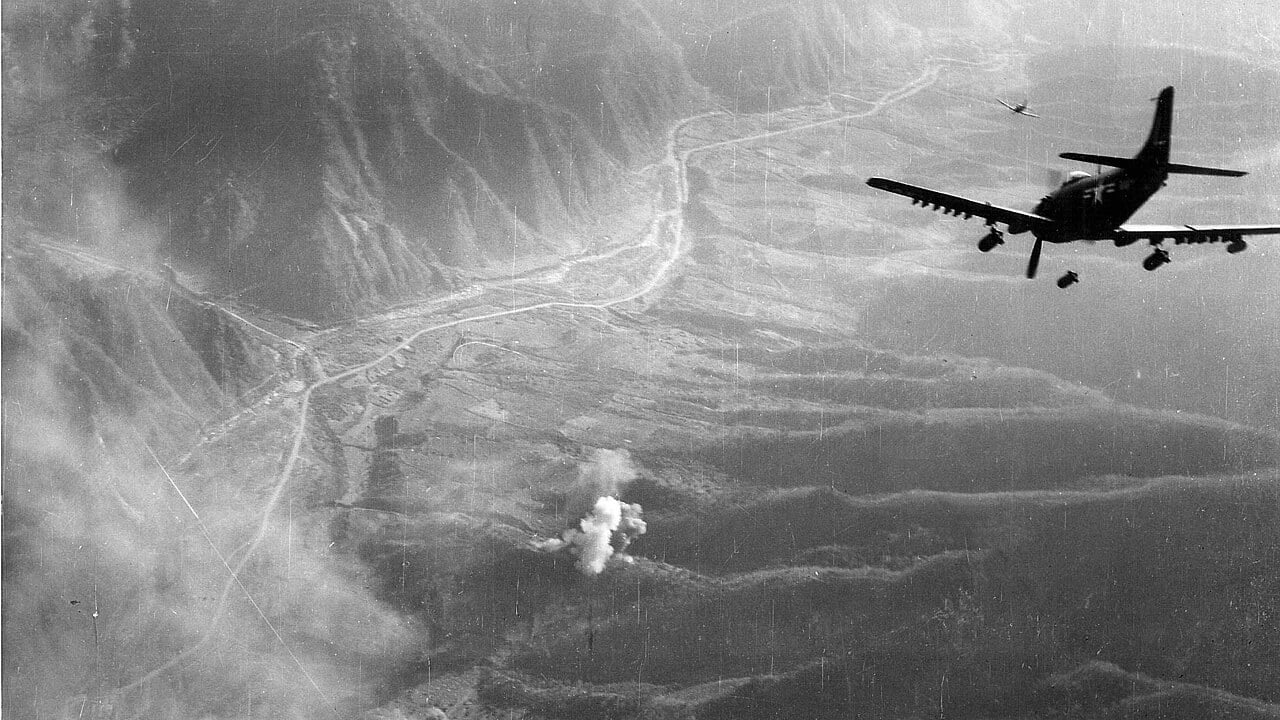
Just before four o’clock on the afternoon of 23 June 1952, US Navy Skyraiders tipped into their dives over the Yalu River. Below them sat the Sui-ho Dam, one of the biggest hydroelectric plants on earth. Across the river, less than 40 miles away, were the MiG-15 bases of Manchuria.
For almost two years, Washington had forbidden anyone to touch it. That afternoon, the Navy, the Air Force, the Marines and a South African squadron hit Sui-ho and a dozen other power plants together. Within four days North Korea was in the dark.
The next morning, American newspapers called it the largest air raid of the Korean War. It was a stunning military success. Politically, it nearly brought down a British government.
Informazioni rapide
- Bersaglio: Sui-ho (Supung) hydroelectric plant on the Yalu, plus 12 other North Korean power plants
- Date: 23–24 and 26–27 June 1952
- Forces: US Air Force, US Navy (Task Force 77), US Marine Corps and South African Air Force
- Carriers: Boxer, Princeton, Philippine Sea, Bon Homme Richard
- Sorties: 1,514 in four days, including 238 F-86 top-cover sorties
- Risultato: 11 of 13 plants knocked out; about 90% of North Korean power capacity lost; two-week blackout
- UN losses: Five aircraft lost or written off, all pilots rescued
- Follow-ups: B-29 night raid 12 September 1952; further strike February 1953
The forbidden target
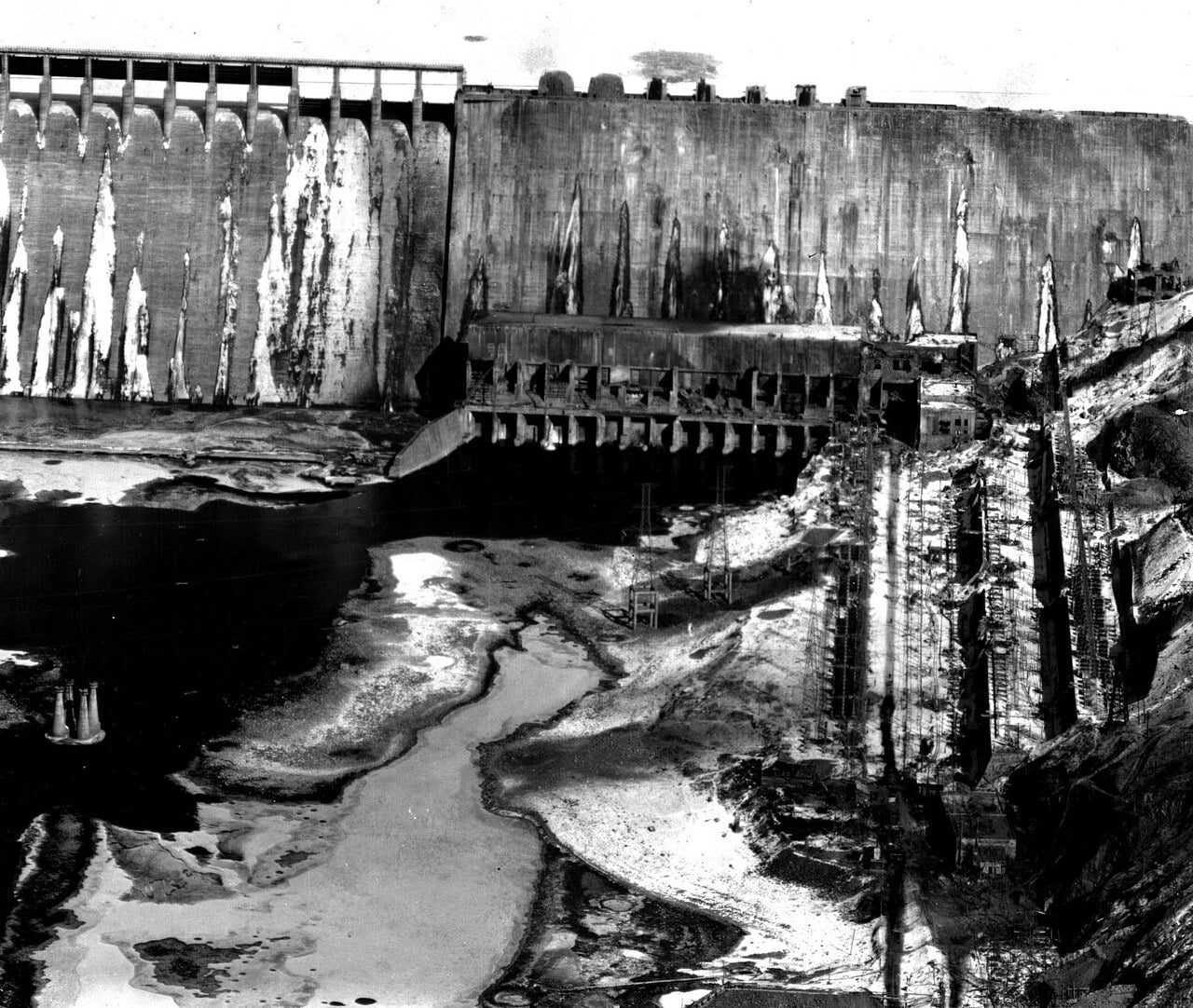
Japan completed the Sui-ho Dam on the Yalu in the early 1940s. It was a concrete wall more than 850 metres long, and its six 100,000-kilowatt generators made it the fourth-largest hydroelectric plant in the world at the time. Its power ran much of western North Korea and reached industry and ports in northeast China.
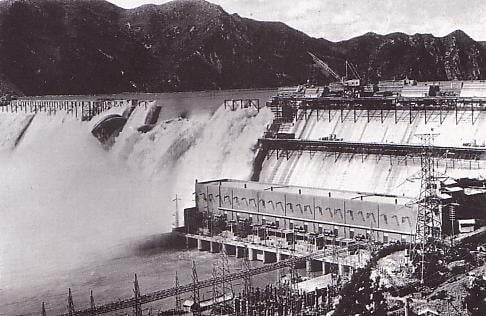
That cross-border role made it politically radioactive. On 6 November 1950, at the State Department’s direction, the US banned attacks on the dam to avoid giving China a reason to enter the war. China entered anyway a few weeks later, but the ban stayed. When truce talks began in July 1951, it was repeated.
By spring 1952 the talks at Panmunjom had stalled over prisoners of war, and the rail interdiction campaign was going nowhere. Far East Air Forces commander General Otto P. Weyland pressed to hit the power grid. General Matthew Ridgway refused.
Then the cast changed. General Mark Clark took over the UN Command on 12 May, followed by new commanders at the Seventh Fleet, Fifth Air Force and Naval Forces Far East. All of them wanted the power plants. On 19 June, with President Truman’s approval, the Joint Chiefs lifted the Sui-ho ban.
Every air arm at once
The plan threw nearly everything in the theatre at 13 power plants: Sui-ho in the west, and the Chosin, Fusen and Kyosen systems in the mountains north of Hungnam. Task Force 77 brought four carriers: Boxer, Princeton, Philippine Sea E Bon Homme Richard, which rushed from Japan to arrive on the morning of the strike.
Thick cloud over the Yalu delayed the launch. When the weather moved south, Weyland ordered the attack for 16:00. Propeller aircraft took off up to an hour before the jets so that everyone would arrive over the targets together. Carrier aircraft crossed the coast and flew low over the mountains to stay under enemy radar.
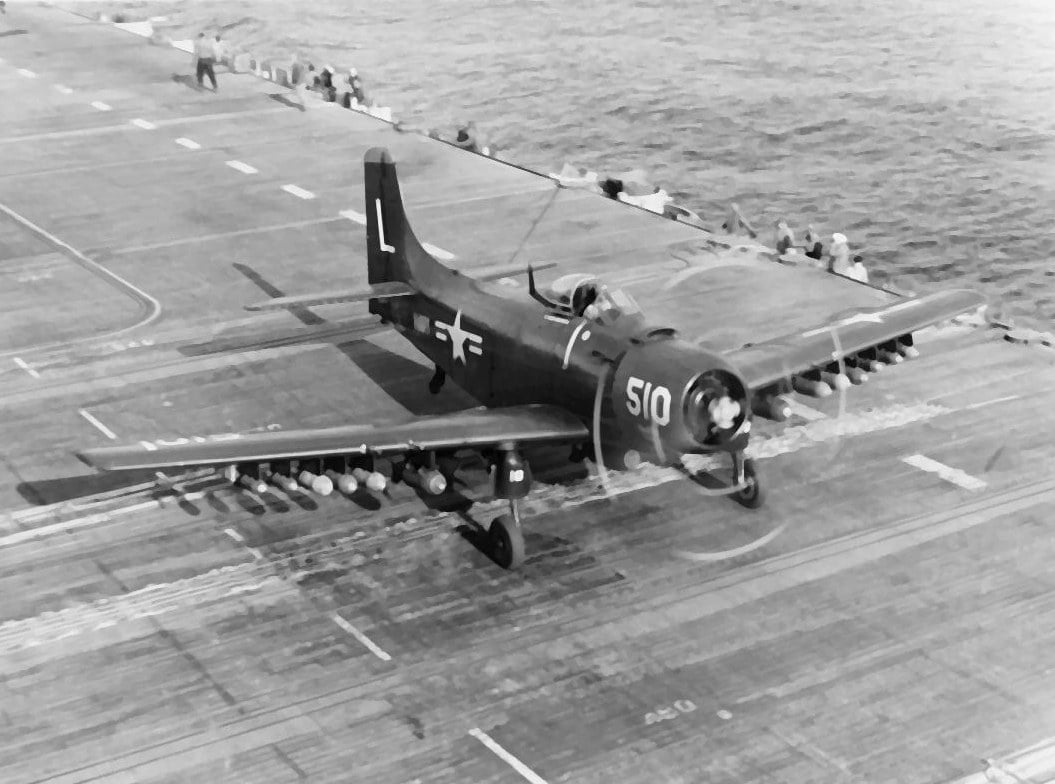
Eighty-four F-86 Sabres got to Sui-ho first, to hold off the MiGs. Then 35 Navy F9F Panthers went down on the anti-aircraft guns, and 35 AD Skyraiders from Boxer, Princeton E Philippine Sea dropped about 81 tons of bombs on the generating plant in a little over two minutes.
British Movietone newsreel from 1952 on the carrier jets that joined the big air strike on the Yalu River power plants.
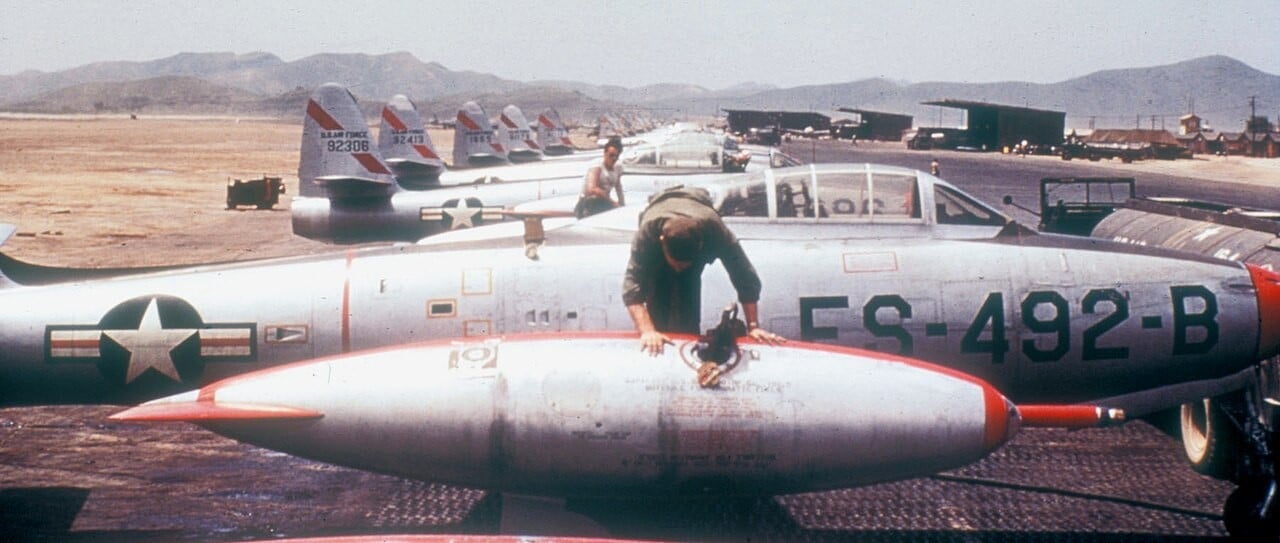
Right behind them came the Air Force: 79 F-84 Thunderjets and 45 F-80 Shooting Stars, adding some 145 tons of bombs. Across the river, the Manchurian airfields were packed with MiGs. Not one tried to intercept.
In the east, F-51 Mustangs of the 18th Fighter-Bomber Group and No. 2 Squadron of the South African Air Force hit the Fusen plants. Marine Skyraiders, Corsairs and Panthers struck Chosin, and more than 130 carrier aircraft, most of them F4U Corsairs, worked over Fusen and Kyosen.
Lights out
Most targets were hit again on 24 June, and Fusen and Chosin once more on 26 and 27 June. Over the four days, land-based fighter-bombers flew 730 sorties and carrier aircraft 546, while Sabres added 238 sorties of top cover: 1,514 in total.
The results were staggering. Eleven of the 13 plants were put completely out of action and the other two were left doubtful. Roughly 90 percent of North Korea’s power capacity was gone, and the country endured a total blackout for two weeks. China lost an estimated 23 percent of the electricity used in its northeast.
Indy Neidell’s week-by-week Korean War series on the week of 23 June 1952, when the UN finally targeted North Korea’s power plants.
The cost was remarkably low. A handful of aircraft were damaged by flak, and over the four days five aircraft were lost or written off, among them two F-80s that crash-landed back at base and two Navy Corsairs that ditched at sea. Every pilot was rescued.
A storm in Westminster
In London, the raid landed like a bomb of its own. Britain had troops, ships and aircraft in Korea, and its Minister of Defence, Lord Alexander, had just visited General Clark without being told. The Labour opposition feared the strikes could widen the war with China.
Labour tabled a censure motion against Winston Churchill’s government. It survived narrowly after US Secretary of State Dean Acheson publicly accepted that Washington should have consulted the British, as a courtesy. A British deputy chief of staff was later appointed to Clark’s headquarters.
In Washington the mood was the opposite. Congressmen asked why such an obvious target had been left alone for two years. The Communist negotiators complained about the bombing but did not walk out of the talks, and the truce was still a year away.
Back to Sui-ho
Chinese and Soviet technicians rushed in to rebuild, so the power plants stayed on the target list. Sui-ho was hit again on 12 September 1952 by B-29 Superfortresses at night, and once more in February 1953. By September the defenders were ready, with far more guns and searchlights around the dam.
The dam wall itself was never the target, and it survived the war. Rebuilt and upgraded in the 1950s, it still generates power on the Yalu today, shared between China and North Korea.
Military Heritage Institute’s Jets Over Korea episode on the Sui-ho Dam strikes.
Sui-ho did not end the Korean War. What it proved was that the Navy, Air Force and Marines could plan and fly one massive joint strike against a single objective, right under the noses of the MiGs. For a war remembered for stalemate, the afternoon of 23 June 1952 was a rare day when everything went to plan.
Sources: Wikipedia (Attack on the Sui-ho Dam; Sup’ung Dam), Walter G. Hermes, Truce Tent and Fighting Front (US Army Center of Military History), US Department of State (Foreign Relations of the United States 1952–1954), Hansard (25 June 1952), The Charlotte News / AP (24 June 1952), Avgeekery
0 Comments