
Grumman F9F Panther
The Navy’s first jet goes to war
A rugged, straight-wing carrier fighter that carried US Navy and Marine aviation through the Korean War — and scored the first jet-versus-jet kill in aviation history.
The straight-wing fighter that carried the Navy through Korea
The Grumman F9F Panther was the US Navy’s first successful carrier-based jet fighter — and one of its most important. When the programme began in 1946, Grumman first sketched an ungainly four-engine night fighter; the company wisely abandoned it for a clean, single-engine day fighter, the XF9F-2, which first flew on 21 November 1947 with test pilot Corwin “Corky” Meyer at the controls. Production Panthers reached the fleet in 1949, first equipping squadron VF-51.
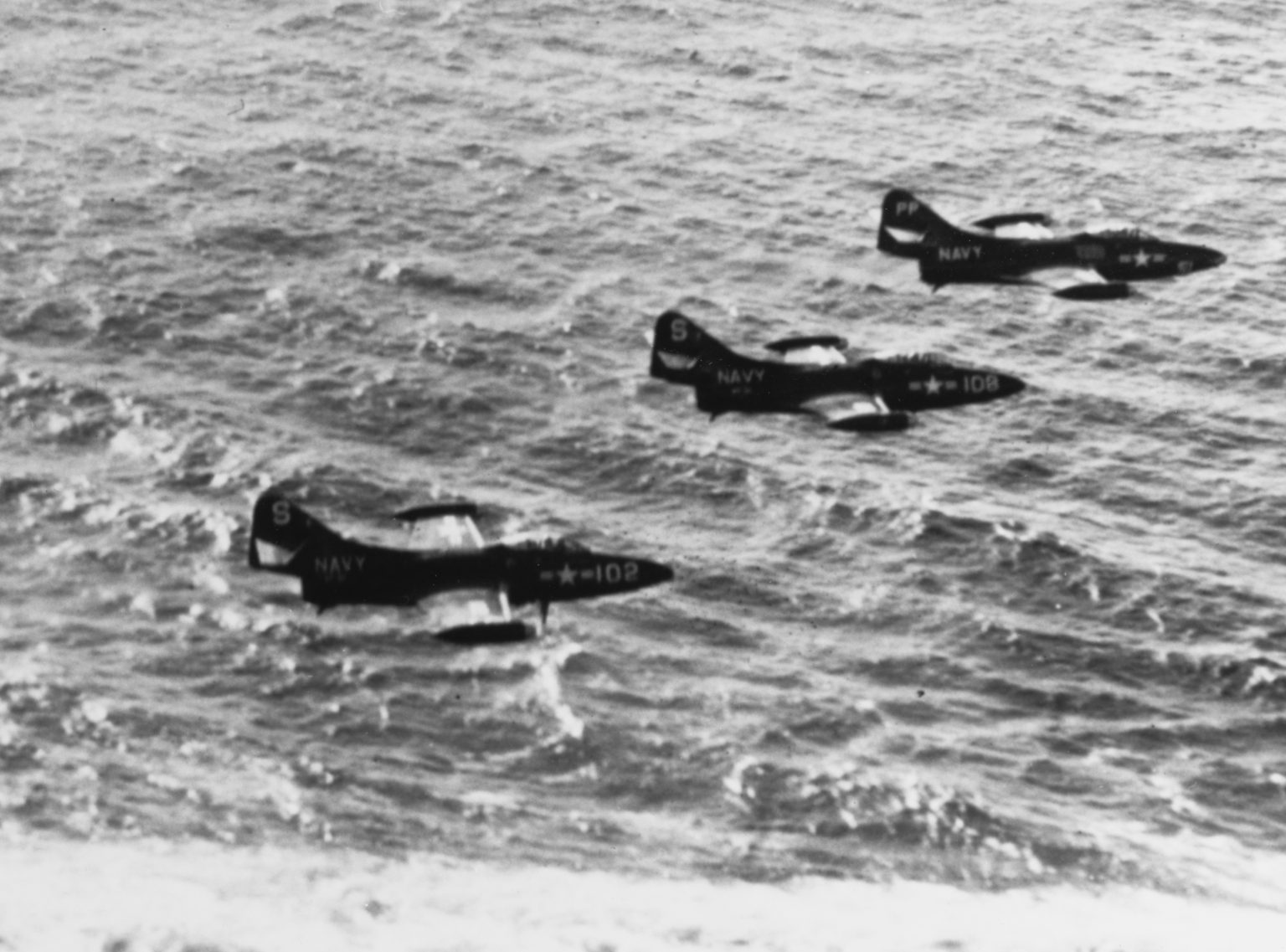
The Panther was deliberately conservative: a straight wing, a conventional tail and the famously tough all-aluminium structure that earned Grumman the nickname “the Iron Works.” It was reliable, easy to fly and could soak up battle damage and still bring its pilot home. Those qualities made it the mainstay of US Navy and Marine carrier aviation over Korea, where Panthers flew the bulk of the Navy’s jet combat sorties — strafing, bombing and rocketing targets as often as they fought in the air.
On 9 November 1950, Lieutenant Commander William Amen of VF-111 out-turned and shot down a Soviet-flown MiG-15 over the Yalu River — the first confirmed jet-versus-jet victory in history, won by a straight-wing Navy fighter over a “superior” swept-wing jet. The MiG-15 was faster and climbed better, so Grumman answered with a swept-wing derivative, the F9F-6 Cougar, which flew in 1951 and reused the Panther’s fuselage and “F9F” designation. But it was the straight-wing Panther that fought Korea, that the Blue Angels first flew, and that carried future legends — astronauts Neil Armstrong and John Glenn, and baseball’s Ted Williams — into combat.
01The Grumman F9F Panther versus the F9F Cougar: straight wing, then swept
It is easy to confuse the two aircraft, because Grumman gave them the same designation. The Panther is the straight-wing family — F9F-2, -3, -4 and -5, the jet that fought the Korean War. When the swept-wing Soviet MiG-15 appeared, Grumman grafted a 35-degree swept wing and tail onto essentially the same fuselage to create the F9F-6 Cougar (first flight 1951, in service from 1952–53). The Cougar was a genuinely different, transonic aircraft, but the Navy kept the “F9F” number to speed it through the budget process.
So when people say “the Panther,” they mean the straight-wing jet of Korea; “the Cougar” is its swept-wing successor. This page is about the Panther — though the Cougar earns a mention because the two are so closely related.
What makes the F9F Panther special
A rugged straight wing and permanent tip tanks
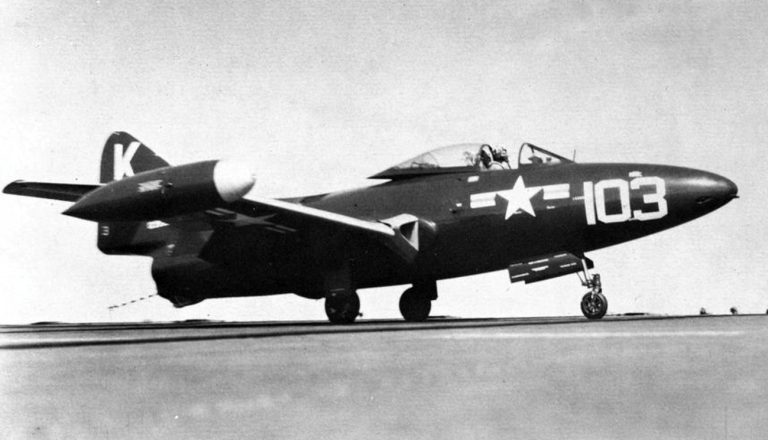
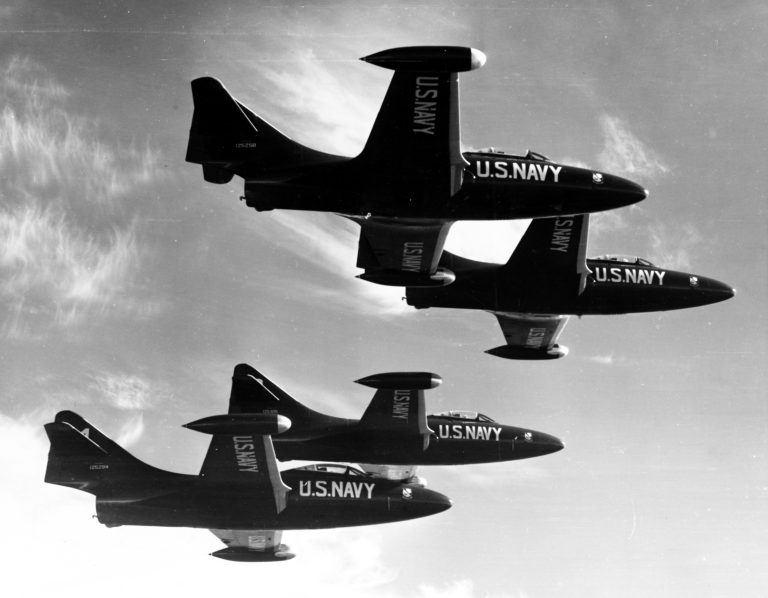
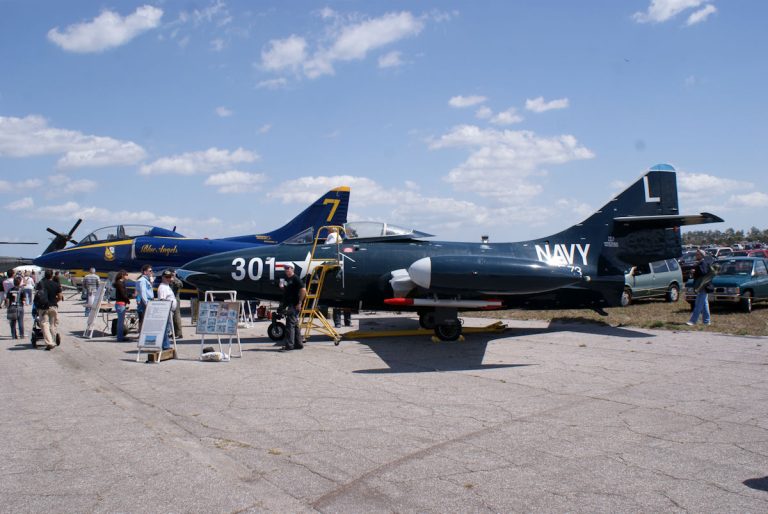
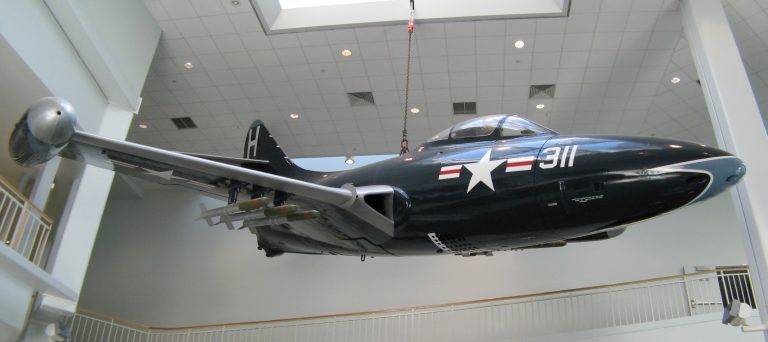
Built to Grumman’s famously tough carrier standards, the Panther’s most recognisable feature is the pair of permanently fixed wingtip fuel tanks. They stretched the jet’s range for long over-water missions and cleaned up the wingtip aerodynamically without the drag or handling penalties of a jettisonable store. The straight wing also gave the Panther a tighter turn radius than the swept-wing MiG-15 — its single greatest dogfighting asset.
A reliable turbojet with a Rolls-Royce lineage
The prototype flew on a British Rolls-Royce Nene; production F9F-2s used the Pratt & Whitney J42, a US licence-built Nene of about 5,000 lbf. The heavier, faster F9F-5 used the more powerful Pratt & Whitney J48, a licence-built development of the Rolls-Royce Tay rated around 6,250 lbf — roughly 7,000 lbf with water injection on later marks. Pilots prized these engines for their reliability.
Fighter and ground-attack in one airframe
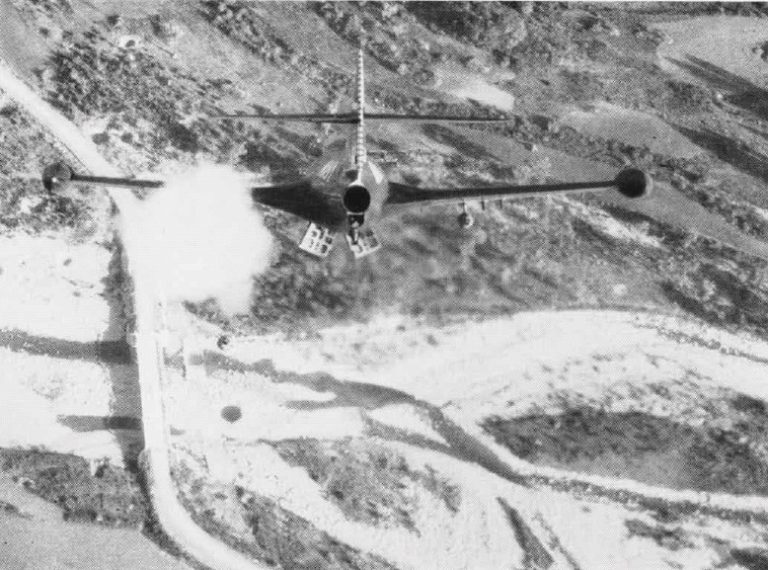
Four 20 mm cannon in the nose made the Panther a hard-hitting gun platform, while underwing hardpoints carried up to about 900 kg (2,000 lb) of bombs or six 5-inch rockets. That versatility made it the Navy and Marines’ workhorse for close air support and interdiction in Korea as much as an air-superiority fighter — a genuine multi-role carrier jet before the term existed.
02The F9F Panther’s engine: how a British Rolls-Royce became an American turbojet
When Grumman needed a reliable jet engine in the late 1940s, the most promising design was British: the Rolls-Royce Nene centrifugal-flow turbojet. Pratt & Whitney acquired a licence and built it as the J42, powering the F9F-2. As the Panther grew heavier, Pratt & Whitney turned to a larger Rolls-Royce design, the Tay, and built it as the J48 for the F9F-5. Both were centrifugal-flow engines — simpler and more rugged than the axial-flow engines that would follow — and their dependability was a big part of why the Panther earned such trust in the fleet. Ironically, the same Nene design, sold to the Soviet Union, also powered the MiG-15 the Panther fought over Korea.
03The F9F Panther in a dogfight: how a straight wing beat the MiG-15
On paper the MiG-15 outclassed the Panther — it was faster, climbed harder and could fight higher. But the straight-wing Panther could out-turn the swept-wing MiG, and Navy pilots fought accordingly: in disciplined divisions, using teamwork and the tighter turn to force MiGs into their gunsights rather than trying to win a climbing or high-speed contest. It was enough to score at least nine air-to-air victories, including the first jet-versus-jet kill in history — a reminder that pilot skill and tactics can beat raw performance.
Full F9F Panther specifications
Figures are for the late-production F9F-5. Sources vary — especially on length and empty weight, which differed between the F9F-2 and the stretched F9F-5 — so contested values are hedged.
Baseline note: the figures below describe the F9F-5 Panther — the definitive mark, 616 built, powered by the Pratt & Whitney J48-P-6A, and the version most US Navy and Marine squadrons were flying by the second half of the Korean War. Deltas for the F9F-2 (Rolls-Royce Nene, built under licence in America as the Pratt & Whitney J42), the F9F-3 (Allison J33) and the swept-wing F9F-6 Cougar are in grey. Six things to settle before the numbers. First, and most important: the Cougar is not a Panther. Grumman kept the F9F designation for the swept-wing G-93 because a fresh type designation would have meant a fresh budget line and a slower contract, but the F9F-6 has a wing swept 35°, a larger wing area, no wingtip tanks at all (the fuel went into the wing to keep the centre of gravity where a swept wing wants it), and it first flew on 20 September 1951. It is a different aeroplane wearing a borrowed name, it reached the fleet too late for Korea, and any specification table that runs the two together should be distrusted. Second, dimensions. The F9F-5 is 11.84 m (38 ft 10 in) long and 3.73 m (12 ft 3 in) tall; the F9F-2 is 11.41 m (37 ft 5 in) long and 3.45 m (11 ft 4 in) tall, the difference being a stretched fuselage and a taller fin. A great many references — including one widely used online aviation history that prints identical tables for both marks — give the -5 figures under an F9F-2 heading. Third, engines get swapped in print too: the National Naval Aviation Museum’s own F9F-2 data sheet credits the aeroplane with a J48-P-6, which is the -5’s engine. The F9F-2 had the J42. Fourth, more power did not buy height. The J48 gave the -5 a quarter more thrust than the -2’s J42, but the -5 was also about 840 kg heavier empty, and it climbed marginally more slowly and topped out some 550 m lower. Fifth, production totals disagree because the F9F-4 order muddles the arithmetic: 109 airframes were ordered as -4s and very nearly all were completed as F9F-5s. Panther totals in print run from about 1,328 to about 1,390; the honest statement is roughly 1,380 airframes. Sixth, weights. Published F9F-2 maxima split between 7,462 kg (16,450 lb) in the clean fighter condition and 8,842 kg (19,494 lb) fully loaded with external stores and fuel; both are correct and they describe different aeroplanes on the same drawing.
Dimensions & weights
- Crew
- 1 — single-seat throughout; the Panther never had a two-seat trainer version, unlike the Cougar, which produced 399 of them
- Length
- 11.84 m (38 ft 10 in) — F9F-2: 11.41 m (37 ft 5 in)
- Wingspan
- 11.58 m (38 ft 0 in) — measured over the permanently fitted tip tanks, which are part of the aeroplane and not a store
- Height
- 3.73 m (12 ft 3 in) — F9F-2: 3.45 m (11 ft 4 in), the -5 having a taller fin
- Wing area
- 23.23 m² (250 sq ft) — unchanged across every Panther mark; the F9F-6 Cougar went to 27.9 m² (300 sq ft) and the F9F-8 to 31.3 m² (337 sq ft)
- Wing sweep
- None — a straight, mid-mounted wing with leading-edge flaps and hydraulically folding outer panels. This is the single fact that governs the whole aeroplane and the whole of its war record
- Empty weight
- 4,603 kg (10,147 lb) — F9F-2: 4,220 kg (9,303 lb)
- Gross weight
- 8,492 kg (18,721 lb) — F9F-2 loaded: 6,456 kg (14,235 lb)
- Maximum weight
- 8,842 kg (19,494 lb) — the figure the National Naval Aviation Museum gives for a fully loaded F9F-2; clean-fighter maxima are quoted around 7,462 kg (16,450 lb)
- Internal fuel
- ~2,590 l (~683 US gal) — not enough, which is the whole reason for the tip tanks
- Tip tanks
- 2 × 454 l (2 × 120 US gal) — fixed, non-jettisonable, standard from the thirteenth production F9F-2; total capacity with them is about 3,500 l (923 US gal)
- Maximum external stores
- ~1,572 kg (~3,465 lb) — on eight underwing pylons; see the sourcing caveat below, because the published maximum varies by a third
- Wing loading
- 366 kg/m² (75 lb/sq ft) — at gross weight; the F9F-2 at loaded weight is about 350 kg/m² (71 lb/sq ft)
Performance
- Maximum speed
- 932 km/h (579 mph, 503 kn) at 1,525 m (5,000 ft) — F9F-2: 925 km/h (575 mph, 500 kn) at sea level
- Cruising speed
- 774 km/h (481 mph, 418 kn)
- Rate of climb
- 25.9 m/s (5,090 ft/min) — F9F-2: 26.1 m/s (5,140 ft/min). The lighter, less powerful mark climbed slightly better, which tells you how much of the J48’s extra thrust went into carrying the extra structure
- Service ceiling
- 13,045 m (42,800 ft) — F9F-2: 13,594 m (44,600 ft)
- Range
- 2,100 km (1,300 miles, 1,100 nm) — ferry figure, tip tanks full, no ordnance
- Combat radius
- Not consistently published — the standard sources quote the ferry range and leave the strike radius alone. What is documented is the problem behind it: Grumman bolted permanent tanks onto the wingtips because the aeroplane could not carry enough fuel inside itself for the mission the Navy had in mind
- Approach and stall
- The F9F-4 introduced bleed-air blown slot flaps, carried over to the F9F-5 — worth about 9 kn off the take-off stalling speed and 7 kn off the approach speed, an unglamorous change that mattered more to a carrier pilot than any figure above
- Take-off
- Catapult launch was normal from a deck — on a calm day an F9F-2 could only be got off with a reduced load, and the shortage of thrust on the early mark is a recurring complaint in squadron accounts
- Thrust-to-weight
- ~0.33 at gross weight — about 0.42 for the F9F-2 at its lighter loaded weight, the comparison that explains the climb figures
- Compressibility limit
- A straight-wing aeroplane, and it behaved like one — buffet and control heaviness arrived in the high Mach 0.7s and the Panther could not follow a MiG-15 into a steep dive. Placarded limits differ between the flight manuals for each mark and no single number should be quoted for the type
- Measured against the MiG-15
- The opponent held 1,005 km/h (624 mph), a ceiling of 15,500 m (50,900 ft) and a climb of about 46 m/s (9,200 ft/min) — faster, roughly 2,500 m higher and climbing at nearly twice the rate. The Panther’s answers were a tighter turn at low speed, a steadier gun platform and a structure that came home with holes in it
Propulsion & systems
- Engine
- 1 × Pratt & Whitney J48-P-6A centrifugal-flow turbojet — single-stage centrifugal compressor, nine combustion chambers, about 943 kg (2,080 lb) dry
- Rating
- 27.8 kN (6,250 lbf) dry, 31.1 kN (7,000 lbf) with water injection
- Engine ancestry
- The J48 is the Rolls-Royce Tay built under licence, and the Tay is a Nene enlarged by about thirty per cent — so every Panther, of every mark, is Nene-powered at one remove or another
- F9F-2 engine
- Pratt & Whitney J42-P-6 or P-8 — the Rolls-Royce Nene under American licence, 22.2 kN (5,000 lbf) dry and about 26.5 kN (5,950 lbf) with water injection. Britain also sold 25 Nenes to the Soviet Union in 1946–47; Klimov reverse-engineered them as the VK-1 and put them in the MiG-15. When a Panther and a MiG-15 met over the Yalu, both were flying behind the same British engine
- F9F-3 and F9F-4 engines
- Allison J33 — the J33-A-8 in the 54 F9F-3s, bought as insurance in case the J42 failed to deliver, and the water-injected J33-A-16 in the F9F-4. Neither worked out: the -3s were converted to F9F-2 standard from February 1950 and nearly every -4 airframe was completed as a J48-powered F9F-5
- Fuel and tip tanks
- Permanently mounted 454 l (120 US gal) wingtip tanks from the thirteenth production aircraft — adopted during prototype trials, never jettisonable, and they improved the roll rate rather than spoiling it, which is why nobody tried to take them off
- High-lift devices
- Leading-edge flaps plus trailing-edge flaps; blown slot flaps using compressor bleed air from the F9F-4 onwards — one of the earliest production applications of boundary-layer control on a combat aeroplane
- Carrier equipment
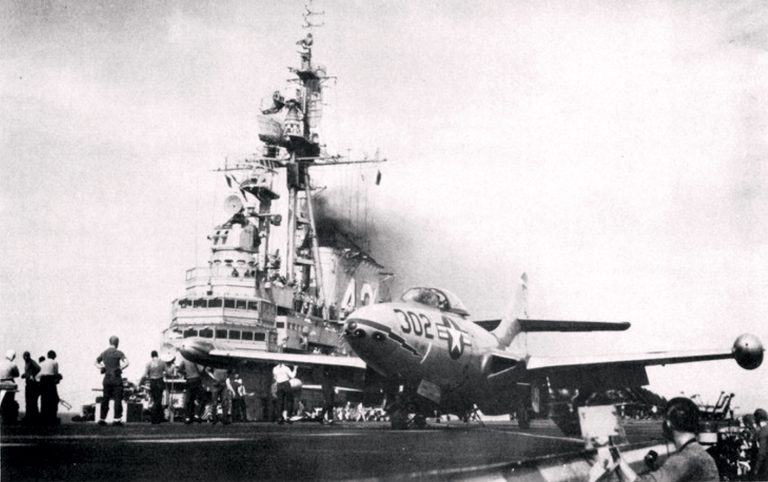
- Hydraulically folding outer wing panels, arrestor hook, catapult attachment and fuselage-side speed brakes — the Panther was cleared for carrier operations in September 1949 after trials that began the previous May
- Cockpit and escape
- Pressurised and air-conditioned cockpit with an ejection seat — squadron accounts single out the air conditioning, a real comfort after the Corsair, and the ejection seat saved at least one future astronaut
- Sighting and avionics
- An optical lead-computing gunsight, radio and navigation gear, and nothing else — no interception radar, no bombing computer, no all-weather capability. The Panther was a clear-weather day fighter that was asked to do a great deal more
- Structure
- Conventional stressed-skin aluminium, built to Grumman’s usual standards — the type’s reputation in Korea rests on battle-damage tolerance more than on any performance figure, and the most-cited example is the F9F-5 that came home to USS Oriskany with 263 holes in it
- Production and designations
- ~1,380 built at Bethpage, New York, 1947–1952 — redesignated in September 1962 under the tri-service system: F-9B (F9F-3), F-9C (F9F-4), F-9D (F9F-5), RF-9D (F9F-5P), QF-9D and DF-9E for the drones and their directors
04The F9F Panther’s cost: what a first-generation Navy jet was worth
Firm cost figures for the Panther are hard to pin down in authoritative sources. Commonly repeated secondary figures put an early-1950s F9F at roughly US$240,000–250,000 per aircraft in the dollars of the day — a fraction of a modern fighter, but a serious sum in 1950. No dependable cost-per-flight-hour figure survives from the era, as such accounting was not kept the way it is for today’s jets. Treat any single dollar figure here as an order-of-magnitude estimate rather than an audited number; the Panther’s real value to the Navy was measured in carrier decks kept in the fight, not in a price tag.
Armament & payload
The Panther’s four cannon killed nine aircraft; its bombs and rockets flew 78,000 sorties
The Panther’s gun armament is four 20 mm cannon grouped in the nose with 190 rounds each, and the whole of its air-to-air record fits in a paragraph: two Yak-9s on the first day of carrier jet operations in Korea, seven MiG-15s over the following three years, and two Panthers lost in air combat in exchange. That record includes the first jet-versus-jet victory ever scored by a United States Navy pilot. It is also, by a very long way, the least important thing the aeroplane did. From early 1951 the Panther’s war was flown with 500 lb bombs and 5-inch rockets against bridges, locomotives, supply dumps and anti-aircraft positions, and the two most famous men ever to fly the type — a baseball player and a future Moon walker — were both employed as attack pilots, not as fighter pilots. Published maximum external loads vary by a third between reputable sources, the cannon are variously identified as AN/M2, AN/M3 or simply "Mk 3", and stores clearances differed between the F9F-2B retrofit standard, the F9F-5 and the ex-US airframes Argentina flew from 1958.
Gun
- Four 20 mm cannon low in the nose ahead of the cockpit, 190 rounds per gun and 760 rounds in total. Sources split on the exact mark: the US Navy’s F9F-5 Standard Aircraft Characteristics chart of June 1952 says AN/M3, the National Naval Aviation Museum’s own data sheet says "Mk-3", and older references say the slower-firing AN/M2. All are Hispano-derived; the M3 is the faster-cycling development, and both types were in service in the period
- Grouping all four in the nose gives a tight, convergence-free cone of fire — a real advantage over wing-mounted batteries, and the reason the Panther was regarded as a steady gun platform in a period when steady gun platforms were rare
- The first US Navy jet-versus-jet kill. On 9 November 1950, Lieutenant Commander William T. Amen, commanding officer of VF-111 "Sundowners", flying an F9F-2B from USS Philippine Sea (CV-47) during strikes on the Sinuiju bridges near the mouth of the Yalu, shot down a MiG-15 and killed its pilot, Captain Mikhail F. Grachev of the Soviet Air Force. Two more MiG-15s fell to Panthers on 18 November 1950
- The other first, which is often confused with it. The Navy’s first aerial victory of the whole war was also a Panther’s, and it came four months earlier: Lieutenant (junior grade) Leonard H. Plog of VF-51, in an F9F-3 from USS Valley Forge, shot down a piston-engined Yak-9 on 3 July 1950, the day of the first US carrier jet operations of the war. A second Yak fell to the same squadron the same day. Amen’s was the first jet-against-jet kill; Plog’s was the first kill of any kind
- The best single fight in the type’s history. On 18 November 1952 Lieutenant Royce Williams of VF-781, in an F9F-5 from USS Oriskany, was drawn into a 35-minute engagement with seven Soviet Naval Aviation MiG-15s off the north-east coast and shot down four of them. His Panther came back with 263 holes and was pushed over the side. Because the opponents were Soviet regulars the action was classified for half a century; the Silver Star he was given in 1953 for "one enemy plane" was upgraded to the Navy Cross in 2023
Air-to-air
- No guided air-to-air weapon of any kind, in any mark. The Panther left front-line service before the Sidewinder was in squadron use, and the card is kept because the absence is the point: this was a gun fighter and nothing else
- The complete air-to-air fit is the four cannon and an optical lead-computing sight. There is no interception radar, no ranging set worth the name and no all-weather capability, so the Panther could only fight what its pilot could see
- Against the MiG-15 the aeroplane was outclassed in every measure that a fighter pilot cares about — slower by about 80 km/h, some 2,500 m lower on ceiling, climbing at roughly half the rate, and unable to follow into a dive. Panther pilots won by making the MiG fight slow and turning, and by shooting well
- Once the F-86 Sabre arrived in numbers the Navy stopped pretending. From 1951 the Panther escorted and attacked; MiG Alley belonged to the Air Force, and Task Force 77 flew its jets where the MiGs mostly were not
- Argentine Naval Aviation Panthers, flown from 1958 to the end of the 1960s, never fired at another aircraft. The only shots they fired in anger were at ground targets
Air-to-surface guided
- None. Never carried, never trialled, never proposed. Every Panther attack in Korea and in Argentina was made with unguided ordnance or with the gun
- There is no bombing computer, no toss-bombing system and no nuclear capability. The Panther was a day fighter given racks; the delivery method was a dive, a mark on a windscreen and a pilot’s judgement
- The contrast with the aeroplane that replaced it is instructive: the swept-wing F9F-8B Cougar was fitted with a low-altitude bombing system and cleared for a tactical nuclear store, and the Cougar family later carried Sidewinders. The Panther got none of that
- Western carrier-borne guided air-to-surface weapons were still years away when the Panther left the fleet in 1956. Bullpup, the Navy’s first, went to attack squadrons flying other types
Bombs
- Eight underwing stations: one heavy inboard pylon per wing rated for a 454 kg (1,000 lb) bomb or a 568 l (150 US gal) drop tank, and three lighter outboard stations per wing for stores of about 113 kg (250 lb) or rockets
- Published maximum external load disagrees badly — 1,572 kg (3,465 lb) in Francillon’s Grumman Aircraft since 1929, 1,361 kg (3,000 lb) on the National Naval Aviation Museum sheet, and 900 kg (2,000 lb) in other standard references. The practical limit was set by thrust rather than by structure, particularly on the J42-powered F9F-2
- The racks were a retrofit, not an original feature. Fitted to all F9F-2s, they earned the aeroplane the interim designation F9F-2B; once every airframe had them the suffix was quietly dropped, which is why the same aircraft appears in the literature under both names
- A representative Korean load is two 227 kg (500 lb) general-purpose bombs on the inboard stations with rockets outboard. Marine Panthers flying close support from land bases carried heavier and more varied loads than carrier aircraft, because they did not have to be recovered aboard ship
- Bombing was what the type actually did. The Panther flew 78,000 sorties over Korea between June 1950 and July 1953, and only a handful of them were fighter sweeps
Rockets
- Six or eight 127 mm (5-inch) HVAR — the High Velocity Aircraft Rocket, the standard American air-to-ground rocket of the period, carried on the outboard wing stations
- Rockets were the Panther’s weapon of choice against locomotives, rolling stock, bridge spans, gun pits and supply dumps, the target set that consumed almost the whole of the type’s war after the spring of 1951
- Flak suppression was the specific and murderous job: Panthers went in ahead of the strike to shoot at the anti-aircraft guns, which meant flying deliberately into the one thing that could reliably kill them. Losses in this role were the type’s heaviest
- Argentine Panthers used bombs, rockets and cannon against columns of the Army’s 8th Tank Regiment advancing on Punta Indio during the naval revolt of April 1963, destroying several M4 Shermans. One Panther was shot down in the action — the type’s only combat loss outside Korea
- No larger rocket — nothing in the class of the 11.75-inch Tiny Tim carried by Corsairs and Skyraiders — was cleared for the Panther
Pods & other stores
- 568 l (150 US gal) drop tanks on the inboard pylons, the only way to extend an already short radius when the fixed tip tanks were not enough
- Camera noses rather than pods: the F9F-2P (36 built) and F9F-5P (36 built) had the cannon removed and a lengthened nose full of cameras. They flew unarmed tactical reconnaissance over Korea throughout the war and were among the busiest Panthers in theatre
- No gun pods, no electronic countermeasures pods, no targeting pods, no buddy refuelling. The Panther predates all of it
- Drone equipment at the end of the type’s life: F9F-5K target drones (QF-9D from 1962) carried radio-control and telemetry gear in place of a pilot’s usefulness, and F9F-5KD directors (DF-9E) carried the control transmitters. Both are recognisable in photographs by the blade aerials on the nose
- The wingtip tanks are not stores and cannot be jettisoned. Any loadout diagram that shows them coming off is wrong
Three typical loadouts
- Combat air patrol, Task Force 77, 1950–51
- Guns only, 760 rounds, fixed tip tanks full. The configuration in which Amen killed his MiG on 9 November 1950 and in which Royce Williams fought seven of them on 18 November 1952 — clean, light, and the only fit in which a Panther had any hope against a MiG-15.
- Close air support and armed reconnaissance, Korea, 1951–53
- Two 227 kg (500 lb) bombs on the inboard pylons, six 127 mm HVAR rockets outboard, full guns. The everyday Korean fit for both Navy and Marine squadrons, and the load that made the 78,000-sortie figure.
- Tactical photo-reconnaissance, F9F-5P
- Cannon deleted, lengthened camera nose, tip tanks full, no external stores. Unarmed, unescorted where necessary, and dependent entirely on speed and the pilot’s eyesight for survival.
Sourcing caveat: gun designations, station ratings and maximum external loads for the Panther are inconsistent across the standard references, and the aeroplane was modified in service (racks retrofitted to the F9F-2 fleet, blown flaps introduced on the F9F-4 and -5) so that a figure true of one airframe in 1950 need not be true of the same airframe in 1953. Where a Navy Standard Aircraft Characteristics sheet for the specific mark exists it should be preferred to any of the figures above.
Variants
Four Panther marks, two camera aeroplanes, and one swept-wing successor that only borrowed the name
The Panther’s variant history is a story about engines. Grumman had a good airframe and no confidence in American turbojets, so the Navy bought the aeroplane three times over — once with a British Nene, once with an American Allison as insurance, and once with the bigger Rolls-Royce Tay — and only the Nene line and its Tay descendant were any good. The F9F-3 with its Allison J33 was converted back to J42 standard within months of delivery; the F9F-4, also an Allison aircraft, was so thoroughly abandoned that almost every airframe ordered as a -4 came off the line as a J48-powered -5.
The second thread is the racks. The Panther was designed as a day fighter and turned into an attack aircraft by the Korean War, which is why the underwing pylons arrive as a retrofit with their own designation suffix and then lose it again when the retrofit becomes universal.
The third thread is the one to be careful about. The F9F-6 Cougar carries a Panther designation and is not a Panther. It has a wing swept 35 degrees, a bigger wing, no tip tanks, and a first flight in September 1951; Grumman and the Navy kept the F9F number to avoid opening a new budget line, and the paperwork has been misleading readers ever since. The Cougar is listed below only so that the boundary is drawn in the right place.
- XF9F-1 and XF9F-2 (1946–48 / 2 flown)
- The XF9F-1 was the four-engined G-75 night fighter, beaten by the Douglas F3D Skyknight on 3 April 1946 and never built; rather than cancel the contract, the Bureau of Aeronautics simply rewrote it to cover three prototypes of the entirely different single-engined G-79. The first flew on 21 November 1947 with Corky Meyer at the controls, on an imported Rolls-Royce Nene; a few sources give 24 November.
- F9F-2 and F9F-2B (1949–51 / 564–567)
- The first production Panther, with the Nene built under licence as the Pratt & Whitney J42. Underwing bomb and rocket racks were retrofitted to the whole fleet as the F9F-2B; the suffix lapsed once it applied to every aircraft. This is the mark that fought the first two years in Korea and the only mark exported.
- F9F-2P (1950–52 / 36)
- Unarmed photo-reconnaissance conversion with a camera nose and no cannon, used hard over Korea from early in the war.
- XF9F-3 and F9F-3 (1949–50 / 54)
- The Allison J33-A-8 insurance batch, ordered in case the licensed Nene failed. The engine proved the less reliable of the two and the aircraft were converted to F9F-2 standard from February 1950. Plog’s Yak-9 on 3 July 1950 was shot down by an F9F-3, which makes this short-lived mark the scorer of the Navy’s first victory of the war. Redesignated F-9B in 1962.
- F9F-4 (1951–52 / 109 ordered)
- Stretched fuselage, taller fin, more internal fuel and the water-injected Allison J33-A-16, and the mark that introduced bleed-air blown flaps — a genuine advance that reduced take-off stalling speed by about 9 kn and approach speed by about 7 kn. Nearly all were completed instead as F9F-5s; the handful delivered went largely to the Marines. Redesignated F-9C.
- F9F-5 (1951–52 / 616)
- The definitive Panther and the most numerous: the -4 airframe with the Pratt & Whitney J48, a licence-built Rolls-Royce Tay, giving 27.8 kN dry and 31.1 kN with water injection. Faster at altitude, heavier, and marginally worse on ceiling and climb than the -2 it replaced. Redesignated F-9D.
- F9F-5P (1951–53 / 36)
- The reconnaissance version of the definitive mark, cannon deleted, nose lengthened for the camera fit. Redesignated RF-9D.
- F9F-5K and F9F-5KD (from the mid-1950s / conversions)
- Retired Panthers converted to radio-controlled target drones (QF-9D from 1962) and to two-seat drone-director aircraft (DF-9E). These kept the type flying in American service into the 1960s, long after the last combat squadron had given it up.
- Argentine F9F-2B (1958–1969 / 24 in service)
- The only export. Argentina bought 28 ex-US Navy aircraft, of which 24 entered service with Naval Aviation from late 1958 and the rest were broken for spares; the carrier ARA Independencia had catapults too weak to launch them, so they flew from Punta Indio and Comandante Espora. One landed aboard Independencia in July 1963 — the first jet landing on an Argentine carrier — and was craned off again. They fought in the naval revolt of 1963 and were mobilised during the 1965 border crisis with Chile.
- F9F-6 Cougar (1951 onward / 646 F9F-6, about 1,985 Cougars of all marks)
- A different aeroplane. Grumman’s G-93 took the Panther fuselage and gave it a wing swept 35 degrees, a larger area, and internal wing fuel in place of the tip tanks; it first flew on 20 September 1951 and reached the fleet too late for Korea. The F9F designation was retained for contractual convenience, not because the two are the same machine. Later Cougars — the F9F-7, the F9F-8 with its stretched fuselage and Sidewinder capability, and the 399 two-seat F9F-8T trainers that served until 1974 — belong to that separate story, not to this one.
Closing note on numbers and survivors. Panther production totals in print run from about 1,328 to about 1,390 because the 109 airframes ordered as F9F-4s were almost all delivered as F9F-5s and different authors count them once, twice or not at all; roughly 1,380 is the defensible figure. The type left US front-line service in 1956, displaced by the Cougar and by the F2H Banshee’s successors, lingered in training and reserve units to 1958 and in drone work into the 1960s; Argentine Naval Aviation flew the last operational Panthers, withdrawing them in 1969 for want of spares, with the Spanish-language sources giving a final flight on 3 March 1970. Roughly two dozen original airframes survive and there are no reproductions, which makes the count unusually clean. Fifteen or so are on public display in the United States, among them F9F-2 BuNo 123050 at the National Naval Aviation Museum at Pensacola, F9F-2 123652 from the Flying Leatherneck collection, F9F-2B 123526 at the National Museum of the Marine Corps at Quantico, F9F-2 125183 at Pima, F9F-5 126226 at the Combat Air Museum in Topeka and F9F-5P 126277 at Planes of Fame. Four more are in Argentina: gate guardians at Puerto Belgrano and Punta Indio, one under restoration at the Argentine Naval Aviation Museum and one at the National Naval Museum at Tigre. A further handful are in storage or under restoration at Yanks, Fantasy of Flight and elsewhere. Exactly one Panther has been kept airworthy in recent years — F9F-2B BuNo 123078, flown by the Cavanaugh Flight Museum until that museum closed on 1 January 2024; its flying status since the move should be checked before it is described as active.
From Grumman drawing board to Korea and beyond
Navy contract to Grumman
The US Navy orders a jet fighter from Grumman; an early four-engine night-fighter concept is dropped for the clean single-engine XF9F-2.
XF9F-2 first flight
Grumman test pilot Corky Meyer takes the prototype Panther aloft for the first time on 21 November 1947.
Enters fleet service
Production F9F-2 Panthers reach the fleet, first equipping VF-51 — the Navy’s first operational carrier jet fighter.
The Blue Angels’ first jet
The Navy flight-demonstration team debuts the F9F-2 Panther in August 1949, beginning the Panther’s Blue Angels era.
First combat — and first Navy jet kills
On 3 July 1950 VF-51 Panthers fly the first US Navy jet combat sorties over Korea and down two Yak-9 propeller fighters.
First jet-vs-jet kill in history
On 9 November 1950 Lt Cmdr William Amen (VF-111) shoots down a Soviet-flown MiG-15 — the first jet-versus-jet victory ever.
The swept-wing Cougar appears
Grumman flies the F9F-6 Cougar, a swept-wing development of the Panther built to counter the MiG-15’s speed.
Famous pilots over Korea
Neil Armstrong, John Glenn and Ted Williams all fly Panthers in Korea; Williams belly-lands his burning jet in February 1953.
Off the front line at home
The Blue Angels move to the swept-wing Cougar, and the Panther begins phasing out of front-line US service through the mid-1950s.
An Argentine afterlife
Argentina’s Naval Aviation buys ex-US Panthers, flying them land-based until their final flight on 3 March 1970.
Twelve F9F Panther stories
The first jet-vs-jet kill in history
On 9 November 1950 a straight-wing Panther downed a swept-wing MiG-15 over the Yalu.
Read the full story
Royce Williams and the secret dogfight
In 1952 one Panther pilot fought roughly seven MiG-15s alone — and it was classified for fifty years.
Read the full story
The Splendid Splinter’s burning belly-landing
Baseball legend Ted Williams rode a flaming Panther down and walked away.
Read the full story
John Glenn led Ted Williams into battle
A future astronaut flew as wingman leader for a baseball Hall of Famer.
Read the full story
Neil Armstrong’s six-foot haircut
A cable strung across a valley sheared feet off the wing of the future Moon-walker’s Panther.
Read the full story
A hole big enough to climb through
John Glenn once flew home with a hole in the tail he could put his shoulders through.
Read the full story
The Blue Angels’ first jet
The Panther launched the Navy demonstration team into the jet age.
Read the full story
Panthers on the silver screen
Hollywood made the Panther the face of Korean-War carrier aviation.
Read the full story
The signature silhouette
Permanent wingtip tanks gave the Panther its unmistakable outline.
Read the full story
Bombs, rockets and cannon
The Panther spent much of Korea working as a fighter-bomber.
Read the full story
First Navy jet victories
Before the MiG kill, Panthers scored the Navy’s first jet air-to-air wins.
Read the full story
The Panther’s Argentine second life
Retired US Panthers flew on from Argentine soil into 1970.
Read the full story
The Panther in pictures
The F9F Panther in motion
A curated video feature for the F9F Panther is coming soon. In the meantime, explore the photo gallery above and the operations map below.
Where the F9F Panther flew
The record that defines the Panther
The F9F Panther was the US Navy and Marine Corps’ principal carrier jet of the Korean War. It opened the Navy’s jet combat account on 3 July 1950, downing two Yak-9 propeller fighters, and on 9 November 1950 scored the first jet-versus-jet kill in aviation history when Lt Cmdr William Amen destroyed a Soviet-flown MiG-15. Panthers are credited with at least nine air-to-air victories — a tally long understated because some, such as Royce Williams’ four MiGs, stayed classified for decades. But the Panther’s greatest contribution was as a fighter-bomber, flying tens of thousands of ground-attack sorties against bridges, supply lines and troops.
Compare the combat record of every military aircraft. Figures as of July 2026.
Everything people ask about the F9F Panther
Can I fly in an F9F Panther?
Was the F9F Panther straight-winged or swept-winged?
Did the F9F Panther really score the first jet-vs-jet kill?
Which famous people flew the F9F Panther?
What engine did the F9F Panther use?
Could the Panther beat the MiG-15?
Who else flew the F9F Panther besides the US?
You can’t fly the Panther.
These, you can.
Some legends only live in museums — others are fuelled and waiting. MiGFlug has put civilians in real military jet cockpits since 2004.
 Fly the L-39 AlbatrosThe world’s most-flown jet trainer — aerobatics included
 Fly the F-104 Starfighter“The missile with a man in it”
 Fly the MiG-21The Cold War’s most-produced jet
 Fly the T-33 Shooting StarAmerica’s first jet trainer
 Fly the DH VampireA piece of early jet history
 Fly the S.211Agile Italian jet trainer
 Fly the MB-326The classic Aermacchi jet
 Fly the MiG-15The Soviet legend of the Korean War
Continue the tour
Every fact, checked
- National Naval Aviation Museum — F9F-2 PantherDevelopment, service entry with VF-51 and airframe data.
- Smithsonian Air & Space — “Panthers at Sea”The Panther’s Korean-War career and reputation for toughness.
- U.S. Naval Institute — Naval Aviators vs. the MiG-15The 9 November 1950 first jet-vs-jet kill and Panther air combat.
- U.S. Naval Institute — The Navy’s Aerial OscarHow Panthers came to star in “The Bridges at Toko-Ri.”
- U.S. Navy Blue Angels — team historyThe Panther as the Blue Angels’ first jet, 1949–1954.
- Baseball Hall of Fame — Ted Williams crash-lands in KoreaTed Williams’ burning belly-landing in a VMF-311 Panther.
- HistoryNet — Neil Armstrong in KoreaArmstrong’s cable strike and ejection flying VF-51 Panthers.
- Military Factory — Grumman F9F PantherSpecifications, engines, armament and production figures.