

In the autumn of 1975 a wooden model about ten feet long sat on a pole in the New Mexico desert while a radar looked at it. The number that came back from that pole is, by a long and badly documented chain of repetition, the reason you have read that an F-22 Raptor shows up on radar as a marble and an F-35 Lightning II as a golf ball.
Those two comparisons are the most widely circulated technical claims in modern military aviation. They appear in newspaper graphics, in defence-industry marketing, in parliamentary debate and in the first paragraph of a thousand forum arguments. They are repeated as though somebody, somewhere, put a fighter in a chamber and wrote the answer down.
Nobody did, or if they did, the result is classified and you have not seen it. What you have seen is a chain of citation that can be followed to its end in an afternoon. This article follows it. The destination is not a measurement. It is a magazine page, a memoir, and a forum thread.
Quick Facts
Most-quoted F-22 figure: 0.0001 m² (−40 dBsm), attributed by Wikipedia to a 2009 Lockheed Martin release
Most-quoted F-35 wording: “lower than a metal golf ball at certain frequencies and angles”
Where the marble and golf ball come from: Aviation Week & Space Technology, 14 November 2005, p. 27, as cited inline by GlobalSecurity
Absolute RCS figures in Ben Rich’s memoir: None. No square metres, no dBsm — only ratios and animals
What the memoir’s golf ball and marble describe: A wooden scale model on a test pole, not an aircraft
Published B-2 figures on one GlobalSecurity page: 0.0001 m² to 0.75 m² — a spread of four orders of magnitude
Rows in that page’s table citing the standard textbook: Zero. Knott, Schaeffer & Tuley is listed in the bibliography and cited by nothing
The Golf Ball Was a Lump of Wood on a Pole
Ben Rich ran Lockheed’s Skunk Works and wrote the memoir that most popular accounts of stealth are built on. In it, the radar specialist Denys Overholser describes measuring the faceted model that became Have Blue and then the F-117 Nighthawk.
Overholser’s account says the model was measuring approximately the equivalent of a golf ball. That is the golf ball. It is not an aircraft. It is a wooden test article, roughly ten feet long, mounted on a pylon on a range, measured at one frequency from one set of angles.
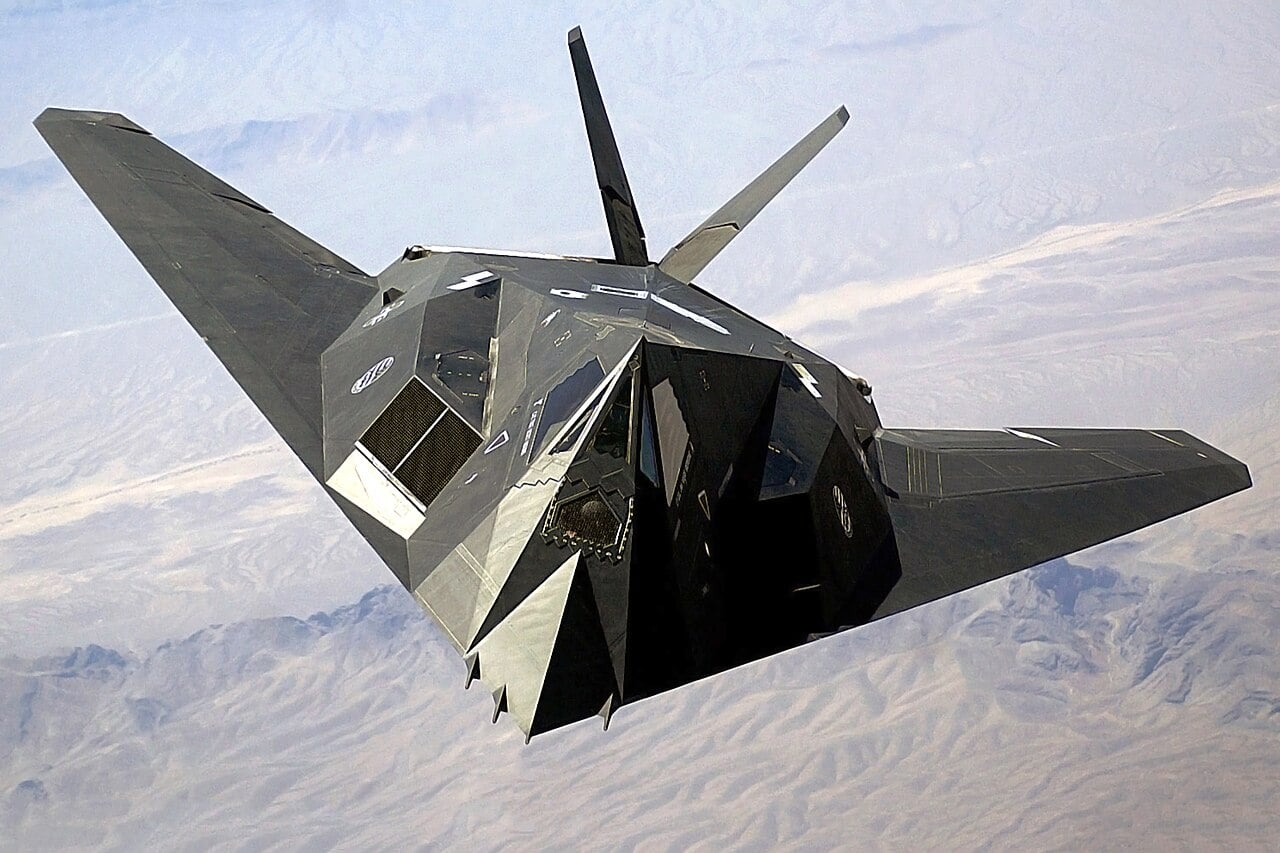
What happens next in the same account is the part nobody repeats. The figure got better, and it got better for the wrong reason.
Read that twice. The celebrated improvement from golf ball to marble, in the one first-hand account anybody cites, is attributed to bad data. The range itself was the problem. The supporting pole registered a return of its own. Bird droppings on the mount, by Overholser’s reckoning, increased the measured radar cross section by one and a half decibels — and three decibels is a doubling. An inversion layer in the desert air made one day’s results four decibels better than they deserved to be.
This is not a scandal. It is ordinary, careful range work, and the team knew exactly what it was fighting. It is only a scandal when a number produced under those conditions, about a lump of wood, is reprinted forty years later as the radar cross section of a combat aircraft.
An Eagle’s Eyeball Was an Answer to a Hypothetical
The second famous comparison is the eagle’s eyeball. In the memoir it appears in a conversation, before anything had been built, in which Rich asks how small the proposed shape would look — as big as a condor, an eagle, an owl, a what? Overholser’s reply is to try as big as an eagle’s eyeball. The line immediately before it is that they are talking about something infinitesimal.
It is an estimate offered in conversation about a design that did not yet exist. It has since been printed as a specification.
The hummingbird has the same character. The memoir’s opening scene has Rich watching a missile test and expecting the fighter’s radar profile to show up as smaller than a hummingbird’s. He then adds, in his own words, that this is what he is betting. It is a prediction with a wager attached, written as a scene-setter in the first pages of a book for general readers. It is not a test result.
Lockheed Martin’s own account of the F-117 and the origins of stealth shaping.
The Ball Bearings Were a Sales Prop, and They Came in a Range
The most cinematic image in the whole story is Rich carrying ball bearings into the Pentagon and rolling them across the desks of four-star generals to show how small the aircraft would look.
It worked. It was also, explicitly, a demonstration rather than a datum. One account inside the memoir, from Lindsay Anderson, says the ball bearings ranged in size from a golf ball to an eighth of an inch in diameter, and that nothing should measure less than an eighth-of-an-inch ball bearing. That last sentence describes a design floor — a target the programme set itself — not an achieved measurement.
There is a further wrinkle worth recording, because it shows how quickly even a first-hand account drifts. Overholser’s version of the Pentagon scene has Rich declaring “Here’s your airplane!” Rich’s own narration of the same moment has him saying something more careful: here is the observability of your airplane on radar. Two tellings of one event, in one book, and the looser one is the one that reads better.
The Memoir Contains No Square Metres at All
This is the finding that ought to end most arguments. Across the whole stealth-origin section of the memoir there is not one absolute radar cross section. No square metres. No dBsm. Every quantitative claim is a ratio with no stated baseline.
The faceted shape is a thousand times stealthier than a twelve-year-old drone. It is between ten thousand and one hundred thousand times lower in radar cross section than any American military aircraft or any new Soviet MiG. The SR-71 Blackbird is about one hundred times stealthier than the F-14 Tomcat. All of those are comparisons. None of them can be converted into a number, because the thing they are compared against is never quantified either.

Rich’s analogies for conventional aircraft make the genre obvious. The B-52 Stratofortress is the equivalent of a flying dairy barn from the side. The F-15 is as big as a two-storey Cape Cod house with a carport. The Blackbird has the radar cross section of a single-engine Piper Cub — and Rich immediately qualifies it: that is what a radar operator would think he was tracking.
That qualifier is the whole point. These were always descriptions of what an operator perceives, written to make an unfamiliar physical quantity legible to a general reading in 1994. They were never offered as engineering values, and the man who wrote them said so in the same sentence.
The Marble and the Golf Ball Have One Source, and It Is a Magazine Page
So where do the modern figures come from — the ones attached to the F-22 and the F-35 rather than to a 1970s wooden model?
GlobalSecurity’s stealth-aircraft page is the usual upstream source for RCS tables on the internet. It gives the F-22 a frontal signature of −40 dBsm with the size of a marble, and the F-35 −30 dBsm with the size of a golf ball. And, to its credit, it says where it got them: an inline citation to Aviation Week & Space Technology, 14 November 2005, page 27.
One page of one trade magazine, published in 2005, is the origin of both comparisons. Everything downstream of it — the infographics, the comparison videos, the confident forum posts — is repetition of that page. Whether the magazine itself was reporting a measurement, a briefing, or a manufacturer’s characterisation is a question the citation does not answer.
Real Engineering on the faceting, the physics and the computing limits that produced the shape.
The Table Everyone Copies Cites a Forum Thread
The numeric table on that same GlobalSecurity page is the ancestor of most RCS tables in circulation. Its F-22 row gives 0.0001 to 0.0005 m² and its F-35 row 0.0015 to 0.005 m². Both rows carry three reference markers. Those three references are an unnamed personal web page on a consumer ISP domain, a thread on the f-16.net discussion forum, and a university course PDF.
That is the sourcing. A forum thread is load-bearing for a figure that has been quoted in defence journalism for twenty years.
Meanwhile the page’s own bibliography lists Knott, Schaeffer and Tuley’s Radar Cross Section — the standard reference text on the subject — as item [4]. Not a single row in the table cites it. The authoritative source is present as decoration.
The page also disagrees with itself. Its first table gives the F-117 as 0.003 m²; its second gives the same aircraft as 0.025 m² or less. And the F-35 entry pairs 0.005 m² with −30 dBsm, which are not the same quantity: −30 dBsm is 0.001 m², and 0.005 m² is roughly −23 dBsm. The table is internally inconsistent in its own arithmetic.
The B-2 Spans Four Orders of Magnitude on a Single Page
For the B-2 Spirit, the same page offers, in prose, a value widely reported to be about −40 dBsm; a figure of approximately 0.75 m² by some accounts; and a head-on value of 0.01 m² from some reports. Its tables add 0.1 m² and 0.0001 m².
Those span from one ten-thousandth of a square metre to three quarters of a square metre — a factor of 7,500. The attributions are “widely reported”, “by some accounts” and “some reports”. No named source is given for any of them.
Any one of those numbers, lifted alone and put in a graphic, looks authoritative. Presented together, as the page itself presents them, they are an admission that nobody writing the page knew.

Why a Single Number Could Not Be Right Anyway
Suppose a genuine measurement were published tomorrow. It still would not be the aircraft’s radar cross section, because there is no such single quantity.
Radar cross section is a function of viewing angle. It is also a function of frequency. A shape optimised to scatter X-band energy away from a nose-on threat behaves quite differently when illuminated from the beam, from above, or at VHF. The number is a property of a geometry, a frequency and an aspect, taken together — not of an airframe.
The scale of that variation is not a rounding error. In our own earlier work on small drones, measured figures for a single quadcopter ranged from 0.004 m² to 0.27 m² purely as a function of viewing angle — a factor of about seventy, or 18 dB, for one unchanging object. There is no reason to expect a faceted or blended fighter to be better behaved.
Wikipedia’s F-22 article, in a sentence that carries no citation at all, gets this right: the RCS value is a restrictive measurement of the aircraft’s frontal or side area from the perspective of a static radar. Its F-35 article is similarly careful, describing the aircraft as lower than a metal golf ball at certain frequencies and angles.
That qualifier — at certain frequencies and angles — is the most important clause in the entire subject, and it is the first thing dropped every time the claim is repeated.
What We Got Wrong
This magazine is not a bystander here. Our own April 2026 explainer on stealth carries a Quick Facts line giving the F-22 an estimated 0.0001 to 0.001 m², glossed as marble to golf ball, and the B-2 an estimated 0.01 m². Neither figure is sourced in that article, because neither figure has a source we could have given.
Having followed the chain, we would not write those lines again. They are not wrong in the sense of contradicting a known value; they are wrong in the more basic sense of presenting a number where no number exists. The honest version of that Quick Facts line is that the figure is unpublished, that the circulating values trace to a 2005 magazine page and a forum thread, and that a single value could not describe the aircraft even if it were real.
The declassified Have Blue story, including the range testing that produced the figures this article traces.
How to Read an RCS Table
Three questions settle almost every one of them.
Does it cite a measurement or a repetition? If the citation is another article, a forum, or nothing, the number has no provenance. Chase it one step; most tables do not survive the first step.
Does it state an aspect and a frequency? A figure without both is not a radar cross section. It is a number with units attached.
Is the precision plausible? A value quoted to two decimal places for a classified airframe is reporting confidence it cannot have. 0.0001 m² and 0.0005 m² differ by a factor of five, and sit in the same cell of the most-copied table on the internet.
The marble and the golf ball are not lies. They are what they were always meant to be: two good analogies, invented to make an invisible idea graspable, which escaped the room they were coined in and hardened into specifications on their way out. The wooden model on the pole in New Mexico did its job. It was never supposed to be cited for the next fifty years.
Sources: Ben Rich and Leo Janos, Skunk Works: A Personal Memoir of My Years at Lockheed; GlobalSecurity.org stealth aircraft RCS page; Wikipedia articles on radar cross-section, the F-22 Raptor, the F-35 Lightning II and Lockheed Have Blue; Knott, Schaeffer and Tuley, Radar Cross Section.
PLACEHOLDER_REPLACE_WITH_VERBATIM_FROM_POST_19385236Frequently Asked Questions
What is the radar cross section of the F-22 Raptor?
Where did the F-35 golf ball comparison come from?
Did Ben Rich give any radar cross section numbers in Skunk Works?
What do the golf ball and marble in the Skunk Works memoir actually describe?
Why is a single radar cross section figure for an aircraft misleading?
Are military aircraft radar cross section figures classified?
What is dBsm in radar cross section?
Related Posts
How Stealth Really Works, and Why Invisible Is a Lie
DJI Phantom vs Pigeon: Why Radar Still Cannot Find Small Drones
Forward Scatter Radar: The Fence Stealth Cannot Defeat
China's Anti-Stealth Radar Network: The Claims and the Reality Gap
AESA Radar Explained: How a Fighter Radar Steers Without Moving



0 Comments