
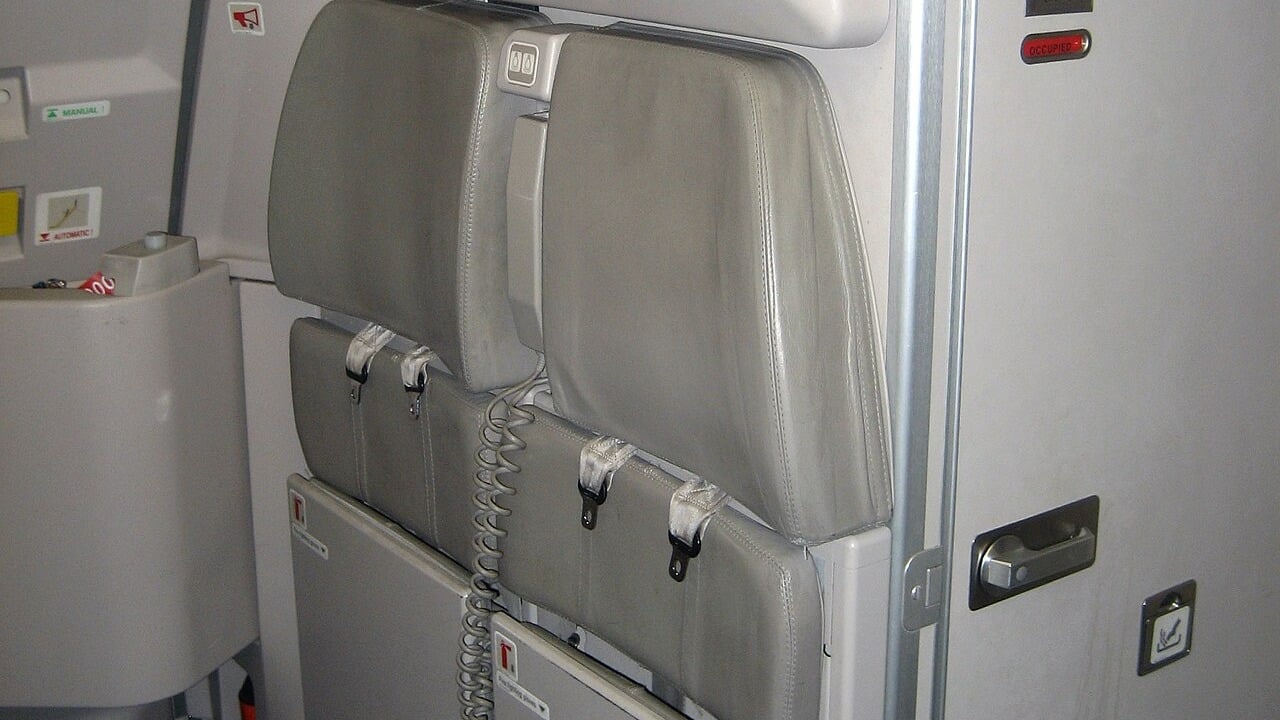
The cart is stowed, the lights are down, and the cabin crew member strapped into the jumpseat a metre from your knees has gone oddly still. Back flat against the seat. Feet together. Hands pushed under the thighs, palms up. Eyes open, looking at nothing in particular.
Passengers read it as a quirk, or boredom, or a rule about posture. It is neither. What you are watching is a rehearsal, run silently, in roughly the last minute before the wheels leave the ground and again from gear-down to touchdown. The industry calls it the silent review, and in most of the world it has been part of cabin crew training for half a century.
The hands have a reason too, and it is a more specific one than the internet usually gives.
Quick Facts
What it is: a silent mental rehearsal of emergency actions, run in the jumpseat
Also called: the sixty-second review, the thirty-second review, the silent moment
When: from strapping in until the restraints come off, at takeoff and landing
ICAO status: named in PANS-OPS Amendment 11, Volume I, Part 13, Chapter 3, dated 1 November 2001
Typical content: exits, equipment, drills, brace, able-bodied and disabled passengers, commands
Jumpseat rules: 14 CFR 25.785(h) sets location, orientation and restraint
Hands: under the thighs, palms up, in US practice; behind the head in parts of Europe
Not universal: recommended by ICAO, but not mandated by every regulator or carrier
The Review Nobody Can Hear
The silent review is exactly what the name says: a self-review of what this particular crew member would do, at this particular door, if the next thirty seconds went wrong. No checklist is read. Nothing is spoken. It happens entirely inside one person’s head, which is precisely why nobody in the cabin has ever noticed it.
It has more names than it needs. Some airlines call it the sixty-second review, some the thirty-second review, some the silent moment. The Australian regulator’s cabin safety inspector Sheryl Gallagher has described the window as starting when the crew member sits in the jumpseat and fastens the shoulder harness, and ending when the restraints are released, which is a cleaner definition than any stopwatch figure.
The International Civil Aviation Organization put the practice into its own documents a quarter of a century ago. ICAO’s training manual had already urged that cabin attendants be encouraged to mentally rehearse emergency procedures during normal flights, and the silent review process was named explicitly in PANS-OPS Amendment 11, Volume I, Part 13, Chapter 3, dated 1 November 2001. Transport Canada had been teaching it since the early 1970s.
OLDABC, and What Is Actually Being Rehearsed
The content is not freeform daydreaming. The Global Aviation Information Network’s cabin safety compendium, published in December 2001, lists the topics carriers should build a silent review around: brace for impact, judgment, crew coordination, evacuation, operation of assigned exits and alternate exits, the location of able-bodied passengers, the location of disabled passengers who will need help, and the evacuation commands themselves.
Several Australian carriers compress that into a mnemonic, OLDABC: Operation of exits, Location of emergency equipment, Drills, Able-bodied and disabled passengers, Brace position, Commands. Other operators teach a variant built on aircraft type, position in the cabin, available equipment, individual responsibilities and the threats particular to this flight.
Read either list slowly and you can see what the crew member is actually doing. They are not thinking about crashing. They are loading a very short list of physical actions into working memory: this handle, that direction, this many steps, those words. Endsley’s point about stress is the whole engineering case for it. Under a sudden load of fear and noise, people are good at retrieving something they rehearsed a minute ago and bad at inventing something new.
Why the Hands Go Under the Thighs
Now the hands. The posture a crew member holds through takeoff and landing is not the full brace, it is a semi-brace: close enough that moving to the real thing costs no time, relaxed enough to hold for several minutes. Arms folded across the stomach is one taught version. Hands under the thighs, palms up, is the other, and it is the one American crews are generally taught.
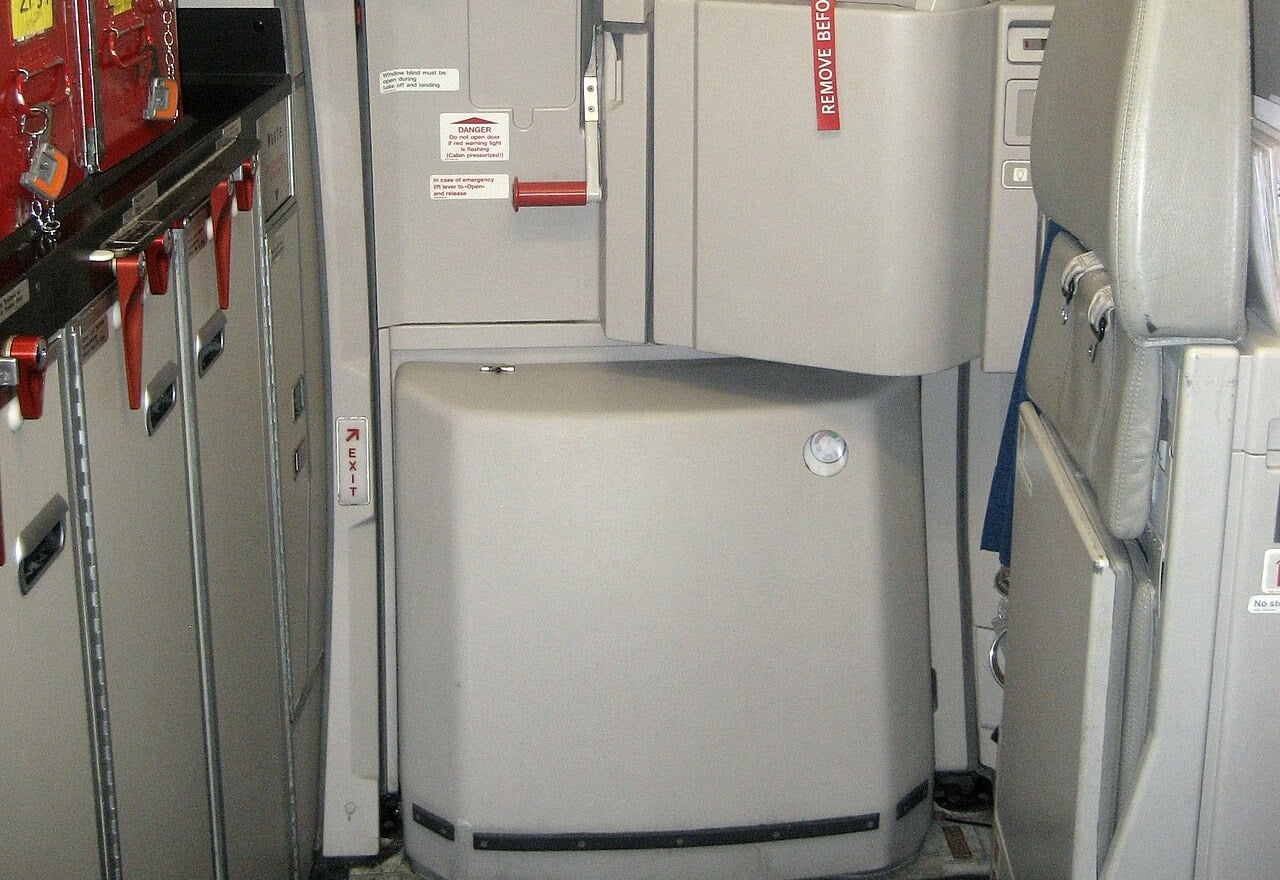
The purpose is restraint of the arms, not comfort and not superstition. In a sudden deceleration anything not held down flails, and arms are heavy. Flailing arms strike structure, break, and are then useless for the one job that matters in the following ninety seconds, which is operating a door. Tucking the hands under the thighs pins them with body weight before the event rather than after it.
There is hard data behind the detail that American training leaves out. Richard F. Chandler’s Brace For Impact Positions, from the FAA’s Civil Aerospace Medical Institute, is blunt about the European habit of clasping the hands behind the head in an aft-facing seat: “Clasping the hands behind the head is not recommended because this may increase the stress on the neck.” The paper notes that a 1969 bulletin had recommended exactly that, apparently without recognising that the mass of the hands and arms would load the neck. Tests in 1984, with forward-facing combined-belt restraints at 10 g, measured the cost: clasping the hands behind the neck raised neck tension by 84 per cent, shear by 59 per cent and bending moments by 26 per cent.
European carriers that still teach hands-behind-the-head have their own argument, which is protection of the face from loose debris while leaving the eyes and the voice free. It is worth being honest that the comparative research on crew positions specifically is thin. Chandler’s paper is written around passengers and gives no flight-attendant-specific guidance at all, beyond an exception for crew who must keep their feet on the controls. What it does recommend for a rear-facing occupant is pushing back into the seat, tightening the belt, keeping the head firmly against the rest, and resting the lower arms on the armrests, the thighs or in front of the waist. Which is, give or take a palm, the American jumpseat position.
Mentour Pilot takes apart the persistent myth that the brace position is designed to kill you, which is the passenger-side version of the same misunderstanding.
Why the Seat Faces the Way It Does
The jumpseat itself is a certification requirement, and reading the rule explains most of what looks arbitrary about it. In the United States, 14 CFR 25.785(h) says a flight attendant seat must be “near a required floor level emergency exit”, that one must sit adjacent to each Type A or Type B exit, and that the rest must be “evenly distributed among the required floor-level emergency exits to the extent feasible”.
Then comes the line that explains the staring. The seat must also be, “to the extent possible, without compromising proximity to a required floor level emergency exit, located to provide a direct view of the cabin area for which the flight attendant is responsible”. The crew member is not looking at nothing. They are looking at their cabin, which the regulation has deliberately put in front of them.
Orientation is left open: the rule allows the seat to be “either forward or rearward facing with an energy absorbing rest that is designed to support the arms, shoulders, head, and spine”. That is why the brace position differs by aircraft and by door, and why the FAA inspector Nancy Claussen has said crew should be thinking about whether a jumpseat faces forward or aft and what the appropriate brace position would be. The restraint is also specified: a combined belt and shoulder harness with a single point release, stowable so it cannot foul a rapid exit.
The Accident That Shows Why It Matters
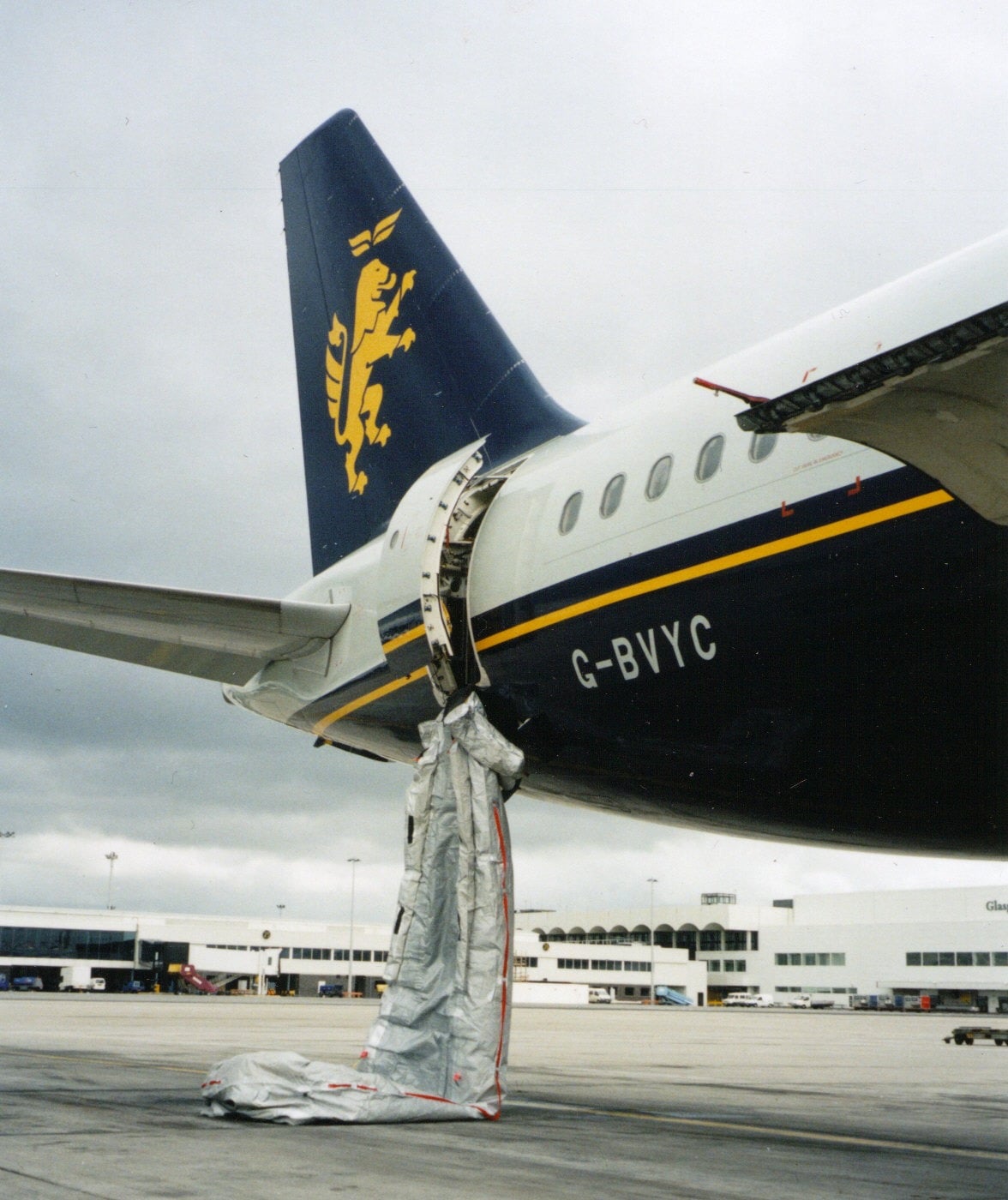
On 20 December 1995 a Tower Air Boeing 747-136, registration N605FF, ran off the runway during an attempted takeoff at New York’s JFK. There were twelve flight attendants on board. The company’s procedures required them to shout brace commands at the first sign of an accident.
The National Transportation Safety Board’s report, NTSB/AAR-96/04, records what actually happened in section 1.15.5: “Based on the recollections of all flight attendants, the only flight attendants who shouted brace position commands during the accident sequence while the airplane was still moving, as required by Tower Air procedures, were those at the R1, R4, and UD positions.” Three out of twelve.
Nobody was killed at JFK that morning, which is part of why the finding is not famous. It is still the cleanest available illustration of what the silent review is for. Claussen has noted that the commands are typically the last item on the mental list, the thing you are holding when the noise starts. Nine people on that 747 were not holding it.
Business Insider inside a cabin crew training centre, where the commands, the doors and the ninety-second standard are drilled until they are automatic.
And It Is Not Even Required Everywhere
Here is the part that surprises people who assume anything this sensible must be law. ICAO recommends the silent review. It does not follow that every regulator mandates it or that every airline enforces it. Candace Kolander, then air safety and health coordinator at the Association of Flight Attendants, put it plainly: silent review is sometimes not required.
Where it is taken seriously, it is taken seriously as behaviour, not paperwork. American Airlines prohibits other activities during the review window. Frances Wokes, chief of cabin safety and standards at Transport Canada, has said Canadian inspectors would raise it if they saw crews reading or chatting before takeoff or landing. The argument is one of latency: a crew member already in a semi-brace who has just finished the review responds faster than one who has to start from a standing stop.
Daniel Maurino, who coordinated ICAO’s flight safety and human factors programme, summarised the case for it in four words: silent review has universal applicability. That is not a statement about regulation. It is a statement about what human beings are like in the first second of an emergency.
So the next time the crew member opposite you goes still, hands tucked away, eyes down the cabin, you are not watching someone switch off. You are watching the only person on the aeroplane who is currently thinking about your door.
The Airbus A380 certification evacuation trial: the ninety-second standard the commands and the door drills exist to meet.
Sources: Flight Safety Foundation Cabin Crew Safety Vol. 37 No. 2; ICAO PANS-OPS Amendment 11; NTSB/AAR-96/04; 14 CFR 25.785; Richard F. Chandler, Brace For Impact Positions, FAA Civil Aerospace Medical Institute; GAIN Cabin Safety Compendium; Transport Canada; GlobalAir.

0 Comments