
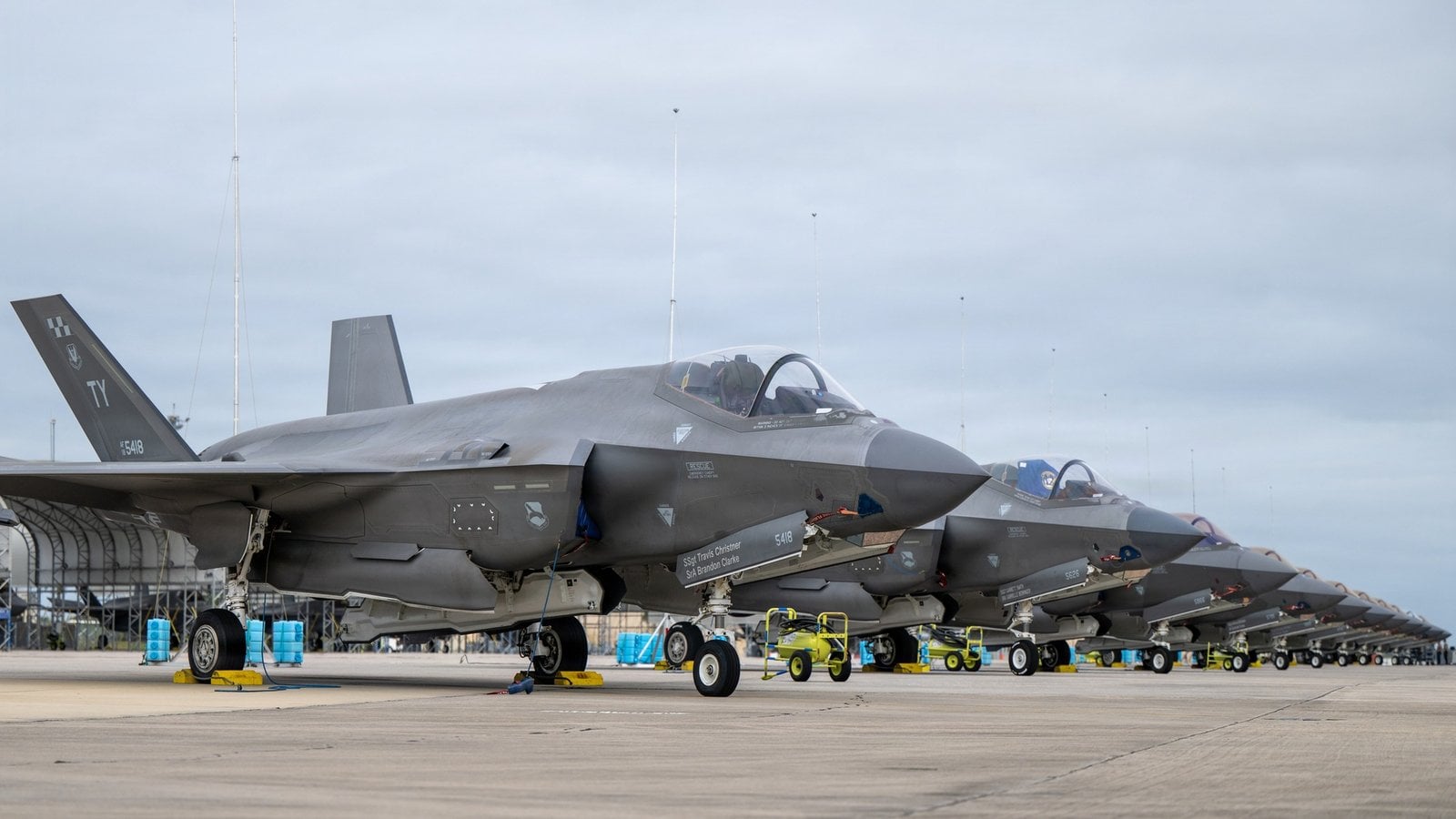
The US Air Force wants to hang nets around the parking spots of its newest fighters. A sources-sought notice posted on SAM.gov on 6 November 2026 asks industry how to wrap six existing aircraft sunshades at Tyndall Air Force Base, Florida, in counter-drone netting, so that small drones cannot reach the F-35A Lightning IIs parked beneath.
In other words, a fly screen for a stealth fighter. Unglamorous, cheap and, after several years of watching drones wreck aircraft parked in the open, arguably overdue.
Responses are due by 4 pm local time on 13 November 2026. The notice, issued by the 325th Contracting Squadron according to The War Zone and Aerospace Global News, is market research only, not a request for proposals, and the Air Force says plainly that no contract is guaranteed.
Quick Facts
- Notice: Sources sought: “Counter-Unmanned Aircraft System (C-UAS) Netting Installation for Aircraft Sunshade Structures”
- Dates: Posted on SAM.gov 6 November 2026; responses due 13 November 2026, 4 pm local time
- Scope: Netting on all four sides of six existing sunshades at Tyndall AFB, each about 630 ft long, 65 ft wide and 30 ft high, with six bays
- Threat: Group 1 (“small”) drones, weighing 20 lb or less
- Spec: Mesh no wider than 3 in, 200 lb tensile strength or more, rated to 400°F, Miami-Dade wind-load rating; north and south sides retractable
- Aircraft: F-35As of the 325th Fighter Wing; reports differ on how many jets the six shelters hold
- Status: Market research and small-business set-aside check only; no contract guaranteed
What the Air Force is asking for
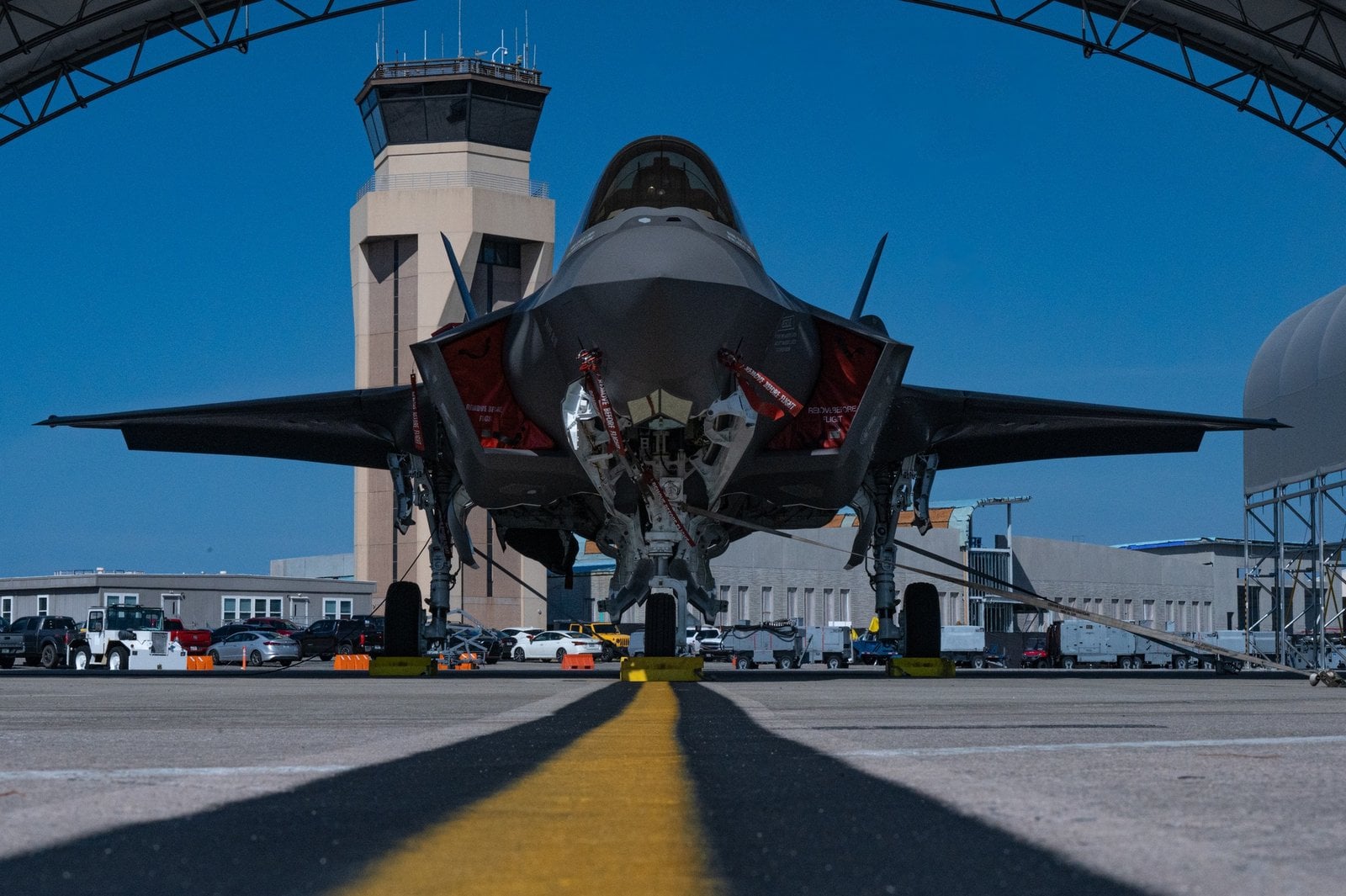
Each of the six structures is roughly 630 feet long, 65 feet wide and 30 feet high, divided into six bays. The contractor would design, supply and install netting on all four sides, with the north and south faces “quickly and easily retractable to allow normal aircraft entry and exit.” The jets do, after all, still need to get out and fly.
The minimum specification reads like a very serious fishing order: polyester or nylon preferred, UV- and moisture-resistant, able to withstand temperatures up to 400°F, a tensile strength of at least 200 lb and mesh squares no wider than three inches. It must also meet Miami-Dade County wind-load requirements, a sensible demand on a base that Hurricane Michael wrecked in 2018. Structural engineers may be needed to check whether the existing metal frames can carry the extra load.
The stated objective is to stop Group 1 (“small”) drones from getting inside the shelters “to protect aircraft and personnel.” In US military classification, Group 1 covers drones of 20 lb or less, the territory of commercial quadcopters and FPV kamikazes. The notice also invites details of any netting already fielded or under evaluation at other Department of Defense installations.
How many jets sit under the six shades depends on whom you read. The War Zone, which broke the story on 9 November, says each is designed for up to six F-35As. AeroTime, citing 2023 Army Corps of Engineers drawings, counts two jets per bay, enough for 72 fighters, the number planned for Tyndall’s three F-35A squadrons. Either way, The War Zone notes these six are only some of the base’s sunshades, and F-35s also park fully in the open.
Why Tyndall, and why now
Tyndall is the Air Force’s newest F-35A hub. The service picked it in 2021 to host three operational squadrons under the 325th Fighter Wing as the base was rebuilt after Michael, and the first three jets touched down on 1 August 2023, according to Air Combat Command.
The idea of netting is not new. After weeks of unexplained drone incursions over Langley Air Force Base, Virginia, in December 2023, the base asked industry in October 2024 about counter-drone netting for up to 42 sunshades sheltering its F-22 Raptors, starting with a single proof-of-concept bay.
Since then the rest of the world has supplied the case studies. On 1 June 2025, Ukraine’s Operation Spiderweb used truck-launched FPV drones against Russian bombers parked in the open; Afterburner covered the raid in detail. In January 2026 the Pentagon’s counter-drone task force, JIATF-401, issued guidance calling for more netting and tensioned cables around critical assets, according to The War Zone and AeroTime.
Closer to the Western flightline, footage released by Ukraine’s Centre for Strategic Communications in August 2026 showed an explosive-laden drone on the tarmac at Leipzig/Halle Airport in Germany, metres from a Ukrainian An-124 cargo aircraft.
The cheap end of the shelter debate
The Air Force has been reluctant to pour concrete. In a July 2026 interview with Breaking Defense, Chief of Staff Gen. Kenneth Wilsbach said he did not want to spend a lot of money on hardening shelters, arguing that the economics of building one impervious to a strike “doesn’t work” and favour defending the airspace and ground around a base instead. He made one notable exception.
Nets are no answer to ballistic missiles or large one-way attack drones; The War Zone points out they would not have saved the E-3 Sentry reported destroyed in Iran’s March 2026 strike on Prince Sultan Air Base in Saudi Arabia. They are aimed at the small, cheap stuff that can buzz into an open-ended shade and find a very expensive jet.
Whether the Tyndall F-35 drone nets ever go up depends on what industry sends back by 13 November and whether the work can be set aside for small businesses. If it does, the Air Force’s most advanced fighters at Tyndall will spend their nights behind the same material as a batting cage. Low-tech, yes. But the drone does not care how stealthy the jet is.
Sources: US Air Force sources-sought notice on SAM.gov (FA481927R9999), The War Zone, AeroTime, Aerospace Global News, Breaking Defense, Air Combat Command, DVIDS.
Header photo: US Air Force photo by Senior Airman Zeeshan Naeem

0 Comments