
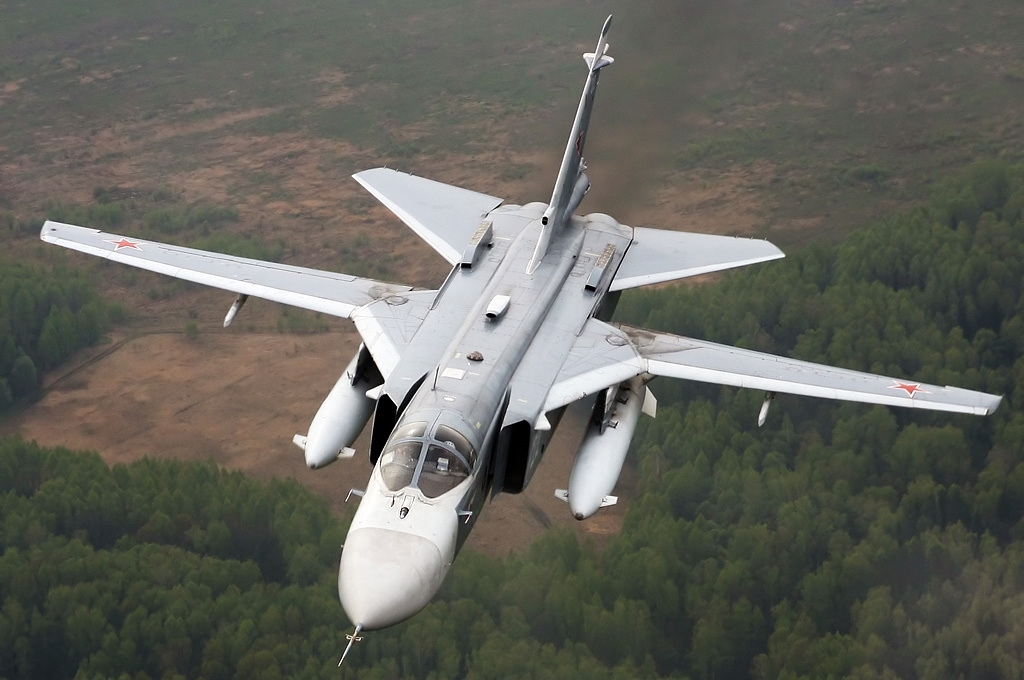
Sukhoi Su-24
“Fencer”
The Soviet answer to the F-111 — a variable-geometry, all-weather strike jet built to hurl itself at the ground at night and deliver its bombs blind. Half a century on it still flies, and fights, on both sides of the war in Ukraine.
Built to strike low, blind, and in any weather
In the early 1960s Soviet planners watched the West field a new kind of strike aircraft — one that could slip under radar at very low level, navigate and bomb blind at night or in cloud, and reach deep behind the front. The American General Dynamics F-111 was the emblem of that idea. The Sukhoi design bureau was tasked with the Eastern answer, and the result — first flown in its definitive variable-geometry form in 1970 — became the Su-24, NATO reporting name “Fencer.”
What made the Fencer new for the Soviet air arm was not speed but capability. It paired a variable-geometry wing with a terrain-following radar and an automatic nav-attack system, so a two-man crew sitting side by side could let the aircraft fly a hands-off profile hugging the ground and release its ordnance without ever seeing the target. Entering service in the mid-1970s, it gave the USSR its first true all-weather, low-level deep-strike platform.
The definitive Su-24M of the 1980s added precision-guided weapons, a laser and TV designator and an in-flight refuelling probe, while the Su-24MR turned the airframe into a tactical reconnaissance platform. Fifty years after its first flight the type is still in front-line service — flown, and lost, on both sides of the war in Ukraine, where Ukrainian Su-24s have become the carrier for Anglo-French cruise missiles. It is presented here as a machine of war, neither celebrated nor condemned.
01The Su-24 and the F-111: two superpowers, one idea
The Su-24 is often called the Eastern counterpart of the General Dynamics F-111 Aardvark, and the comparison is a fair one. Both were designed for the same mission — penetrate hostile airspace at very low level, in any weather, and strike deep behind the front — and both bureaus arrived at strikingly similar answers: a variable-geometry “swing” wing, a two-seat side-by-side cockpit and a terrain-following radar. The Fencer is smaller and lighter than the F-111 and never matched the American jet’s range, but it filled the same doctrinal slot in Soviet service. The convergence was less imitation than two engineering teams solving an identical problem with the physics of the day.
What makes the Su-24 special
The swing wing and the ground-hugging radar
The Su-24’s wings sweep to four settings — roughly 16, 35, 45 and 69 degrees — spread wide for takeoff and landing, swept back for a high-speed low-level dash. Married to the wing is the PNS nav-attack suite and a terrain-following radar, which let the aircraft fly an automatic profile hugging valleys and ridgelines in cloud or darkness and then deliver its weapons blind. It was the first Soviet tactical aircraft that could do this, and it is the Fencer’s whole reason for being.
Eight tonnes of ordnance — and a Western cruise missile
The Su-24M carries about 8,000 kg of ordnance across eight or nine hardpoints: dumb and cluster bombs, rocket pods, and a broad guided arsenal including Kh-25, Kh-29 and Kh-58 missiles and laser-guided bombs. The most unexpected chapter came in 2023, when Ukraine integrated the Anglo-French Storm Shadow / SCALP-EG cruise missile onto its Su-24Ms. Because the missile is pre-programmed before flight, the adaptation reportedly took only weeks.
Two rugged Lyulka turbojets
Power comes from two Lyulka (Saturn) AL-21F-3A afterburning turbojets — turbojets, not turbofans, a detail many spec sheets get wrong. Each gives roughly 110 kN in afterburner, enough to haul a fully loaded Fencer off the runway and push it past the sound barrier at low level. The AL-21 was a robust, high-thrust engine broadly in the class of the American J79; the trade-offs were heavy fuel consumption and a relatively short overhaul life.
02The Su-24’s terrain-following radar: automatic attack at treetop height
The heart of the Fencer is its PNS-24 nav-attack system and terrain-following radar, often identified with the Orion-A attack radar and a Relief terrain-following channel. Engaged in automatic mode, it flew the aircraft along a pre-planned route at very low altitude, rising and falling with the ground beneath it, in weather that would have grounded earlier Soviet strike aircraft. For the crew it demanded a particular kind of nerve: trusting a 1970s computer to fly them at high speed a few dozen metres above the terrain, at night, without seeing it. That capability, not raw speed, is what made the Su-24 a genuine leap for Soviet aviation.
03The 2015 shootdown: a Fencer, an F-16 and a NATO crisis
On 24 November 2015 a Russian Su-24M was shot down by a Turkish F-16 near the Syria–Turkey border. Turkey said the aircraft had crossed into its airspace for a matter of seconds and ignored repeated warnings; Russia disputed that account and said the jet never left Syrian airspace. The pilot, Lt-Col Oleg Peshkov, was killed after ejecting; the navigator, Konstantin Murakhtin, was recovered in a rescue operation in which a Russian marine also died. The incident became one of the most serious direct NATO–Russia confrontations of the Syrian war and led to a prolonged rupture in Russian–Turkish relations. The facts of the airspace crossing remain contested between the two governments.
Full specifications
Baseline note: the figures below describe the Su-24M (NATO Fencer-D), the definitive strike variant built from 1979 and the aircraft that flew the great majority of Russian sorties over Syria and both sides’ Fencer missions over Ukraine. Deltas for the early Su-24 (Fencer-A/B/C) and for the Su-24MR reconnaissance and Su-24MP electronic intelligence conversions in grey. Published Su-24 data is unusually inconsistent, largely because references disagree about whether to measure the nose probe and about which mark a weight belongs to; where authorities differ, both figures are given.
Dimensions & weights
- طاقم
- 2 — pilot and weapon systems operator seated side by side, not in tandem. The layout was forced by the width of the original Orion radar antennas, and Sukhoi then discovered what General Dynamics had found on the F-111: on a long, low, blind night sortie, two men who can see each other’s hands and displays work far better as a crew
- طول
- 24.59 m (80 ft 8 in) over the refuelling probe; references that measure to the radome give 22.53 m (73 ft 11 in). The Su-24M is 0.76 m (30 in) longer ahead of the cockpit than the early Su-24
- Wingspan, wings forward
- 17.64 m (57 ft 10 in) at 16° sweep
- Wingspan, wings swept
- 10.37 m (34 ft 0 in) at 69° sweep
- Sweep settings
- 16°, 35°, 45° and 69° — four fixed detents selected by the pilot, not a continuously variable wing: 16° to get off a short strip, 35° and 45° to cruise, 69° for the low-level dash
- ارتفاع
- 6.19 m (20 ft 4 in)
- منطقة الجناح
- 55.2 m² (594 sq ft)
- الوزن الفارغ
- 22,300 kg (49,160 lb)
- الوقود الداخلي
- ~11,100 kg (~24,470 lb), about 11,000 litres; PTB-2000 and PTB-3000 drop tanks available. The Su-24M lost 85 litres of internal fuel to the Kaira sensor installation
- Normal take-off weight
- 33,500 kg (73,850 lb)
- أقصى وزن للإقلاع
- 39,700 kg (87,520 lb); Wikipedia’s Su-24MK entry and some Western references give 43,755 kg (96,460 lb), which is hard to reconcile with the published wing loading and is best treated with caution
- Maximum ordnance
- ~8,000 kg (~17,600 lb) on 8 stations — some sources give 9 stations and 7,500 kg. Two of the wing-glove pylons swivel to stay aligned as the wing sweeps
- Wing loading
- 651 kg/m² (133 lb/sq ft) — deliberately high, which is what gives the aircraft its famously steady ride in low-level turbulence
Performance
- Maximum speed, altitude
- 1,650 km/h (1,025 mph), Mach 1.35–1.6. The early Su-24 was faster: with working variable intake ramps it reached 2,320 km/h (1,440 mph), Mach 2.18. The ramp actuators were deleted in production because the aircraft never flew that profile in service and the weight and maintenance were not worth it
- Maximum speed, sea level
- 1,315 km/h (817 mph), Mach 1.06 clean — genuinely supersonic on the deck, which is the number that mattered and the one the whole aeroplane was built around
- سقف الخدمة
- 11,000 m (36,100 ft); the early Su-24 with intake ramps reached 17,500 m (57,400 ft)
- معدل الصعود
- 150 m/s (29,500 ft/min)
- Terrain-following
- Automatic, hands-off, in cloud and at night — the Relyef set flies the aircraft at low and extremely low altitude. Published minimum set clearances range from about 50 m to 200 m (165–660 ft) depending on the source; operational minima were higher than the advertised floor
- Combat radius, lo-lo-lo
- ~560–615 km (~350–380 mi) with 3,000 kg (6,600 lb) of ordnance and drop tanks — short, and the price of flying the whole profile on the deck
- Ferry range
- 2,775 km (1,725 mi) on internal fuel and tanks; the Su-24M’s retractable probe removes the ceiling on that
- Take-off run
- 1,150–1,300 m (3,770–4,265 ft) at typical strike weight with the wings at 16°
- Landing run
- 950–1,100 m (3,120–3,610 ft), with a brake chute
- Landing speed
- 230 km/h (143 mph) at light weight with the wings fully forward — lower than the much smaller Su-17, which is the clearest single argument for the swing wing on this aircraft. Sources quoting typical service weights give 285–310 km/h (177–193 mph)
- Load factor limit
- +6 g (+6.5 g in some sources)
- Thrust-to-weight
- 0.6 at normal take-off weight
Propulsion & systems
- Engines
- 2 × Saturn / Lyulka AL-21F-3A afterburning turbojets — not turbofans, whatever some references say. Fed by rectangular side intakes with splitter plates; the variable ramps of the earliest aircraft were removed in production
- Thrust, each
- 75.0 kN (16,860 lbf) dry, 109.8 kN (24,690 lbf) with reheat
- Fuel and refuelling
- ~11,100 kg internal plus PTB-2000 and PTB-3000 drop tanks; the Su-24M added a retractable in-flight refuelling probe in the extended nose, and the type can carry a buddy refuelling store to tank other aircraft
- Nav/attack system
- PNS-24 Puma, PNS-24M on the Su-24M — the whole reason the aircraft exists. Two superimposed Orion-A radar scanners for navigation and attack, a separate dedicated Relyef terrain-clearance radar, and an Orbita-10-58 digital computer. It gave Soviet tactical aviation genuine day, night and all-weather strike for the first time, and it took until 1974 to make it work — the state trials ran seven years because of this system alone
- Designation and targeting
- Kaira-24 laser ranger, designator and television system in a bulged fairing on the port lower fuselage — the direct Soviet answer to the American Pave Tack, and what makes the Su-24M the first Soviet aircraft that could find, designate and hit a point target on its own. Deleted on the Su-24MR and Su-24MP
- Later upgrades
- SVP-24 Gefest bombing computer, GLONASS, multi-function displays, head-up display and Shchel helmet-mounted sight on the Su-24M2 — the Gefest fit is credited with turning Soviet-era unguided bombs into something approaching accurate weapons, and it is why Russia kept the type in service rather than replacing it wholesale with the Su-34
- Self-protection
- SPO-15 Beryoza radar warning receiver, missile launch warning, internal jammers on later aircraft and podded SPS-141 and SPS-161 jammers, with chaff and flare dispensers in the wing-glove fences or scabbed onto the fin. The earliest aircraft had almost nothing — an old Sirena warning receiver and no jammer at all
- Crew escape
- 2 × Zvezda K-36D ejection seats, side by side — zero-zero capable, usable at any speed and altitude including during the take-off and landing roll. Both crews survived the 2015 Turkish shootdown ejection; the pilot was then killed on the ground by Syrian Turkmen fighters
- First flight
- 2 July 1967 (T-6-1, the fixed-delta prototype with four lift jets); the variable-geometry T-6-2I flew on 17 January 1970, the first production aircraft on 31 December 1971 and the first production Su-24M on 20 June 1979
- Service entry
- 4 February 1975 (Su-24); the Su-24M was accepted in 1983. Development cost thirteen test pilots’ lives in ten fatal accidents, and the type continued to average more than five crashes a year afterwards
- Number built
- ~1,400 all marks — about 500 Su-24 (1971–1983), about 770 Su-24M and Su-24MK (1981–1993), 130 Su-24MR and just 10 Su-24MP. Production ended in 1993
04The Su-24’s cost: why no reliable price exists
Like most Soviet military aircraft, the Su-24 was a state product rather than an item sold on an open dollar market, so a firm flyaway unit price simply does not exist in the public record. Export deals for the Su-24MK in the 1980s and 1990s were bundled, barter-laden and rarely disclosed. No credible cost-per-flight-hour figure exists in open sources either. Any precise dollar number attached to a Fencer should be read as an estimate, not a sourced fact.
Armament & payload
The Su-24 gave Soviet tactical aviation its first real all-weather strike capability, and Ukraine turned it into a Storm Shadow launcher
For twenty years the Su-24M was the only Soviet aircraft that could take a laser-guided bomb or a television-guided missile, find its own target through cloud at night, and hit it. That is what the Kaira-24 fairing under the nose is for, and it is why the Fencer, not the Su-17 or the MiG-27, was the aircraft the Warsaw Pact would have sent against NATO airfields and nuclear sites. The irony of its later career is that this precision capability barely mattered: over Syria, Su-24Ms flew more than eighty per cent of Russian strike sorties and dropped almost entirely Soviet-era unguided bombs, made adequate by the Gefest computer rather than by guided weapons.
Then, in May 2023, Ukraine did something genuinely remarkable with the airframe. British Storm Shadow and French SCALP-EG cruise missiles weigh about 1,300 kg each and were designed for a completely different aircraft; Ukrainian engineers hung them on Su-24Ms using pylons taken from decommissioned RAF Tornado GR4s, with the target coordinates loaded on the ground before take-off because there was no way to integrate the missile with a 1970s Soviet weapons bus. It worked. The Black Sea Fleet headquarters in Sevastopol, the submarine Rostov-na-Donu, the landing ships Minsk و Novocherkassk and the corvette Askold were all hit by weapons delivered this way. Fits differ enormously by mark and operator: the early Su-24 could carry almost no guided weapon at all, export Su-24MKs were deliberately downgraded, the Su-24MR carries no offensive weapon whatever, and the Ukrainian Storm Shadow fit exists on a handful of aircraft and on no one else’s.
Gun
- One Gryazev-Shipunov GSh-6-23M six-barrel 23 mm rotary cannon with 500 rounds, buried in the underside of the fuselage behind an eyelid shutter
- About 10,000 rounds per minute — the fastest-firing autocannon ever put into service. Unusually, it is gas-operated rather than driven by an electric or hydraulic motor, and it is cocked by pyrotechnic charges
- It was also dangerous. After two Su-24s were lost to premature shell detonation in 1983 the Soviet Air Force banned use of the gun outright; the restriction was later lifted and Russian aircraft now fly with working guns
- Additional guns can be carried in SPPU-6 pods, whose barrels traverse 45° down and 45° either side, allowing the aircraft to strafe without pointing at the target
- ال Su-24MR deletes the cannon along with the attack radar and the Kaira sensor; the Su-24MP keeps it
Air-to-air
- Two or four R-60 and R-60MK (AA-8 Aphid) short-range infrared missiles — self-defence only, and the standard fit on the Su-24M and Su-24MK
- R-73E (AA-11 Archer) on Su-24M2 upgrades, paired with the Shchel helmet-mounted sight
- The early Su-24 carried the R-55, an infrared derivative of the K-5 family and a nearly useless weapon by the standards of the 1970s
- The Fencer has no air-to-air radar mode worth the name and no ability to fight. After the November 2015 shootdown Russia began arming its Syrian Su-24 sorties with air-to-air missiles as a matter of course — a gesture, since the aircraft would lose to any fighter that found it
Air-to-surface guided
- Kh-25ML and Kh-25MP (AS-10 Karen / AS-12 Kegler), Kh-27PS, and the older Kh-23M (AS-7 Kerry) radio-command missile on the early aircraft
- Kh-29L, Kh-29T and Kh-29D (AS-14 Kedge) — the heavy laser, television and satellite-guided bunker-killers, and the weapon the Kaira-24 exists to designate for
- Kh-58 and Kh-58E (AS-11 Kilter) and the older Kh-28 (AS-9 Kyle) anti-radiation missiles; Kh-31P (AS-17 Krypton) on upgraded aircraft, and Kh-31A in the anti-ship role
- Kh-59 and Kh-59M/MK (AS-13 Kingbolt / AS-18 Kazoo) television-guided stand-off missiles, flown with a datalink pod
- Storm Shadow and SCALP-EG on Ukrainian Su-24Ms from May 2023 — two carried on wing-glove pylons cannibalised from retired RAF Tornado GR4s. Coordinates are loaded before take-off; there is no in-flight retargeting. It is one of the most improbable weapon integrations of the war and it sank or crippled several major Russian warships
Bombs
- KAB-500L laser-guided, KAB-500KR television-guided and KAB-500S satellite-guided 500 kg bombs; KAB-500OD fuel-air weapons
- KAB-1500L and KAB-1500KR 1,500 kg guided bombs for hardened targets — a capability no other Soviet tactical aircraft had when the Su-24M entered service
- FAB-250, FAB-500 and OFAB free-fall bombs in quantity; BETAB-500 concrete-piercing bombs for runway attack; ODAB-500PM thermobaric bombs
- RBK-250 and RBK-500 cluster bombs — used by Russian Su-24Ms against Ukrainian small boats near Cape Tarkhankut in September 2023, among much else
- Tactical nuclear bombs. This was the Su-24’s primary wartime task in Europe and the reason the terrain-following radar and the side-by-side cockpit were worth their cost
Rockets
- S-5 57 mm rockets in UB-32 pods — the oldest and least useful of the family, largely gone by the 1990s
- S-8 80 mm rockets in B-8M pods, twenty per pod: the standard Russian and Ukrainian unguided rocket and the one most often seen on Fencers over Ukraine
- S-13 122 mm rockets in five-round B-13 pods, with a penetrating warhead intended for hardened shelters and runways
- S-24B 240 mm and S-25-OFM and S-25-LD 340 mm heavy single rockets carried on rails — the S-25-LD is laser-guided and blurs the line between a rocket and a missile
- Ukrainian crews adopted lofted rocket delivery early in the war, pitching up to throw rockets ballistically from low level rather than diving into the range of Russian short-range air defences
Pods & other stores
- Fantasmagoria و Tekon emitter-location pods, needed because the anti-radiation missiles carry no target-finding capability of their own
- SPS-141 and SPS-161 jammer pods and chaff and flare dispensers — the Su-24 has never had a self-protection suite that anyone would call good
- Su-24MR reconnaissance sensors: two panoramic camera installations, the Aist-M television system, the Shtik side-looking airborne radar and the Zima infrared line-scanner internally, with further sensors podded. Ukraine still flies these and they are among its scarcest aircraft
- Su-24MP electronic intelligence antennas and jamming equipment, built to replace the Yak-28PP. Only ten were made
- PTB-2000 and PTB-3000 drop tanks, and a buddy refuelling store — the Su-24M can tank other aircraft as well as receive
Three typical loadouts
- Central Front nuclear strike, 1985
- One tactical nuclear bomb on the fuselage centreline, two drop tanks, two R-60s for self-defence, wings at 69°. The profile was a hands-off terrain-following run in cloud at a few hundred feet, a single delivery on a NATO airfield or nuclear storage site, and an escape at low level. Nothing else in Soviet tactical aviation could fly that mission in bad weather at night, and that fact alone justified the aeroplane.
- Syria, 2015–2017
- Six to eight OFAB-250 or FAB-500 free-fall bombs, no guided weapons, an SVP-24 Gefest computer doing the aiming, released from medium altitude well above the reach of rebel MANPADS. Su-24Ms flew more than eighty per cent of Russian strike sorties in the campaign. It is a striking waste of the type’s designed capability — and it was also, in a permissive environment, entirely sufficient.
- Ukrainian stand-off strike, 2023 to date
- Two Storm Shadow or SCALP-EG cruise missiles on ex-RAF Tornado pylons under the wing gloves, target coordinates loaded on the ground, launched from low level well inside Ukrainian-held territory. Missions flown this way struck the Black Sea Fleet headquarters in Sevastopol in September 2023, the corvette Askold at Kerch that November and the landing ship Novocherkassk in December.
Sourcing caveat: weapon lists for the Su-24 vary widely between Sukhoi’s own material, Russian reference works and Western compilations, and export Su-24MKs were cleared for a deliberately narrower set of stores than Soviet and Russian aircraft. The Ukrainian Storm Shadow fit is documented from photographs, Ukrainian government imagery and battle-damage assessment rather than from any published clearance document, and the exact pylon and interface arrangement remains partly unconfirmed.
Variants
One airframe, four jobs, and a Soviet answer to the F-111 that took seven years of trials to make work
The Su-24 began as an attempt to avoid a swing wing altogether. Sukhoi first drew a fixed delta with four lift jets in the fuselage for short-field performance, built it, flew it, and found that the lift engines ate the fuel volume, blocked the underfuselage hardpoints and made the transition to wing-borne flight unstable. Only after the F-111 had entered service and demonstrated that variable geometry could be made to work did the bureau receive formal authorisation, in August 1968, to fit one.
What followed was a family unusually neatly divided by job: bomber, reconnaissance aircraft, electronic intelligence aircraft, and export bomber. The break that matters is between the early Su-24 and the Su-24M — the M is the one with the refuelling probe, the Kaira designator and the ability to carry guided weapons, and it is what almost everybody still operates.
- T-6-1 (1967, 1 built)
- The fixed cropped-delta prototype with two AL-21F cruise engines and four RD-36-35 lift jets. Flew 2 July 1967; the lift engines were fitted that October and abandoned soon after.
- T-6-2I and successors (1970–1974)
- Variable-geometry prototypes. First flight 17 January 1970 with Vladimir Ilyushin at the controls; state trials ran until 1974, delayed almost entirely by the complexity of the Puma nav/attack system.
- Su-24 (1971–1983, about 500 built)
- First production version, NATO Fencer-A/B/C. Kh-23 and Kh-28 guided missiles only; no refuelling probe, no laser designator. NATO’s B and C suffixes mark a reshaped rear fuselage and the addition of proper electronic countermeasures, neither of which earned a new Soviet designation.
- Su-24M (1979–1993, about 770 built with the MK)
- NATO Fencer-D and the definitive aircraft. Fuselage stretched 0.76 m ahead of the cockpit for a retractable refuelling probe, shorter radome, PNS-24M nav/attack, Kaira-24 laser and television designator, and clearance for the whole guided-weapon inventory. Accepted into service in 1983.
- Su-24MK (1988–1992, export)
- Export Su-24M with downgraded avionics and a narrower weapons clearance. Sold to Algeria, Iraq, Libya and Syria. Most of Iraq’s were flown to Iran in 1991 and never came back — which is why Iran operates the type today.
- Su-24MR (1983–1993, 130 built)
- NATO Fencer-E. Dedicated tactical reconnaissance: keeps the terrain-following radar and navigation suite, deletes the attack radar, the Kaira system and the cannon, and carries panoramic cameras, the Aist-M television system, Shtik side-looking radar and Zima infrared line-scanner. Still in Russian and Ukrainian service.
- Su-24MP (1983–, 10 built)
- NATO Fencer-F. Electronic intelligence and jamming aircraft intended to replace the Yak-28PP. Keeps the gun and four R-60s, loses the Kaira fairing. Ten aircraft was never enough to matter.
- Su-24M2 (from 1999–2000, rolling upgrade)
- Two parallel modernisation lines, one by Sukhoi and one by Gefest & T. SVP-24 navigation and bombing computer, new weapons control, ILS-31 head-up display, and clearance for Kh-31A/P, Kh-59MK and KAB-500S. The last Sukhoi-standard aircraft were delivered in 2009; the Gefest programme continued and by 2013 the whole Central Military District fleet had it.
- Ukrainian Storm Shadow conversion (2023, small number)
- Not an official designation, but a real and distinct configuration: Su-24M and Su-24MR airframes fitted with wing-glove pylons taken from decommissioned RAF Tornado GR4s to carry two Storm Shadow or SCALP-EG cruise missiles apiece. Coordinates are entered on the ground before flight.
Closing caveat: the Su-24 is now an old aeroplane being flown hard by both sides of a major war, and inventory figures age fast. Oryx’s visually confirmed tally in December 2023 stood at 12 Russian Su-24M and MR airframes and 20 Ukrainian ones, and neither figure includes losses that were never photographed. Russia is replacing the type with the Su-34, slowly; Ukraine cannot replace it at all, which makes each surviving Fencer a strategic asset out of all proportion to its age.
From Cold-War striker to Ukraine-war missile carrier
First prototype
The fixed-wing T6-1 prototype flies on 2 July; its lift-jet delta layout is later abandoned.
The swing-wing flies
The variable-geometry T6-2I flies on 17 January, establishing the definitive Su-24 configuration.
Enters service
The Su-24 is accepted into Soviet service as the USSR’s first all-weather low-level strike jet.
Su-24M
The upgraded Su-24M enters service with precision weapons, a laser/TV designator and a refuelling probe.
Afghanistan
The Fencer sees its first combat over Afghanistan, bombing from medium and high altitude.
Production ends
Serial production closes after roughly 1,400 aircraft across all variants.
Turkish shootdown
A Russian Su-24M is downed by a Turkish F-16 near the Syrian border; the pilot is killed after ejecting.
Storm Shadow carrier
Ukraine reveals its Su-24s launching Anglo-French Storm Shadow and SCALP-EG cruise missiles.
From the cockpit: twelve Su-24 stories
The Eastern F-111
Two superpowers set the same problem and reached nearly the same aircraft.
Read the full story
Hands off at treetop height
The Fencer could fly its own attack run, blind, a few dozen metres above the ground.
Read the full story
Shot down on the border
A Turkish F-16 downed a Russian Fencer near the Syrian frontier, killing its pilot.
Read the full story
A Cold War jet, a Western missile
Ukraine turned its ageing Fencers into launchers for Anglo-French cruise missiles.
Read the full story
Four clicks of the wing
16, 35, 45, 69 degrees — each sweep setting for a different job.
Read the full story
The six-barrel fist
Buried in the fuselage is a 23 mm Gatling gun few remember the Fencer carries.
Read the full story
The jets that never went home
Iraqi Fencers flew to Iran to escape Desert Storm — and Tehran kept them.
Read the full story
Eyes over the front
The camera-carrying Su-24MR has quietly shadowed conflicts for four decades.
Read the full story
Shoulder to shoulder
Unlike most fast jets, the Fencer seats its two crew side by side.
Read the full story
Baptism over the Panjshir
The Fencer first went to war bombing from above the reach of the guns.
Read the full story
The last great turbojet
A thirsty, muscular Lyulka turbojet gave the Fencer its brute low-level punch.
Read the full story
Fifty years and still firing
From Soviet nuclear striker to Ukrainian missile truck, the Fencer refuses to retire.
Read the full story
The Fencer in pictures
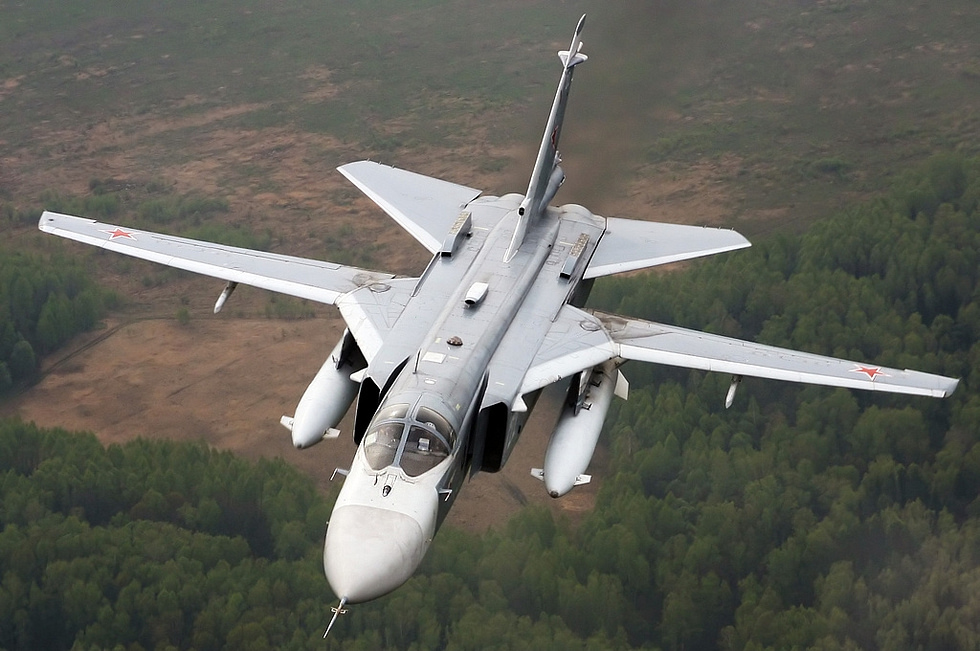
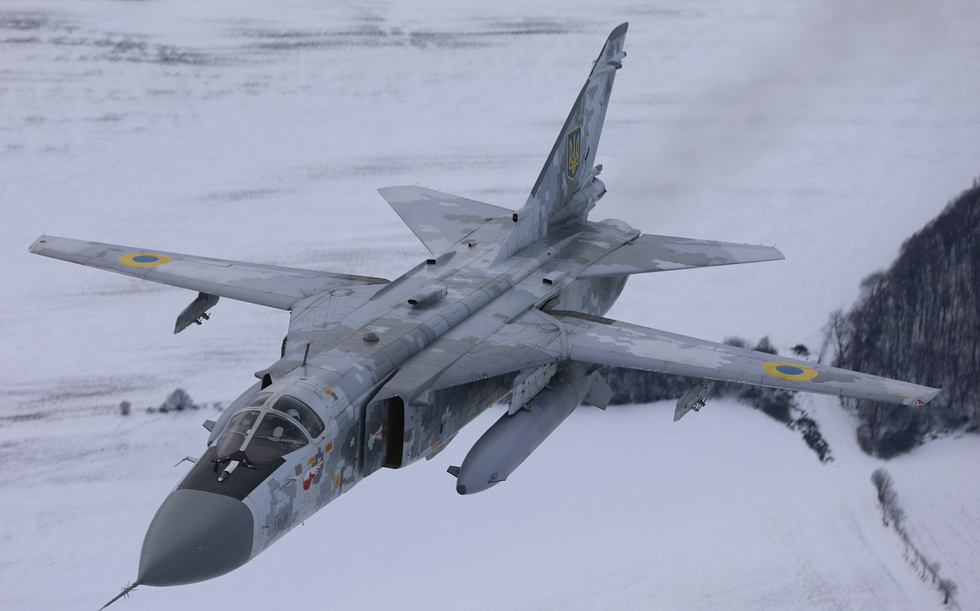
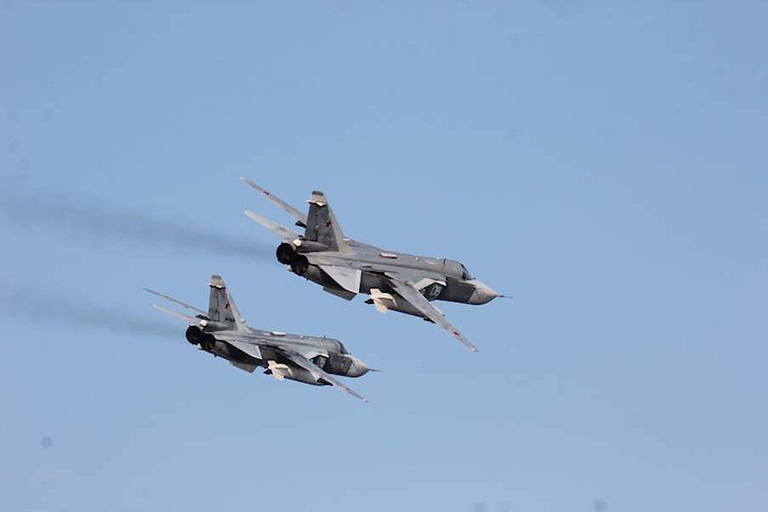
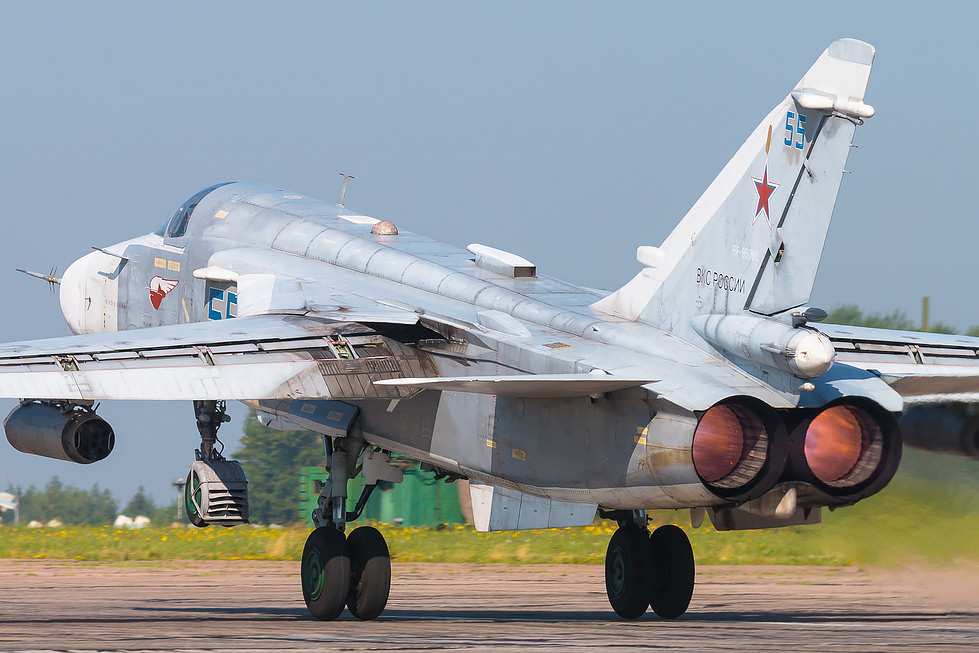
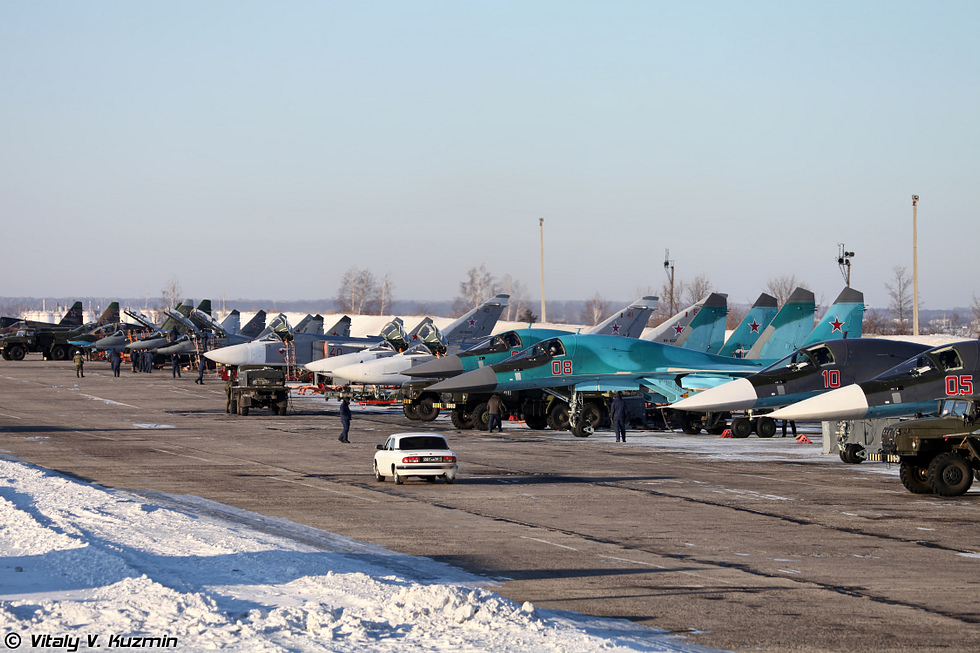
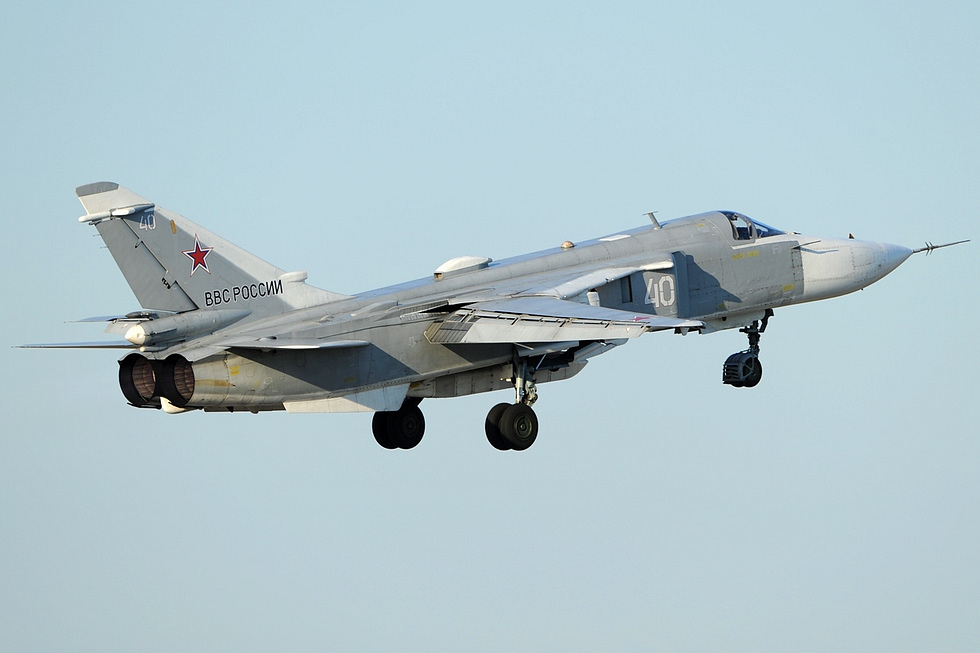
The Su-24 in motion
A dedicated video feature for the Su-24 Fencer is coming soon. In the meantime, explore the photo gallery above and the full combat record below.
Where the Fencer flies
Operators today
Russia holds almost the entire surviving Fencer fleet, and everyone else operates the leftovers of Soviet export policy
Roughly 1,400 Su-24s were built and the great majority were kept at home; the export customers were a short list of Soviet clients in the late 1980s, and what survives in those air forces today is largely a matter of how much money and how many spares each has had since. The one anomaly is Iran, which never bought a Fencer: its aircraft are Iraqi Su-24MKs flown across the border during Operation Desert Storm in 1991 and never returned.
These are estimates. Many airframes counted on paper are stored, in deep overhaul, or not operational. All figures are delivered aircraft rather than orders, and all are owned rather than leased. Sources: IISS The Military Balance and FlightGlobal World Air Forces; entries that could not be corroborated are omitted. Notes on the individual entries: the Russian total covers the Aerospace Forces and Naval Aviation together and is the least reliable number here, with credible published counts ranging from about 260 to about 300, and it does not reflect combat losses since 2022. Algeria is 33 Su-24M/MK plus 3 Su-24MR. Ukraine’s figure is roughly 5 Su-24M and 8 Su-24MR as of 2024 and has certainly fallen since. Sudan’s four are ex-Belarusian aircraft delivered from 2013. Deliberately excluded: Libya, where the Libyan National Army has an unknown and unquantifiable number of Su-24Ms flown by Russian contractors; Syria, whose remaining Su-24MKs were struck during Israel’s Operation Bashan Arrow in December 2024 and which FlightGlobal dropped from its directory entirely in late 2025; and Azerbaijan, Belarus, Kazakhstan, Turkmenistan and Uzbekistan, all former operators whose aircraft are retired, stored or sold. We do not copy competitor datasets; where a figure could not be corroborated against a recognised order of battle, the operator is described in words above rather than given a bar.
Fifty years of strike missions
The Su-24 has been in near-continuous combat use since 1984 — over Afghanistan, in both Chechen wars, across Syria from 2015, and on both sides of the war in Ukraine since 2022. Its record is one of a workhorse strike aircraft rather than a fighter: it delivers ordnance, and it is delivered against. Losses have been taken on every front, most prominently the 2015 Turkish shootdown and steady attrition in Ukraine. Figures on the current war are contested and change constantly; treat any single tally with caution.
Compare the combat record of every military aircraft. Figures as of July 2026.
Everything people ask about the Su-24
Can I fly in a Su-24?
What is the Su-24 the Soviet equivalent of?
When did the Su-24 first fly?
Why is Ukraine’s Su-24 in the news?
Was a Su-24 shot down by Turkey?
How much can the Su-24 carry?
How many were built and who still flies it?
Is the Su-24 nuclear-capable?
You can’t fly the Su-24.
These, you can.
Some legends only live in museums — others are fuelled and waiting. MiGFlug has put civilians in real military jet cockpits since 2004.
 Fly the L-39 AlbatrosThe world’s most-flown jet trainer — aerobatics included
 Fly the F-104 Starfighter“The missile with a man in it”
 Fly the MiG-21The Cold War’s most-produced jet
 حلّق بطائرة تي-33 شوتينغ ستارAmerica’s first jet trainer
 Fly the DH VampireA piece of early jet history
 Fly the S.211Agile Italian jet trainer
 Fly the MB-326The classic Aermacchi jet
 Fly the MiG-15The Soviet legend of the Korean War
Continue the tour
Every fact, checked
- GlobalSecurity.org — Su-24 FencerDevelopment lineage (T6-1/T6-2I), variants, avionics and service history.
- The Aviation Geek ClubThe 2015 Turkish shootdown in detail and the Iranian ex-Iraqi fleet.
- The War Zone (TWZ)Storm Shadow integration and the Su-24 as Ukraine’s stand-off missile carrier.
- Defense ExpressThe speed and nature of the MBDA Storm Shadow adaptation for the Su-24M.
- The National InterestIranian fleet history and technical assessment of the type.
- Hush-KitThe Lyulka AL-21 turbojet, its heritage and character.
- Key.AeroUkrainian Su-24 fleet status, losses and wartime employment.
- CSISStrategic and diplomatic analysis of the 2015 shootdown.