
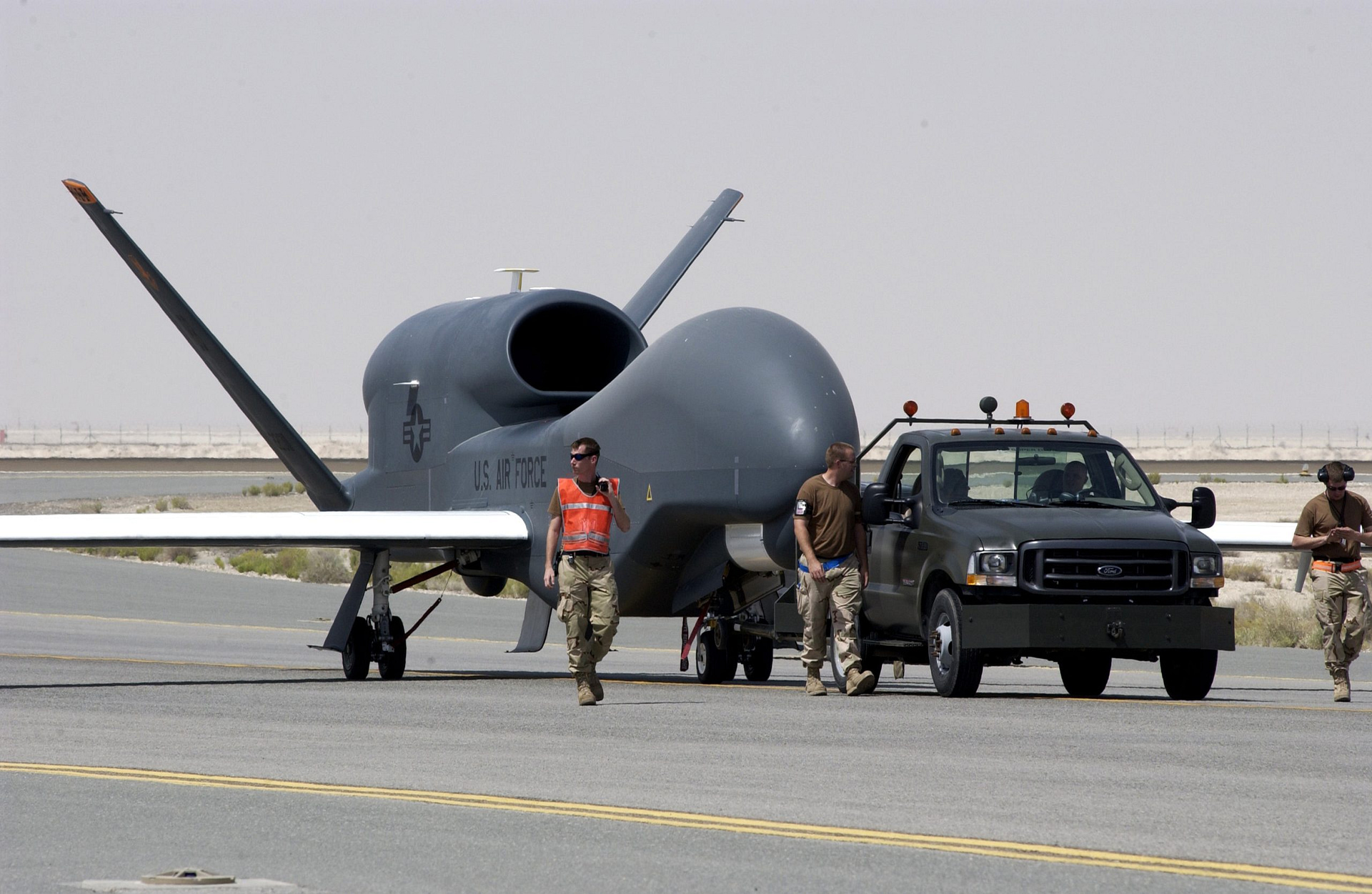
Northrop Grumman RQ-4
Global Hawk
A jet-sized robot spy plane that takes off, flies and lands entirely on its own — loitering above 60,000 feet for a day and a half at a time, watching whole countries through cloud and darkness.
A spy plane with no pilot on board
For half a century, high-altitude reconnaissance meant putting a person in an impossible place — a pilot sealed in a pressure suit at the edge of the atmosphere, as in the U-2 and the SR-71. The RQ-4 Global Hawk broke that rule. It is a robot: a jet-powered, high-altitude, long-endurance (HALE) unmanned aircraft that takes off, flies its mission and lands again with no one aboard, following a pre-programmed flight plan while operators on the ground simply supervise over a satellite link.
Developed by Teledyne Ryan — absorbed into Northrop Grumman in 1999 — the Global Hawk first flew on 28 February 1998 at Edwards Air Force Base in California. It was still officially a technology demonstrator when the September 11 attacks pushed it into combat: by late 2001 Global Hawks were flying intelligence, surveillance and reconnaissance (ISR) sorties over Afghanistan, and soon afterwards over Iraq. A trials aircraft went to war years before the type was formally in production.
What makes it remarkable is stamina. Cruising near 60,000 feet for more than 30 hours, a single Global Hawk can watch an area the size of a small country in one sortie, mapping the ground with radar that sees through cloud and building a picture no crewed aircraft could sustain. The “R” in RQ-4 marks it as a reconnaissance type and the “Q” as unmanned; it carries sensors, not weapons. That endurance and reach came at a famously steep price, making the Global Hawk one of the most expensive uncrewed aircraft ever fielded — and a lightning rod in debates over the cost of drone ISR.
01The RQ-4 Global Hawk’s autonomy: how a pilotless jet flies itself across the planet
The Global Hawk is not flown with a joystick. An operator loads a mission plan, and the aircraft executes it — taxi, take-off, climb, route, sensor tasking and landing — under its own flight-control computers, navigating by GPS and inertial systems. Crews interact with it through mouse clicks and keyboard commands over line-of-sight and satellite datalinks, retasking sensors or diverting the route rather than hand-flying it. This autonomy is what lets one ground team run a mission lasting well over a day, and why the people who operate it are often called mission commanders rather than pilots. It also means a lost datalink does not simply drop the aircraft out of the sky: it can continue its plan or fly a pre-set contingency route home.
What makes it special
Built to loiter, not to dash
A single Rolls-Royce AE 3007H turbofan — a relative of the engine on regional jets, rated around 7,600 lbf — sips fuel behind a long, glider-like wing spanning roughly 39.9 m (131 ft) on the RQ-4B. The Global Hawk cruises slowly, near 570 km/h, because its job is to stay airborne for more than a day, not to outrun anything.
Eyes that see through cloud and night
The aircraft carries an integrated sensor suite: electro-optical and infrared (EO/IR) cameras plus a synthetic-aperture radar (SAR) that images the ground through cloud and darkness and can flag moving vehicles. Later blocks added signals-intelligence and advanced radar payloads, letting one airframe map, photograph and eavesdrop across vast areas.
Unarmed by design
Unlike the missile-carrying MQ-9 Reaper, the Global Hawk is a pure reconnaissance platform — the “R” in RQ-4. It carries no weapons. Its value is persistence and coverage: feeding imagery and electronic intelligence to commanders in near real time, hour after hour, from an altitude where it is hard to reach and hard to hide from.
02The RQ-4 Global Hawk’s sensor suite: what it sees from 60,000 feet
Early Block 10/20/30 aircraft combined EO/IR imaging with SAR/GMTI radar, so a single pass could deliver detailed photographs by day, thermal imagery by night, and radar maps regardless of weather — while the ground-moving-target indicator picked out vehicles in motion. Block 30 added the Airborne Signals Intelligence Payload (ASIP) to intercept electronic emissions, and the specialised Block 40 carries the MP-RTIP radar for wide-area ground surveillance. The point of loitering so high for so long is coverage: from about 60,000 feet a Global Hawk can survey tens of thousands of square kilometres in a single mission, cueing other assets to whatever it finds.
03The RQ-4 Global Hawk over the Strait of Hormuz: the 2019 shootdown
On 20 June 2019 an Iranian surface-to-air missile destroyed a U.S. Navy RQ-4A — a Global Hawk-derived BAMS-D maritime-surveillance demonstrator — near the Strait of Hormuz. The two governments gave sharply different accounts: Iran said the aircraft had violated its airspace, while the United States insisted it was in international airspace over the Gulf of Oman. No one was aboard, so the incident cost no lives, but it brought the two countries close to open conflict and became one of the most consequential drone losses on record. The exact flight path remains disputed; treat both sides’ airspace claims with caution.
Full specifications
Baseline note: the figures below describe the RQ-4B Block 30 — the multi-intelligence aeroplane that carries the Enhanced Integrated Sensor Suite and the Airborne Signals Intelligence Payload together, that the US Air Force tried four times to retire, and that Japan and South Korea bought. Deltas for the earlier RQ-4A Block 10 and the radar-carrying Block 40 are in grey. Three published disagreements need settling before the tables start. First, range: the US Air Force fact sheet and most tables give 12,300 nmi (22,800 km), while Northrop’s own variant data says the heavier, larger-span RQ-4B is cut to 8,700 nmi (16,100 km); both circulate, and the second is the honest number for a Block 30 carrying a full multi-INT fit. Second, ceiling: 65,000 ft belongs to the light RQ-4A, 60,000 ft to every RQ-4B, and the two are routinely conflated. Third, endurance: 36 hours is an RQ-4A figure, 34-plus hours the RQ-4B one, and the certified records are 33.1 hours in March 2008 and 34.3 hours in 2014 — all of them shorter than the brochure implies, because a real sortie carries a payload and a reserve. Wing area is published for the RQ-4A and, oddly, almost never for the RQ-4B.
Dimensions & weights
- طاقم
- 0 on board, 3 on the ground — a Launch and Recovery Element pilot at the runway, and a Mission Control Element pilot plus a sensor operator who may be on another continent. The aeroplane is not flown with a stick; it is told where to go and lands itself on differential GPS
- طول
- 14.50 m (47 ft 7 in). RQ-4A Block 10: 13.53 m (44 ft 4.75 in)
- طول الجناحين
- 39.90 m (130 ft 11 in) — wider than a Boeing 737-800 and within a metre of an Airbus A320. RQ-4A Block 10: 35.42 m (116 ft 2.5 in). The 4.5 m the RQ-4B gained is where the extra 1,100 lb of payload was paid for
- ارتفاع
- 4.70 m (15 ft 3 in), measured to the top of the V-tail
- منطقة الجناح
- 50.2 m² (540 sq ft) on the RQ-4A, the only figure the manufacturer has published consistently. The RQ-4B wing is a new and larger structure and its area is not reliably in the open literature; scaling the quoted aspect ratio to the wider span gives something near 64 m² (690 sq ft), which should be treated as an estimate rather than a specification
- Aspect ratio
- 25:1 with 5.9° of sweep at quarter chord — sailplane proportions on a jet. This single number, more than the engine, is why the aeroplane can sit at 60,000 ft for a day and a half
- V-tail
- 3.47 m span per surface (11.4 ft), 3.98 m² (42.8 sq ft) each, 50° dihedral, aspect ratio 3. The vee keeps the tail surfaces out of the engine efflux, which exits between them
- الوزن الفارغ
- 6,781 kg (14,950 lb). RQ-4A: about 4,170 kg (9,200 lb) including fluids — the RQ-4B is a substantially heavier machine on the same basic layout
- أقصى وزن للإقلاع
- 14,628 kg (32,250 lb). RQ-4A Block 10: 11,612 kg (25,600 lb)
- الوقود الداخلي
- 7,847 kg (17,300 lb) of JP-8 in integral wing tanks — 54 per cent of maximum take-off weight is fuel. There is no external tank and no air refuelling; a proposed tanker derivative and a refuelling-receiver demonstration went nowhere
- Payload
- 1,360 kg (3,000 lb) internal on the RQ-4B against 862 kg (1,900 lb) on the RQ-4A. For comparison the manned U-2 carries roughly 2,270 kg (5,000 lb) and flies higher, which is the whole of the argument that followed
- Structure
- Aluminium semi-monocoque fuselage, all-composite wing — graphite-epoxy skins and spars, with the nose and the engine nacelle in composite too. The bulbous forward fuselage is a fibreglass radome over a 48-inch satellite antenna, and it is the reason the aeroplane looks like a beluga with wings
Performance
- أقصى سرعة
- 629 km/h (391 mph, 340 kt)
- Cruise and loiter speed
- 570 km/h (357 mph, 310 kt); the loiter figure most often quoted is 343 kt true airspeed. The aeroplane does not dash and does not manoeuvre; the sensor, not the airframe, decides the sortie
- سقف الخدمة
- 18,300 m (60,000 ft) for every RQ-4B. RQ-4A Block 10: 19,800 m (65,000 ft). The U-2 works above 21,300 m (70,000 ft), and that 3,000 m of difference matters for standoff sensor geometry more than any table suggests
- Endurance
- More than 34 hours on the RQ-4B; 36 hours quoted for the lighter RQ-4A. Certified marks: 33.1 hours over Edwards on 22 March 2008, and 34.3 hours in 2014 — both records for a full-scale operational unmanned aircraft
- Ferry range
- 22,800 km (14,200 miles, 12,300 nmi) in the official fact sheet; Northrop’s RQ-4B data gives 16,100 km (8,700 nmi) once the larger airframe and payload are accounted for. The two numbers describe different aeroplanes and are quoted interchangeably far too often
- On-station endurance
- 24 hours at 1,930 km (1,200 miles) from base for the RQ-4B; the RQ-4A figure was 24 hours at 3,000 nmi. This, not ferry range, is the number an air component commander actually buys
- Lift-to-drag ratio
- 33 — comparable to a competition sailplane and roughly double a modern fighter’s best
- Absolute distance record
- 13,219.86 km (8,214.44 miles), Edwards AFB to RAAF Base Edinburgh, South Australia, 24 April 2001, in 22 hours — the first unmanned crossing of the Pacific and still a world record for its class
- Radar imagery
- 1 m wide-area, 0.3 m spot (3 ft and 1 ft), X-band, 600 MHz bandwidth, 3.5 kW peak power. Ground moving target indication down to a minimum detectable velocity of 4 kt
- Optical imagery
- NIIRS 5.5 wide-area, 6.5 spot — the camera can distinguish an object about 30 cm (12 in) across from 20 km (66,000 ft). Geolocation accuracy 20 m circular error probable
- Collection rate
- 40,000 nmi² per day (137,000 km²) in wide-area search, or up to 1,900 spot targets of about 2 km² each
- Weather limits
- None permitted, effectively — the airframe has no de-icing and was designed to climb straight through weather to the stratosphere and stay there. It flew for seventeen years with no weather radar at all; Garmin GSX 70 sets were finally retrofitted across the fleet, the programme completing in late 2019
Propulsion & systems
- محرك
- 1 × Rolls-Royce F137-RR-100 turbofan — the military designation for the AE 3007H, a high-altitude variant of the AE 3007 that powers the Embraer ERJ family, itself sharing a core with the AE 1107 turboshaft in the V-22. A civil regional-jet engine is an unglamorous but exactly correct choice for an aeroplane that must run for thirty hours without a mechanic
- Thrust
- 34 kN (7,600 lbf) on the RQ-4B; the RQ-4A installation was rated near 31 kN (7,050 lbf). Sea-level thrust is almost beside the point — what matters is that the engine still makes usable thrust in air a fifteenth as dense as at the surface
- Installation
- Dorsal, above the rear fuselage with the exhaust between the tail booms. Mounting the engine on top keeps the intake out of runway debris and, incidentally, shields the hot exhaust from below
- Electrical power
- Smiths Aerospace generator system delivering about 150 per cent more output than the original installation — an upgrade forced by sensors, not by the airframe. Every block increment of this aeroplane has been an argument about electrical power and cooling
- Imagery payload
- Enhanced Integrated Sensor Suite (Raytheon EISS): synthetic aperture radar with ground moving target indication, plus electro-optical and infrared cameras sharing a common 10-inch reflecting telescope. EISS gave roughly 50 per cent more range than the original Integrated Sensor Suite, itself a cost-reduced descendant of the ASARS-2 radar Hughes built for the U-2
- Signals payload
- Airborne Signals Intelligence Payload (Northrop Grumman ASIP) on Block 30 only — a wide-spectrum communications and electronic intelligence sensor carried simultaneously with EISS. This combination is what "multi-INT" means, and it is the capability Congress refused to let the Air Force give up
- Radar payload
- MP-RTIP AN/ZPY-2 on Block 40 only — an active electronically scanned array from the Multi-Platform Radar Technology Insertion Program, producing synthetic aperture imagery and moving-target tracks at the same time over a wide area. It is the reason NATO bought the Block 40 airframe and the reason Congress will not let the Air Force retire it
- Data links
- Ku-band SATCOM to 47.9 Mbit/s through the 48-inch dish in the nose, with selectable rates from 1.5 Mbit/s; a Common Data Link line-of-sight channel to 137 Mbit/s; and UHF satellite and line-of-sight links for command and control. The aeroplane is worthless without bandwidth, and its bandwidth appetite is the single largest hidden cost of the system
- Ground segment
- Two Raytheon shelters — a Mission Control Element of 8 × 8 × 24 ft with four workstations, mission planning and image processing, and a Launch and Recovery Element of 8 × 8 × 10 ft with two workstations. Take-off and landing are automatic, flown by the aircraft against differential GPS with the LRE crew supervising
- Self-protection
- Radar warning receiver and towed decoy — the AN/ALR-89 warning suite and an ALE-50-class towed decoy are the fit generally reported. Against a modern medium-range surface-to-air system this is decoration, as June 2019 demonstrated. There is no jammer of consequence, no stealth shaping and no manoeuvre margin
- Fuel and servicing
- JP-8, single-point refuelling — no probe, no boom receptacle, no in-flight refuelling of any kind in service. Everything the aeroplane will burn is loaded before it leaves
04The RQ-4 Global Hawk’s operating costs: what a Global Hawk hour really costs
The Global Hawk became notorious for its price. Flyaway cost per aircraft is commonly cited around $130 million, and once the programme’s research and development is spread across the fleet, per-aircraft figures have been reported above $200 million in U.S. government accounting — though the exact number depends heavily on which costs are counted. Cost per flight hour has drawn the same scrutiny: U.S. Government Accountability Office and Air Force reporting in the early 2010s put it in the region of $18,000–$24,000 per hour for the Block 30, with some assessments higher, before efficiency drives brought quoted figures down. All of these numbers are contested and shift with block, year and methodology, so treat any single dollar figure as an estimate rather than a fixed fact. The recurring controversy — at one point the Air Force argued the venerable U-2 was cheaper — is itself part of the Global Hawk’s story.
Armament & payload
The Global Hawk carries no weapon of any kind, and its payload bays are the entire argument about it
There is nothing to say about the RQ-4’s armament because it has none, has never had any, and was never intended to. What it has instead is 1,360 kg (3,000 lb) of internal payload volume, about 25 kW of conditioned electrical power and a satellite pipe wide enough to move the results, and every fight in this aeroplane’s twenty-eight-year history has been a fight about what goes in that space. The Block 10 carried a single Integrated Sensor Suite. The Block 30 carried imagery and signals sensors together and became the multi-intelligence aircraft the Air Force built its high-altitude reconnaissance case around. The Block 40 gave up both to carry one enormous radar. The Block 20 carried nothing at all in the intelligence sense and instead relayed other people’s radios. Four aeroplanes, one airframe, four incompatible ideas about what high-altitude reconnaissance is for — and that incoherence, as much as the cost growth, is why the programme has spent fifteen years being cancelled and un-cancelled. The six cards below therefore describe sensors and systems rather than weapons, honestly labelled. Payload fits vary sharply by block and by operator: the Japanese and South Korean aircraft are Block 30 airframes with export-configured sensor suites, the NATO RQ-4D is a Block 40 with a NATO-specific ground segment, and the German Euro Hawk carried a European signals payload that had nothing to do with ASIP.
Imagery — the Integrated Sensor Suite
- Raytheon Enhanced Integrated Sensor Suite (EISS): an X-band synthetic aperture radar with a ground moving target indication mode, an electro-optical camera and an infrared camera, the last two sharing a common 10-inch reflecting telescope.
- Radar resolution 1 m in wide-area search and 0.3 m in spot mode, at 600 MHz bandwidth and 3.5 kW peak power; moving targets detected down to 4 kt.
- Optical performance rates at NIIRS 5.5 wide-area and 6.5 spot — good enough to identify a vehicle, not good enough to read its markings, and measurably behind the SYERS-2 sensor the U-2 carries.
- The original ISS was a cost-reduced derivative of the ASARS-2 radar Hughes developed for the U-2. EISS added roughly 50 per cent more range to both the radar and the infrared channel.
- Coverage is the selling point: 40,000 nmi² a day in search, or up to 1,900 individual spot targets. No manned aircraft covers that much ground in one sortie.
Signals — ASIP and the Block 30
- Northrop Grumman Airborne Signals Intelligence Payload: a wide-spectrum communications and electronic intelligence sensor, carried on the Block 30 alongside EISS.
- Carrying both at once is what made the Block 30 "multi-INT" and what made it politically defensible — one orbit producing imagery, radar and signals product simultaneously.
- ASIP was also the Block 30’s worst early failure. The 2011 initial operational test and evaluation found it did not consistently deliver actionable signals intelligence, citing technical performance shortfalls and immature tactics and training.
- A dedicated ASIP performance improvement plan addressing detection and geolocation deficiencies followed, and by FY12 the picture had improved markedly — but the damage to the programme’s reputation was already done.
- The same sensor family flies on the U-2, which is precisely why the Air Force argued in 2012 that it could retire the Global Hawk and keep the manned aircraft.
Radar — MP-RTIP and the Block 40
- AN/ZPY-2 MP-RTIP: a large active electronically scanned array from the Multi-Platform Radar Technology Insertion Program, the only payload the Block 40 carries.
- It produces synthetic aperture imagery of fixed targets and tracks of moving ground targets at the same time, over an area no rotating-antenna radar can cover.
- Only three MP-RTIP systems were built for Global Hawk development; the first full-system flight was in July 2011, and Block 40 initial operational capability followed in 2015–2016.
- This is the payload NATO bought. All five RQ-4D Phoenix aircraft at Sigonella are Block 40 airframes carrying MP-RTIP, and their radar is the Alliance’s only organic wide-area ground surveillance asset.
- It is also the reason the Block 40 has outlived the Block 30 politically: there is no substitute in the inventory, and Congress has said so repeatedly.
Relay — BACN and the EQ-4B
- Five RQ-4B Block 20 airframes were converted between 2010 and 2021 to EQ-4B configuration, carrying the Battlefield Airborne Communications Node.
- BACN is a translating gateway: it bridges radio and data-link networks that cannot otherwise talk to each other, and it relays line-of-sight traffic across mountains.
- In Afghanistan this was arguably the most useful thing any Global Hawk ever did, and it had nothing to do with reconnaissance. Three of four operational EQ-4Bs were committed to US Central Command in the FY12 reporting period.
- On 11 November 2015 an EQ-4 became the first Global Hawk airframe to reach 500 sorties.
- The Air Force divested the EQ-4B fleet in October 2021 and moved BACN onto manned Bombardier Global 6000 business jets as the E-11A.
Links, bandwidth and the ground crews
- Ku-band satellite communications at rates up to 47.9 Mbit/s through a 48-inch dish behind the nose radome, with a Common Data Link line-of-sight channel to 137 Mbit/s.
- UHF satellite and line-of-sight links carry command and control. Losing the link does not lose the aeroplane — it flies its programmed route and returns — but it does lose the mission.
- Three people fly it: a Launch and Recovery Element pilot at the airfield and a Mission Control Element pilot and sensor operator who may be thousands of miles away, retasking sensors and rewriting the collection plan in flight.
- Take-off and landing are fully automatic against differential GPS. The Global Hawk has no cockpit, no stick and no camera looking forward for the operator.
- Satellite bandwidth is the system’s largest hidden cost and its hardest wartime constraint, and it is almost never counted in the cost-per-flying-hour comparisons that decided this aircraft’s fate.
What it cannot carry, and cannot survive
- No gun, no missile, no bomb, no rack, no pylon. The Scaled Composites Model 396, an armed half-scale derivative offered for the USAF Hunter-Killer requirement, lost to the MQ-9 Reaper and was never built as a service aircraft.
- Self-protection amounts to a radar warning receiver of the AN/ALR-89 family and a towed decoy. On 20 June 2019 a US Navy BAMS-D RQ-4A was destroyed over the Strait of Hormuz by a single surface-to-air missile; Iran claims a domestically built 3rd Khordad, the Pentagon reportedly assessed an S-125 derivative.
- No de-icing and, until the Garmin GSX 70 retrofit completed in late 2019, no weather radar. The aeroplane was designed to punch through weather and stay above it, which is exactly what the Navy had to redesign for the Triton.
- No sense-and-avoid system meeting ICAO requirements — the failure that killed the German Euro Hawk outright and that still constrains where these aircraft may fly in civil airspace.
- No air refuelling, no armour, no redundancy of the kind a manned aircraft carries. It is a sensor truck with a thirty-hour tank, and against a competent integrated air defence it is a target.
Three typical loadouts
- Block 30 multi-INT orbit
- EISS radar, electro-optical and infrared sensors plus ASIP carried together; roughly 24 hours on station at 1,930 km (1,200 miles) from base, cueing imagery off signals detections and passing product down a Ku-band pipe in near real time. This is the sortie the whole Block 30 case was built on.
- Block 40 wide-area radar orbit
- MP-RTIP alone, no imagery or signals payload, working a synthetic aperture and moving-target picture across tens of thousands of square kilometres. Flown by the USAF from Grand Forks and by NATO from Sigonella over the Black Sea and the eastern flank since 2022.
- EQ-4B relay orbit
- No reconnaissance payload at all — a BACN gateway loitering over Afghanistan translating between radio networks and extending line-of-sight range for aircraft and ground units below. Retired October 2021, mission handed to the manned E-11A.
Sourcing caveat: sensor performance figures are those released by the manufacturers and by the US Air Force and are almost certainly conservative; the classified performance of ASIP and MP-RTIP is not public. Block-by-block payload fits are drawn from Air Force fact sheets and the Director, Operational Test and Evaluation annual reports, which are the only unclassified documents that assess these sensors critically.
Variants
One airframe, four blocks and six nations, and no two of them wanted the same aeroplane
The Global Hawk began as a DARPA Advanced Concept Technology Demonstration, not a procurement. The 1994 Tier II+ requirement asked for a high-altitude endurance vehicle at a unit flyaway price of ten million dollars; Teledyne Ryan won the ACTD contract in March 1995, the RQ-4A designation was assigned in January 1997, and the first aircraft flew at Edwards on 28 February 1998. Its stealthy stablemate, the Lockheed Martin RQ-3 DarkStar, was killed because the Air Force wanted range and payload more than it wanted a low signature — a judgement that reads very differently now that the Air Force is retiring Global Hawks and pointing at penetrating classified platforms.
What happened next is the classic story of a demonstrator conscripted into a war. After 11 September 2001 the normal acquisition process was bypassed and developmental airframes went straight into Afghanistan in November 2001. Four of the six or seven prototypes were lost, with a mishap rate per flying hour more than a hundred times the F-16’s. Requirements grew, the aeroplane grew with them into the RQ-4B, and the price grew fastest of all: from a ten-million-dollar target in 1994 to $60.9 million flyaway by 2001 and $131.4 million by 2013. The programme breached the Nunn-McCurdy cost threshold and was certified to Congress in June 2011 on the grounds that it was essential to national security, that no alternative offered acceptable capability at less cost, and that it cost $220 million a year less to operate than the U-2 on a comparable mission. Seven months later, in January 2012, the Pentagon announced it was terminating Block 30 procurement because the aeroplane was more expensive to operate than the U-2 and its sensors were worse. Both statements came from the same building.
Congress refused. The FY2013 National Defense Authorization Act mandated Block 30 operations through the end of 2014. The Air Force reversed itself for FY2015, shifting three billion dollars from the U-2 to the Block 30 as Global Hawk flying-hour costs collapsed from $40,600 in 2010 to $18,900 by mid-2013 — and then proposed retiring the U-2 instead, which Congress also refused. The 2018 budget indefinitely postponed U-2 retirement. In 2021 the Air Force asked again to divest 24 Block 20 and Block 30 aircraft and Congress attached certification conditions. The Block 20s went in October 2021, the last Block 30 left Beale on 7 July 2022, and the type was gone from Beale for good — leaving the U-2, the aircraft it was supposed to replace, still flying there. The nine surviving Block 40s were to follow in FY2027; the FY2026 defence authorisation extended the statutory bar on retiring them to 30 September 2030.
- RQ-4A — Tier II+ ACTD and Block 10 (1995–2006, 7 demonstrators and 16 airframes in total)
- The short-span original: 35.42 m wingspan, 862 kg payload, one Integrated Sensor Suite, 65,000 ft ceiling. Seven DARPA-sponsored demonstrators were flown operationally over Afghanistan and Iraq before the aeroplane was a programme at all, and four were lost; engineering and manufacturing development ran from March 2001 and low-rate production was approved in February 2002. The last Block 10 was delivered on 26 June 2006 and all USAF examples were retired by 2011. Sources disagree on how many passed to the Navy for the BAMS-Demonstrator effort — two in one account, five in another; the Navy’s own end-of-deployment statement describes five.
- RQ-4B Block 20 (rolled out 25 August 2006, first flight 1 March 2007)
- The stretched airframe: span to 39.9 m, length to 14.5 m, payload to 1,360 kg, ceiling down to 60,000 ft, range reduced accordingly. Upgraded imagery sensors, no signals payload.
- EQ-4B (2010–2021, 5 converted)
- Block 20 airframes rebuilt as Battlefield Airborne Communications Node relays. Divested October 2021 with the mission moved to the manned E-11A.
- RQ-4B Block 30 (IOC August 2011, 21 built, retired 2023)
- The multi-INT aircraft: EISS and ASIP together. Judged neither operationally effective nor operationally suitable at its 2011 test, with effective time on station of 27 per cent against a 55 per cent requirement; mission capable rates then rose from about 52 per cent in FY11 to over 80 per cent in FY12. Fought over for a decade and retired anyway.
- RQ-4B Block 40 (IOC 2015–2016, 11 built, 9 remaining)
- MP-RTIP radar in place of the imagery and signals fit. The only version still in USAF service, at Grand Forks AFB, North Dakota, and the only one Congress has explicitly protected.
- RQ-4E Euro Hawk (2007–2013, 1 of 5 delivered)
- A Block 20 airframe with a Cassidian ISIS signals intelligence payload, ordered to replace the Luftwaffe’s 1972-vintage Breguet Atlantic. First flight 29 June 2010, ferried to Manching 21 July 2011 — then found uncertifiable for European airspace for want of an ICAO-compliant collision-avoidance system, with certification costed at a further €500–700 million against €562 million already spent. Cancelled 15 May 2013 amid a Bundestag inquiry that nearly cost the defence minister his job. It set a 25.3-hour European endurance record on 8 August 2013, after it had been cancelled, and ended up in a museum.
- RQ-4D Phoenix (2012–2020, 5 delivered)
- NATO Alliance Ground Surveillance: five Block 40 airframes with European ground stations, funded by fifteen nations, first arrival at Sigonella 21 November 2019, final delivery 12 November 2020, initial operational capability February 2021. Flying the eastern flank and the Black Sea since 2022.
- RQ-4B Block 30(I) — Japan and South Korea (2014–2023, 3 and 4 aircraft)
- Export Block 30s with tailored sensor fits. South Korea ordered four in December 2014 for $657 million, delivered December 2019 to September 2020 and based near Sacheon; Japan ordered three in November 2018 under a contract reported at $1.2 billion, delivered to Misawa between 12 March 2022 and 30 June 2023.
- MQ-4C Triton (first flight 22 May 2013, US Navy and Australia)
- The maritime rebuild, and the most successful thing to come out of the programme. Reinforced wing and lower fuselage, de-icing, lightning protection and the ability to descend through cloud to identify a ship at 10,000 ft — all the things the Global Hawk deliberately could not do. AN/ZPY-3 MFAS radar, MTS-B electro-optical turret, electronic support measures and AIS. US Navy initial operational capability September 2023; Australia is the only export customer.
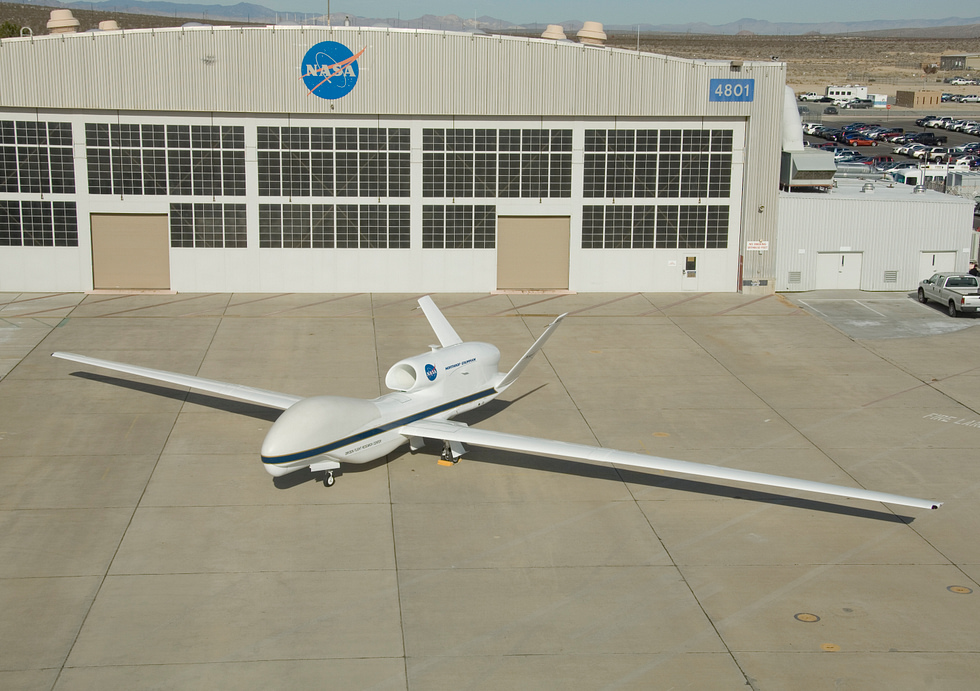
- NASA Global Hawk and SkyRange (2007–present)
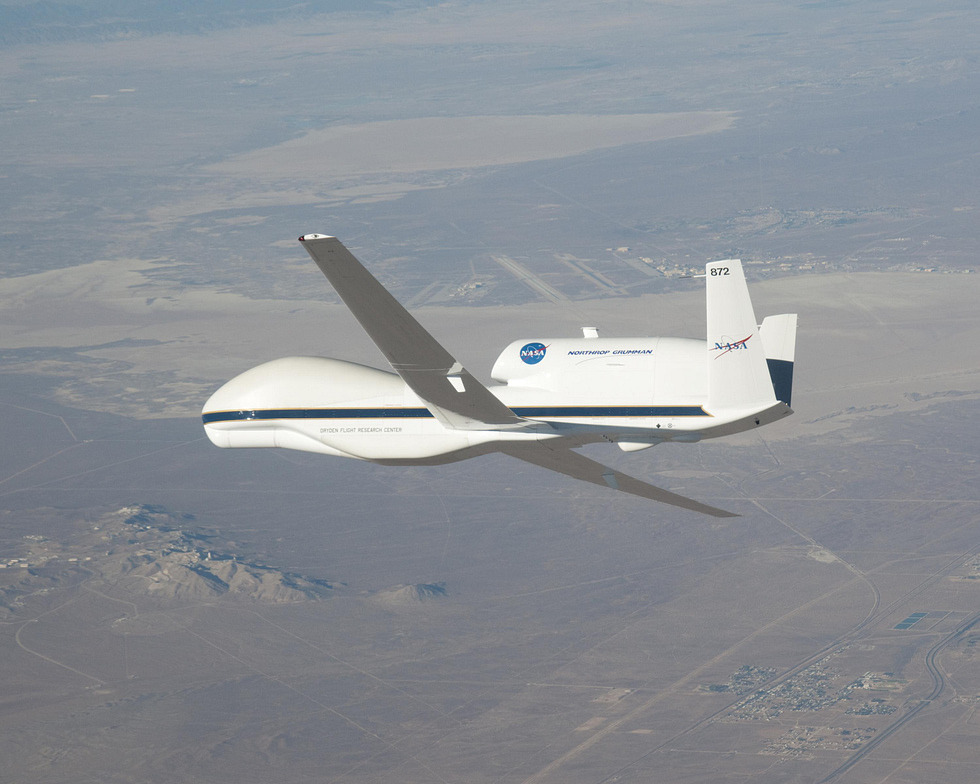
- Two airframes went to NASA Dryden in December 2007 for atmospheric and hurricane science, including flights into Atlantic storms. Separately the Pentagon’s Test Resource Management Center is converting retired Block 20 and Block 30 airframes into SkyRange "RangeHawk" telemetry aircraft for hypersonic weapons testing, flown from Grand Sky in North Dakota.
Closing caveat: production totals for this type are unusually slippery because demonstrators, test airframes and converted aircraft are counted differently by different sources. The figures above follow US Air Force and Director, Operational Test and Evaluation documents where they exist. About 42 Global Hawk airframes had been delivered by FY2013 against an original requirement of 63, cut to 45; the fleet peaked well short of that and is now measured in single figures in American service.
Operators today
Twenty-two Global Hawks still fly, and only nine of them are American
The RQ-4 is in service, but barely, and the shape of what survives is instructive. The United States Air Force — which built the aeroplane, flew it in every campaign from Afghanistan to Libya, and tried four times to get rid of it — now has nine Block 40 radar aircraft at Grand Forks AFB, North Dakota, and Congress has forbidden it from retiring them before 30 September 2030. NATO has five. South Korea has four, Japan three. NASA keeps one airworthy for atmospheric science. The bars below count Global Hawk airframes proper; the US Navy’s MQ-4C Triton is a substantially different aeroplane and is counted separately, with about 30 delivered against a reduced requirement of 27 operational aircraft, plus three of four for the Royal Australian Air Force. Add those and the wider family is healthier than the parent type — which is the honest verdict on the whole programme: the airframe was sound, the maritime mission fitted it, and the high-altitude land reconnaissance mission it was actually built for has been slowly taken away from it.
These are estimates. The USAF figure of nine RQ-4B Block 40 aircraft is the inventory published in the Air & Space Forces Magazine almanac and matches independent reference tallies from 2022 onward; the Block 20s were divested in October 2021 and the last Block 30 left Beale AFB on 7 July 2022, with the fleet fully retired by 2023. NATO’s five RQ-4D Phoenix are owned by the Alliance, based at Sigonella and flown by the NATO Intelligence, Surveillance and Reconnaissance Force on behalf of fifteen contributing nations. South Korea’s four were delivered between December 2019 and September 2020 and are based near Sacheon; availability has been questioned in Korean reporting over sustainment contracting. Japan’s three RQ-4B Block 30(I) arrived at Misawa between March 2022 and June 2023. NASA lists several airframes on charge at Armstrong but offers only one, N872NA (AV-6), as available for missions; N871NA (AV-1), the first Global Hawk ever built, is retired. Many airframes counted on paper are stored, in deep overhaul, or not operational. Retired Block 20 and Block 30 airframes now being converted to SkyRange RangeHawk telemetry aircraft are excluded, as is the MQ-4C Triton, which is a separate type. Sources: IISS The Military Balance and FlightGlobal World Air Forces cross-checked against US Air Force fact sheets, NATO and national announcements; entries that could not be corroborated are omitted.
From demonstrator to global ISR workhorse
Programme launched
DARPA and the U.S. Air Force select Teledyne Ryan to build the Global Hawk as a high-altitude endurance demonstrator.
First flight
The prototype flies at Edwards Air Force Base on 28 February. Northrop Grumman acquires Teledyne Ryan the following year.
Straight into combat
Still officially a demonstrator, Global Hawks begin flying ISR missions over Afghanistan after the September 11 attacks.
Over Iraq
The type provides wide-area surveillance during the invasion of Iraq, cueing strikes and mapping the battlefield.
Disaster response
A Global Hawk surveys the stricken Fukushima nuclear plant after Japan’s earthquake and tsunami, and the type flies over Libya.
EuroHawk cancelled
Germany halts its EuroHawk signals-intelligence variant over certification and cost problems — a cautionary tale for the programme.
Shot down over the Gulf
Iran downs a U.S. Navy RQ-4A (BAMS-D) near the Strait of Hormuz on 20 June; the airspace claim is disputed.
NATO takes the reins
NATO’s RQ-4D “Phoenix” fleet reaches initial operating capability at Sigonella, Italy, flying alliance-wide surveillance.
From the ground station: twelve Global Hawk stories
A demonstrator that never stopped
The Global Hawk was meant to prove a concept — then war kept it flying.
Read the full story
No stick, no rudder
Operators command the Global Hawk with a keyboard and mouse, not a control column.
Read the full story
Watching Afghanistan from the stratosphere
From late 2001 the Global Hawk fed commanders a persistent, high-altitude view of the battlefield.
Read the full story
A day and a half aloft
Thirty-plus hours in the air changes what a single aircraft can watch.
Read the full story
Seeing through the weather
The synthetic-aperture radar maps the ground in cloud and darkness alike.
Read the full story
The most expensive eyes in the sky
The Global Hawk’s price became a running controversy in Washington.
Read the full story
Flying over Fukushima
After the 2011 tsunami, a Global Hawk imaged reactors too dangerous to approach.
Read the full story
The Phoenix over Europe
NATO bought its own Global Hawks to give the alliance a shared surveillance fleet.
Read the full story
From Global Hawk to Triton
The Navy took the airframe to sea as the maritime MQ-4C Triton.
Read the full story
NASA’s high-flying laboratory
NASA flies Global Hawks into hurricanes and across the Pacific for research.
Read the full story
The missile over Hormuz
In 2019 Iran shot down a U.S. Navy Global Hawk, and the airspace claim is still disputed.
Read the full story
Japan and Korea join in
Both East Asian allies now operate their own Global Hawks for regional surveillance.
Read the full story
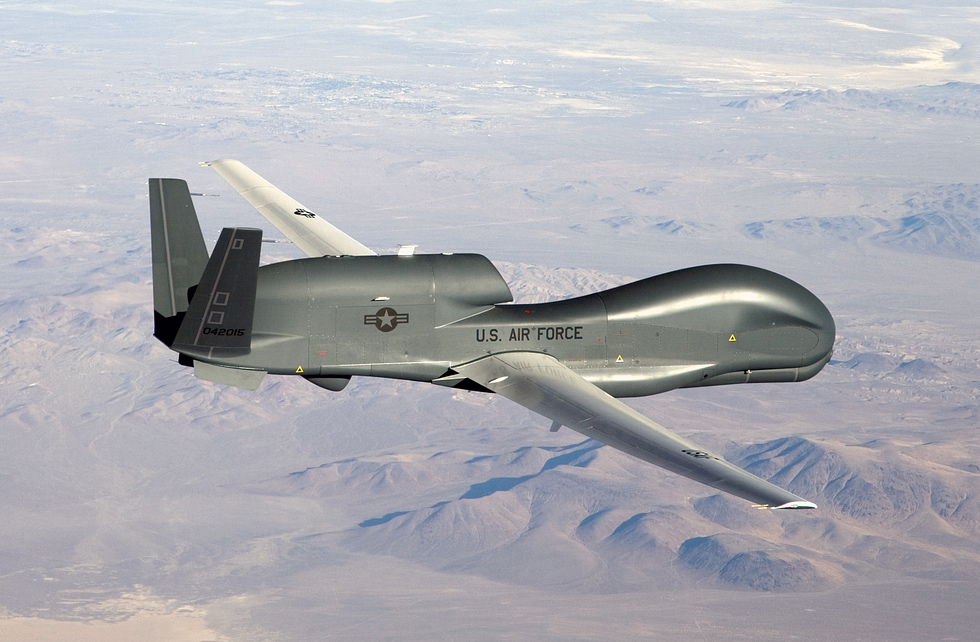
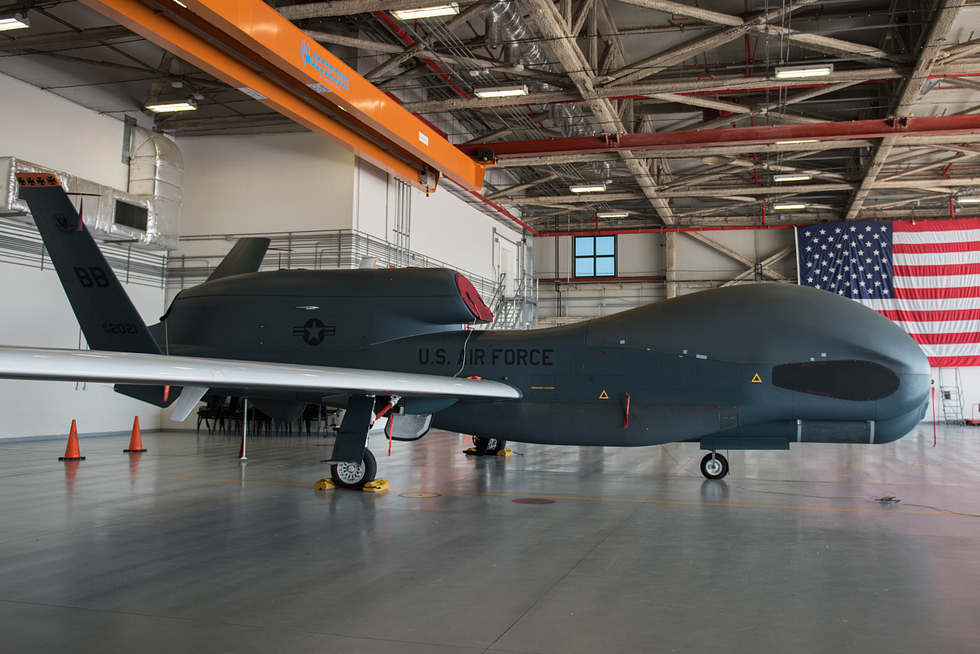
The Global Hawk in pictures
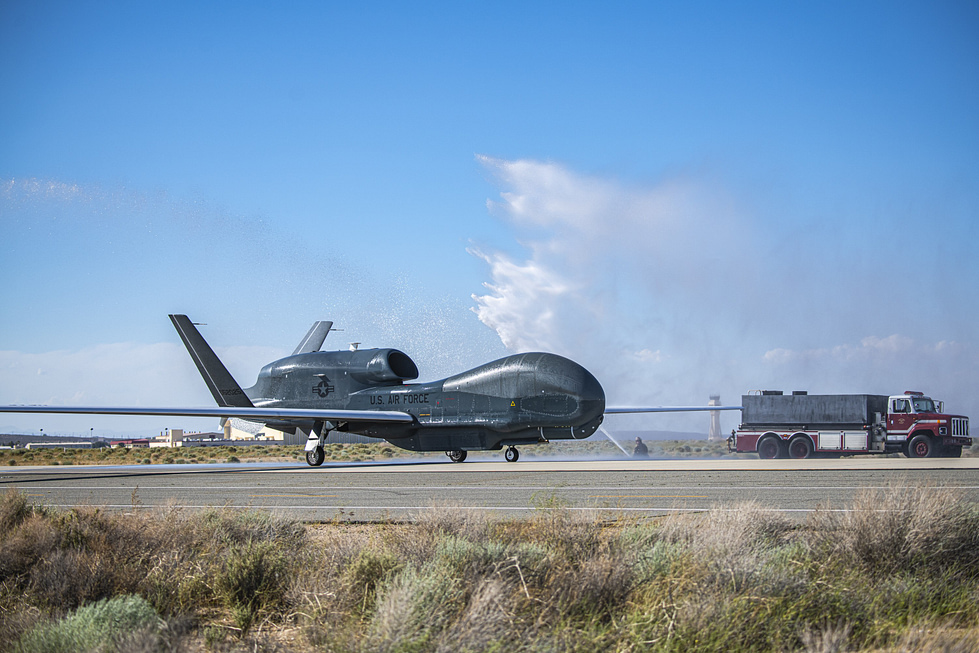
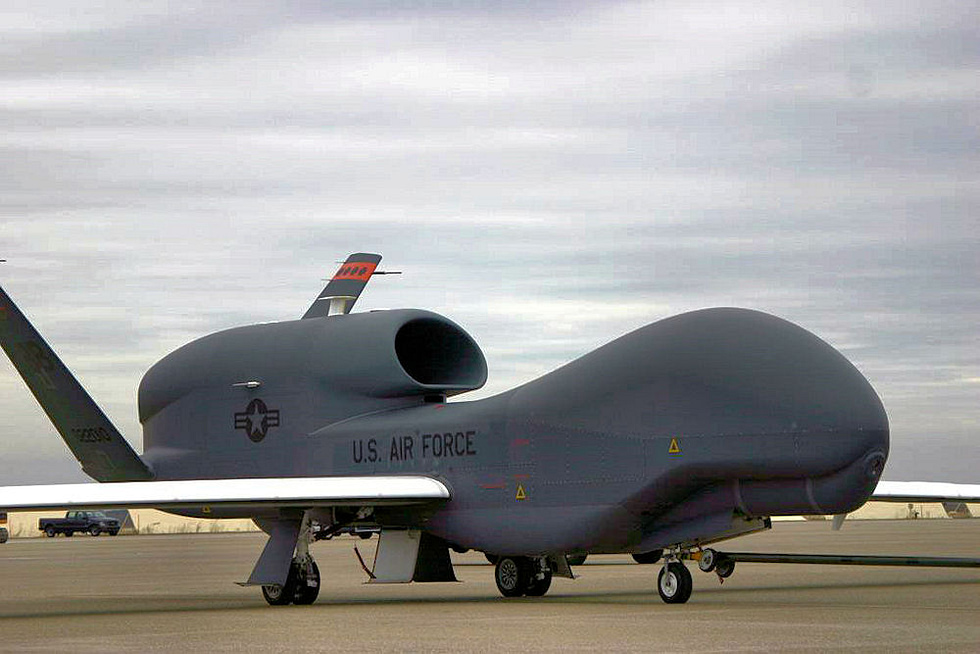
The Global Hawk in motion
The Daily Aviation: Inside the Factory Building the RQ-4 Global Hawk. A documentary look at how the world’s largest reconnaissance drone is built and flown — several hundred thousand views on an established aviation channel.
Where the Global Hawk operates
A record measured in coverage, not kills
The Global Hawk has no air-to-air score, and never will — it is unarmed. Its record is written in endurance and coverage: two decades of persistent surveillance over Afghanistan and Iraq, disaster-response flights over Fukushima and beyond, and a global ISR footprint no crewed reconnaissance fleet could sustain. Its most famous single moment was a loss, not a victory.
Compare the combat record of every military aircraft. Figures as of 2026.
Everything people ask about the RQ-4 Global Hawk
Can I fly in an RQ-4 Global Hawk?
Is the RQ-4 Global Hawk flown by a pilot?
How long can a Global Hawk stay in the air?
Is the Global Hawk armed?
How much does an RQ-4 Global Hawk cost?
Who operates the Global Hawk?
Did Iran really shoot down a Global Hawk?
You can’t fly the Global Hawk.
These, you can.
Some legends only live in museums — others are fuelled and waiting. MiGFlug has put civilians in real military jet cockpits since 2004.
 Fly the L-39 AlbatrosThe world’s most-flown jet trainer — aerobatics included
 Fly the F-104 Starfighter“The missile with a man in it”
 Fly the MiG-21The Cold War’s most-produced jet
 حلّق بطائرة تي-33 شوتينغ ستارAmerica’s first jet trainer
 Fly the DH VampireA piece of early jet history
 Fly the S.211Agile Italian jet trainer
 Fly the MB-326The classic Aermacchi jet
 Fly the MiG-15The Soviet legend of the Korean War
Continue the tour
Every fact, checked
- U.S. Air Force — RQ-4 Global Hawk fact sheetOfficial specifications, role and operational history.
- Northrop Grumman — Global HawkManufacturer overview of the airframe, sensors and variants.
- NASA Armstrong — Global Hawk science aircraftNASA’s Earth-science and high-altitude research use of the type.
- U.S. Government Accountability OfficeProgramme cost, unit price and cost-per-flight-hour assessments.
- NATO — Alliance Ground Surveillance (AGS)The RQ-4D “Phoenix” fleet and Sigonella basing.
- U.S. NavyBAMS-D and the MQ-4C Triton maritime derivative.
- The War Zone (TWZ)Reporting on the 2019 Strait of Hormuz shootdown and Global Hawk operations.
- National Museum of the U.S. Air ForceReference for preserved and early Global Hawk airframes.