
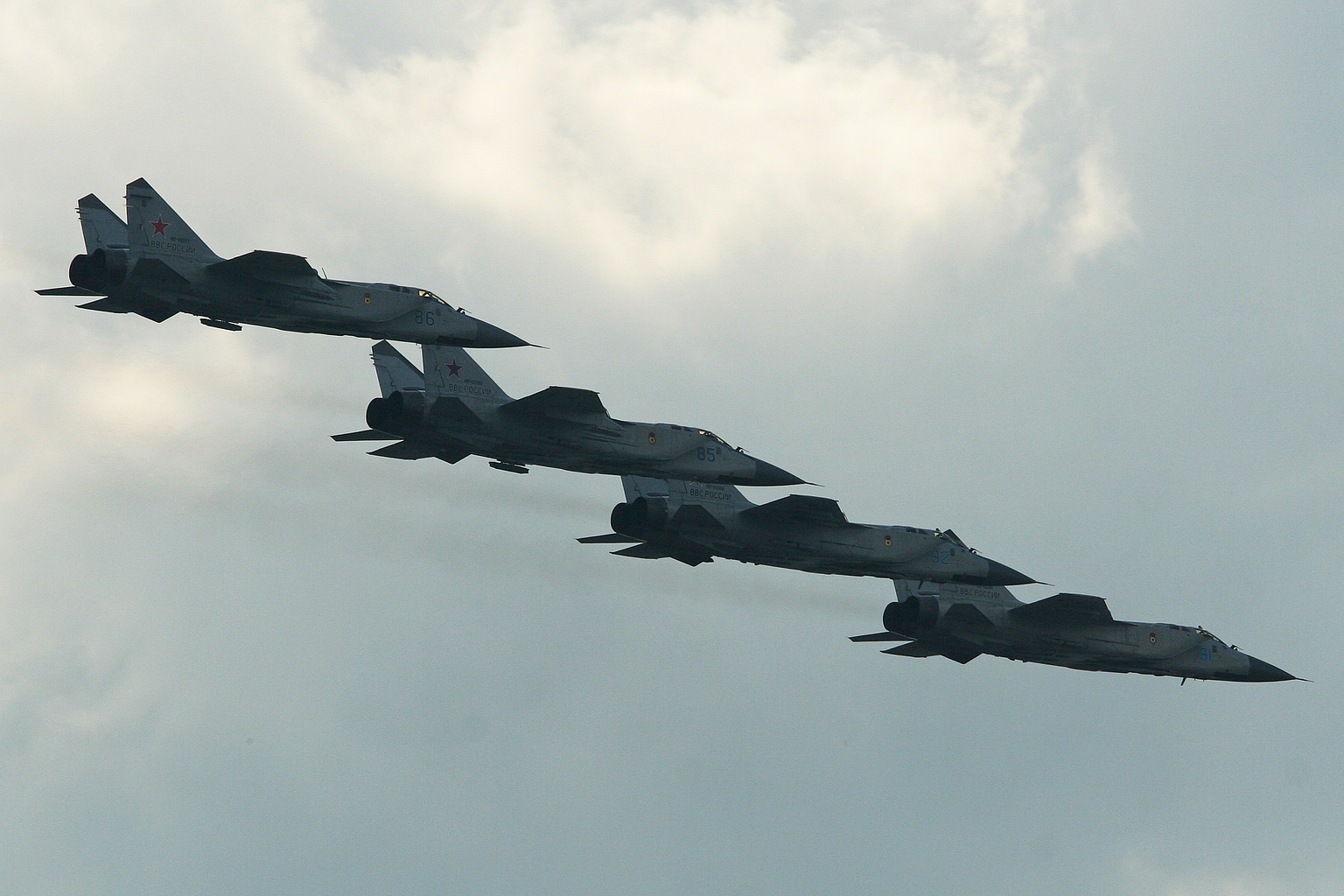
Mikoyan-Gurevich MiG-31
“Foxhound”
The fastest combat aircraft still flying — a Mach-2.83 long-range interceptor whose 1981 Zaslon radar was the world’s first operational fighter PESA, and which today carries Russia’s Kinzhal hypersonic missile.
The interceptor built to fix the Foxbat
The MiG-31 was born from the shortcomings of its famous ancestor. The MiG-25 Foxbat could sprint to Mach 2.8, but it couldn’t look down and shoot down: its radar was blinded by ground clutter, it handled poorly at low altitude, and its thirsty turbojets gave it short legs. Against the low-flying bombers and cruise missiles of the 1970s, the Foxbat was nearly useless. The answer was the Ye-155MP — a new aircraft that only looked like a Foxbat.
First flown on 16 September 1975 by test pilot Alexander Fedotov and in service from 1981, the MiG-31 kept the Foxbat’s brute speed but added everything it lacked: a second crewman to work the sensors, genuine afterburning turbofans that could sustain Mach 2.83 without wrecking themselves, and above all the Zaslon radar — the world’s first electronically-scanned array to enter service on a fighter. The sprinter had become a long-range interception system.
Unlike the widely-exported MiG-21, the Foxhound was never sold abroad in numbers — only the Soviet Union, then Russia, and briefly Kazakhstan have flown it. Around 500 were built before production ended in 1994, and roughly 130 modernised MiG-31BM/BSM remain the backbone of Russian long-range air defence. Today the type is globally famous again as the launch platform for the Kh-47M2 Kinzhal — and, at Mach 2.83, it is simply the fastest combat aircraft still flying anywhere in the world.
01The MiG-31’s Zaslon radar: how the first operational fighter PESA rewrote air defence
When the MiG-31 entered service in 1981, Western fighters like the F-14 and F-15 still swept the sky with mechanically-rotated radar dishes. The Foxhound’s Zaslon S-800 (NATO “Flash Dance”) had no moving antenna at all: it steered its beam electronically in milliseconds, the first passive electronically-scanned array (PESA) ever fielded on a fighter. It could track around ten targets and engage several at once with the long-range R-33 missile — and, crucially, it could look down and pluck a low-flying cruise missile out of ground clutter, the exact task that had defeated the MiG-25.
Netted together by datalink, four MiG-31s could patrol a barrier nearly 900 km wide across the Arctic approaches to the USSR — each jet feeding the others a shared picture. The modernised Zaslon-M of the MiG-31BM is claimed to reach much further still, feeding today’s very-long-range R-37M. Treat the biggest range numbers with caution, but the through-line is real: from the Cold War Foxhound to the missile-truck of the 2020s, the Foxhound has always been a radar first and an airframe second.
What makes it special
The Zaslon PESA radar
The MiG-31’s heart is the Zaslon S-800 — the world’s first passive electronically-scanned array to enter service on a fighter, in 1981. With no moving antenna it steers its beam electronically, tracking around ten targets and engaging several simultaneously, and it can look down to kill low-flying cruise missiles in clutter. The modernised Zaslon-M feeds today’s R-37M very-long-range missiles.
D-30F6 turbofans
Where the MiG-25 used thirsty turbojets, the Foxhound carries two Soloviev D-30F6 afterburning turbofans of about 152 kN each. They let it sustain Mach 2.83 and even supercruise without tearing themselves apart — giving the MiG-31 genuine long range and endurance rather than a single wasteful dash.
Two crew, one network
A pilot flies while a dedicated weapons officer works the Zaslon in the back seat. Linked by the APD-518 datalink, four MiG-31s form a single picket line nearly 900 km wide, each sharing its radar picture — a networked hunting pack built decades before “network-centric warfare” had a name.
02The MiG-31’s engines: why turbofans beat the Foxbat’s turbojets
The MiG-25’s R-15 turbojets were optimised for one thing — a flat-out Mach 2.8 dash — and they drank fuel so fast that sustained high-speed flight risked damaging them. The MiG-31’s Soloviev D-30F6 afterburning turbofans changed the equation: more efficient at cruise, they let the Foxhound hold Mach 2.83 at altitude and reach out to a combat radius of around 720 km at high speed, or roughly 1,450 km subsonic. It is the difference between a sprinter that must dash and recover, and an interceptor that can actually patrol.
03The MiG-31’s picket line: four jets, one 900-kilometre radar wall
A single MiG-31 is formidable; four are a system. Using the APD-518 datalink, a flight of four Foxhounds could space themselves out and share a single fused radar picture, sweeping a corridor almost 900 km wide across the northern approaches to the Soviet Union. One jet could detect a target and hand it to another to engage. In an era when Western fighters still fought largely as individuals, this networked, look-down barrier was a genuinely radical piece of air-defence doctrine — and it is the direct ancestor of the datalinked missile-launch tactics Russia uses with the R-37M today.
Full specifications
Airframe & Performance
- طاقم
- 2 (pilot + weapons officer)
- طول
- ~22.6 m
- طول الجناحين
- ~13.46 m
- ارتفاع
- ~6.15 m
- Max takeoff weight
- ~46,200 kg
- Max speed
- Mach 2.83 · ~3,000 km/h
- سقف الخدمة
- ~20,600 m
- نطاق القتال
- ~720 km at Mach 2.35
- Ferry range
- ~3,300 km
Propulsion & Systems
- Engines
- 2 × Soloviev D-30F6
- Thrust
- ~93 kN dry / ~152 kN reheat (each)
- Radar
- Zaslon / Zaslon-M PESA
- Missiles
- R-33; up to 6 × R-37M (BM)
- Cannon
- 1 × 23 mm GSh-6-23
- First flight
- 16 September 1975
- Unit cost
- ~$30–50 million (estimate)
- Cost per flight hour
- No reliable public figure
04The MiG-31’s operating costs: what open sources actually show
Hard numbers for the MiG-31 are scarce and unreliable. It was and remains a Soviet-then-Russian state product that was never openly exported, so there is no export price list to anchor an estimate. Figures circulating online range from soft estimates of roughly $30–50 million per airframe to an often-repeated but unsourced “$100 million” — treat all of them as guesswork. No credible cost-per-flight-hour figure exists in open sources either. What is certain is that the MiG-31 is un-buildable: production ended in 1994 and cannot be restarted, so every jet lost is gone for good — a fleet Russia keeps flying precisely because it can no longer make more.
Fifty years of the Foxhound
The Ye-155MP programme
Soviet designers begin an aircraft to fix the MiG-25’s inability to look down and shoot down low-flying targets.
First flight
Test pilot Alexander Fedotov takes the prototype up on 16 September 1975.
Service & the first PESA
The MiG-31 enters PVO service, carrying the Zaslon radar — the world’s first operational fighter PESA.
The 900 km wall
Four datalinked MiG-31s adopt the doctrine of a continuous radar picket line across the Arctic approaches.
The MiG-31B
An improved variant adds aerial refuelling and upgraded avionics.
Production ends
After roughly 500–519 built, the line closes for good — the type can no longer be manufactured.
The BM upgrade
The modernised MiG-31BM/BSM brings Zaslon-M, a glass cockpit and the very-long-range R-37M missile.
Kinzhal revealed
Russia unveils the MiG-31K carrying the Kh-47M2 Kinzhal air-launched missile.
Combat over Ukraine
MiG-31s reportedly fire R-37M air-to-air missiles and MiG-31K launch Kinzhals — both widely reported but contested.
Twelve things to know about the Foxhound
The world’s first PESA fighter
In 1981 the MiG-31 fielded an electronically-scanned radar years before the West.
Read the full story
The 900-kilometre wall
Four datalinked MiG-31s could sweep a corridor almost 900 km wide.
Read the full story
Looking down at last
The MiG-31 could do the one thing the MiG-25 never could.
Read the full story
The “AWACS killer”
The modernised MiG-31BM carries the very-long-range R-37M missile.
Read the full story
The longest shot in history?
Claims of a 200 km-plus air-to-air kill are widely repeated but unverified.
Read the full story
Intercepting at the edge
With a ~20 km ceiling and a zoom climb, the MiG-31 reaches where few fighters can.
Read the full story
It can’t dogfight — and doesn’t need to
The Foxhound is a straight-line missileer, not a turning fighter.
Read the full story
Carrying the Kinzhal
Since 2018 the MiG-31K has launched Russia’s Kh-47M2 Kinzhal.
Read the full story
Supercruise without reheat
The D-30F6 turbofans give sustained speed the MiG-25 never had.
Read the full story
Two brains, one jet
A dedicated weapons officer works the radar while the pilot flies.
Read the full story
The quickest combat jet flying
At Mach 2.83, nothing in frontline service is faster.
Read the full story
Fighting with a jet it can no longer make
Production ended in 1994 and cannot be restarted.
Read the full story
The Foxhound in pictures
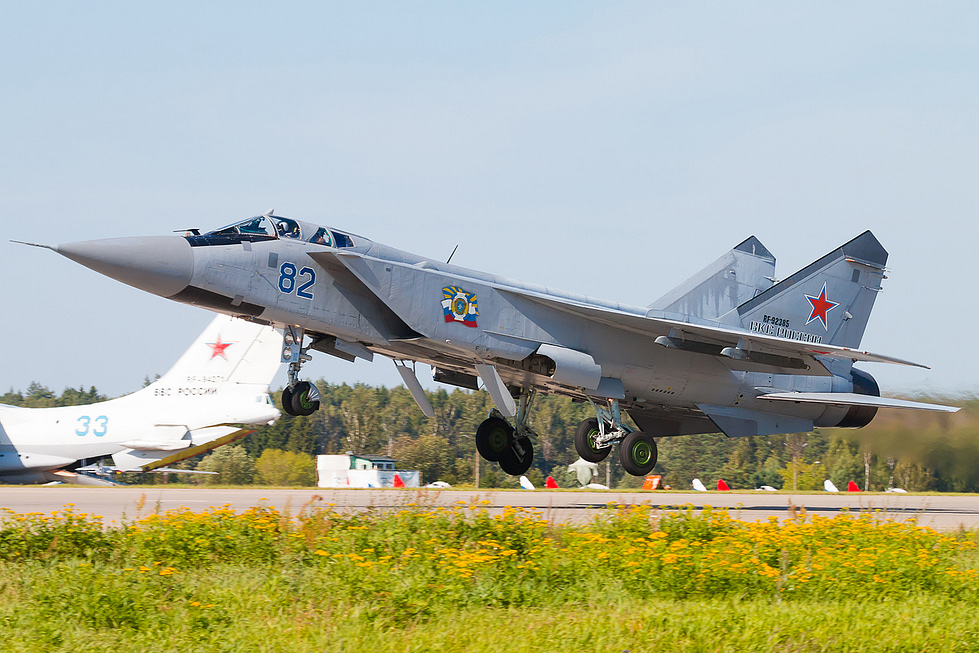
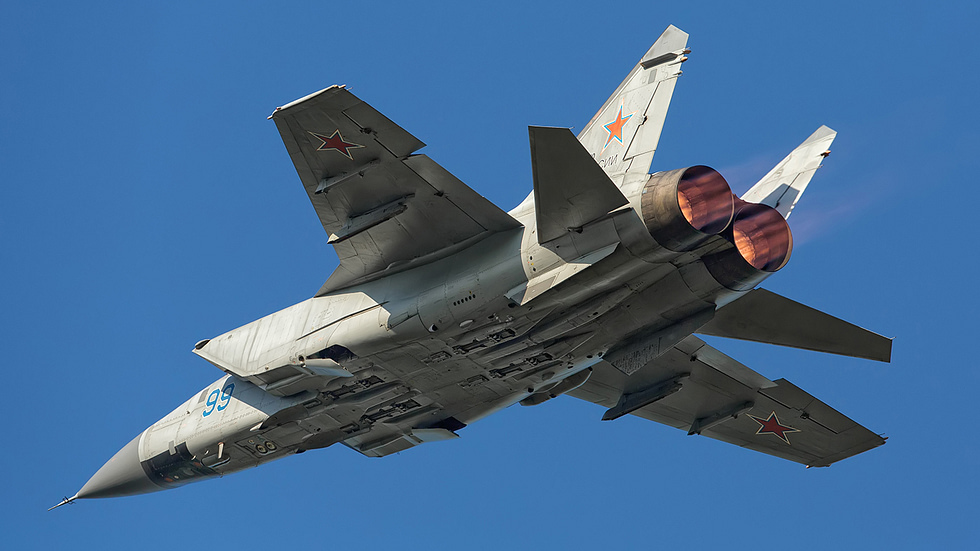
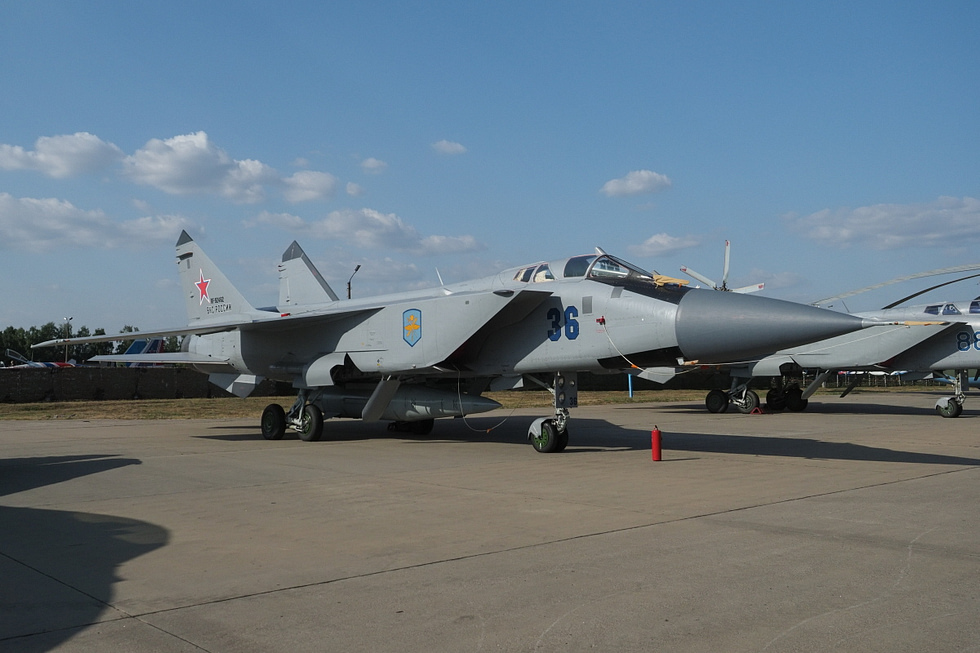
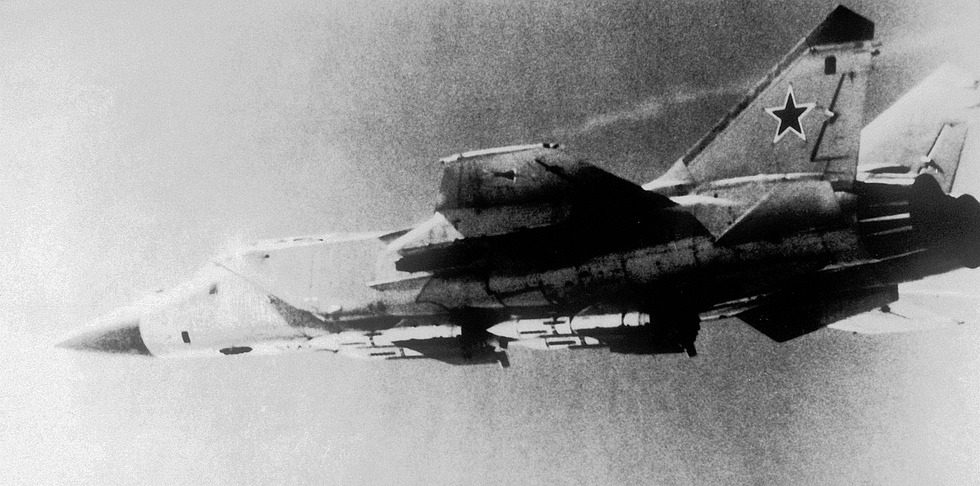
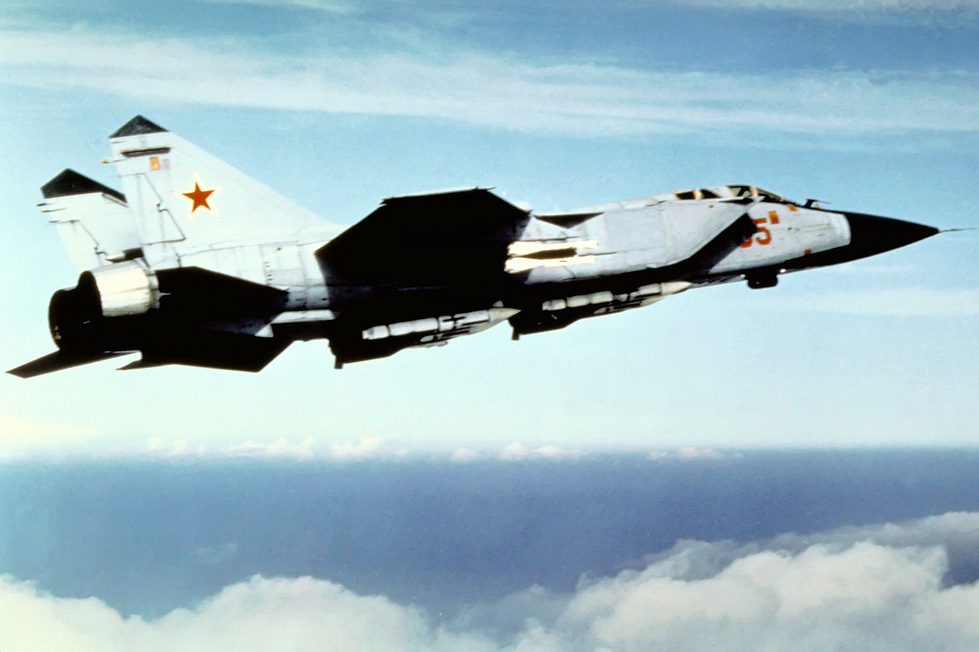
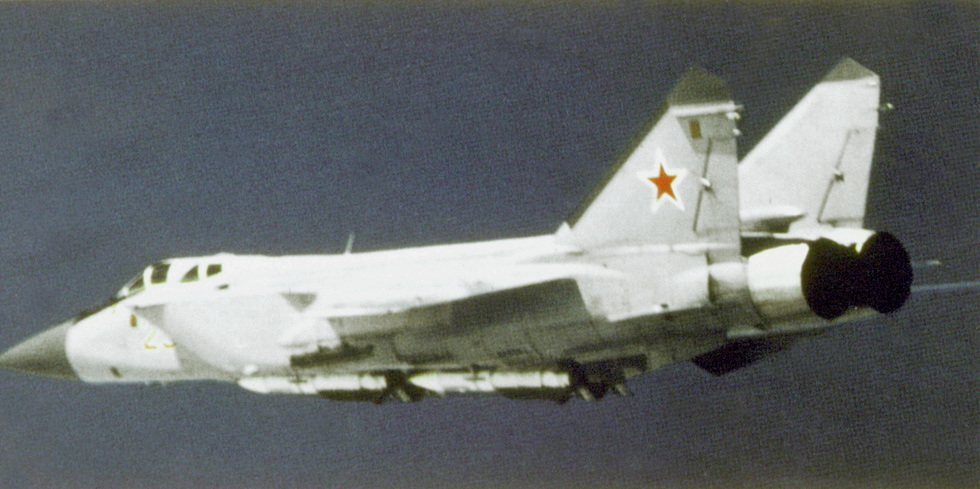
The Foxhound in motion
A documentary look at the MiG-31 — the Cold War interceptor still setting the pace.
Where the Foxhound flies
The fastest jet still in the fight
For most of its life the MiG-31’s job was deterrence — shadowing NATO patrols and guarding the Soviet, then Russian, frontiers rather than fighting. Since 2022 it has been widely reported firing R-37M air-to-air missiles and, as the MiG-31K, launching Kinzhal missiles over Ukraine. Treat the specific claims as contested: kill counts, record ranges and interception claims are all disputed and rarely independently verified.
Compare the combat record of every military aircraft. Figures as of July 2026.
Everything people ask about the MiG-31
Can I fly in a MiG-31?
How fast is the MiG-31?
Is the MiG-31 still in service?
What is the Kinzhal missile?
What is the Zaslon radar?
How is the MiG-31 different from the MiG-25?
You can’t fly the MiG-31.
These, you can.
Some legends only live in museums — others are fuelled and waiting. MiGFlug has put civilians in real military jet cockpits since 2004.
 Fly the L-39 AlbatrosThe world’s most-flown jet trainer — aerobatics included
 Fly the F-104 Starfighter“The missile with a man in it”
 Fly the MiG-21The Cold War’s most-produced jet
 حلّق بطائرة تي-33 شوتينغ ستارAmerica’s first jet trainer
 Fly the DH VampireA piece of early jet history
 Fly the S.211Agile Italian jet trainer
 Fly the MB-326The classic Aermacchi jet
 Fly the MiG-15The Soviet legend of the Korean War
Continue the tour
Every fact, checked
- Airforce TechnologyMiG-31 airframe, radar and weapons overview (note: their cannon calibre is misstated).
- 19FortyFiveOrigins of the Foxhound and its 2020s status as an un-buildable but still-vital interceptor.
- CSIS Missile ThreatThe Kh-47M2 Kinzhal air-launched missile and the MiG-31K launch platform.
- Military Watch MagazineThe R-37M very-long-range missile and modernised MiG-31BM (claims treated as contested).
- MilitarnyiUkrainian assessment of MiG-31 and R-37M activity since 2022.
- The National InterestContext on Russian MiG-31s briefly based in Syria (a hosting arrangement, not a Syrian operator).
- The War Zone (TWZ)MiG-31 modernisation, Kinzhal operations and the type’s continuing role.
- The Aviation Geek ClubZaslon PESA radar history and MiG-31 development background.