
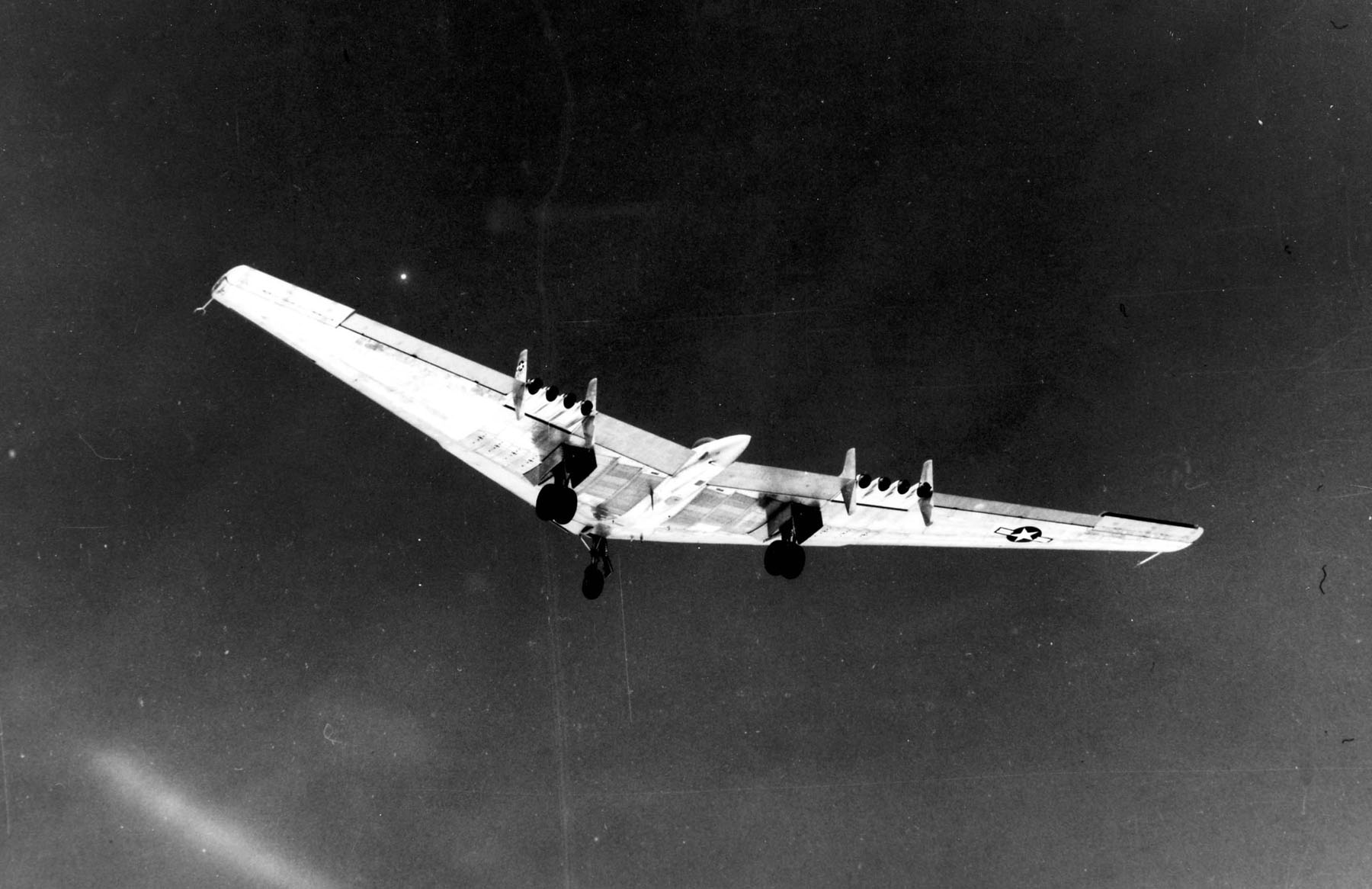
Northrop YB-49
Flying Wing
Jack Northrop’s tailless jet bomber of 1947 — a machine four decades ahead of its time, cancelled after fatal crashes and controversy, then reborn as the B-2 Spirit stealth bomber that shares its 172-foot wingspan.
The bomber that was 40 years too early
For most ofof his career the aircraft designer Jack Northrop chased a single idea: the pure flying wing. Strip away the fuselage and the tail — the parts that create drag but no lift — and what remains is, in theory, the most aerodynamically efficient shape an aeroplane can take. Through the 1930s and 1940s Northrop built a series of tailless prototypes to prove it, and during the Second World War the U.S. Army Air Forces backed the concept as a way to build a bomber that could reach Europe from America and return.
That bomber was the giant piston-engined XB-35, which first flew on 25 June 1946. It was magnificent to look at but mechanically tormented: its complex contra-rotating pusher propellers, their gearboxes and long drive shafts produced relentless vibration and never worked reliably. With the jet age arriving, Northrop took two of the airframes and replaced the troublesome propellers with eight turbojets buried in the wing. The result, the YB-49, first flew on 21 October 1947 — clean, fast for its day, and blessed with the long range and low drag Northrop had always promised.
But the tailless wing had a flaw no propaganda film mentioned: without a vertical tail it was directionally unstable, and in an era before flight computers or fly-by-wire there was nothing but the pilot’s hands to tame its constant yawing. As a bomber it was hopeless — testing found its bombing errors were roughly twice those of a wartime B-29. On 5 June 1948 a YB-49 broke apart in the air, killing all aboard, among them Captain Glen Edwards, for whom Edwards Air Force Base would soon be named. The programme was cancelled in 1949 and every airframe scrapped. Northrop later alleged the wing had been killed by politics rather than physics — a claim still disputed today. Four decades on, his idea returned in the stealth B-2 Spirit, which shares the YB-49’s span almost to the inch.
01The Northrop YB-49’s cancellation: was the flying wing killed by politics or by physics?
Two explanations have competed for the YB-49’s death ever since. The technical case is straightforward: the aircraft was directionally unstable, a poor bombing platform in an age with no computers to steady it, and it had suffered two catastrophic losses. The Convair B-36 — conventional, proven and already in production — simply made more sense as a strategic bomber.
ال political case comes largely from Jack Northrop himself, who claimed decades later that Air Force Secretary Stuart Symington had pressured him to merge his company with Convair, and that when he refused the flying-wing contracts were cancelled and the airframes ordered destroyed. Symington did later become an executive at Convair’s parent company, which kept the story alive. Most historians treat the allegation as unproven — a genuine grievance layered over an aircraft that also had real, serious shortcomings. We flag it here as contested rather than settled.
What makes it special
All-wing aerodynamics: range from pure efficiency
With no fuselage and no tail, almost the entire aircraft generated lift and very little of it generated drag. That gave the YB-49 exceptional aerodynamic efficiency and a range commonly cited at around 4,000 miles on internal fuel, plus enormous internal volume for fuel and bombs spread through the wing. It was the payoff Jack Northrop had promised for twenty years.
The stability problem: a bomber flown every second
The price of deleting the tail was directional instability. The wing wanted to yaw and wander, and with no flight computers, no fly-by-wire and only rudimentary yaw damping, the crew had to correct it constantly. It could not hold the steady, hands-off course a bomb run demands — tests reportedly found its aiming errors were about twice those of a B-29.
From YB-49 to B-2: a 40-year vindication
Everything that doomed the YB-49 became an asset once computers arrived. The B-2 Spirit, first flown in 1989, is a flying wing with the same ~172-foot span, its instability tamed by digital fly-by-wire — and the missing vertical tail, once a handling nightmare, turned out to be a gift for stealth.
02The Northrop XB-35’s propeller nightmare: why the piston flying wing failed first
The jet YB-49 exists because its piston predecessor, the XB-35, never worked properly. To turn the huge wing into a bomber, Northrop drove it with four buried Pratt & Whitney engines spinning contra-rotating pusher propellers through long drive shafts and complex gearboxes. Those gearboxes, propeller governors and shafts produced chronic vibration and repeated failures; switching to single-rotation propellers only traded one set of problems for another. The aircraft spent far more time grounded than flying, and by the time the bugs were understood the jet engine had made the whole propeller arrangement obsolete — so two airframes were converted to turbojets as the YB-49.
03The Northrop YB-49 and Edwards Air Force Base: the crash that named a legend
On 5 June 1948 the second YB-49 broke up in flight near Muroc Dry Lake, killing its entire five-man crew. Among them was Captain Glen W. Edwards, a decorated wartime bomber pilot and test pilot who had privately noted the wing could be “quite uncontrollable at times.” Investigators could assign no single cause but concluded the airframe had suffered a major structural failure. In December 1949 Muroc Air Force Base — today the U.S. military’s premier flight-test centre — was renamed Edwards Air Force Base in his honour. It is the flying wing’s most enduring, if sombre, memorial.
Full specifications
Airframe & Performance (YB-49)
- طاقم
- ~6–7 (sources vary)
- طول
- ~16.2 m (53 ft)
- طول الجناحين
- 52.4 m (172 ft)
- ارتفاع
- ~6.2 m (20 ft)
- Max takeoff weight
- ~87,000–88,000 kg (~193,000 lb)
- Max speed
- ~800 km/h (~495 mph · Mach ~0.65)
- سقف الخدمة
- ~12,800 m (~42,000 ft)
- يتراوح
- ~6,400 km (~4,000 mi)
- Bomb load
- Up to ~7,300 kg (16,000 lb)
Propulsion, Origin & Programme
- Engines
- 8 × Allison / GE J35-A-5 turbojets
- Thrust (each)
- ~17.8 kN (4,000 lbf)
- Manufacturer
- Northrop Aircraft, California
- First flight (XB-35 piston)
- 25 June 1946
- First flight (YB-49 jet)
- 21 October 1947
- Built
- 2 YB-49 (converted from YB-35)
- Programme cancelled
- 1949 · all airframes scrapped
- Unit cost
- No meaningful figure (prototypes only)
- Cost per flight hour
- No reliable public figure
04The Northrop YB-49’s cost: why no real price tag exists
The YB-49 was never a production aircraft, so it has no flyaway unit price in any meaningful sense. It was an experimental prototype programme — two airframes converted from earlier YB-35s, flown only for test and evaluation before cancellation. Its true cost was absorbed into a research effort that produced no operational aircraft, and no credible cost-per-flight-hour figure exists for the type. Any dollar amount attached to a “YB-49” today is at best an allocation of programme spending, not a sourced unit price. The real bill was paid decades later, and far more effectively, in the B-2 programme it foreshadowed.
From a designer’s dream to the ancestor of stealth
Proof of concept
Northrop flies the little N-1M flying-wing testbed, proving a tailless aircraft could fly and setting the stage for a bomber.
The XB-35 is ordered
The U.S. Army Air Forces back Jack Northrop’s all-wing bomber as a long-range strategic aircraft — the piston-engined XB-35.
XB-35 first flight
The giant piston flying wing flies on 25 June from Muroc, but its contra-rotating propellers and gearboxes prove hopelessly troublesome.
YB-49 first jet flight
On 21 October a converted airframe flies with eight buried turbojets — clean, fast and long-legged where the piston version had failed.
The fatal crash
On 5 June a YB-49 breaks apart in flight, killing all five aboard, including Capt. Glen Edwards.
Cancelled — and a base is named
The flying-wing programme is cancelled amid controversy. In December, Muroc is renamed Edwards Air Force Base.
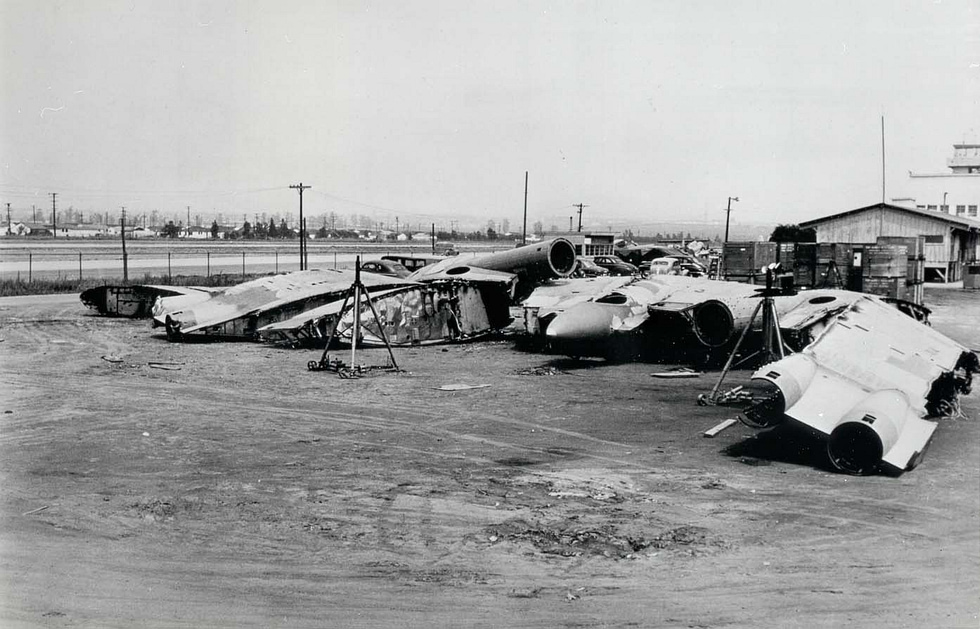
The last wing is scrapped
The final airframe is destroyed in a taxi accident on 15 March; the surviving wings are cut up. Nothing is preserved.
The wing returns
The B-2 Spirit — a flying wing with the same ~172-ft span — flies. Jack Northrop’s idea is finally vindicated.
The flying wing in twelve stories
Jack Northrop’s obsession
For twenty years Northrop chased the tailless all-wing aircraft as aviation’s perfect form.
Read the full story
The little wing that proved it
The tiny N-1M testbed showed a tailless aircraft could actually fly and be controlled.
Read the full story
The piston giant
The XB-35 first flew in June 1946 — beautiful, enormous, and mechanically cursed.
Read the full story
The propeller nightmare
Contra-rotating propellers, gearboxes and long drive shafts shook the XB-35 into near-uselessness.
Read the full story
Ripping out the propellers
Northrop converted two XB-35 airframes to eight jet engines, creating the YB-49.
Read the full story
The jet wing flies
On 21 October 1947 the YB-49 made its first flight, clean and fast where the piston version had struggled.
Read the full story
Flying it every second
Without a tail or computers, the wing wandered and yawed, demanding the crew’s constant attention.
Read the full story
A poor bomb-truck
As a bomber the wing was hopeless: its aiming errors were roughly double a wartime B-29’s.
Read the full story
Glen Edwards’ last flight
A YB-49 broke apart in flight on 5 June 1948, killing all five crew, including Capt. Glen Edwards.
Read the full story
A name in the desert
Muroc Air Force Base was renamed Edwards AFB in Glen Edwards’ honour — the wing’s lasting memorial.
Read the full story
Politics or physics?
Jack Northrop later claimed the wing was cancelled for political reasons — a disputed charge.
Read the full story
The deathbed vindication
Shown the secret B-2 design in 1980, an elderly Jack Northrop reportedly wept.
Read the full story
The flying wing in pictures
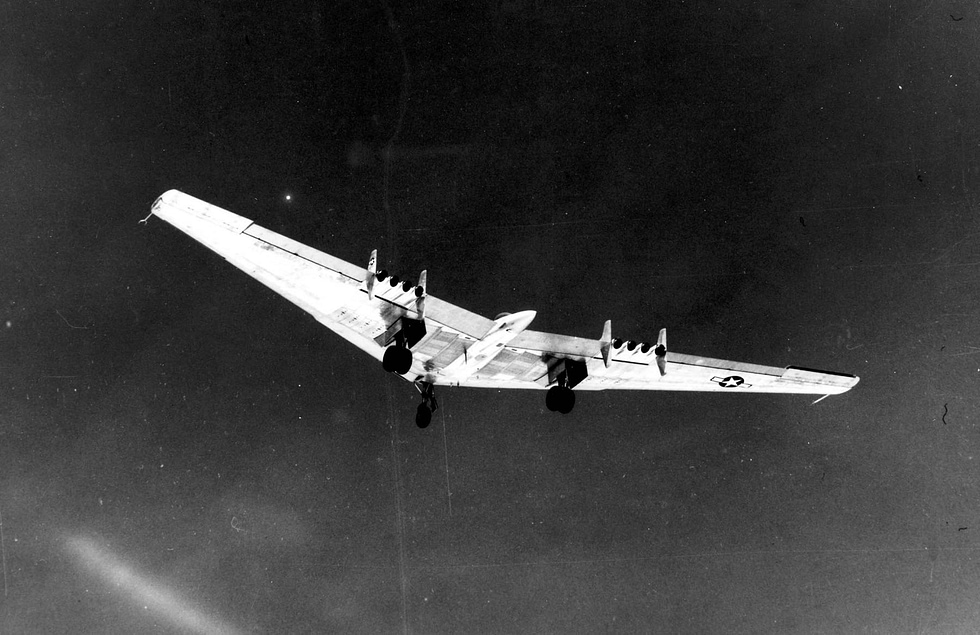


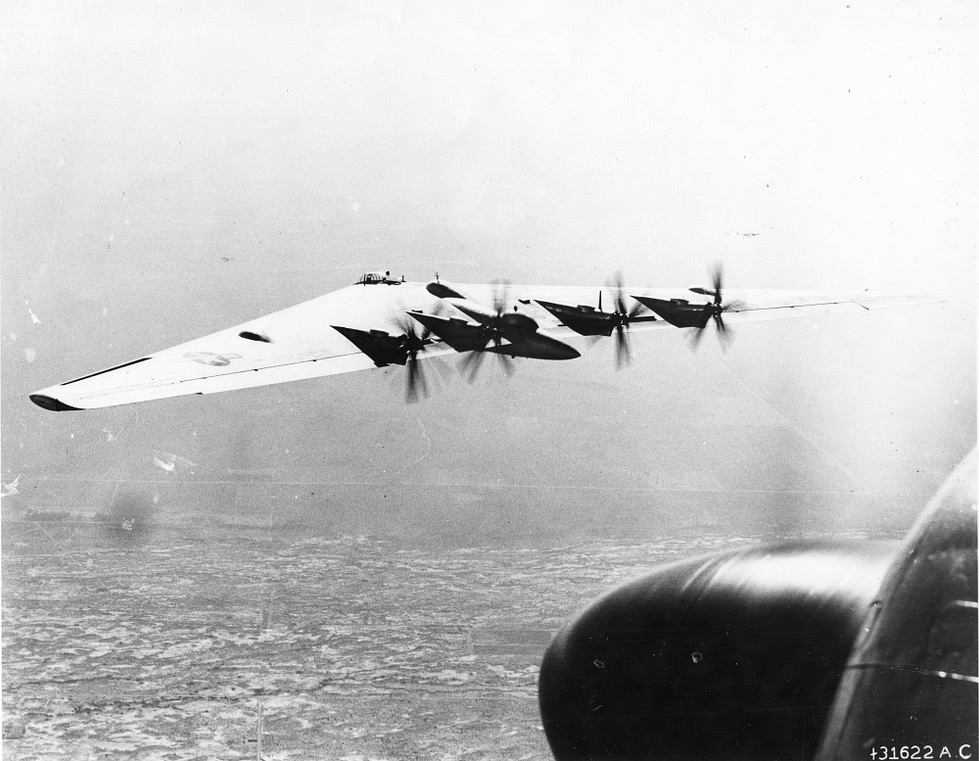
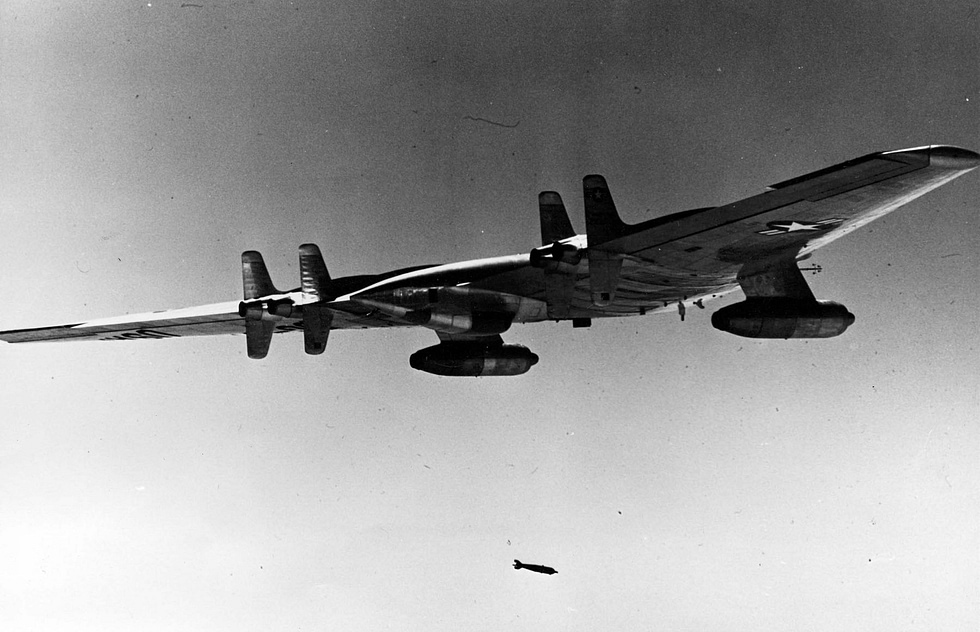
The flying wing in motion
A dedicated YB-49 video feature is coming soon. In the meantime, period newsreel of the Northrop flying wings survives in U.S. Air Force and archive collections — look for the 1947–49 Muroc test footage of the eight-jet wing in flight.
Where the flying wing flew
The record that defines it
The YB-49 never fired a shot in anger — it never reached squadron service. Its record is one of promise and paradox: an aircraft that flew beautifully in a straight line, failed as a bomber, and was then erased so completely that not a single airframe survives. Its real legacy was written forty years later, in the aircraft it inspired.
See how the aircraft it foreshadowed stack up in the combat record of every military aircraft.
Everything people ask about the YB-49
Can I fly in a YB-49?
What was the Northrop YB-49?
Why was the YB-49 cancelled?
Is the B-2 Spirit based on the YB-49?
How was the YB-49 different from the XB-35?
Who was Glen Edwards, and is Edwards AFB named after this aircraft?
Do any YB-49s survive today?
You can’t fly the YB-49.
These, you can.
Some legends only live in museums — others are fuelled and waiting. MiGFlug has put civilians in real military jet cockpits since 2004.
 Fly the L-39 AlbatrosThe world’s most-flown jet trainer — aerobatics included
 Fly the F-104 Starfighter“The missile with a man in it”
 Fly the MiG-21The Cold War’s most-produced jet
 حلّق بطائرة تي-33 شوتينغ ستارAmerica’s first jet trainer
 Fly the DH VampireA piece of early jet history
 Fly the S.211Agile Italian jet trainer
 Fly the MB-326The classic Aermacchi jet
 Fly the MiG-15The Soviet legend of the Korean War
Continue the tour
Every fact, checked
- Air & Space Forces Magazine — Jack Northrop and the Flying WingAuthoritative account of the programme, the cancellation controversy and the B-2 vindication.
- GlobalSecurity.org — B-49 developmentTechnical development, the bombing-accuracy tests and the 1948 crash and cancellation.
- National Museum of the U.S. Air ForceReference fact sheets on the Northrop XB-35 and YB-49 flying wings.
- Vintage Aviation News — Grounded Dreams: the YB-49Narrative history of the jet flying wing and its stability problems.
- This Day in AviationFirst-flight dates, crew and the YB-49 test programme timeline.
- Air & Space Forces Magazine — Namesakes: Glen EdwardsBiography of Capt. Glen Edwards and the renaming of Edwards Air Force Base.
- Plane Historia — Northrop XB-35 / YB-35The piston flying wing and its propeller and gearbox problems.
- Northrop Grumman heritageCompany history linking the wartime flying wings to the modern B-2 Spirit.