
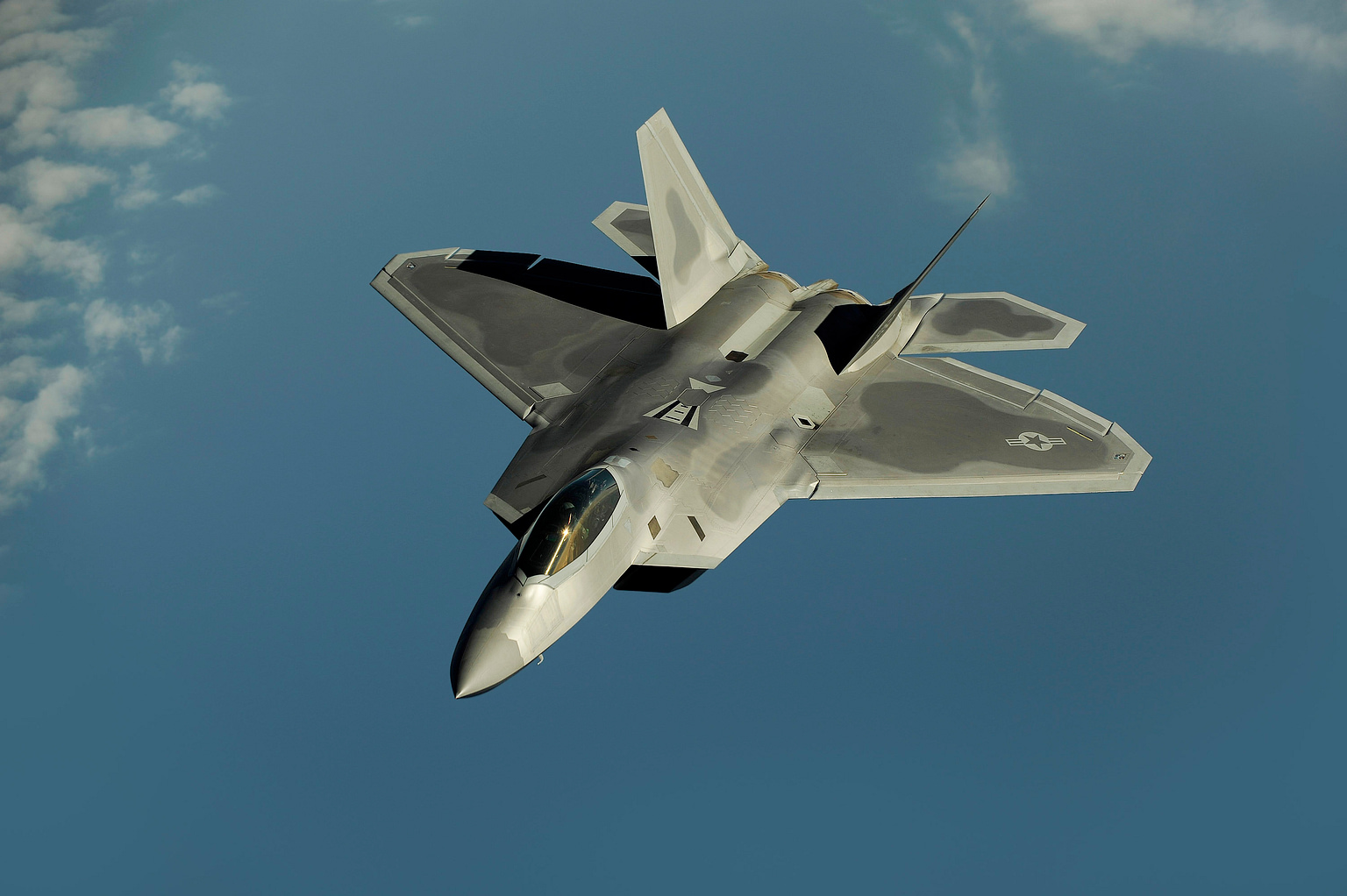
Lockheed Martin F-22
“Raptor”
The world’s first operational fifth-generation fighter — a stealthy, supercruising, thrust-vectoring air-dominance machine so advanced and so costly that only 195 were ever built, and U.S. law forbids selling a single one abroad.
The F-22 Raptor: first of the fifth generation
The F-22 Raptor is the world’s first operational fifth-generation fighter — the aircraft that defined what “fifth-gen” even means. It fused four capabilities no previous fighter combined: all-aspect stealth, supercruise (sustained supersonic flight without afterburner), thrust-vectoring super-maneuverability, and sensor fusion that blends radar, electronic-warfare and datalink information into a single picture for one pilot.
In exercises the Raptor has posted lopsided simulated kill ratios and has been called the most dominant air-superiority fighter ever fielded. Yet it arrived at the wrong moment: conceived to defeat Soviet fighter fleets, it entered service into an era of counter-insurgency wars where its air-to-air edge went largely unused.
Extreme cost and a 2011 production cap left the U.S. Air Force with fewer than 190 jets — a small, irreplaceable, export-banned force that remains America’s premier air-dominance asset while the sixth-generation NGAD is developed to replace it.
01The F-22 Raptor’s fifth-generation formula: what actually makes it “fifth-gen”
Before the Raptor, fighters were “fourth generation” — fast, agile and radar-equipped, but visible and reliant on numbers. The F-22 rewrote the definition by combining, in one airframe, four traits that had never been fielded together: a very low radar cross-section from all aspects, the ability to cruise supersonically without afterburner, thrust-vectoring maneuverability, and a computer that fuses every sensor into one clear tactical picture.
The result is an aircraft that can see first, shoot first and leave before it is ever detected. Every fifth-generation fighter since — the F-35, China’s J-20, Russia’s Su-57 — is measured against the template the F-22 Raptor set in 2005.
What makes the F-22 Raptor special
All-aspect stealth & internal carriage
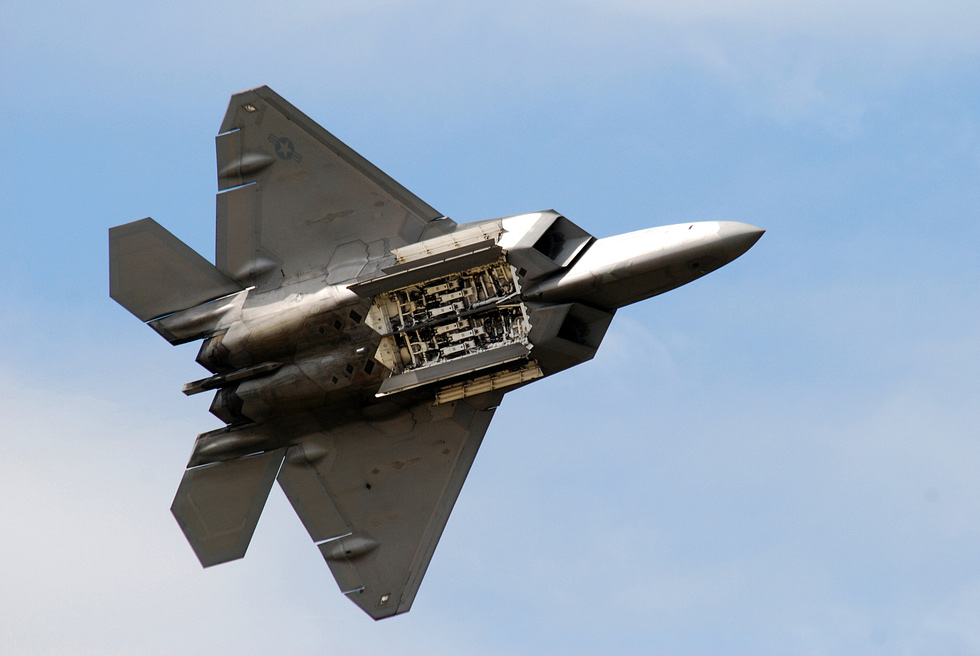
The Raptor’s faceted, planform-aligned shaping, radar-absorbent materials and carefully aligned edges give it a very low radar cross-section from every angle. All primary weapons ride in internal bays — side and belly — so the jet stays clean and stealthy, with no external stores to betray it on an enemy scope.
Twin F119s: supercruise & thrust vectoring
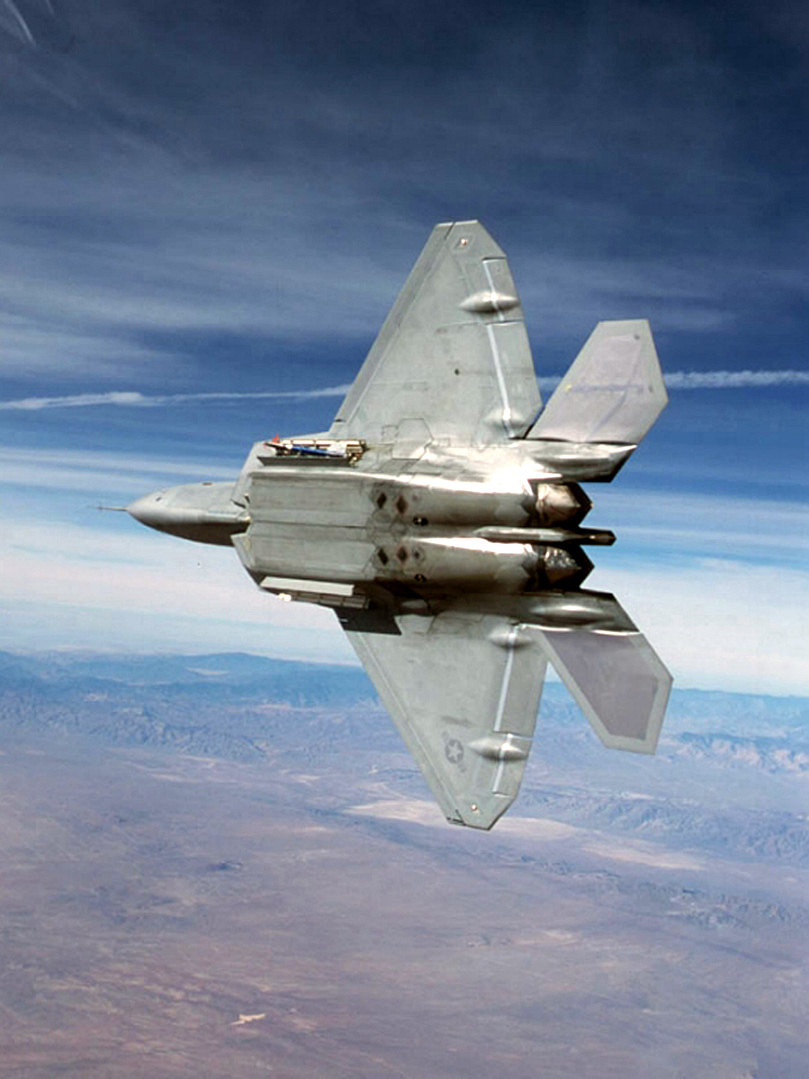
Two Pratt & Whitney F119-PW-100 afterburning turbofans in the ~35,000-lb-thrust class let the Raptor supercruise at roughly Mach 1.8 without afterburner. Two-dimensional pitch-axis thrust-vectoring nozzles give it extraordinary nose-pointing authority and post-stall maneuverability.
Sensor fusion & AESA radar
Ten/Ta/To AN/APG-77 active electronically scanned array radar, blended with electronic-warfare and communications sensors, feeds a sensor-fusion system that merges everything into one integrated picture — cutting pilot workload and enabling first-look, first-shot, first-kill engagements.
02The F-22 Raptor’s stealth: shaped to vanish, armed from within
Stealth is not one trick but many working together. The Raptor’s airframe is shaped so that its edges — wings, tails, bay doors, inlets — are aligned into a few directions, scattering radar energy away from the emitter. Radar-absorbent coatings soak up what shaping cannot deflect. And because bombs and missiles hung under the wings would light up on radar, the F-22 carries everything inside: six AIM-120 AMRAAMs and two AIM-9 Sidewinders in internal bays, opened only for the split second it takes to fire. The penalty is maintenance-hungry coatings and a smaller weapons load than a non-stealthy jet — the price of being nearly invisible.
03The F-22 Raptor’s F119 engines: the muscle behind supercruise
Most fighters need fuel-gulping afterburner to break the sound barrier. The Raptor’s two F119 turbofans produce so much dry thrust that it can hold roughly Mach 1.8 without reheat — extending range, missile reach and time on station while staying efficient and harder to spot on infrared. The same engines drive two-dimensional nozzles that pivot the exhaust up and down, letting the jet point its nose in ways aerodynamics alone forbid. Together they make the F-22 both a sprinter and an acrobat — a rare combination even a generation later.
Full F-22 Raptor specifications
Airframe & Performance
- Posádka
- 1
- Délka
- 18.9 m (62 ft 1 in)
- Rozpětí křídel
- 13.6 m (44 ft 6 in)
- Výška
- 5.1 m (16 ft 8 in)
- Prázdná hmotnost
- ~19,700 kg (43,340 lb)
- Max takeoff weight
- ~38,000 kg (83,500 lb)
- Max speed
- ~Mach 2.25 with afterburner
- Supercruise
- ~Mach 1.8 (no afterburner)
- Servisní strop
- Above 50,000 ft (~15 km)
- Ferry range
- >1,850 mi with 2 external tanks
Propulsion, Armament & Programme
- Engines
- 2 × P&W F119-PW-100, ~35,000 lb class
- Nozzles
- 2-D pitch-axis thrust vectoring
- Gun
- 1 × M61A2 20 mm, 480 rounds
- Air-to-air (internal)
- 6 × AIM-120 + 2 × AIM-9
- Air-to-ground (internal)
- 2 × 1,000-lb GBU-32 JDAM
- First flight
- 7 September 1997 (F-22A)
- Number built
- 195 (~187 operational)
- Unit cost
- ~$143M+ flyaway (see below)
- Cost per flight hour
- ~$60,000–70,000 (USAF, 2010s)
04The F-22 Raptor’s cost: why 195 was all America bought
The Raptor is famously expensive, and the figures depend on how you count. The flyaway cost — the price of one more jet off the line — is commonly cited above $143 million. But spread the programme’s roughly $67 billion in research and procurement across just 195 airframes and the programme-unit cost balloons toward $350 million each. Cite whichever you mean and say so. Either way, the number is why the Air Force’s planned 750 jets became 381, then 195: the F-22 was simply too costly to buy in the quantities first imagined, and the line closed in 2011.
The F-22 Raptor: four decades in the making
The requirement is set
The USAF establishes the Advanced Tactical Fighter (ATF) requirement to counter projected Soviet fighters such as the Su-27 and MiG-29.
Fly-off begins
A demonstration/validation phase pits Lockheed’s YF-22 against Northrop’s YF-23.
Prototypes fly
Both the YF-22 and the YF-23 make their first flights.
YF-22 wins
In August the Lockheed-led YF-22 is declared the winner and moves into Engineering & Manufacturing Development.
First F-22A flight
The first production-standard F-22A flies on 7 September.
Initial Operational Capability
The Raptor reaches IOC on 15 December, entering frontline service.
Production ends
The line is capped and closed at 195 aircraft; the final airframe is delivered in 2012.
Combat debut
On 22 September the F-22 flies its first combat mission — air-to-ground strikes on ISIS targets over Syria.
First air-to-air kills
In February the Raptor downs a Chinese surveillance balloon and two other high-altitude objects — its first-ever aerial kills.
From the flight line: twelve F-22 Raptor stories
YF-22 vs YF-23: the fly-off that chose the future
Two radically different stealth prototypes dueled in 1990–91.
Read the full story
Supercruise: fast without the fuel bill
The Raptor cruises supersonic without ever lighting the afterburner.
Read the full story
The thrust-vectoring cobra
Vectoring nozzles let the Raptor point its nose where aerodynamics forbid.
Read the full story
Only ~187: a fleet too small
The Air Force wanted 750 Raptors and got fewer than 190 usable jets.
Read the full story
Banned from export by law
A 1998 U.S. law made it illegal to sell the F-22 to anyone.
Read the full story
The highest kill in history: the 2023 balloon
A single AIM-9X ended a Chinese spy balloon at over 60,000 feet.
Read the full story
Three shoot-downs in nine days
Days after the balloon, Raptors downed two more mystery objects.
Read the full story
The silent quarterback
In the Middle East the Raptor watched, escorted and deterred more than it fired.
Read the full story
The 100-plus-to-nothing exercises
Red Flag data is the root of the Raptor’s “unbeatable” reputation.
Read the full story
$67 billion and the 2011 line closure
The Raptor’s price made it politically fragile — and finite.
Read the full story
Raptors over Syria, 2014
The Raptor’s first shots in anger were bombs, not missiles.
Read the full story
Upgrade, or retire for NGAD?
With production long closed, the Raptor’s twilight is fiercely debated.
Read the full story
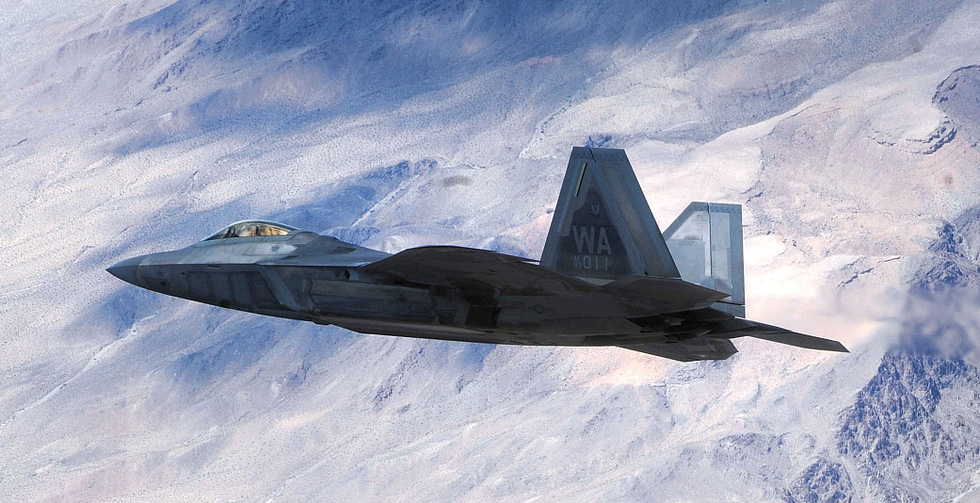
The F-22 Raptor in pictures
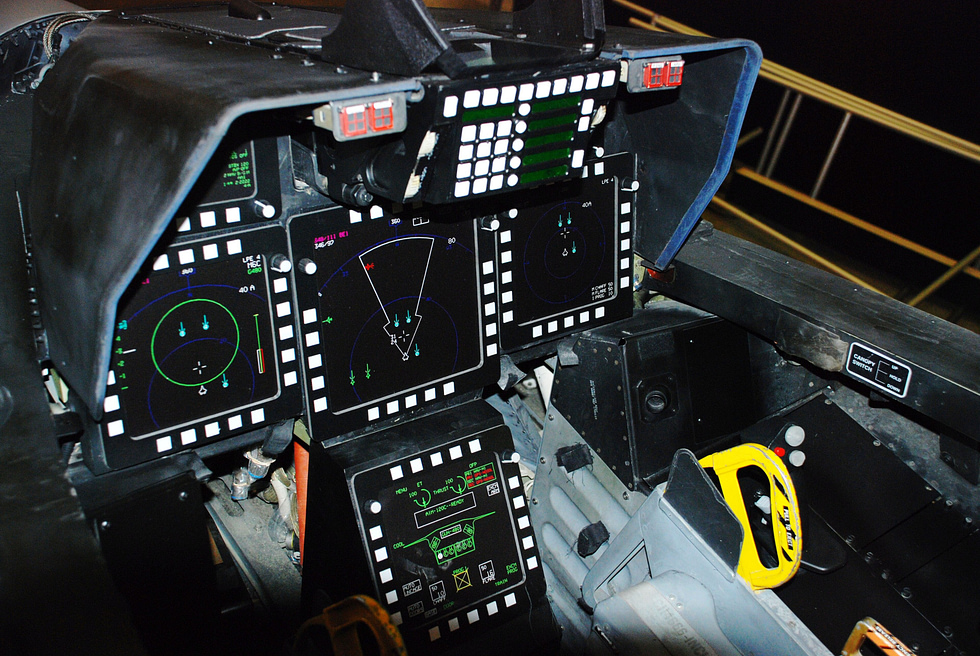
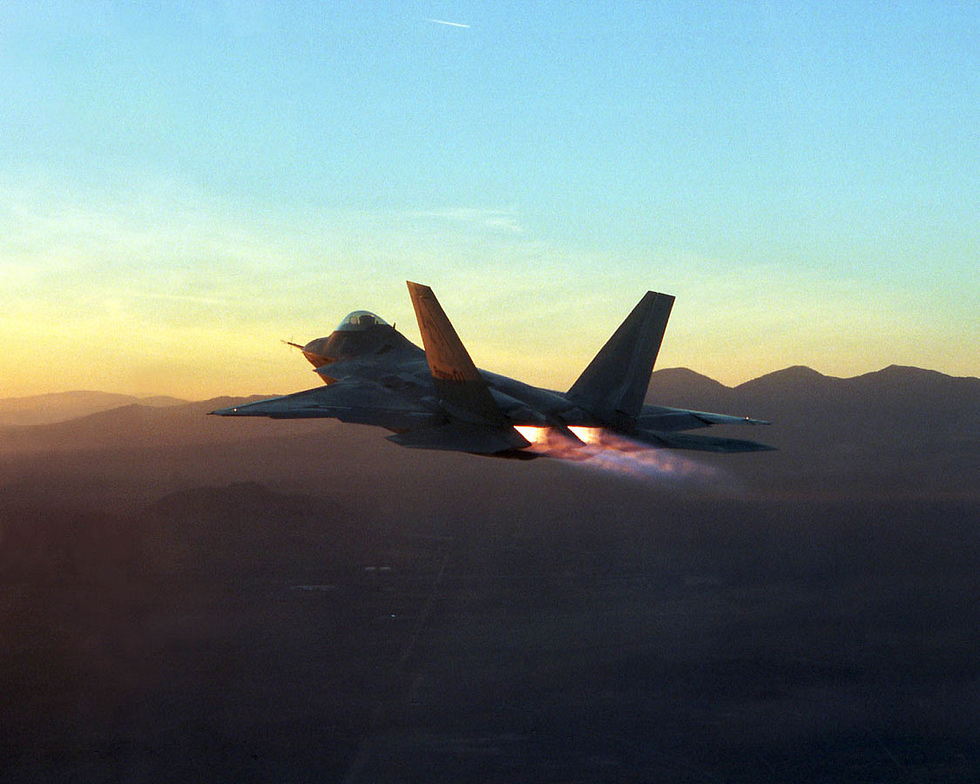
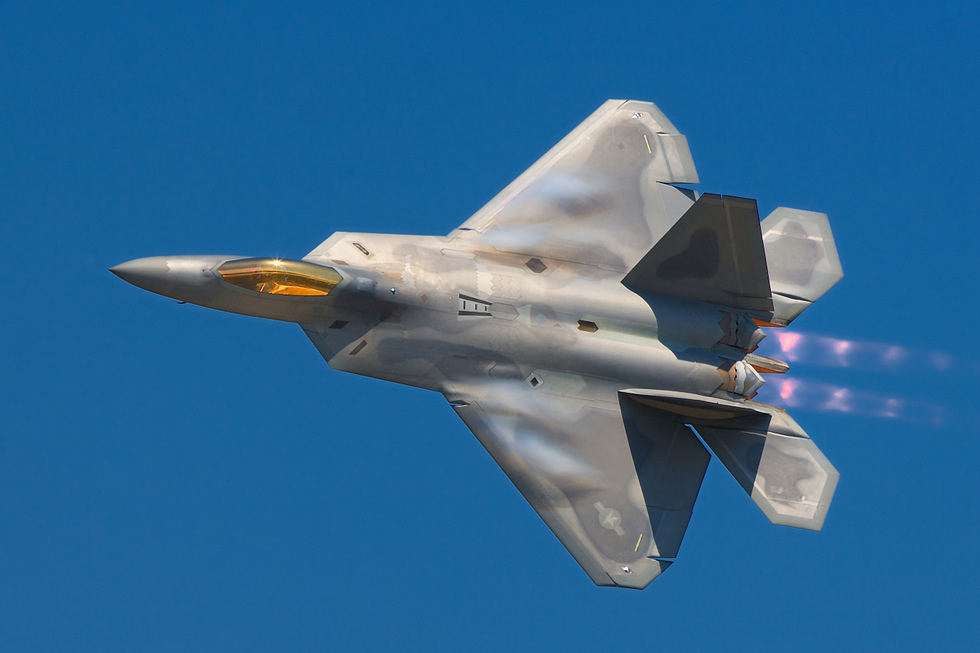
The F-22 Raptor in motion
A featured F-22 Raptor video — showcasing supercruise, high-alpha and thrust-vectoring maneuvers — is coming soon.
The F-22 Raptor in motion
DroneScapes — one of the most-watched F-22 Raptor films on YouTube.
Where the F-22 Raptor flies
The F-22 Raptor’s combat record
For all its dominance, the F-22 Raptor has never shot down an enemy fighter aircraft. Its combat debut, on 22 September 2014 over Syria, was an air-to-ground strike with GPS-guided JDAMs against ISIS targets near the Tishrin Dam. In deployments it has worked as an aerial “quarterback,” escorting strike packages and deterring adversary aircraft rather than fighting them.
The Raptor’s only air-to-air kills came in February 2023: on 4 February an F-22 downed the Chinese surveillance balloon off South Carolina with a single AIM-9X — likely the highest-altitude air-to-air kill on record — followed by two more high-altitude objects over Canada and Lake Huron. Compare the combat record of every military aircraft. Figures as of July 2026.
Everything people ask about the F-22 Raptor
Can I fly in an F-22 Raptor?
How fast is the F-22 Raptor?
Is the F-22 really stealthy?
Is the F-22 still in service?
Why were so few built, and why can’t other countries buy it?
Did the F-22 shoot down the Chinese balloon?
How many F-22s were built?
What’s the difference between the F-22 and the F-35?
You can’t fly the F-22.
These, you can.
Some legends only live in museums — others are fuelled and waiting. MiGFlug has put civilians in real military jet cockpits since 2004.
 Fly the L-39 AlbatrosThe world’s most-flown jet trainer — aerobatics included
 Fly the F-104 Starfighter“The missile with a man in it”
 Fly the MiG-21The Cold War’s most-produced jet
 Leťte s T-33 Shooting StarAmerica’s first jet trainer
 Fly the DH VampireA piece of early jet history
 Fly the S.211Agile Italian jet trainer
 Fly the MB-326The classic Aermacchi jet
 Fly the MiG-15The Soviet legend of the Korean War
Continue the tour
Every F-22 Raptor fact, checked
- U.S. Air Force — F-22 Raptor Fact SheetOfficial specifications, service history and role.
- GlobalSecurity.org — F-22 Raptor HistoryATF program origins and development timeline.
- Lockheed Martin — F-22 RaptorManufacturer overview of the aircraft and its systems.
- Military MachineF-22 combat record and operational deployments.
- Simple FlyingWhy the F-22 is banned from export.
- Air & Space Forces MagazineOngoing F-22 coverage, upgrades and the NGAD debate.
- The AviationistThe F-22’s initial combat operations against ISIS.
- National Security JournalThe F-22 as the only U.S. fifth-gen fighter that cannot be legally exported.