
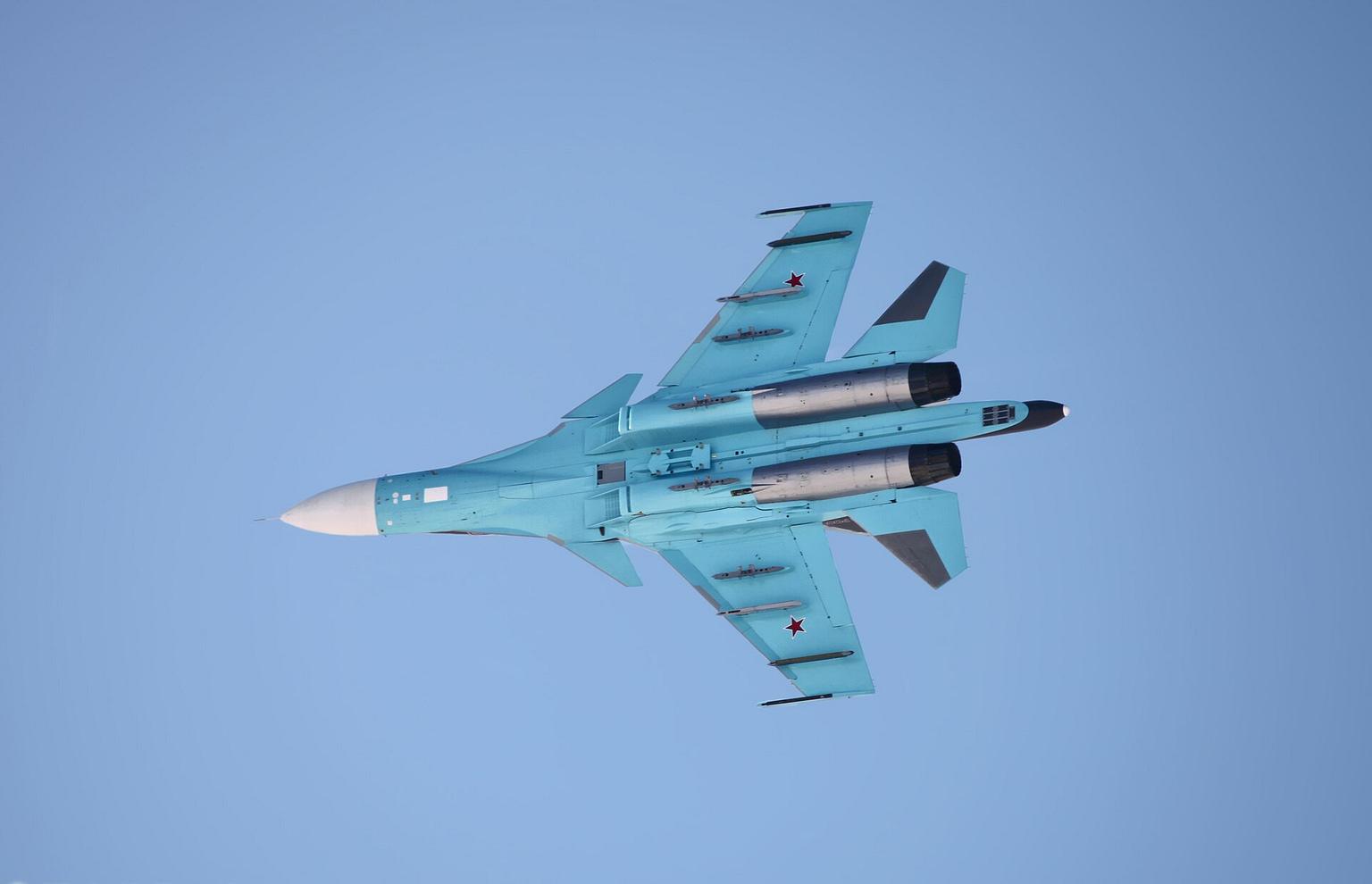
Sukhoi Su-34
“Fullback”
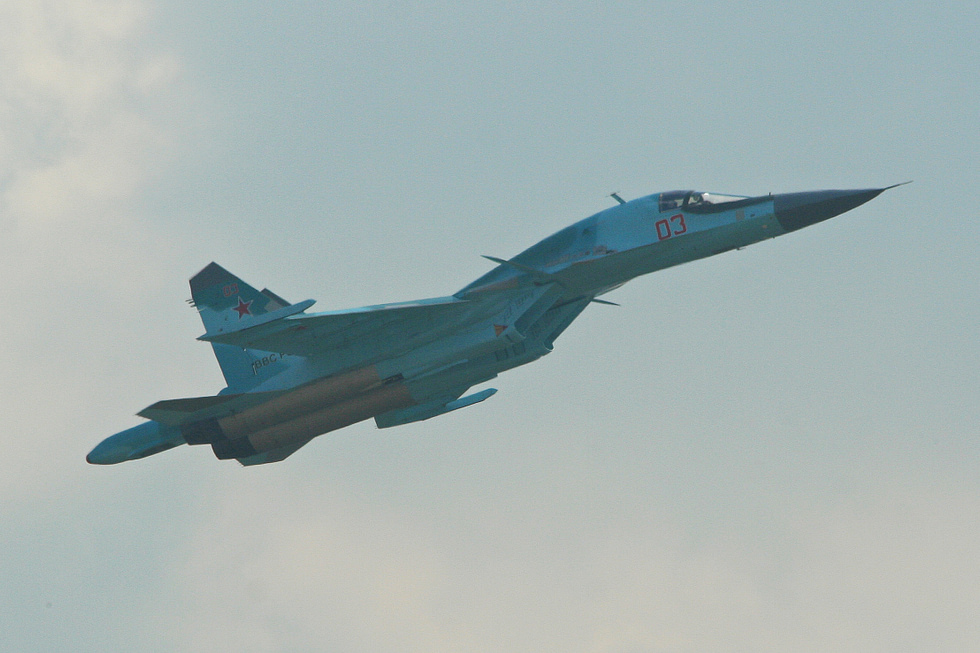
A Flanker rebuilt around a side-by-side armoured cockpit — Russia’s long-range strike bomber, and the workhorse of its glide-bomb campaign over Ukraine. This page presents its capabilities and combat record neutrally, sourced and hedged.
The Flanker that became a bomber
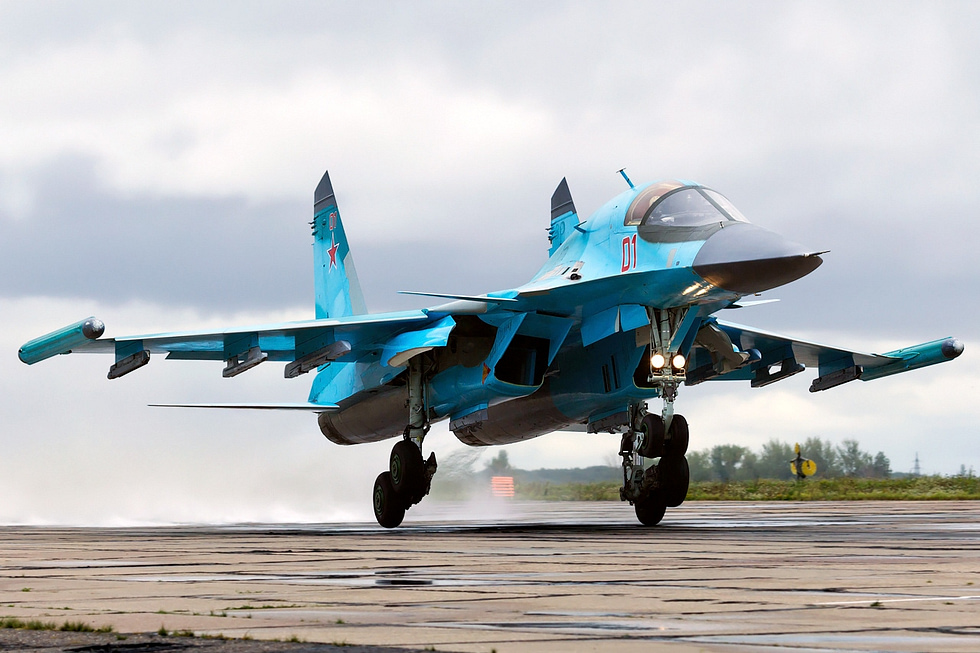
The Su-34 began in the mid-1980s as a Soviet effort to replace the ageing Su-24 “Fencer” swing-wing bomber. Rather than design a clean-sheet aircraft, the Sukhoi bureau took the aerodynamics of the Su-27 “Flanker” air-superiority fighter and grafted on an entirely new forward fuselage: a broad, flattened “duckbill” nose housing two crew side by side inside an armoured tub. Western observers first labelled it the Su-27KU; its real Soviet designation was Su-27IB (istrebitel-bombardirovshchik, fighter-bomber). The prototype first flew on 13 April 1990.
The programme then stalled for two decades. The collapse of the Soviet Union, chronic underfunding and a slow flight-test effort pushed the aircraft’s formal entry into Russian service all the way to 20 March 2014 — nearly a quarter-century after its first flight. By then it had been redesignated Su-34 and re-engineered around modern precision-strike avionics, the V004 radar and the Khibiny electronic-warfare system.
Its distinguishing idea is comfort and protection for long missions: a pressurised, side-by-side cockpit that lets a two-person crew fly extended sorties, reportedly with room to stand, a rudimentary galley and a toilet. Since 2022 the type has become the most visible tool of Russia’s air campaign over Ukraine — a role that has also made it a repeated target for Ukrainian air defences. Those competing sortie and shoot-down claims are presented here with caution: figures from both sides are contested.
01Why the Su-34 took 24 years to reach the front line
Few modern combat aircraft have had as long a gestation as the Su-34. First flown in 1990 as the Su-27IB, it was orphaned almost immediately by the disintegration of the Soviet defence budget. Development crawled through the 1990s on a handful of prototypes; a first production-standard airframe flew in 1994, but full-rate production at Novosibirsk only ramped up in the 2000s, and state trials were not completed until 2011. Formal service entry followed on 20 March 2014. The aircraft that finally emerged was substantially more capable than the 1990 prototype — but the timeline is a reminder that Russian claims about the type should be read against a long record of delay.
What makes the Su-34 special
An armoured, side-by-side cockpit
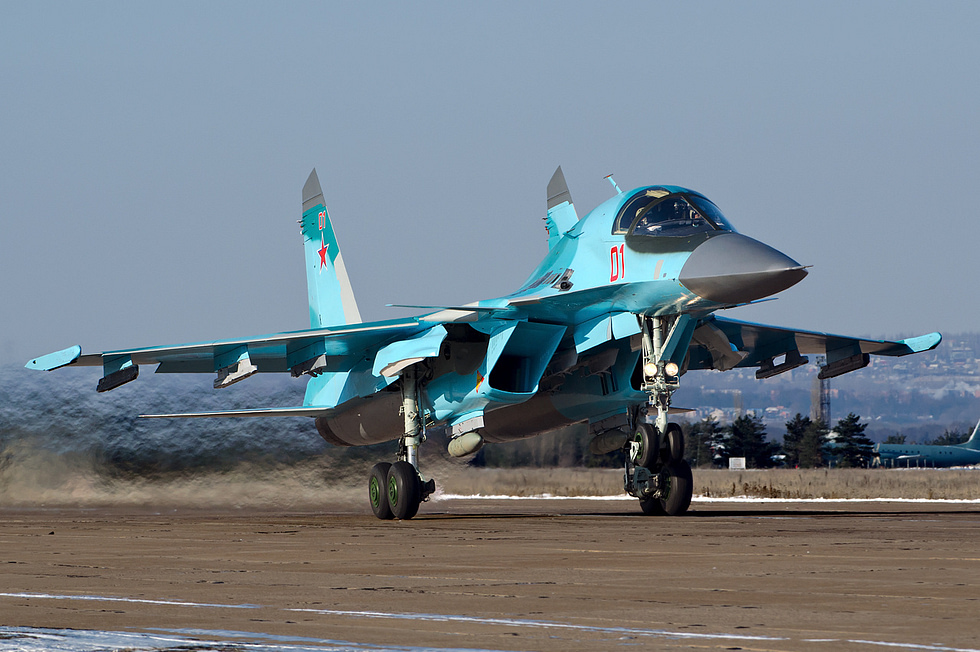
The Su-34’s crew of two sit shoulder to shoulder inside what Sukhoi describes as a continuous titanium armour capsule (about 17 mm). The cabin is pressurised enough to operate up to ~10,000 m without oxygen masks, and Russian sources say it offers space to stand, a hand-held urinal “toilet” and a vacuum-flask “galley” for long sorties. Crew enter through a hatch and ladder in the nose gear bay. How much the armour actually helps against modern air-defence missiles is unproven.
Heavy ordnance on twelve hardpoints
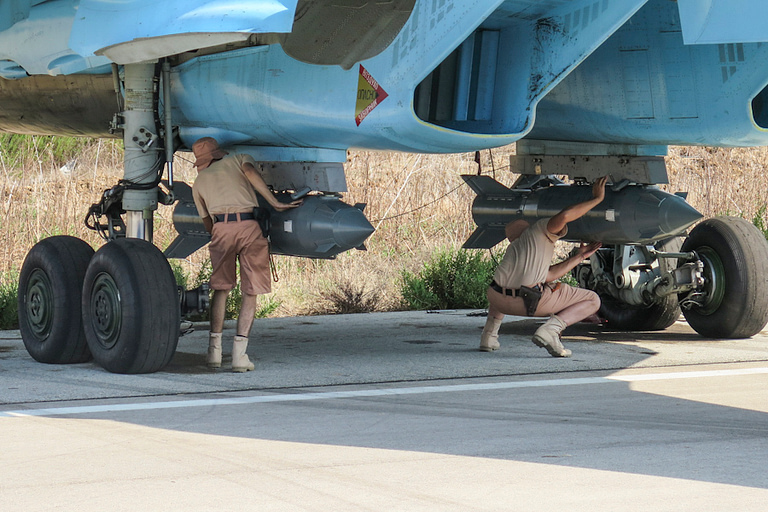
The Fullback carries its weapons on 12 external hardpoints. Russian figures cite a war load commonly given as ~8,000–12,000 kg (some sources claim up to 14,000 kg), spanning guided and unguided bombs, stand-off missiles and, since 2023, cheap glide bombs fitted with UMPK guidance kits. A single 30 mm GSh-30-1 cannon is fitted. Real-world loads flown in combat are typically far below the theoretical maximum.
Range, engines and self-defence
Two Saturn AL-31FM1 afterburning turbofans (about 132 kN / ~13,500 kgf each) give a top speed near Mach 1.8 and a ferry range around 4,500 km, extendable by in-flight refuelling. For survivability the type carries the Khibiny jamming system as standard; the modernised Su-34M adds a rear-facing radar intended to warn of missiles approaching from behind. Their effectiveness in the Ukraine war is disputed.
02The Su-34’s low-level dilemma: why a strike bomber flew into danger
For the first year of the 2022 invasion the Su-34 lacked large numbers of precision stand-off weapons, so to hit targets accurately it reportedly had to fly low — straight into the reach of Ukrainian man-portable and medium-range surface-to-air missiles. That exposure is widely cited as the reason a well-protected aircraft nonetheless suffered repeated losses. The 2023 arrival of the UMPK glide-bomb kit, which lets the aircraft toss a winged bomb from tens of kilometres away while staying behind its own lines, changed the tactic — though Ukraine has continued to claim shoot-downs. All of these tactical accounts rest heavily on wartime reporting and should be treated as provisional.
03The Su-34’s engines and range: a genuinely long-legged strike aircraft
The Fullback’s two AL-31FM1 turbofans are a modest evolution of the engine that powers the Su-27, tuned for the heavier strike airframe. What sets the Su-34 apart from most tactical bombers is fuel: a large internal capacity plus air-to-air refuelling give a ferry range commonly cited around 4,500 km and a combat radius near 1,100 km with a heavy load. This is what lets the type loiter and strike across the full depth of a theatre. As with all its performance figures, the numbers come largely from the manufacturer and should be read as nominal rather than independently verified.
Full Su-34 specifications
Airframe & Performance
- Posádka
- 2 (side by side)
- Délka
- ~23.34 m
- Rozpětí křídel
- ~14.7 m
- Výška
- ~6.09 m
- Prázdná hmotnost
- ~22,500 kg
- Max takeoff weight
- ~45,100 kg
- Max speed
- ~Mach 1.8 (1,900 km/h at altitude)
- Bojový rádius
- ~1,100 km (heavy load)
- Ferry range
- ~4,500 km (refuelling-capable)
- Servisní strop
- ~17,000 m
Propulsion & Systems
- Engines
- 2 × Saturn AL-31FM1
- Thrust (each)
- ~132 kN / ~13,500 kgf with afterburner
- Radar
- Leninets V004 (rear-facing radar on Su-34M)
- Cannon
- 1 × 30 mm GSh-30-1 (180 rounds)
- Závěsné body
- 12
- Ordnance
- ~8,000–12,000 kg (claimed)
- First flight
- 13 April 1990 (as Su-27IB)
- Service entry
- 20 March 2014
- Built
- ~160+ (7 test + ~156 serial, early 2024)
- Unit cost
- ~$36 million (widely cited estimate)
04The Su-34’s cost: why the price tag is only an estimate
Because the Su-34 is a state product bought by the Russian military on domestic contracts, no audited flyaway price exists in open sources. A figure of roughly $36 million per aircraft is widely repeated, drawn from Russian contract totals divided by aircraft counts and converted at various exchange rates — it should be read as an order-of-magnitude estimate, not a firm number. No reliable public cost-per-flight-hour figure exists either. Export deals, such as Algeria’s reported Su-34ME contract, are quoted with secret pricing, so even the export cost is not independently confirmed.
From Su-27IB prototype to frontline bomber
Programme begins
Sukhoi starts work on the T-10V / Su-27IB, a Flanker-derived side-by-side bomber to replace the Su-24.
First flight
The prototype flies on 13 April 1990 with test pilot Anatoliy Ivanov at the controls.
Production standard
The first production-standard airframe flies; the type is redesignated Su-34, but funding stalls the programme.
Enters service
After long delays and completed state trials, the Su-34 formally enters Russian Aerospace Forces service on 20 March.
Syria deployment
Su-34s deploy to Latakia and fly strikes in Syria — the type’s combat debut. Damage claims varied.
Ukraine invasion
The Su-34 becomes Russia’s principal tactical bomber over Ukraine; both sides make contested loss claims.
Glide bombs
UMPK-kitted glide bombs let the Su-34 strike from stand-off range, reshaping its role in the war.
Losses & export
Modernised Su-34Ms remain in heavy use amid documented combat losses; Algeria reportedly receives its first Su-34ME aircraft.
Twelve stories about the Su-34 Fullback
Replacing the Fencer
The Su-34 was conceived to replace the Su-24 swing-wing bomber with a Flanker-based airframe.
Read the full story
The “duckling” nose
The Su-34’s flattened duckbill nose earned it nicknames like Duckling, Hellduck and Platypus.
Read the full story
An armoured tub for two
The cockpit is built as a continuous titanium armour capsule roughly 17 mm thick.
Read the full story
A galley and a toilet
For long sorties, Russian sources say the Su-34 offers room to stand, a rudimentary galley and a toilet.
Read the full story
Twenty-four years to the front
First flown in 1990, the Su-34 did not formally enter service until 2014.
Read the full story
Combat debut
Su-34s deployed to Syria in 2015 and flew strike missions; battle-damage claims were hard to verify.
Read the full story
The strike workhorse
Since 2022 the Su-34 has been Russia’s most-used tactical bomber over Ukraine.
Read the full story
The glide-bomb turn
From 2023, cheap UMPK glide-bomb kits let the Su-34 strike from behind the front line.
Read the full story
A hard war on the fleet
Multiple independent trackers have documented a significant number of Su-34 losses since 2022.
Read the full story
The modernised Fullback
The upgraded Su-34M added new sensors, including a rear-facing radar to warn of missiles.
Read the full story
Algeria’s Fullbacks
Algeria reportedly ordered the Su-34ME and began receiving its first aircraft.
Read the full story
A costly peacetime record too
Beyond combat, the Su-34 fleet has suffered a string of accidents.
Read the full story
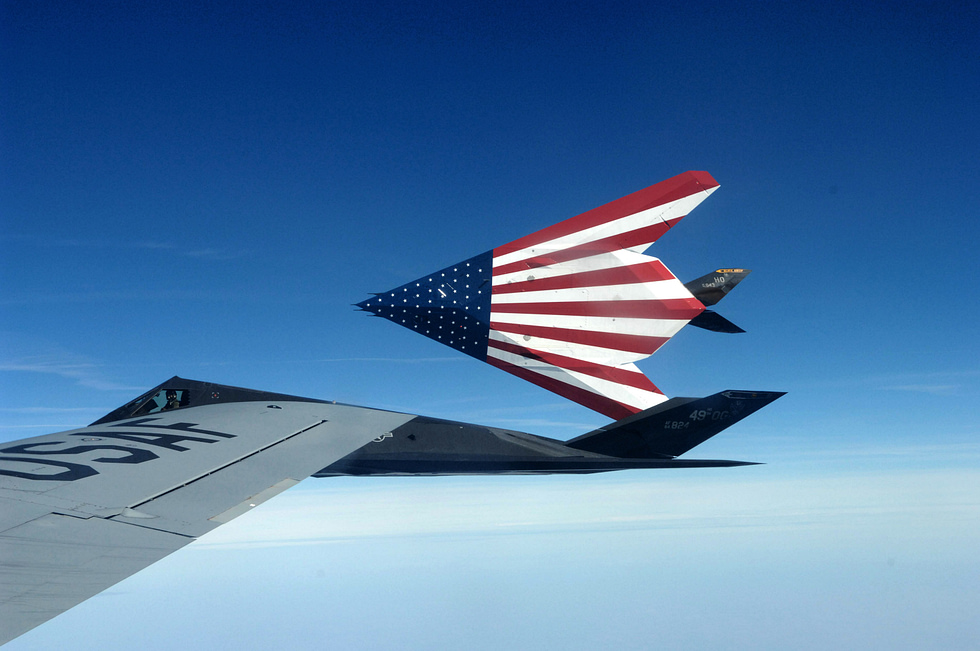
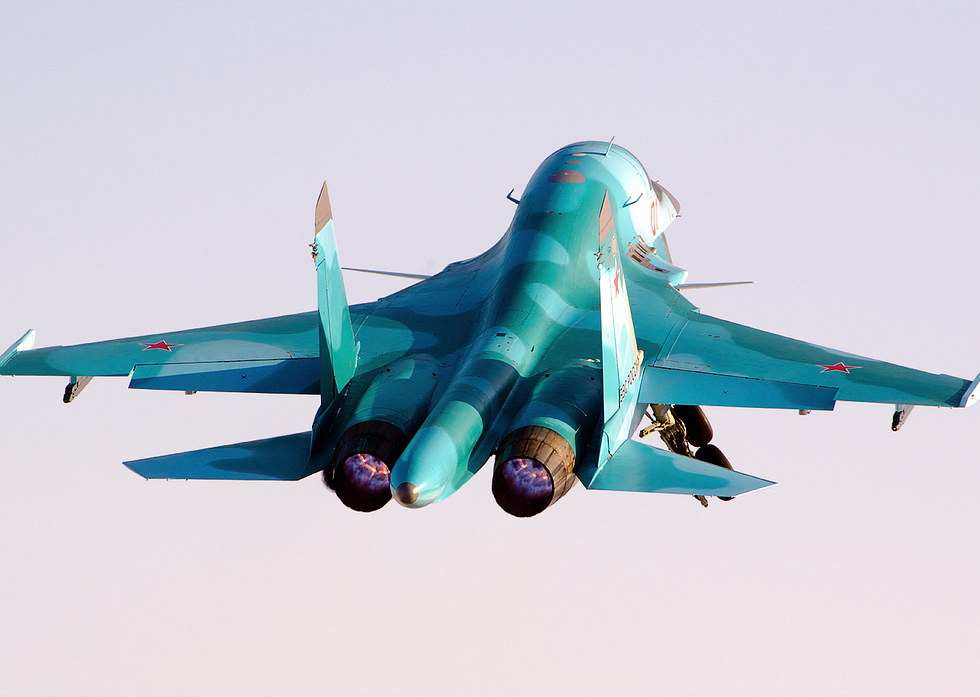
The Su-34 Fullback in pictures
The Su-34 Fullback in motion
A curated Su-34 video is coming soon. In the meantime, explore the gallery above and the full combat and technical record below.
The Su-34 Fullback in motion
Found And Explained — one of the most-watched Su-34 Fullback films on YouTube.
Where the Su-34 Fullback operates
A contested combat record
The Su-34 is an active combat aircraft, and its record is being written in real time in a war where both sides publish figures that serve their own narratives. Russia emphasises the scale of its strike sorties and glide-bomb campaign; Ukraine emphasises the number of Fullbacks it has shot down. The claims below are therefore hedged deliberately — treat every tally, from either side, as contested.
Independent trackers that count only visually confirmed cases have logged losses in the mid-tens since February 2022; Ukrainian official claims run higher and Russian acknowledgements lower. Compare the combat record of every military aircraft. Figures as of July 2026 and subject to change.
Everything people ask about the Su-34
Can I fly in a Su-34?
What is the Su-34?
How much can the Su-34 carry?
Is the Su-34 really armoured?
How many Su-34s has Russia lost in Ukraine?
What are the glide bombs the Su-34 drops?
Who operates the Su-34?
Is the Su-34 still in production and service?
You can’t fly the Su-34.
These, you can.
Some legends only live in museums — others are fuelled and waiting. MiGFlug has put civilians in real military jet cockpits since 2004.
 Fly the L-39 AlbatrosThe world’s most-flown jet trainer — aerobatics included
 Fly the F-104 Starfighter“The missile with a man in it”
 Fly the MiG-21The Cold War’s most-produced jet
 Leťte s T-33 Shooting StarAmerica’s first jet trainer
 Fly the DH VampireA piece of early jet history
 Fly the S.211Agile Italian jet trainer
 Fly the MB-326The classic Aermacchi jet
 Fly the MiG-15The Soviet legend of the Korean War
Continue the tour
Every fact, checked
- Airforce Technology — Su-34 (Su-32) FullbackTechnical overview of the airframe, systems and armament.
- Military Factory — Sukhoi Su-34Specifications, development history and variants.
- Oryx — visually-confirmed loss documentationOpen-source tracking of confirmed Russian equipment losses, including Su-34s.
- National Security JournalAnalysis of Su-34 losses and the type’s vulnerabilities over Ukraine.
- Military Watch MagazineReporting on Algeria’s reported Su-34ME deliveries and export status.
- Defense ExpressUkrainian defence outlet on Su-34 combat use and Algerian deliveries (read alongside Russian sources).
- 19FortyFiveCoverage of Su-34 production, modernisation and wartime attrition.
- AeroCorner — Su-34 / Su-32Reference specifications and photographs.