
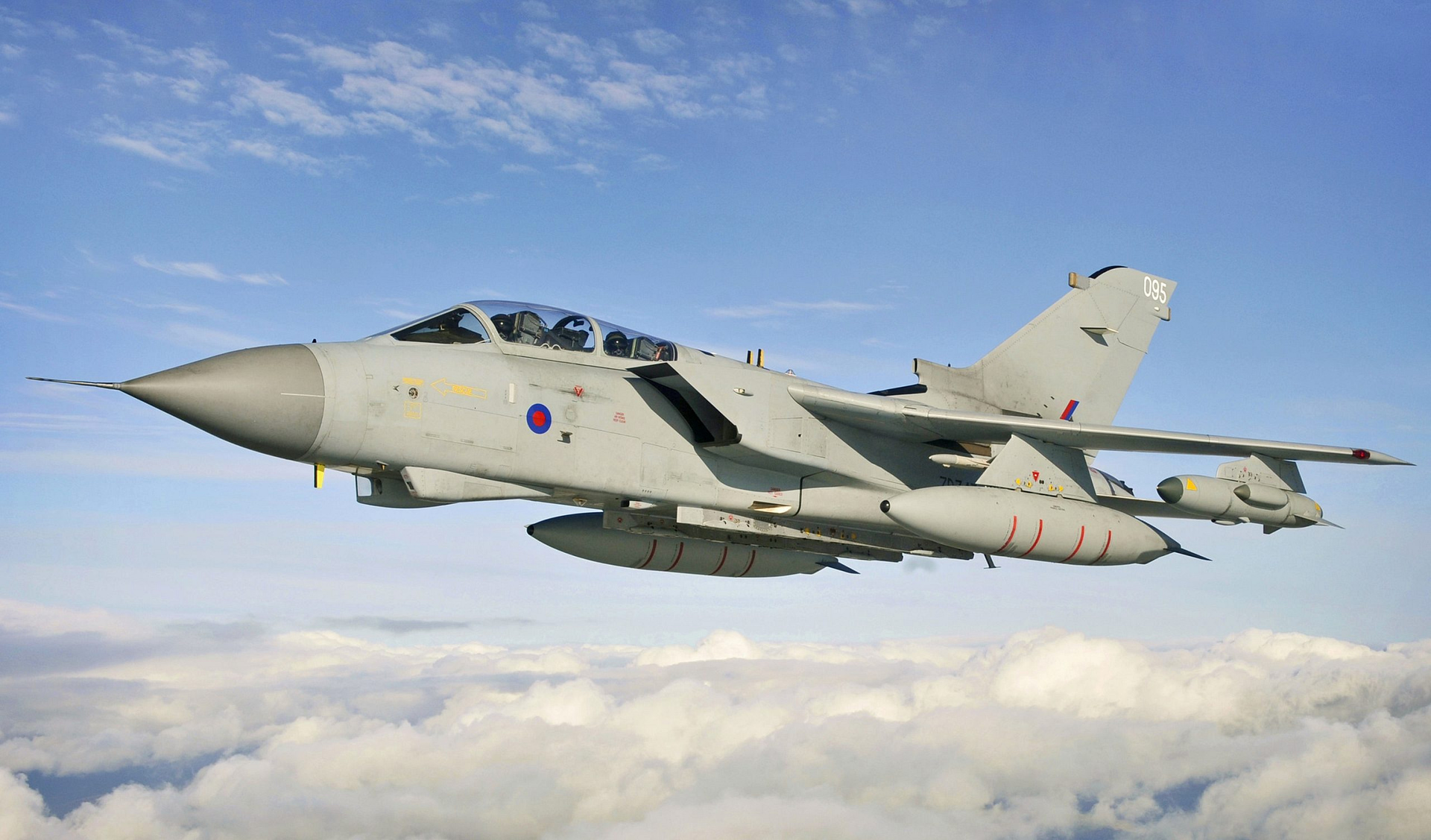
Panavia Tornado
IDS · ADV · ECR
Europe’s Cold War strike jet — a tri-national, variable-geometry swing-wing bomber built to punch through Warsaw Pact defences at treetop height and hit its target on the first pass, in any weather, day or night.
One jet, three nations, a whole continent to defend
By the late 1960s, several European air forces faced the same problem and none could afford to solve it alone. Britain, West Germany and Italy all needed a fast, all-weather strike aircraft able to fly under Soviet radar, cross the Iron Curtain at low level and hit airfields and bridges deep in Warsaw Pact territory. In 1968 they launched the Multi-Role Combat Aircraft (MRCA) programme, and in 1969 founded Panavia Aircraft GmbH — a consortium of British, German and Italian firms — to build it.
The answer was the Tornado: a compact, two-seat jet with a variable-geometry “swing” wing that spread wide for slow, short-field takeoff and swept back sharply for a Mach-capable low-level dash. The prototype first flew from Manching, Germany, on 14 August 1974, and the type entered service with the RAF and Luftwaffe in 1979–80. Roughly 990 were built before production ended in 1998.
Two very different families grew from the same airframe. The IDS (Interdictor/Strike) — the RAF’s GR1 and later GR4 — was the low-level bomber the programme was really about. From it Britain developed the stretched ADV (Air Defence Variant), the Tornado F3 interceptor built to guard UK airspace, while Germany and Italy fielded the ECR for radar-hunting defence suppression. The Tornado went on to fight in every major Western air campaign from 1991 to 2019.
01Why the Panavia Tornado was almost impossible to build — and got built anyway
A three-nation weapons programme is a political minefield: every partner wants work-share, a say in the design, and an aircraft tuned to its own doctrine. The MRCA nearly collapsed several times — the Netherlands, Belgium and Canada dropped out early, and Britain, Germany and Italy each wanted something slightly different. The compromise was a single flexible airframe that could be a low-level strike bomber, an interceptor or a defence-suppression platform depending on the fit-out.
Work was split by stake: Britain and West Germany held 42.5% each, Italy 15%, mirrored in the engine consortium Turbo-Union. That the partners delivered a genuinely capable aircraft — on a scale no single European nation could have managed — made the Tornado the template for later joint programmes like the Eurofighter Typhoon and the A400M.
What makes the Tornado special
The variable-geometry “swing” wing
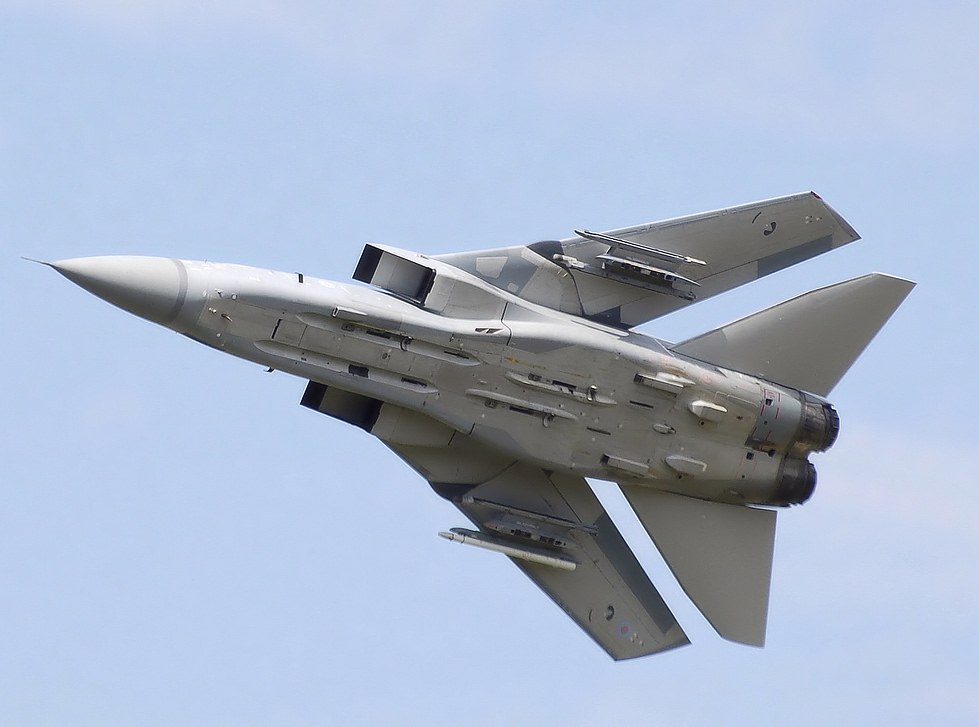
The Tornado’s wings pivot in flight from about 25° spread to 67° swept. Spread wide, the wing gives the lift and low speed needed to operate from short, damaged runways; swept back, it becomes a clean, low-drag dart for a high-speed run at treetop height. One airframe therefore does two contradictory jobs — short-field flexibility and a stable, punishing low-level dash — that a fixed wing cannot.
Terrain-following, blind first-pass attack
The strike Tornado pairs a ground-mapping radar with a dedicated terrain-following radar, letting it fly automatically at 60 m in cloud, fog or dark while hugging the contours of the ground. Coupled to an inertial navigation and computing system, it was built to reach a target it had never seen and hit it accurately on the first pass, in any weather — the core promise of the whole programme.
Twin RB199 turbofans with thrust reverser
Power comes from two Turbo-Union RB199 three-shaft afterburning turbofans — a compact, fuel-efficient design giving roughly 71 kN each in reheat. Uniquely for a fighter, the RB199 has an integrated thrust reverser, so the Tornado can slam to a stop on a short, wet or battle-damaged strip — a decisive advantage for an aircraft meant to keep flying after its airfields were hit.
02The Tornado’s two-man crew: why the navigator mattered as much as the pilot
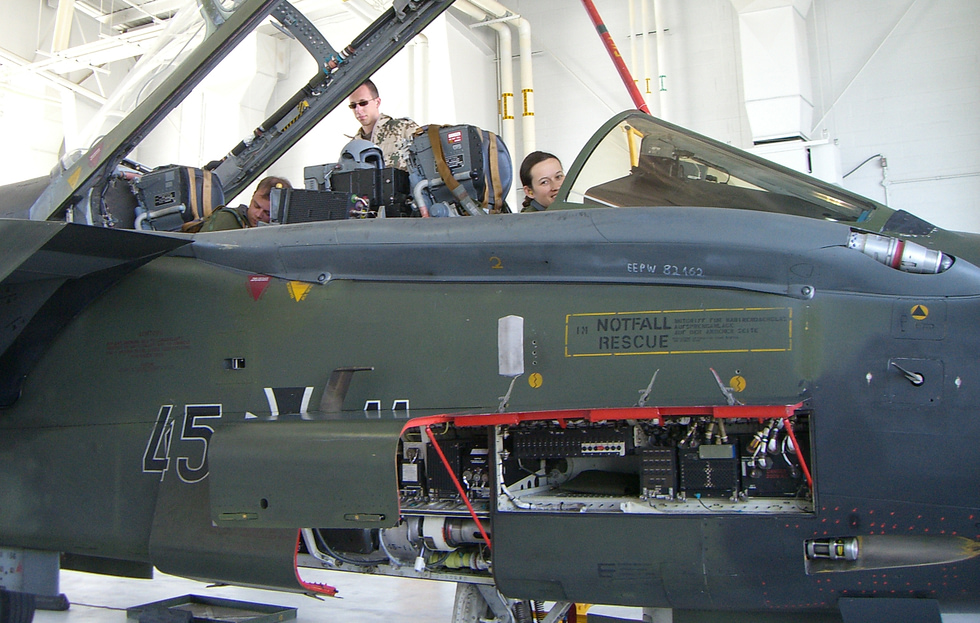
The Tornado was always a two-seat aircraft: a pilot in front and a navigator (in RAF service, the “nav”; elsewhere a weapon systems officer) behind. Low-level all-weather strike is a two-person job — at 900 km/h and 60 m, one crew member flies the jet while the other runs the radar, navigation, targeting and defensive systems. The back-seater managed the terrain-following approach, found and designated the target, and worked the electronic-warfare kit, freeing the pilot to concentrate on not flying into the ground. It is a division of labour the single-seat strike fighters that replaced the Tornado now hand to software.
03IDS, ADV and ECR: three Tornados from one airframe
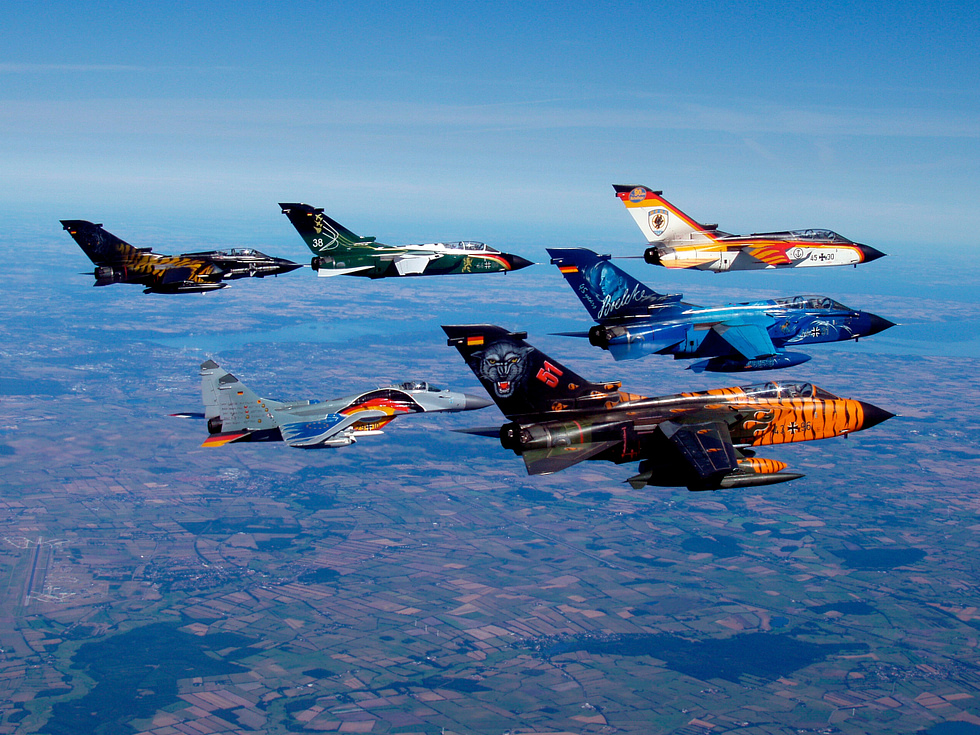
El IDS (Interdictor/Strike) is the original low-level bomber — the RAF’s Tornado GR1, later upgraded to the GR4, plus the German, Italian and Saudi strike jets. The ADV (Air Defence Variant), the RAF’s Tornado F3, is a stretched interceptor with a longer fuselage, a bigger radar and long-range missiles, built to defend UK airspace against Soviet bombers rather than to attack ground targets. The ECR (Electronic Combat/Reconnaissance) is a German and Italian defence-suppression variant that hunts enemy radars with anti-radiation missiles. Same wing, same engines — three very different missions.
Full specifications — Tornado IDS
Airframe & Performance
- Multitud
- 2 (pilot + navigator)
- Longitud
- 16.72 m
- Envergadura
- 13.91 m spread · 8.60 m swept
- Altura
- 5.95 m
- Max takeoff weight
- ~28,000 kg
- Max speed
- Mach 2.2 · ~2,400 km/h at altitude
- Techo de servicio
- ~15,240 m (~50,000 ft)
- Radio de combate
- ~1,390 km (hi-lo-hi strike)
- Ferry range
- ~3,890 km
Propulsion & Systems
- Engines
- 2 × Turbo-Union RB199-34R
- Thrust (each)
- ~40 kN dry · ~71 kN reheat
- Radar
- Ground-mapping + terrain-following
- Cannon
- 2 × 27 mm Mauser BK-27 (GR: 1)
- Strike weapons
- JP233, Storm Shadow, ALARM, Brimstone, Paveway
- First flight
- 14 August 1974
- Built
- ~990 (+11 prototypes), 1979–1998
- Unit cost
- ~£17–20 million (GR4-era estimate)
- Cost per flight hour
- No reliable public figure
04What did a Tornado cost to buy and fly?
Because the Tornado was a government-to-government programme delivered across three nations over two decades, no single clean flyaway price exists in the public record. Contemporary estimates for the upgraded RAF GR4 put the airframe in the region of £17–20 million, but the figure varies widely with fit, batch and how development costs are shared out. Operating costs are similarly hard to pin down: a twin-engine, two-crew jet with a heavy maintenance burden is expensive to run, and published cost-per-flight-hour numbers are inconsistent. Treat any precise dollar or pound figure attached to a Tornado as an estimate, not a sourced fact.
From Cold-War compromise to last combat sortie
The MRCA is launched
Britain, West Germany and Italy agree to jointly develop a Multi-Role Combat Aircraft after larger European programmes collapse.
Panavia is founded
Panavia Aircraft GmbH and the Turbo-Union engine consortium form, splitting work 42.5/42.5/15 between the UK, Germany and Italy.
First flight
The first prototype flies from Manching, Germany, on 14 August — the swing-wing MRCA finally in the air.
Enters service
The Tornado IDS enters RAF and Luftwaffe service; Italy follows in 1981. The strike variant reaches the front line.
The F3 interceptor
The stretched Air Defence Variant, the Tornado F3, enters RAF service to guard UK airspace against Soviet bombers.
Combat debut — the Gulf War
RAF, Italian and Saudi Tornados fly low-level strikes against Iraqi airfields; six RAF GR1s are lost in the campaign.
Kosovo to Libya
Tornados strike in Kosovo (1999) and Iraq (2003), then fire Storm Shadow cruise missiles over Libya in 2011.
Anti-ISIS & RAF retirement
RAF GR4s fly precision Brimstone and Paveway strikes against ISIS, then retire in 2019 after 40 years. Germany, Italy and Saudi Arabia fly on.
From the cockpit: twelve Tornado stories
The jet nobody could build alone
Britain, Germany and Italy pooled money and industry to build a strike jet none could afford solo.
Read the full story
The swing-wing bargain
Wings that spread for short runways and swept back for a Mach low-level dash.
Read the full story
Airborne over Bavaria
The first Tornado prototype flew from Manching, Germany, on 14 August 1974.
Read the full story
Down in the weeds with JP233
On the first nights of Desert Storm, RAF Tornados attacked Iraqi airfields at extreme low level.
Read the full story
Buddy-lasing with the Buccaneer
Once the Iraqi threat eased, Tornados climbed to medium level and bombed with laser guidance.
Read the full story
The F3 that guarded Britain
The stretched Tornado F3 stood alert for decades against Soviet and Russian bombers.
Read the full story
The radar-hunting ECR
Germany and Italy fielded the ECR to find and kill enemy air-defence radars.
Read the full story
Over Kosovo
Italian, German and British Tornados flew strike and SEAD missions in the 1999 Kosovo campaign.
Read the full story
3,000 miles to strike
RAF Tornados flew from England to Libya and back to fire Storm Shadow cruise missiles.
Read the full story
Precision to the last
In its final campaign the Tornado struck ISIS with Brimstone and Paveway to minimise civilian harm.
Read the full story
The Saudi Tornados
Saudi Arabia became the largest export operator and has used the type in combat.
Read the full story
Farewell to the Tonka
After 40 years the RAF retired the Tornado in 2019; Germany and Italy fly on.
Read the full story
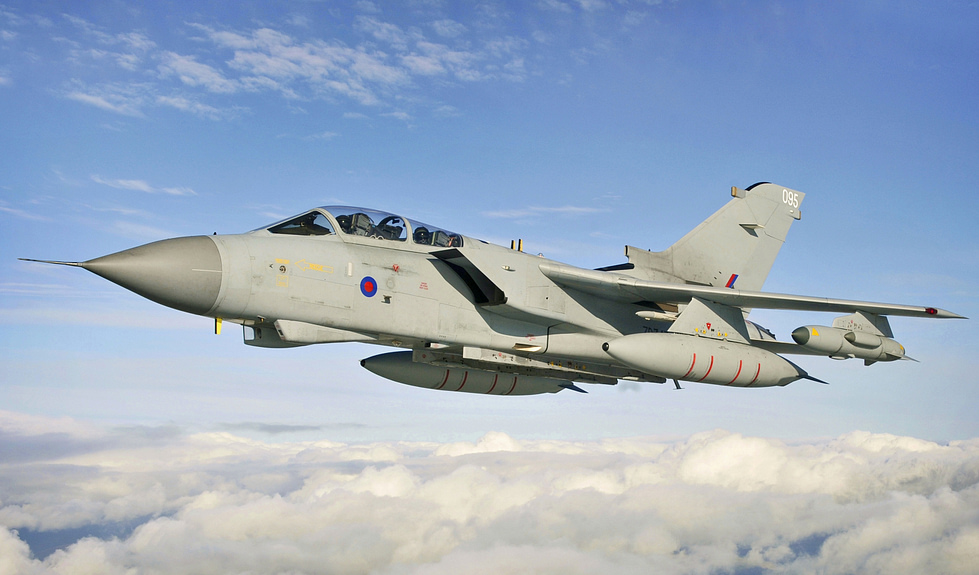
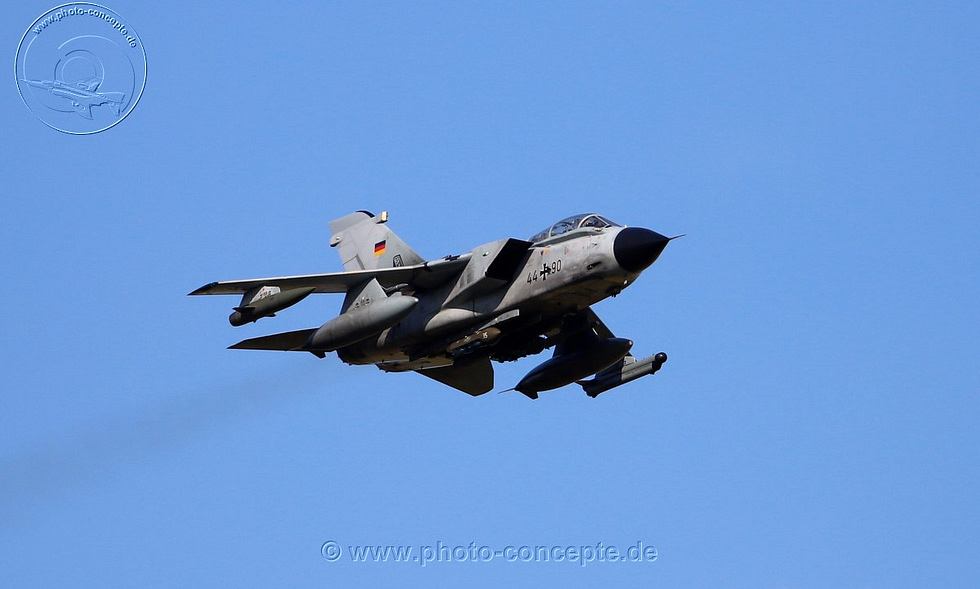
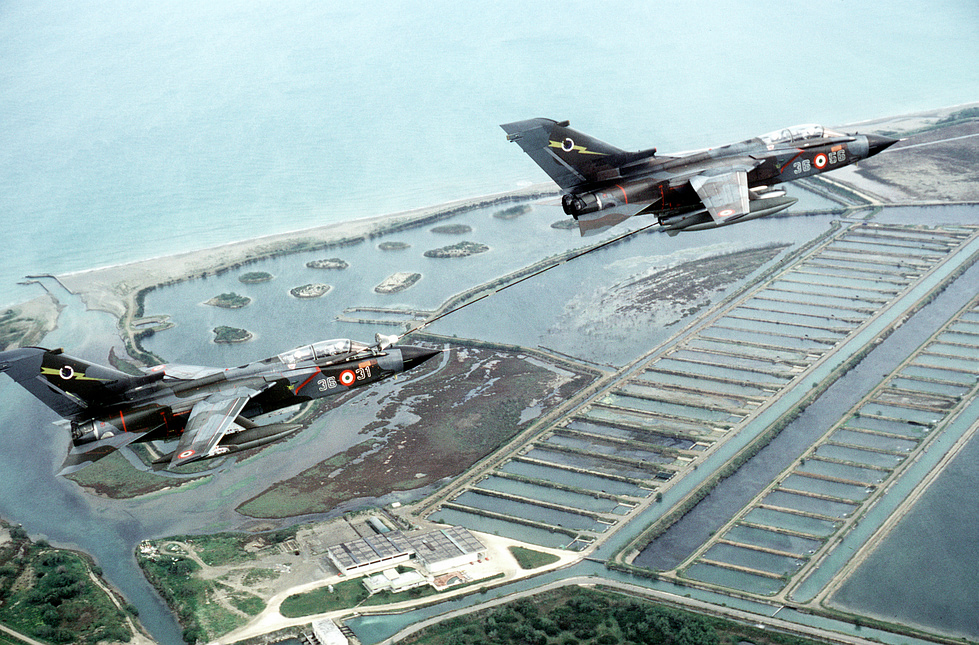
The Tornado in pictures
The Tornado in motion
Video coming soon. A curated Panavia Tornado documentary embed will be added here — low-level swing-wing footage, RB199 reheat departures and the type’s combat history.
The Tornado ADV in motion
Imperial War Museums — one of the most-watched Tornado ADV films on YouTube.
Where the Tornado flew
The score that defines it
The Tornado was a bomber, not a dogfighter — its record is written in strike missions, not air-to-air kills. Across nearly three decades it flew in every major Western air campaign, evolving from a Cold-War runway-cratering bomber into a precision-strike aircraft. Its most dangerous days were the low-level airfield attacks of the 1991 Gulf War; its most refined, the discriminating anti-ISIS strikes that closed its RAF career.
Compare the combat record of every military aircraft. Figures as of July 2026 and, for contested actions, reported rather than confirmed.
Everything people ask about the Tornado
Can I fly in a Tornado?
How fast is the Tornado?
Why does the Tornado have swing wings?
What is the difference between the IDS, GR4, ADV/F3 and ECR?
What weapons did the Tornado carry?
Is the Tornado still in service?
What replaced the Tornado?
You can’t fly the Tornado.
These, you can.
Some legends only live in museums — others are fuelled and waiting. MiGFlug has put civilians in real military jet cockpits since 2004.
 Fly the L-39 AlbatrosThe world’s most-flown jet trainer — aerobatics included
 Fly the F-104 Starfighter“The missile with a man in it”
 Fly the MiG-21The Cold War’s most-produced jet
 Vuela el T-33 Shooting StarAmerica’s first jet trainer
 Fly the DH VampireA piece of early jet history
 Fly the S.211Agile Italian jet trainer
 Fly the MB-326The classic Aermacchi jet
 Fly the MiG-15The Soviet legend of the Korean War
Continue the tour
Every fact, checked
- The Aviationist — Panavia TornadoOverview of the programme, variants and operational history.
- MTU Aeroreport — Fifty years of the TornadoThe RB199 engine, the Turbo-Union consortium and the thrust reverser.
- Global Aviation Resource — Farewell Tornado (Gulf War)First-hand account of the 1991 JP233 low-level attacks and the shift to medium level.
- FlightGlobal — How the RAF’s Tornados made a storming contributionGR4 combat record: Libya, Afghanistan, anti-ISIS and the 2019 retirement.
- The War Zone — British Tornados and the JP233The runway-denial weapon and the danger of the low-level airfield attacks.
- Imperial War Museums — RAF Tornados in the Gulf WarThe Tornado’s role and losses in the 1991 air campaign.
- RAF Air Historical Branch — First Gulf War studyOfficial RAF analysis of Tornado operations and lessons from 1990–91.
- Fighter-Planes.com — Panavia Tornado IDS/ADV/ECRReference specifications and variant breakdown.