
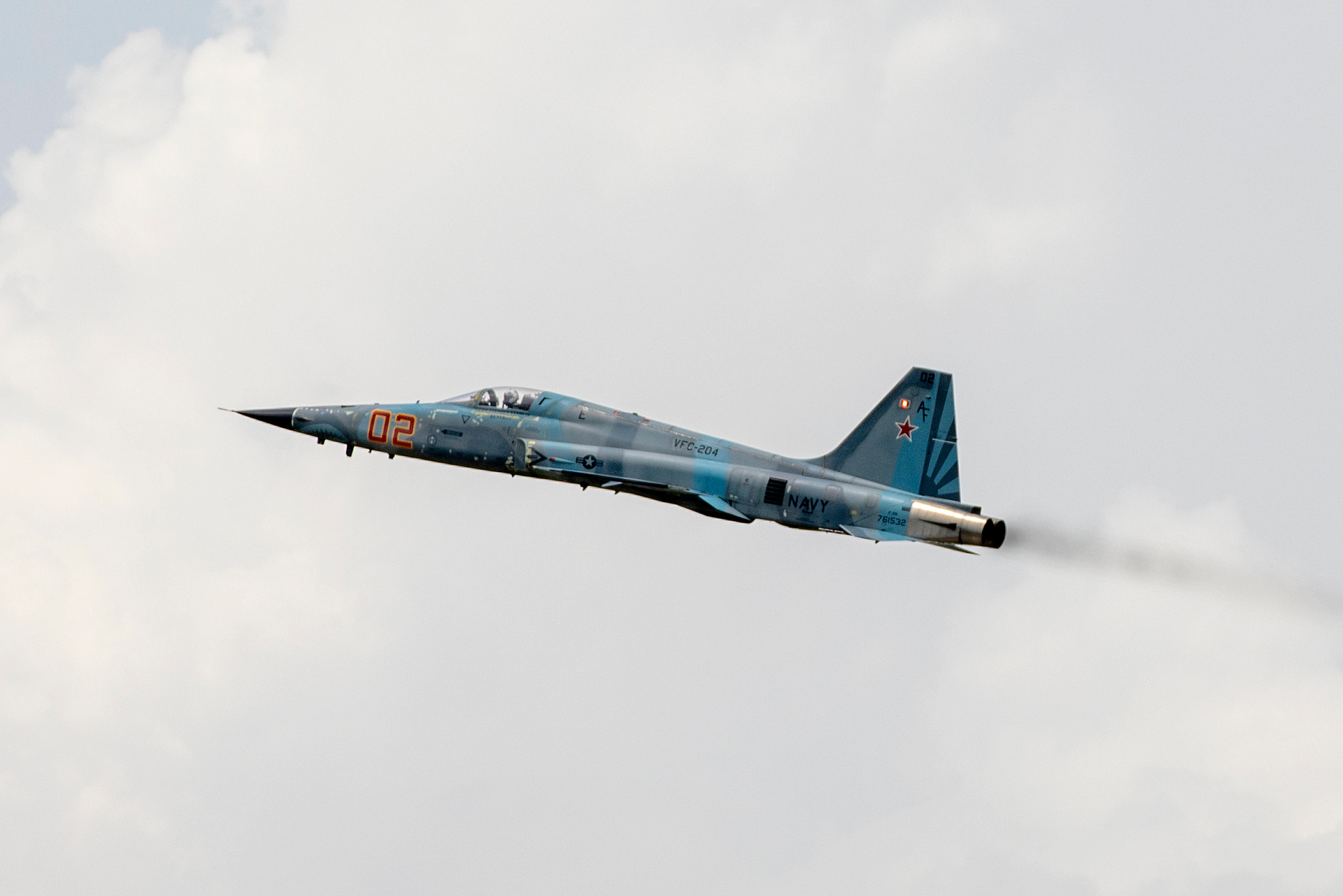
Northrop F-5
“Freedom Fighter / Tiger II”
The cheap, small, twin-engined fighter Northrop built for America’s allies — so nimble and MiG-like that it became the West’s favourite pretend enemy, from TOPGUN to Swiss aerobatics, and it is still flying in the 2020s.
The little fighter that armed the free world
In the mid-1950s a Northrop team toured NATO and SEATO countries and came home with a simple observation: America’s allies needed a jet fighter they could actually afford, fly and maintain. The heavyweight Century-series fighters were too costly and too complex. Northrop’s answer was the N-156 — a small, light, twin-engined supersonic fighter designed around cost and simplicity rather than raw performance.
The single-seat fighter first flew on 30 July 1959, and in 1962 the US Department of Defense picked it for the Military Assistance Program as the F-5A Freedom Fighter. It entered service in 1964, with the first examples delivered to Iran in early 1965. A two-seat trainer version of the same airframe became the T-38 Talon, which still trains US Air Force pilots today. Over the following decades the F-5 was built in the thousands and licence-produced in Canada, Spain, Switzerland, South Korea and Taiwan.
An improved model, the F-5E Tiger II, won the US International Fighter Aircraft competition in 1970 and first flew in 1972 — better engines, a better wing and a real radar. But the F-5’s strangest career was at home: its small size and MiG-like handling made it the perfect aggressor, the stand-in Soviet fighter that trained a generation of Western pilots and starred as the “MiG-28” in Top Gun. Upgraded Tigers still fly frontline and adversary missions into the 2020s.
01Why Northrop built a “cheap” fighter — and why that turned out to be genius
Most 1950s fighter design chased speed and altitude at any price. Northrop’s designers went the other way. They wrapped two small General Electric J85 turbojets — originally developed for a decoy drone — in the smallest, lightest airframe that could still go supersonic. The result weighed a fraction of its contemporaries, cost far less to buy and to run, and could operate from short, rough runways with minimal support.
That frugality is exactly why the F-5 succeeded where flashier jets did not. It could be given or sold cheaply to dozens of allied air forces under the Military Assistance Program, kept flying by modest maintenance crews, and later operated in large numbers as a training adversary at a fraction of the cost of a real frontline fighter. The “compromise” fighter became one of the most widely operated jets of the Cold War.
What makes the F-5 special
Two small engines, a very light airframe
The F-5 is tiny by fighter standards — an empty weight around 4.4 tonnes and a max takeoff weight of only about 11 tonnes. Power comes from two General Electric J85 afterburning turbojets, roughly 22 kN each in the Tiger II. The combination of light weight, a slim area-ruled fuselage and modest but efficient thrust gave the F-5 genuine agility, a small radar and visual signature, and honest supersonic performance to about Mach 1.6.
Affordable — and everywhere
The F-5 was designed to be cheap to buy and cheap to run. Simple systems, easy maintenance and short-field capability made it ideal for the US Military Assistance Program, and it was licence-built in Canada, Spain, Switzerland, South Korea and Taiwan. More than 2,600 F-5 fighters were produced (plus around 1,200 T-38 trainers), and it flew — and still flies — with dozens of air forces around the world.
The perfect pretend MiG
The F-5’s size and handling were uncannily close to the MiG-21 it was meant to fight. That made it the ideal aggressor aircraft for dissimilar air combat training. From the 1970s the USAF, US Navy TOPGUN and others flew F-5s as surrogate Soviet fighters, teaching Western pilots to beat the real thing — a role the type still performs today.
02The J85 engine: a drone motor that powered a fighter
The heart of the F-5 is the General Electric J85, a compact afterburning turbojet that began life as the powerplant for the McDonnell ADM-20 Quail decoy missile. Northrop scaled its fighter around a pair of them. In the F-5E Tiger II the uprated J85-GE-21 produced roughly 22 kN (about 5,000 lbf) of thrust in afterburner each. Two of them in such a light airframe gave the Tiger II a healthy thrust-to-weight ratio and crisp acceleration — and the same engine family went on to power the T-38 Talon and a range of other aircraft.
03Freedom Fighter to Tiger II: what changed in the F-5E
The original F-5A/B Freedom Fighter was a day fighter with a simple gunsight and little radar. When the USAF ran its International Fighter Aircraft competition in 1970 to find a MiG-21 rival for export, Northrop reworked the design into the F-5E Tiger II. It gained uprated J85-GE-21 engines, a wider fuselage, extended and manoeuvre-flapped wings for better turning, an Emerson radar, and improved avionics. First flown in 1972, the Tiger II became the definitive F-5 and the version most widely used as both a frontline fighter and an aggressor.
Full specifications (F-5E Tiger II)
Airframe & Performance
- Multitud
- 1 (two-seat F-5F seats 2)
- Longitud
- ~14.45 m (14.7 m with probe)
- Envergadura
- ~8.13 m (over wingtip launchers)
- Altura
- ~4.08 m
- Peso vacío
- ~4,410 kg
- Max takeoff weight
- ~11,190 kg
- Max speed
- ~Mach 1.6 · ~1,700 km/h at altitude
- Techo de servicio
- ~15,800 m (~51,800 ft)
- Combat range
- ~1,400 km · ferry ~2,900 km with tanks
- Tasa de ascenso
- ~175 m/s (~34,300 ft/min)
Propulsion, Armament & Production
- Engines
- 2 × General Electric J85-GE-21B
- Thrust (each)
- ~22 kN (~5,000 lbf) with afterburner
- Radar
- Emerson AN/APQ-153 / -159
- Cannon
- 2 × 20 mm Pontiac M39A2
- Missiles
- AIM-9 Sidewinder (wingtips) + external stores
- Puntos duros
- 7 · up to ~3,200 kg ordnance
- First flight
- F-5A 1959 · F-5E 11 August 1972
- Built
- 2,600+ F-5 fighters (plus ~1,200 T-38)
- Unit cost
- ~$2.1 million (F-5E, 1970s — estimate)
- Cost per flight hour
- No single reliable public figure
04The F-5’s operating cost: why it became the aggressor of choice
Exact dollar figures for the F-5 vary by variant, year and buyer, so any single number is an estimate. What is consistently reported is that the F-5 was cheap to acquire and cheap to fly relative to frontline fighters. That economy is precisely why the US Navy and Air Force adopted it as an aggressor: reporting around the adversary role has cited the F-5 as costing on the order of one-third as much per flight hour to operate as a fast jet like the F/A-18. Whatever the precise figures, low cost is the thread that runs through the entire F-5 story — from Military Assistance Program exports to red-air training today.
From MAP export to modern aggressor
The N-156 concept
Northrop begins studies for a small, cheap, twin-engined lightweight fighter for America’s allies.
First flight
The single-seat N-156F prototype flies on 30 July; the T-38 Talon trainer sibling had first flown that April.
F-5A Freedom Fighter
Chosen for the Military Assistance Program as the F-5A; enters service in 1964, first delivered to Iran in early 1965.
Skoshi Tiger
The USAF sends F-5s to Vietnam for a combat evaluation; the aircraft later pass to the South Vietnamese Air Force.
Tiger II
The improved F-5E wins the International Fighter Aircraft competition and first flies on 11 August 1972.
Enter the aggressors
The USAF stands up dedicated Aggressor squadrons flying F-5s as MiG surrogates; the US Navy TOPGUN school does the same.
Real combat
Ethiopian F-5Es fight Somali MiG-21s over the Ogaden; Iranian F-5s fly throughout the Iran–Iraq War.
Still on the flight line
Ex-Swiss F-5s transfer to the US Navy for aggressor duty; Switzerland plans to retire its Tigers and Patrouille Suisse around 2027.
Twelve F-5 stories
A fighter shaped by a sales trip
A 1950s Northrop tour of allied air forces led directly to the cheapest supersonic fighter of its day.
Read the full story
Two decoy-drone engines
The J85 turbojet was born for a missile, not a fighter — Northrop built its jet around a pair of them.
Read the full story
The T-38 that never left
The F-5’s two-seat trainer cousin still teaches US Air Force pilots more than sixty years on.
Read the full story
Skoshi Tiger
A small squadron of F-5s went to Vietnam in 1965 to prove the little fighter could fight.
Read the full story
First blood against the MiG-21
Ethiopian F-5Es are generally credited with the first air-to-air kills of an F-5 over a MiG-21.
Read the full story
Tigers over the Gulf
Iranian F-5s flew hard through the Iran–Iraq War, claiming kills against Iraqi jets.
Read the full story
The MiG-28 that never existed
The “enemy” jets in Top Gun were F-5s wearing black paint.
Read the full story
Learning to beat the MiG
The F-5’s MiG-like size and handling made it the perfect training adversary.
Read the full story
Switzerland’s Tigers
Switzerland flew the F-5 for decades and made it the mount of its national aerobatic team.
Read the full story
Ex-Swiss jets, US colours
In 2024 the US Navy began taking on retired Swiss F-5s to keep its aggressor fleet flying.
Read the full story
The digital Tiger
Modern avionics have kept the F-5 relevant far longer than anyone expected.
Read the full story
The fighter that armed the world
Dozens of air forces flew the F-5 — and many still do.
Read the full story
The F-5 in pictures
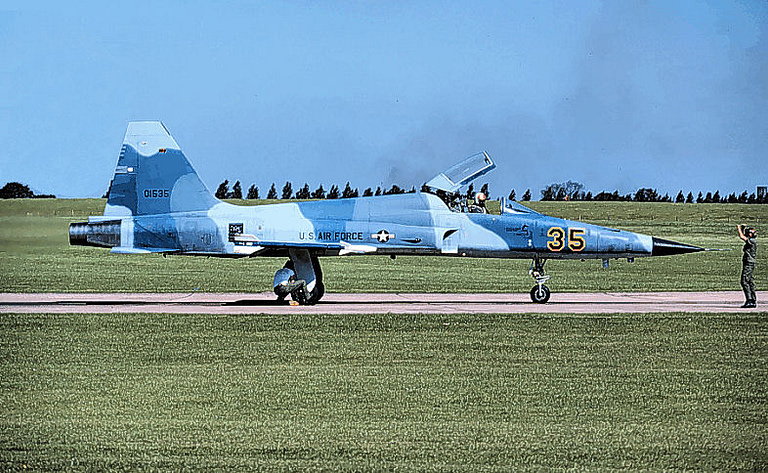
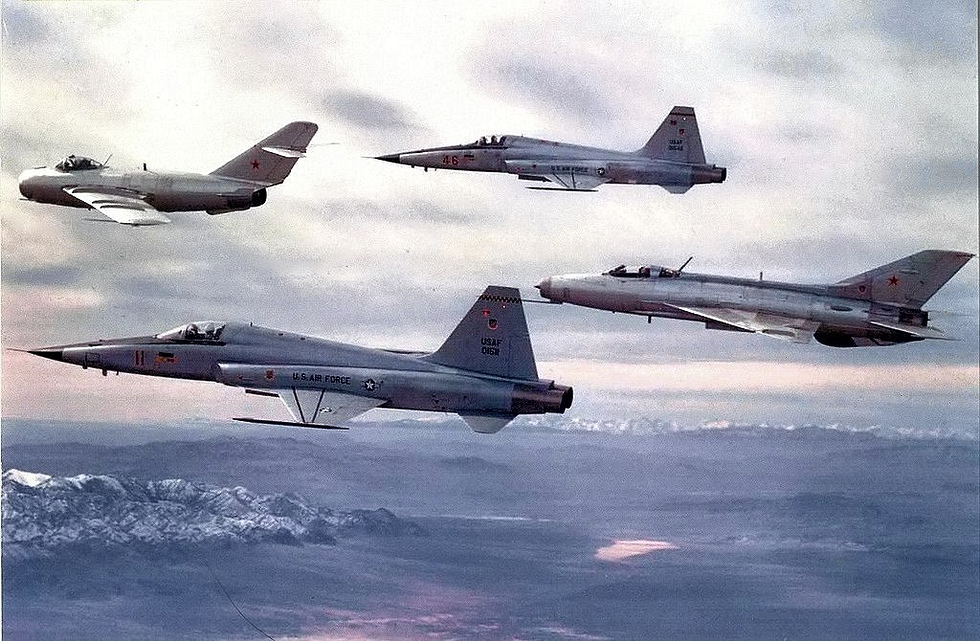
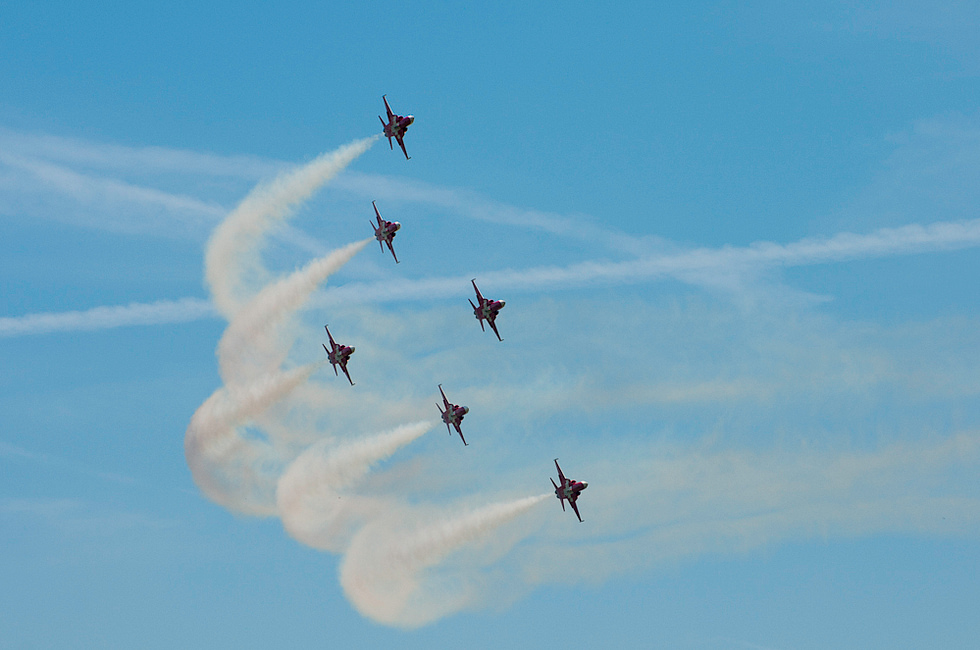
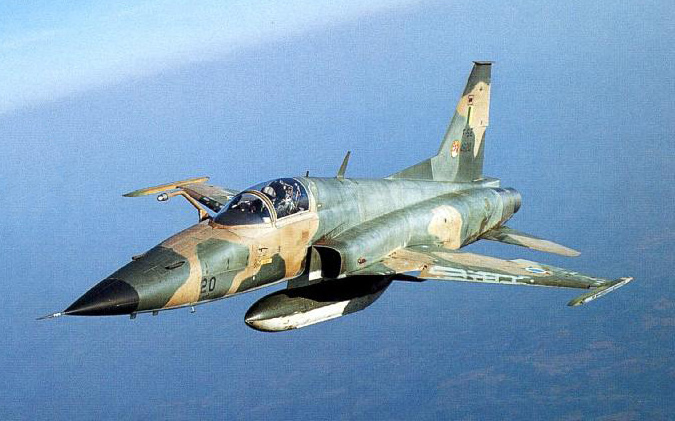
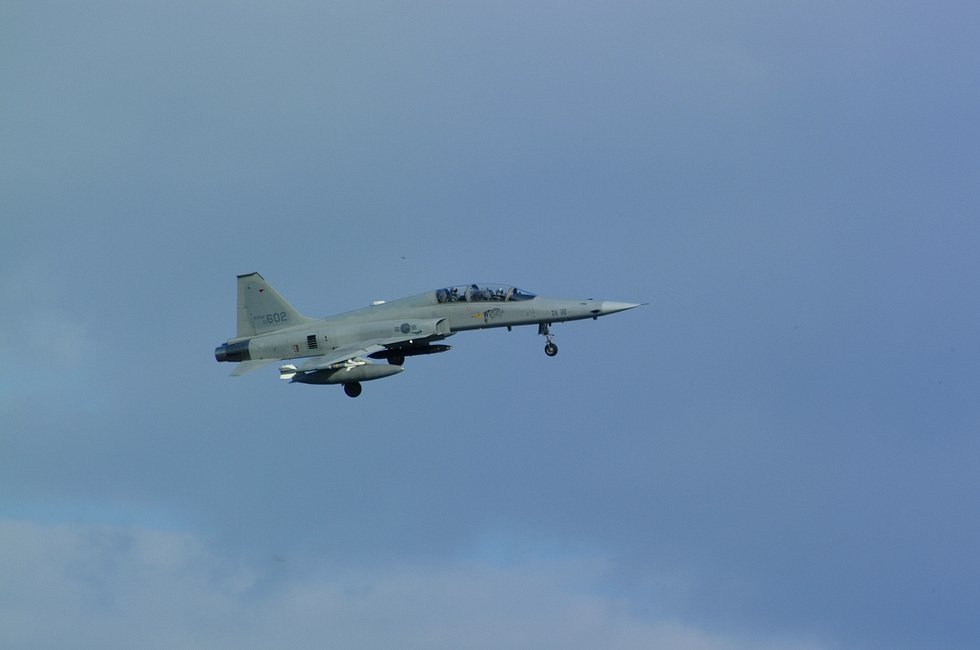
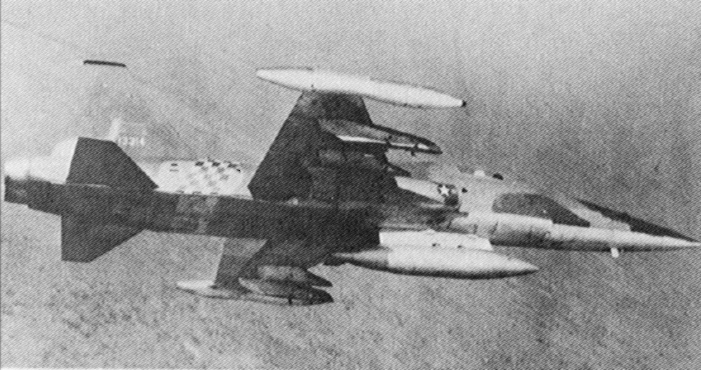
The F-5 in motion
A dedicated F-5 video feature is coming soon. In the meantime, explore the gallery above and the twelve stories — from Skoshi Tiger over Vietnam to the ex-Swiss Tigers now flying US Navy aggressor missions.
The F-5 Freedom Fighter in motion
Skyships Eng — one of the most-watched F-5 Freedom Fighter films on YouTube.
Where the F-5 flies
The score that defines it
The F-5 was never a first-rank air-superiority fighter, yet it fought — and won — in several wars. Ethiopian Tiger IIs are generally credited with the first F-5 kills over MiG-21s in the 1977–78 Ogaden War, Iranian F-5s flew hard throughout the Iran–Iraq War, and the type saw ground combat from Vietnam to the Western Sahara. Many combat claims from these wars are contested and hard to verify from open sources, so exact tallies should be read with caution.
Compare the combat record of every military aircraft. Figures as of July 2026.
Everything people ask about the F-5
Can I fly in an F-5?
Why is the F-5 called the “Freedom Fighter” and “Tiger II”?
Is the F-5 the same as the T-38 Talon?
Why was the F-5 used as an aggressor and in Top Gun?
Did the F-5 ever shoot down enemy aircraft?
How fast is the F-5?
Is the F-5 still in service?
How many F-5s were built?
You can’t fly the F-5.
These, you can.
Some legends only live in museums — others are fuelled and waiting. MiGFlug has put civilians in real military jet cockpits since 2004.
 Fly the L-39 AlbatrosThe world’s most-flown jet trainer — aerobatics included
 Fly the F-104 Starfighter“The missile with a man in it”
 Fly the MiG-21The Cold War’s most-produced jet
 Vuela el T-33 Shooting StarAmerica’s first jet trainer
 Fly the DH VampireA piece of early jet history
 Fly the S.211Agile Italian jet trainer
 Fly the MB-326The classic Aermacchi jet
 Fly the MiG-15The Soviet legend of the Korean War
Continue the tour
Every fact, checked
- GlobalSecurity.org — F-5 Freedom Fighter / TigerDevelopment history, MAP export role and aggressor use.
- NAVAIR — F-5 Tiger IIUS Navy adversary F-5N/F fleet and current role.
- Air & Space Forces Magazine — USAF’s AggressorsOrigins of the aggressor concept and F-5 use in dissimilar air combat training.
- FlyAJetFighter — F-5 Tiger II aggressorTop Gun “MiG-28,” aggressor economics and the ex-Swiss transfers.
- GlobalMilitary.net — F-5E Tiger IISpecifications, operators and production figures (cross-checked).
- Airfighters.com — F-5E Tiger II dataDimensions, weights and performance figures.
- Wings over OgadenEthiopian F-5 vs Somali MiG-21 combat in the 1977–78 Ogaden War.
- SWI swissinfo.chSwiss decision to retire the F-5 Tiger and Patrouille Suisse.