
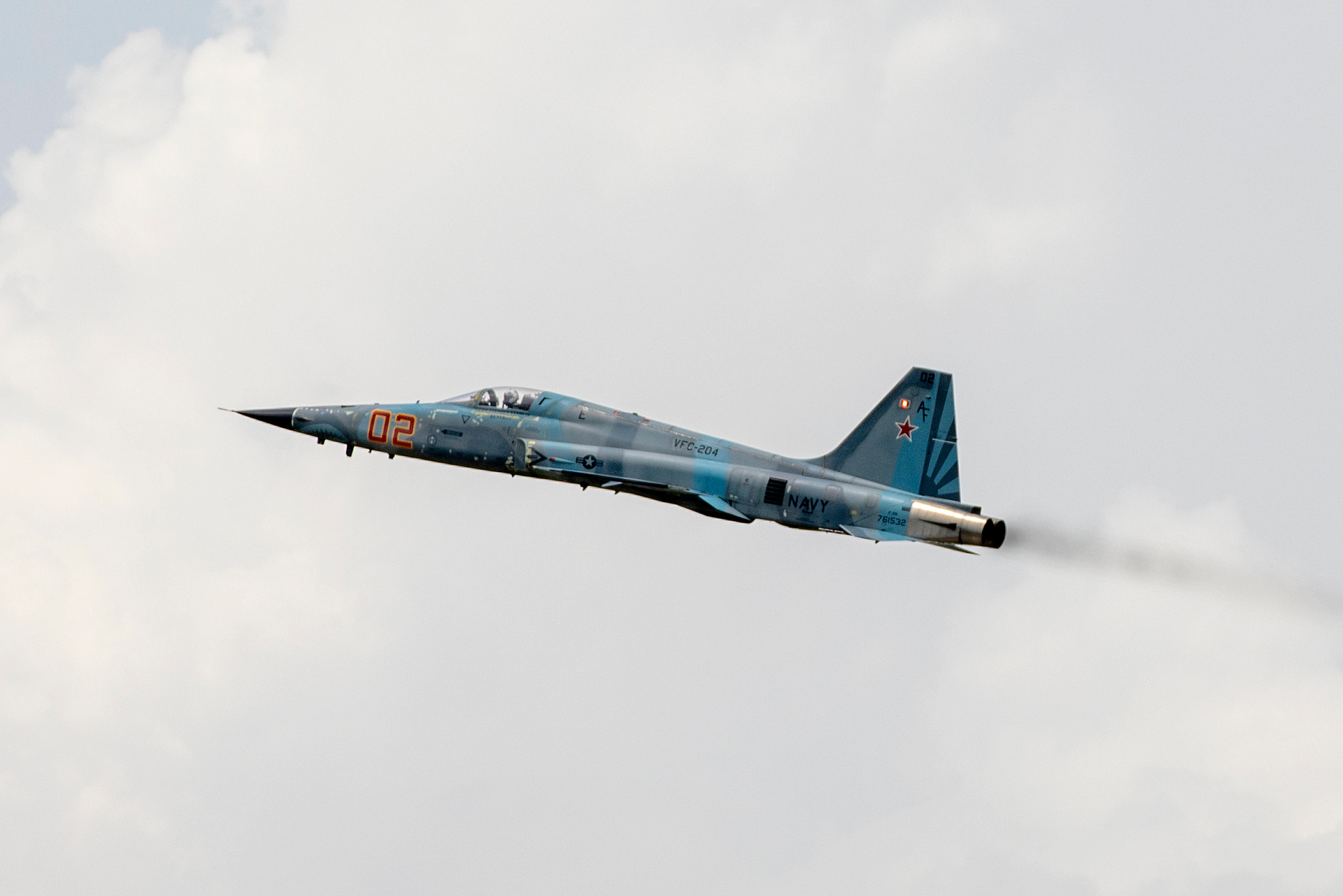
Northrop F-5
“Freedom Fighter / Tiger II”
The cheap, small, twin-engined fighter Northrop built for America’s allies — so nimble and MiG-like that it became the West’s favourite pretend enemy, from TOPGUN to Swiss aerobatics, and it is still flying in the 2020s.
The little fighter that armed the free world
In the mid-1950s a Northrop team toured NATO and SEATO countries and came home with a simple observation: America’s allies needed a jet fighter they could actually afford, fly and maintain. The heavyweight Century-series fighters were too costly and too complex. Northrop’s answer was the N-156 — a small, light, twin-engined supersonic fighter designed around cost and simplicity rather than raw performance.
The single-seat fighter first flew on 30 July 1959, and in 1962 the US Department of Defense picked it for the Military Assistance Program as the F-5A Freedom Fighter. It entered service in 1964, with the first examples delivered to Iran in early 1965. A two-seat trainer version of the same airframe became the T-38 Talon, which still trains US Air Force pilots today. Over the following decades the F-5 was built in the thousands and licence-produced in Canada, Spain, Switzerland, South Korea and Taiwan.
An improved model, the F-5E Tiger II, won the US International Fighter Aircraft competition in 1970 and first flew in 1972 — better engines, a better wing and a real radar. But the F-5’s strangest career was at home: its small size and MiG-like handling made it the perfect aggressor, the stand-in Soviet fighter that trained a generation of Western pilots and starred as the “MiG-28” in Top Gun. Upgraded Tigers still fly frontline and adversary missions into the 2020s.
01Why Northrop built a “cheap” fighter — and why that turned out to be genius
Most 1950s fighter design chased speed and altitude at any price. Northrop’s designers went the other way. They wrapped two small General Electric J85 turbojets — originally developed for a decoy drone — in the smallest, lightest airframe that could still go supersonic. The result weighed a fraction of its contemporaries, cost far less to buy and to run, and could operate from short, rough runways with minimal support.
That frugality is exactly why the F-5 succeeded where flashier jets did not. It could be given or sold cheaply to dozens of allied air forces under the Military Assistance Program, kept flying by modest maintenance crews, and later operated in large numbers as a training adversary at a fraction of the cost of a real frontline fighter. The “compromise” fighter became one of the most widely operated jets of the Cold War.
What makes the F-5 special
Two small engines, a very light airframe
The F-5 is tiny by fighter standards — an empty weight around 4.4 tonnes and a max takeoff weight of only about 11 tonnes. Power comes from two General Electric J85 afterburning turbojets, roughly 22 kN each in the Tiger II. The combination of light weight, a slim area-ruled fuselage and modest but efficient thrust gave the F-5 genuine agility, a small radar and visual signature, and honest supersonic performance to about Mach 1.6.
Affordable — and everywhere
The F-5 was designed to be cheap to buy and cheap to run. Simple systems, easy maintenance and short-field capability made it ideal for the US Military Assistance Program, and it was licence-built in Canada, Spain, Switzerland, South Korea and Taiwan. More than 2,600 F-5 fighters were produced (plus around 1,200 T-38 trainers), and it flew — and still flies — with dozens of air forces around the world.
The perfect pretend MiG
The F-5’s size and handling were uncannily close to the MiG-21 it was meant to fight. That made it the ideal aggressor aircraft for dissimilar air combat training. From the 1970s the USAF, US Navy TOPGUN and others flew F-5s as surrogate Soviet fighters, teaching Western pilots to beat the real thing — a role the type still performs today.
02The J85 engine: a drone motor that powered a fighter
The heart of the F-5 is the General Electric J85, a compact afterburning turbojet that began life as the powerplant for the McDonnell ADM-20 Quail decoy missile. Northrop scaled its fighter around a pair of them. In the F-5E Tiger II the uprated J85-GE-21 produced roughly 22 kN (about 5,000 lbf) of thrust in afterburner each. Two of them in such a light airframe gave the Tiger II a healthy thrust-to-weight ratio and crisp acceleration — and the same engine family went on to power the T-38 Talon and a range of other aircraft.
03Freedom Fighter to Tiger II: what changed in the F-5E
The original F-5A/B Freedom Fighter was a day fighter with a simple gunsight and little radar. When the USAF ran its International Fighter Aircraft competition in 1970 to find a MiG-21 rival for export, Northrop reworked the design into the F-5E Tiger II. It gained uprated J85-GE-21 engines, a wider fuselage, extended and manoeuvre-flapped wings for better turning, an Emerson radar, and improved avionics. First flown in 1972, the Tiger II became the definitive F-5 and the version most widely used as both a frontline fighter and an aggressor.
Full specifications (F-5E Tiger II)
Baseline note: the figures below describe the single-seat F-5E Tiger II as delivered by Northrop in the 1970s — the definitive mark, the one built in the largest numbers and the one still flying with a dozen air forces. Deltas for the earlier F-5A Freedom Fighter and the two-seat F-5F in grey. Where an upgraded fleet differs sharply from the baseline aircraft — Brazil, Chile, Thailand, Switzerland, the US Navy — that is said explicitly rather than folded into the number.
Dimensions & weights
- Bemanning
- 1 (2 in the F-5B and F-5F. The F-5B trainer carries no cannon at all; the F-5F, whose nose was stretched by about 0.9 m (3 ft) to fit the second cockpit, keeps one gun with reduced ammunition)
- Lengte
- 14.68 m (48 ft 2 in) — F-5A 14.38 m (47 ft 2 in); F-5F about 15.7 m (51 ft 5 in)
- Spanwijdte
- 8.13 m (26 ft 8 in); 8.53 m (27 ft 11.9 in) over wingtip missile rails
- Hoogte
- 4.08 m (13 ft 4.5 in)
- Vleugelgebied
- 17.28 m² (186 sq ft), aspect ratio 3.86, NACA 65A004.8 section. The F-5A wing was 15.79 m² (170 sq ft); the Tiger II added enlarged leading-edge root extensions, and that extra area is most of what improved the turn
- Leeggewicht
- 4,346 kg (9,583 lb) — lighter empty than a loaded Second World War heavy fighter, and roughly a third of an F-4 Phantom
- Gross weight, clean
- 7,142 kg (15,745 lb)
- Maximaal startgewicht
- 11,192 kg (24,675 lb)
- Interne brandstof
- ~2,563 litres (677 US gal; 564 imp gal) — about 2,050 kg (4,520 lb). Short legs are the type’s permanent weakness and no upgrade has fixed it
- External fuel
- Up to 3 × 1,041-litre (275 US gal) Sargent Fletcher drop tanks; 568-litre (150 US gal) tanks also cleared
- Maximum external load
- 3,175 kg (7,000 lb) across all stations, which is more than the airframe can usefully carry any distance
- Store stations
- 7 — two wingtip missile rails, four underwing pylons and one centreline. Only stations 3, 4 and 5 are plumbed for fuel
- Wing loading
- 649 kg/m² (133 lb/sq ft) at maximum take-off weight; about 413 kg/m² (85 lb/sq ft) clean — light enough to hold its own in a turning fight against far more expensive aircraft
Performance
- Maximum speed, altitude
- 1,730 km/h (1,075 mph), Mach 1.63 at 11,000 m (36,000 ft)
- Maximum cruise speed
- 1,041 km/h (647 mph), Mach 0.98 at 11,000 m (36,000 ft)
- Never-exceed speed
- 1,315 km/h (817 mph) indicated, 710 kn IAS
- Overtreksnelheid
- 230 km/h (143 mph; 124 kn) at 50% internal fuel with flaps and undercarriage down
- Klimsnelheid
- 175 m/s (34,500 ft/min)
- Serviceplafond
- 15,790 m (51,800 ft); 12,500 m (41,000 ft) on one engine — twin engines on a light fighter buy real redundancy, and several operators chose the type for exactly that
- Gevechtsradius
- ~222 km (~138 mi; 120 nmi) with two Sidewinders and 2,360 kg (5,200 lb) of ordnance, five minutes of combat at maximum power at sea level, 20 minutes reserve
- Range, clean
- 891 km (554 mi; 481 nmi)
- Ferry range
- 2,565 km (1,594 mi; 1,385 nmi) with drop tanks retained; 2,945 km (1,830 mi) if they are jettisoned
- Take-off run
- 610 m (2,000 ft) with two Sidewinders at 7,142 kg; 884 m (2,900 ft) to clear 15 m (50 ft). The two-position nose leg borrowed from the Canadian CF-5 rotates the aircraft on the ground and shortens the run
- Landing run from 15 m
- 762 m (2,500 ft) with the brake chute; 1,128 m (3,700 ft) without it
- Thrust-to-weight
- 0.63 clean at gross weight, falling to 0.40 at maximum take-off weight. Acceleration was the F-5E’s weakest quality and the single reason Northrop went looking for one F404 to replace two J85s
- Lift-to-drag ratio
- 10:1 — exceptionally clean for a supersonic fighter, and the reason it goes as far as it does on very little fuel
Propulsion & systems
- Motor
- 2 × General Electric J85-GE-21 afterburning turbojets — an engine originally designed as the powerplant for the ADM-20 Quail decoy carried by B-52s, with a thrust-to-weight ratio of 6.25 to 7.5 against about 4.7 for the F-4’s J79. The whole aircraft was designed around the availability of that engine. The F-5A used the smaller J85-GE-13
- Thrust
- 15.6 kN (3,500 lbf) dry, 22.2 kN (5,000 lbf) with afterburner, each — 44.4 kN (10,000 lbf) total in reheat. The F-5A’s J85-GE-13 gave 18.1 kN (4,080 lbf) each
- Fuel and refuelling
- ~2,563 litres internal in fuselage and wing tanks, three plumbed external stations. No refuelling probe as standard: the twelve Skoshi Tiger F-5C aircraft sent to Vietnam had a removable non-retractable probe bolted to the port side, and several export fleets later added one
- Radar
- Emerson AN/APQ-153 on early F-5E, replaced in later production by the planar-array AN/APQ-159 with about 37 km (20 nmi) range. AN/APQ-157 in the F-5F; AN/APG-69 with ground-mapping on US Navy F-5N and some Swiss aircraft. The F-5A and F-5B had no radar at all — that, more than anything else, is what separates the two generations. Upgraded fleets fly Leonardo Grifo-F (Brazil, formerly Singapore) or Elta EL/M-2032 (Chile, Thailand, Morocco) sets that outclass anything Emerson ever built for the type
- Sights and cockpit
- Lead-computing optical sight and analogue instruments as delivered. The Brazilian F-5EM, Chilean Tiger III and Thai F-5TH have glass cockpits, HOTAS, wide-angle HUDs and Elbit DASH helmet-mounted sights — a 1959 airframe flying a 2010s cockpit
- Defensive aids
- None fitted as standard on early aircraft; AN/ALR-46 or AN/ALR-87 radar warning receivers and chaff and flare dispensers added progressively. Brazil and Thailand carry the Rafael Sky Shield jamming pod; Switzerland flew the Ericsson Vista 5 jammer
- Schietstoel
- Northrop-built rocket-assisted seat as delivered, with a minimum safe ejection speed above zero. Zero-zero seats were fitted in several later upgrade programmes; the exact fit varies by operator
- First flight
- N-156F prototype 30 July 1959, supersonic on its first flight; F-5E 11 August 1972; F-5F 25 September 1974
- Service entry
- F-5A with the USAF 4441st Combat Crew Training Squadron at Williams AFB, 30 April 1964, training allied crews rather than American ones; F-5E with the 425th TFS, 6 April 1973
- Number built
- ~2,600 — 1,204 of the F-5A/B/C/D generation and 1,399 F-5E/F/RF-5E. Licence and offshore production accounts for a large share: 240 by Canadair, 308 by AIDC in Taiwan, 91 in Switzerland, 70 by CASA in Spain and 68 by Korean Air. The related T-38 Talon adds another 1,189 airframes on the same design philosophy
- Cost
- No single published flyaway figure covers the type, but the comparison that mattered held: in 1972 an F-5 cost about a third of an F-4 Phantom, and the US Navy today reckons it operates the F-5 for roughly a third of the hourly cost of an F/A-18. Life-cycle cost was an explicit design parameter from the start, which is why chief engineer Welko Gasich, not the marketing department, is the man usually credited with the aeroplane’s longevity
04The F-5’s operating cost: why it became the aggressor of choice
Exact dollar figures for the F-5 vary by variant, year and buyer, so any single number is an estimate. What is consistently reported is that the F-5 was cheap to acquire and cheap to fly relative to frontline fighters. That economy is precisely why the US Navy and Air Force adopted it as an aggressor: reporting around the adversary role has cited the F-5 as costing on the order of one-third as much per flight hour to operate as a fast jet like the F/A-18. Whatever the precise figures, low cost is the thread that runs through the entire F-5 story — from Military Assistance Program exports to red-air training today.
Armament & payload
The F-5E was armed as a 1972 gunfighter, and almost every operator that kept it has spent thirty years bolting a modern missile onto it
As Northrop built it, the Tiger II carried two 20 mm cannon in the nose, a Sidewinder on each wingtip and whatever iron would fit on five pylons. That was a deliberate choice, not an oversight: the International Fighter Aircraft requirement was for something a modestly funded air force could arm, maintain and afford, and a radar-guided missile in 1970 was neither cheap nor reliable. The consequence is that the aeroplane aged badly in exactly one dimension — it could not shoot beyond visual range — and the entire global upgrade industry that grew up around it from the 1990s exists to fix that one thing. Brazil, Chile and Thailand now fly F-5s with Israeli radars firing the active-radar Derby; Thailand adds IRIS-T and Python-4 with a helmet sight. Clearances vary more between F-5 fleets than for almost any other type. AMRAAM was integrated only on Singapore’s F-5S, which left service around 2015, so no F-5 flying today carries an American beyond-visual-range missile; the Iranian fits of Russian missiles on Saeqeh derivatives are claimed rather than demonstrated; and the US Navy and Marine aircraft carry no live weapons at all.
Gun
- 2 × Ford Aerospace M39A2 20 mm revolver cannon in the nose, 280 rounds per gun — a single-barrel revolver design, not a rotary, firing at about 1,500 rounds per minute
- The two-seat F-5F retains one M39A2 with roughly half the ammunition; the F-5B trainer and the RF-5A carry none
- The RF-5E Tigereye gives up the radar and one cannon to the camera pallet, keeping a single gun
- 1 × GPU-5/A podded 30 mm GAU-13 gun on the centreline — fitted only by the Royal Thai Air Force, and an unusually heavy weapon for the airframe
- 20 mm is light by the standards of the aircraft’s European contemporaries, which mostly chose 30 mm; against the MiG-17 and MiG-21 the F-5 was built to fight, it was enough
Air-to-air
- AIM-9 Sidewinder on both wingtip rails — AIM-9B and AIM-9J on early aircraft, AIM-9P and AIM-9M later. Upgraded fleets carry four, moving two to underwing stations
- Rafael Python III, Python IV and Python-4 on Ecuadorian, Chilean and Thai aircraft, cued by an Elbit DASH helmet-mounted sight on the Brazilian and Thai fleets
- Rafael Derby and I-Derby ER active-radar beyond-visual-range missiles — the Brazilian F-5EM, Chilean Tiger III and Thai F-5TH, and the only genuine BVR capability the type has today
- Diehl IRIS-T on the Thai F-5TH Super Tigris, which is the most heavily modernised F-5 fleet anywhere
- AIM-120 AMRAAM: cleared only on Singapore’s F-5S, now retired. The claim that F-5s generally carry AMRAAM is a common error and worth correcting
Air-to-surface guided
- AGM-65 Maverick, up to four, on aircraft upgraded after about 1995 — the standard Western stand-off answer to armour and hardened targets
- Paveway II laser-guided bombs, self-designated once a targeting pod is carried; GBU-12 is the common fit
- Rafael Lizard laser guidance kits on Thai aircraft, and Brazilian Mectron and SMKB guided weapons on the F-5EM
- The baseline 1972 F-5E carried no guided air-to-surface weapon whatsoever. Everything in this card is a retrofit
- No anti-radiation and no anti-ship missile has ever been a standard F-5 fit — a real gap for operators such as Brazil and Taiwan with long coastlines
Bombs
- Mark 80 series unguided bombs — Mk 82 (227 kg), Mk 83 and Mk 84, with the practical load closer to four or six Mk 82 than to the 3,175 kg paper maximum
- CBU-24, CBU-49, CBU-52 and CBU-58 cluster munitions — heavily used by Iran against Iraqi armour in the 1980s and by Morocco over the Western Sahara
- Napalm canisters and the M129 leaflet bomb, both cleared and both used in South-East Asia
- 3 kg and 14 kg practice bombs on multiple ejector racks, which is what most F-5s actually drop in a normal training year
- Iron bombs remain the type’s bread and butter: the 1965–66 Skoshi Tiger evaluation rated the F-5 as good a ground-attack aircraft as the far larger F-100 Super Sabre, with shorter legs
Rockets
- 2 × LAU-61 or LAU-68 pods, 19 or 7 Hydra 70 mm rockets each — the standard American fit
- 2 × LAU-5003 pods with 19 × CRV7 70 mm rockets, the higher-velocity Canadian round, on Canadair-built CF-5 and NF-5 airframes and their many second-hand owners
- 2 × LAU-10 pods with 4 × 127 mm Zuni rockets each — heavy, short-ranged and effective against soft targets and light structures
- 2 × Matra pods with 18 × SNEB 68 mm rockets, the usual European fit on French-supplied and French-influenced fleets
- Unguided rockets were a serious weapon for this aircraft rather than a legacy entry, and remain so for the African and Latin American operators
Pods & other stores
- Up to 3 × Sargent Fletcher drop tanks of 1,041 litres (275 US gal) or 568 litres (150 US gal) — on an aircraft this short-legged, tanks are close to mandatory equipment
- Rafael Litening III targeting pods on Brazilian and Thai aircraft, which is what makes their laser-guided weapons usable
- Rafael Sky Shield jamming pods (Brazil, Thailand); the Ericsson Vista 5 jammer flew on Swiss F-5F
- Reconnaissance is a nose, not a pod: the RF-5A carries a four-camera nose, the RF-5E Tigereye a modular sensor pallet, and Taiwan’s seven RF-5E Tigergazer conversions served until July 2025
- Buddy-lasing and datalink are recent additions — Brazil’s Link-BR2 lets an F-5EM take a track from an E-99 airborne early-warning aircraft, which is a genuinely modern capability on a 1970s airframe
Three typical loadouts
- Adversary sortie, US Navy VFC-13 or VMFT-401, today
- Clean, or with a single centreline tank. No weapons, no live ordnance, occasionally a captive Sidewinder seeker head and an ACMI instrumentation pod on a wingtip rail. The aircraft’s job is to be small, agile and difficult to see — and it is very hard to see
- Air defence alert, Brazilian F-5EM, 2020s
- 2 × Derby beyond-visual-range missiles on underwing stations, 2 × Python IV on the wingtips, 1 × centreline 1,041-litre tank, 280 rounds per gun. Grifo-F radar, DASH helmet sight and a Link-BR2 track from an E-99. This is the F-5 doing a job it was never designed for and doing it credibly
- Interdiction, Iranian F-5E, Iran–Iraq War, 1982–86
- 4 × Mk 82 or a pair of CBU-58 cluster munitions on the underwing pylons, 2 × AIM-9P on the wingtips, 1 × centreline tank. Iran flew this profile at very low level for years against Iraqi armour, and kept serviceability high on the F-5 long after its F-4s and F-14s were grounded for spares
Sourcing caveat: the baseline armament list follows Jane’s All the World’s Aircraft and Northrop’s own published clearances for the F-5E. Upgrade fits are drawn from the integrator and customer announcements — Elbit and Embraer for Brazil, Elbit for Chile and Thailand, RV Connex for the F-5TH — and those are marketing documents as much as technical ones. Iranian weapon integrations on the Azarakhsh, Saeqeh and Kowsar are asserted by Iranian state media and have not been independently verified; they are listed nowhere above for that reason.
Variants
Northrop built two different aeroplanes under one designation, and other people built at least six more
The F-5 family divides cleanly in two. The F-5A and F-5B Freedom Fighter of 1962 was a cheap radar-less day fighter distributed to allies under the Military Assistance Program — the aircraft the United States gave away rather than sold. The F-5E and F-5F Tiger II of 1970 won the International Fighter Aircraft competition on the strength of a radar, more thrust and enlarged leading-edge root extensions, and it is a genuinely different machine. Both descend from the T-38 Talon trainer, which flew first and outsold both.
The second half of the story is not Northrop’s. Canadair, CASA, AIDC in Taiwan, Korean Air and the Swiss federal aircraft factory built more than 700 airframes between them, and since the 1990s Elbit, Embraer, ST Aerospace, IAI and Leonardo have rebuilt hundreds more. The result is an aircraft whose most capable examples were never touched by its manufacturer.
- N-156F / F-5A / F-5B Freedom Fighter (1959–1972, 3 prototypes, 624 F-5A and 200 F-5B)
- The private-venture prototype went supersonic on its first flight, was shelved when USAF interest lapsed in 1960 and was revived by the Kennedy administration’s 1962 export-fighter requirement. The production aircraft had two J85-GE-13, no radar and two 20 mm guns; the two-seat F-5B had none. Norway placed the first international order in February 1964.
- RF-5A (from 1964, ~86–120 built)
- Four-camera reconnaissance nose in place of the guns. The recce F-5 is a genuine sub-family; the later RF-5E Tigereye took the idea to Saudi Arabia and Malaysia, and Taiwan’s RF-5E Tigergazer conversions flew until 2025.
- F-5C Skoshi Tiger (1965–66, 12 converted)
- Twelve F-5A given a bolt-on refuelling probe, 41 kg of cockpit and engine armour and jettisonable pylons for a five-month combat evaluation in Vietnam. Officially a success; in practice a sales demonstration.
- F-5E / F-5F Tiger II (1972–1987, 792 F-5E and 146 F-5F by Northrop)
- J85-GE-21 engines, AN/APQ-153 then AN/APQ-159 radar, enlarged wing root extensions, two-position nose leg. The F-5F stretched the nose to fit a second seat and kept one gun.
- CF-5 / NF-5 / SF-5 (1968–1975, 240 by Canadair and 70 by CASA)
- Licence production for Canada (CF-116), the Netherlands and Spain, with Orenda-built engines and two-position nose gear in the Canadian aircraft. Their second-hand descendants now fly in Botswana, Turkey and Venezuela.
- KF-5E/F and AIDC Chung Cheng (1974–1986, 68 in Korea and 308 in Taiwan)
- Offshore Tiger II production. Taiwan built more F-5s than any country other than the United States and once held 336 of them; the last batch used the F-20’s shark nose.
- F-5S/T, F-5EM/FM, Tiger III, F-5TH Super Tigris, F-5TIII (Singapore, Brazil, Chile, Thailand, Morocco, 1993–present)
- The modern upgrade industry, and the reason the type is still flying. Singapore rebuilt about 49 aircraft with the FIAR Grifo-F, AMRAAM and Python and retired them around 2015; Brazil rebuilt 46 and then 11 more with the Grifo-F, air-to-air refuelling, Derby and Link-BR2; Chile fitted the EL/M-2032 in 1993 and again in the Tiger III Plus; Thailand’s 14 F-5TH carry EL/M-2032, Link-T, IRIS-T and I-Derby; Morocco has 24 F-5TIII.
- F-5N (US Navy and Marine Corps, from 2006, ~41 in service)
- Low-hours ex-Swiss F-5E rebuilt with AN/APG-69 radar and modern avionics for the adversary role, plus three two-seat "FrankenTiger" hybrids grafting an F-5F front fuselage onto an F-5E rear.
- Azarakhsh, Saeqeh, Kowsar (Iran, 1997–present, numbers unclear)
- Unlicensed Iranian derivatives: the Azarakhsh with relocated intakes, the Saeqeh with canted twin fins, the two-seat Kowsar. Real aircraft, flying and shown publicly, but built in small numbers and with capabilities that Iranian claims consistently overstate.
- F-20 Tigershark (1982–1986, 3 built, none sold)
- One General Electric F404 in place of two J85s — 60% more thrust, thrust-to-weight raised from 1.0 to 1.13, an AN/APG-67 radar and AIM-7 Sparrow capability the F-16A then lacked. Northrop spent over US$750 million of its own money. Washington preferred to sell the F-16, two prototypes were lost in fatal demonstration crashes, and the programme was cancelled in November 1986.
Closing caveat: F-5 variant designations are a thicket. The same airframe can carry a Northrop model number, a US military designation, a licence-builder’s name and a national designation — a Royal Thai Air Force F-5E is also a B.Kh.18B, a Spanish F-5B is an AE.9, a Canadian CF-5A is a CF-116. Production totals for the reconnaissance marks in particular vary between sources; the figures above follow Johnsen and Jane’s where they can be reconciled, and are given as approximations where they cannot.
From MAP export to modern aggressor
The N-156 concept
Northrop begins studies for a small, cheap, twin-engined lightweight fighter for America’s allies.
First flight
The single-seat N-156F prototype flies on 30 July; the T-38 Talon trainer sibling had first flown that April.
F-5A Freedom Fighter
Chosen for the Military Assistance Program as the F-5A; enters service in 1964, first delivered to Iran in early 1965.
Skoshi Tiger
The USAF sends F-5s to Vietnam for a combat evaluation; the aircraft later pass to the South Vietnamese Air Force.
Tiger II
The improved F-5E wins the International Fighter Aircraft competition and first flies on 11 August 1972.
Enter the aggressors
The USAF stands up dedicated Aggressor squadrons flying F-5s as MiG surrogates; the US Navy TOPGUN school does the same.
Real combat
Ethiopian F-5Es fight Somali MiG-21s over the Ogaden; Iranian F-5s fly throughout the Iran–Iraq War.
Still on the flight line
Ex-Swiss F-5s transfer to the US Navy for aggressor duty; Switzerland plans to retire its Tigers and Patrouille Suisse around 2027.
Twelve F-5 stories
A fighter shaped by a sales trip
A 1950s Northrop tour of allied air forces led directly to the cheapest supersonic fighter of its day.
Read the full story
Two decoy-drone engines
The J85 turbojet was born for a missile, not a fighter — Northrop built its jet around a pair of them.
Read the full story
The T-38 that never left
The F-5’s two-seat trainer cousin still teaches US Air Force pilots more than sixty years on.
Read the full story
Skoshi Tiger
A small squadron of F-5s went to Vietnam in 1965 to prove the little fighter could fight.
Read the full story
First blood against the MiG-21
Ethiopian F-5Es are generally credited with the first air-to-air kills of an F-5 over a MiG-21.
Read the full story
Tigers over the Gulf
Iranian F-5s flew hard through the Iran–Iraq War, claiming kills against Iraqi jets.
Read the full story
The MiG-28 that never existed
The “enemy” jets in Top Gun were F-5s wearing black paint.
Read the full story
Learning to beat the MiG
The F-5’s MiG-like size and handling made it the perfect training adversary.
Read the full story
Switzerland’s Tigers
Switzerland flew the F-5 for decades and made it the mount of its national aerobatic team.
Read the full story
Ex-Swiss jets, US colours
In 2024 the US Navy began taking on retired Swiss F-5s to keep its aggressor fleet flying.
Read the full story
The digital Tiger
Modern avionics have kept the F-5 relevant far longer than anyone expected.
Read the full story
The fighter that armed the world
Dozens of air forces flew the F-5 — and many still do.
Read the full story
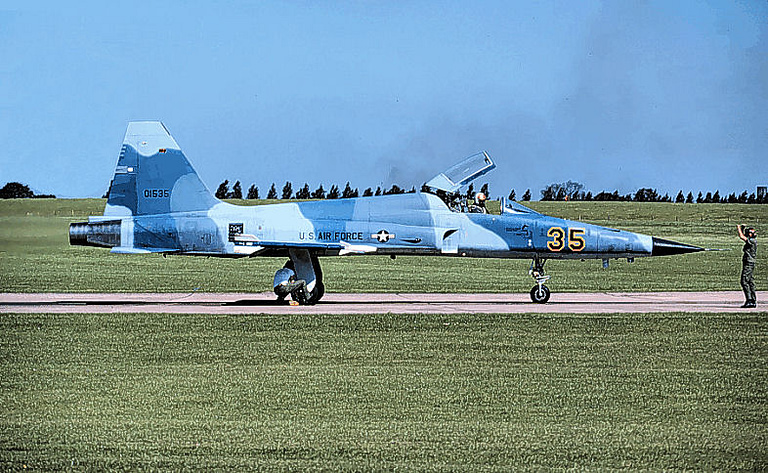
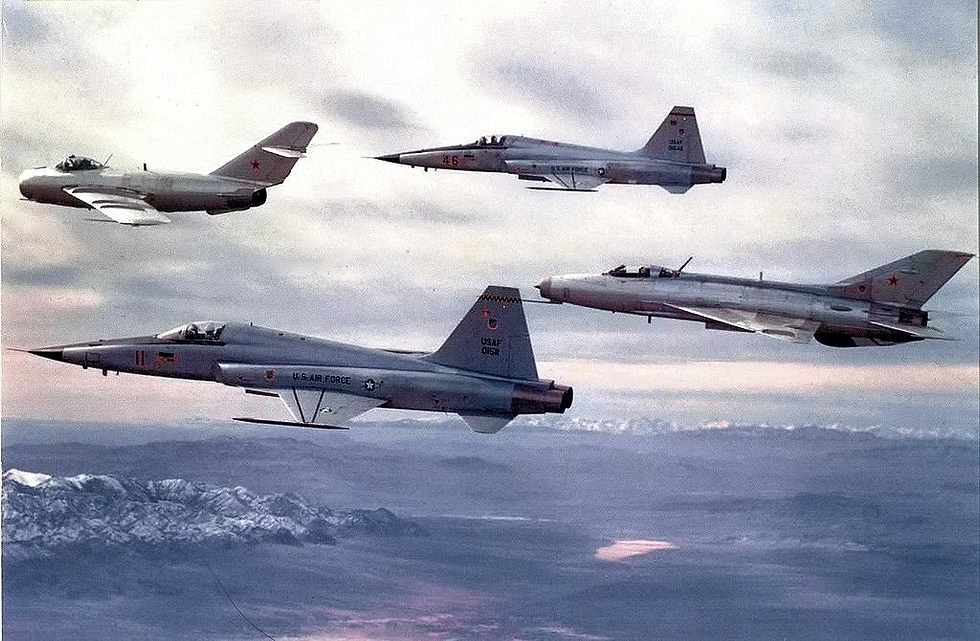
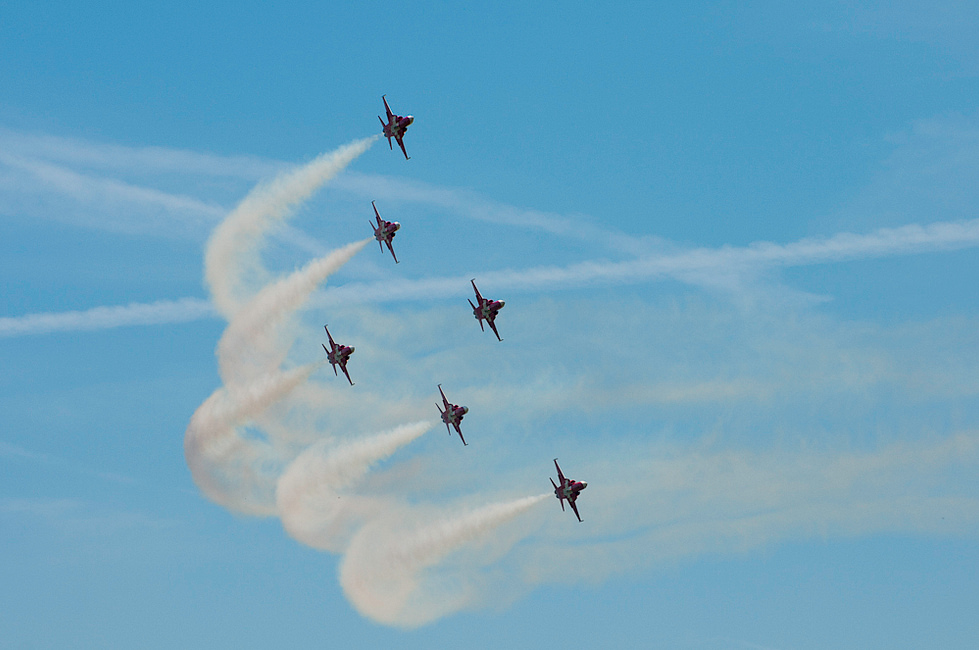
The F-5 in pictures
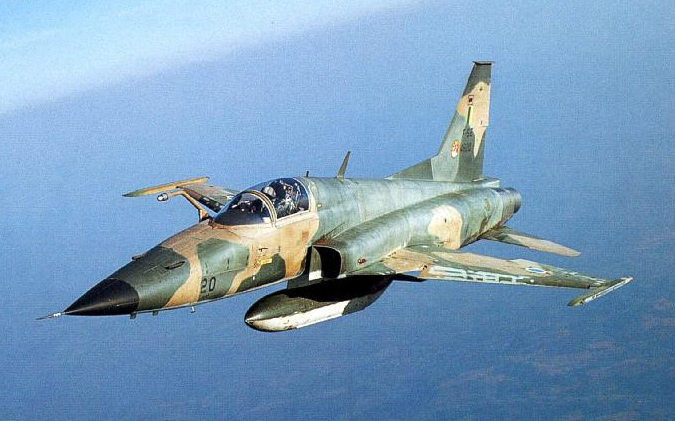
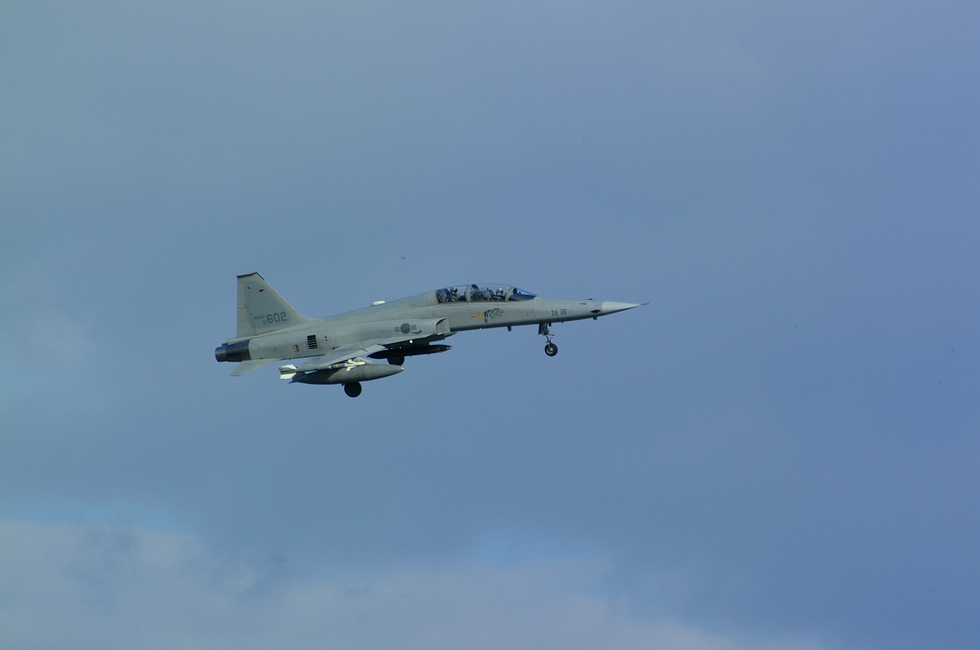
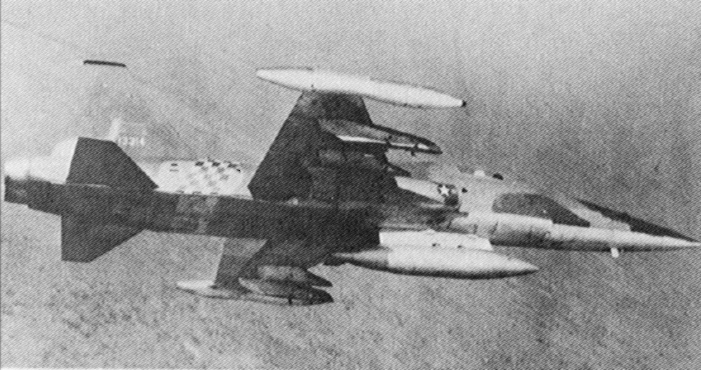
The F-5 in motion
A dedicated F-5 video feature is coming soon. In the meantime, explore the gallery above and the twelve stories — from Skoshi Tiger over Vietnam to the ex-Swiss Tigers now flying US Navy aggressor missions.
The F-5 Freedom Fighter in motion
Skyships Eng — one of the most-watched F-5 Freedom Fighter films on YouTube.
Where the F-5 flies
Operators today
More than a dozen air forces still fly the F-5, and the largest fleets are the ones closest to retirement
Sixty years after the first delivery the F-5 remains one of the most widely operated supersonic fighters in the world, but the shape of that fleet has changed. The very large legacy fleets — South Korea, Switzerland, Taiwan — are training and secondary-role aircraft now being run down on published dates. The fleets that matter operationally are the mid-sized, heavily rebuilt ones: Brazil, Chile, Thailand and Morocco fly F-5s with Israeli or Italian radars and active-radar missiles, which is a different aeroplane from the one Northrop delivered. And a fifth of the flying F-5s in the world wear US Navy and Marine Corps markings and never carry a weapon at all.
These are estimates of delivered aircraft on charge, and several of them need qualifying. South Korea’s figure is by far the largest and the least representative: those are F-5E/F and licence-built KF-5E/F used as light fighters and lead-in trainers, and Seoul intends to retire the entire fleet by 2027 as FA-50s arrive. Switzerland’s Tigers fly training, target-towing and the Patrouille Suisse display team, not air defence; 22 decommissioned airframes were shipped to the US Marine Corps from March 2024, and the remainder go at the end of 2027. The American entry is entirely adversary: about 27 US Navy F-5N/F and 14 US Marine Corps aircraft, unarmed, flown by VFC-13, VFC-111, VMFT-401 and VMFT-402 — the type has never been a front-line USAF or USN fighter. Spain’s 19 are F-5M two-seaters used purely as fighter trainers. Iran’s number is a best estimate of operational airframes from a delivered total of 181 F-5E/F, and excludes the Azarakhsh, Saeqeh and Kowsar derivatives, whose numbers are not published. Tunisia (about 12), Honduras (about 6), Mexico (about 4), Turkey (a dozen F-5-2000 flown by the Turkish Stars display team) and a residual Yemeni fleet are omitted for space or because they could not be corroborated to a firm figure. Taiwan is deliberately absent: it was once the largest operator in the world with 336 aircraft, retired its F-5Es in November 2023 and its last F-5F and RF-5E Tigergazers in July 2025. Sources: IISS The Military Balance, FlightGlobal World Air Forces (Hoyle), NAVAIR and national announcements; entries that could not be corroborated are omitted.
The score that defines it
The F-5 was never a first-rank air-superiority fighter, yet it fought — and won — in several wars. Ethiopian Tiger IIs are generally credited with the first F-5 kills over MiG-21s in the 1977–78 Ogaden War, Iranian F-5s flew hard throughout the Iran–Iraq War, and the type saw ground combat from Vietnam to the Western Sahara. Many combat claims from these wars are contested and hard to verify from open sources, so exact tallies should be read with caution.
Compare the combat record of every military aircraft. Figures as of July 2026.
Everything people ask about the F-5
Can I fly in an F-5?
Why is the F-5 called the “Freedom Fighter” and “Tiger II”?
Is the F-5 the same as the T-38 Talon?
Why was the F-5 used as an aggressor and in Top Gun?
Did the F-5 ever shoot down enemy aircraft?
How fast is the F-5?
Is the F-5 still in service?
How many F-5s were built?
You can’t fly the F-5.
These, you can.
Some legends only live in museums — others are fuelled and waiting. MiGFlug has put civilians in real military jet cockpits since 2004.
 Fly the L-39 AlbatrosThe world’s most-flown jet trainer — aerobatics included
 Fly the F-104 Starfighter“The missile with a man in it”
 Fly the MiG-21The Cold War’s most-produced jet
 Vlieg met de T-33 Shooting StarAmerica’s first jet trainer
 Fly the DH VampireA piece of early jet history
 Fly the S.211Agile Italian jet trainer
 Fly the MB-326The classic Aermacchi jet
 Fly the MiG-15The Soviet legend of the Korean War
Continue the tour
Every fact, checked
- GlobalSecurity.org — F-5 Freedom Fighter / TigerDevelopment history, MAP export role and aggressor use.
- NAVAIR — F-5 Tiger IIUS Navy adversary F-5N/F fleet and current role.
- Air & Space Forces Magazine — USAF’s AggressorsOrigins of the aggressor concept and F-5 use in dissimilar air combat training.
- FlyAJetFighter — F-5 Tiger II aggressorTop Gun “MiG-28,” aggressor economics and the ex-Swiss transfers.
- GlobalMilitary.net — F-5E Tiger IISpecifications, operators and production figures (cross-checked).
- Airfighters.com — F-5E Tiger II dataDimensions, weights and performance figures.
- Wings over OgadenEthiopian F-5 vs Somali MiG-21 combat in the 1977–78 Ogaden War.
- SWI swissinfo.chSwiss decision to retire the F-5 Tiger and Patrouille Suisse.