

Convair B-36
“Peacemaker”
The largest mass-produced piston aircraft ever flown — a ten-engined giant with a wing wider than a modern airliner, built to carry the atomic bomb across an ocean and back without ever landing. The West called it the “aluminum overcast.”
The bomber built to cross an ocean and come home
The B-36 was conceived in the darkest month of 1941. With Britain seemingly on the brink of falling, U.S. planners asked a terrifying question: if there were no friendly airfields left in Europe, could America still strike Nazi Germany directly from bases on its own soil? The answer they demanded was a bomber that could fly roughly 10,000 miles — carry a heavy bomb load to a target 5,000 miles away and return — without ever refuelling. Nothing remotely like it existed.
Convair’s solution, first flown on 8 August 1946, was simply enormous. Its wing spanned about 70 metres — wider than a modern Boeing 747 — and was over two metres thick at the root, thick enough for a crew member to crawl out toward the engines in flight. Six huge Pratt & Whitney R-4360 Wasp Major radial engines were buried in the trailing edge, driving pusher propellers. By the time it reached Strategic Air Command in 1948, the war it was designed for was long over — but a new one had begun, and the B-36 became the first aircraft that could deliver an atomic bomb from the continental United States to the Soviet Union and fly back.
It was the backbone of American nuclear deterrence for a decade, and it never dropped a bomb in anger. Critics mocked it as slow, vulnerable and obsolete the day it was born — a piston relic in the jet age. Its defenders answered that a bomber that keeps the peace by never being used has done its job perfectly. When the all-jet B-52 Stratofortress arrived, the Peacemaker was retired in 1959, having flown for barely a decade but having anchored the most dangerous stand-off in history.
01The Convair B-36’s origins: why 1941 America needed a 10,000-mile bomber
The requirement that produced the B-36 was written in April 1941, before the United States had even entered the war. The fear was concrete: if Britain fell, the U.S. would lose every forward base within striking distance of Germany, and any bomber launched from North America would need intercontinental legs. The Army Air Forces asked for a machine that could carry 10,000 lb of bombs to a target 5,000 miles away and return — a 10,000-mile round trip with no refuelling, at a time when the best heavy bombers could barely manage a fraction of that.
Development was deliberately slowed once the B-29 proved able to reach Japan from Pacific island bases, and the giant Convair design was not urgently needed during the war. It was the arrival of the atomic bomb and the Cold War that gave it a mission: an aircraft that could put a nuclear weapon on Moscow from Texas. The B-36 was, in a sense, a weapon designed for one war and pressed into service for another.
What makes it special
“Six turning and four burning”
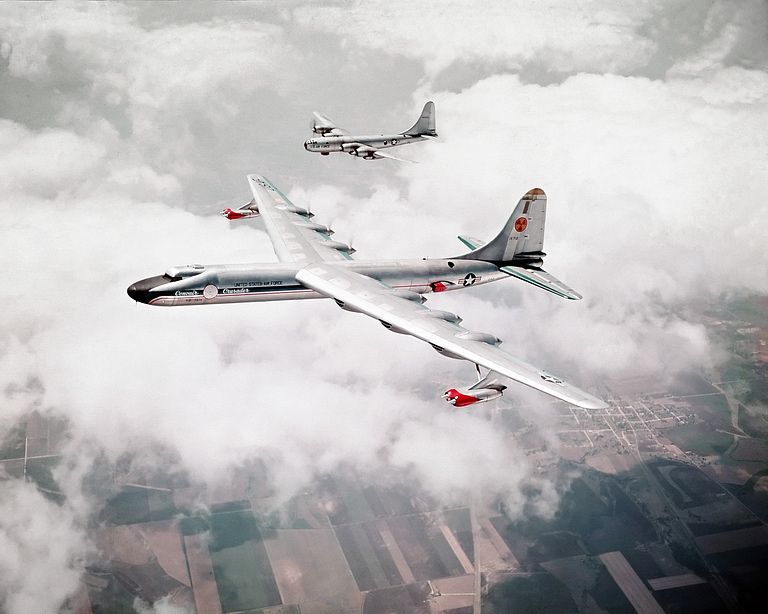
Early B-36s flew on six Pratt & Whitney R-4360 Wasp Major radials — the most powerful piston aero-engines ever mass-produced, each a 28-cylinder monster — mounted backwards to drive pusher propellers. From the D-model, Convair bolted on four General Electric J47 turbojets in two underwing pods for extra dash speed over the target. Crews summed up the unique ten-engine layout in one phrase: “six turning and four burning.”
True intercontinental range
The B-36 was the first bomber that could genuinely reach another continent and return without air-to-air refuelling. Its combat radius stretched past 5,000 km and its ferry range toward 16,000 km, carried on a vast, deep wing packed with fuel. That single capability — strike from home soil and come back — is what made it the foundation of early U.S. nuclear deterrence.
A pressurised world inside the wing
The crew of about 15 lived in two pressurised compartments joined by an 25-metre tunnel running through the wing centre-section, traversed on a wheeled trolley. The wing was so deep — more than two metres at the root — that a flight engineer could crawl inside it toward the engines during flight. It was less an aeroplane than a flying building.
02The B-36’s Wasp Major engines: why six giant radials faced backwards
Each R-4360 Wasp Major packed 28 cylinders in four rows and produced around 3,800 horsepower — the most powerful piston aero-engine ever to reach mass production. On the B-36 they were mounted as pushers, buried in the thick wing with the propellers on the trailing edge, which kept the wing aerodynamically clean but left the engines prone to cooling problems and even in-flight fires. Engine fires were a recurring hazard; one of them triggered the type’s first major loss in 1950. The later addition of four J47 jets gave the aircraft a burst of speed for the bomb run and shortened its take-off, producing the celebrated “six turning, four burning” configuration.
03The B-36 Peacemaker’s size: just how big the “aluminum overcast” was
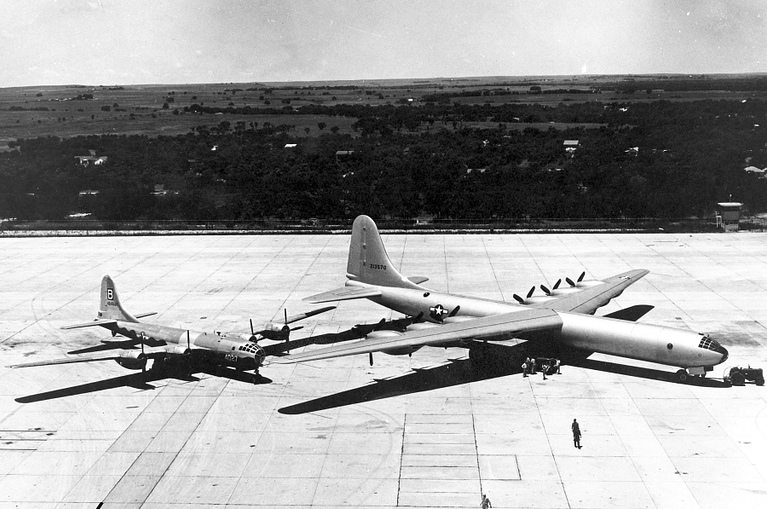
With a wingspan of about 70 metres and a length near 49 metres, the B-36 remains the largest mass-produced piston-engined aircraft ever built and had the longest wingspan of any combat aircraft in history. Its wing area of roughly 443 square metres dwarfed contemporaries; parked next to a B-29 — itself a huge bomber — the Peacemaker looked from another scale entirely. The nickname “aluminum overcast” captured the sight of one passing overhead. Yet it was subsonic and, by the mid-1950s, increasingly vulnerable to jet fighters — which is why its reign was measured in a single decade.
Full specifications
Airframe & Performance (B-36J)
- Multitud
- ~15
- Longitud
- 49.4 m (162 ft 1 in)
- Envergadura
- 70.1 m (230 ft)
- Altura
- ~14.2 m (46 ft 8 in)
- Área del ala
- ~443 m² (4,772 sq ft)
- Peso vacío
- ~77,600 kg (171,000 lb)
- Max takeoff weight
- ~186,000 kg (410,000 lb)
- Max speed
- ~700 km/h (435 mph) at altitude
- Techo de servicio
- ~13,300 m (43,600 ft)
- Ferry range
- ~16,000 km (10,000 mi)
Propulsion, Payload & Programme
- Piston engines
- 6 × P&W R-4360-53 Wasp Major (~3,800 hp each)
- Jet engines
- 4 × GE J47-GE-19 turbojets
- Max bomb load
- ~39,000 kg (86,000 lb)
- Armamento
- Up to 16 × 20 mm cannon (defensive)
- First flight
- 8 August 1946 (XB-36)
- Built
- 384 (1946–1954)
- Unit cost
- ~$4.1 million (period estimate)
- Cost per flight hour
- No reliable public figure
04The B-36 Peacemaker’s operating costs: what a ten-engine giant cost to run
The B-36 was among the most expensive aircraft programmes of its era. Contemporary figures put the flyaway unit cost at very roughly $4.1 million in early-1950s dollars — a substantial sum, though sources vary and it should be read as an order-of-magnitude estimate rather than a precise, audited number. Maintaining ten engines, six of them enormous 28-cylinder radials that were notoriously hard to keep running, made the type maintenance-heavy; but a firm, sourced cost-per-flight-hour figure for the B-36 does not exist in the open record. Any exact modern dollar figure attached to it is an estimate. Programme totals across the roughly 384 airframes built ran into the billions.
From wartime idea to nuclear shield
An impossible requirement
With Britain apparently near collapse, the U.S. Army Air Forces ask for a bomber able to strike Europe from North America and return — a 10,000-mile round trip without refuelling.
The giant flies
The XB-36 prototype makes its first flight on 8 August at Fort Worth, Texas — the largest bomber the world had yet seen.
Into Strategic Air Command
The first operational B-36s reach SAC’s 7th Bombardment Group at Carswell AFB, giving America its first true intercontinental nuclear delivery aircraft.
“Revolt of the Admirals”
The B-36 sits at the centre of a bitter inter-service fight, as the Navy questions whether the bomber, not its cancelled supercarrier, should carry the nuclear mission.
The first Broken Arrow
On 13–14 February a B-36B suffers engine fires over British Columbia; the crew jettison a Mark 4 bomb into the Pacific — the first loss of a U.S. nuclear weapon.
The nuclear-powered experiment
The one-off NB-36H flies with an operating nuclear reactor aboard, testing shielding for a proposed atomic-powered bomber that was never built.
The Peacemaker retires
The last B-36 flight is made on 30 April as the all-jet B-52 Stratofortress takes over the strategic mission. The type never fired a shot in combat.
Twelve stories from the age of the Peacemaker
The bomber for a Britain that might fall
A wartime nightmare — no bases left in Europe — produced the demand for a 10,000-mile bomber.
Read the full story
Wider than a 747
The B-36 remains the largest mass-produced piston aircraft and the longest-winged combat aircraft ever built.
Read the full story
Six turning, four burning
The ten-engine layout gave the aircraft its most famous phrase.
Read the full story
The 28-cylinder monster
The Wasp Major was the most powerful piston aero-engine ever mass-produced — and a maintenance nightmare.
Read the full story
The first Broken Arrow
America lost its first nuclear weapon from a burning B-36 off the coast of Canada.
Read the full story
The Revolt of the Admirals
The giant bomber ignited one of the fiercest inter-service fights in American history.
Read the full story
The flying reactor
One B-36 carried a working nuclear reactor aloft to test a dream that never flew.
Read the full story
A weapon that never fought
The Peacemaker’s entire career passed without a single combat mission.
Read the full story
Eyes over the enemy
Camera-carrying RB-36 variants turned the bomber into a strategic spy platform.
Read the full story
A fighter in its belly
The B-36 experimented with carrying its own parasite jet fighter for protection.
Read the full story
Passing the torch
The all-jet B-52 ended the Peacemaker’s reign after barely a decade.
Read the full story
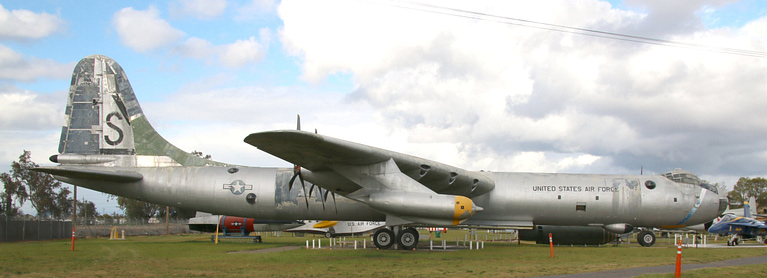
Only four survive
Of 384 built, a mere handful of Peacemakers escaped the scrapyard.
Read the full story
The Peacemaker in pictures


An all-American aircraft
The score that defines it: none, by design
The B-36 Peacemaker never flew a combat mission, never dropped a bomb in anger and never met an enemy aircraft in the air. That is not a footnote — it is the whole point. The Peacemaker was a deterrent weapon whose success was measured by the war it helped prevent. For a decade it stood ready to carry America’s nuclear arsenal across the world, and its entire record is written in readiness rather than kills.
Compare the combat record of every military aircraft. Figures as of July 2026.
Everything people ask about the B-36 Peacemaker
Can I fly in a B-36?
Why does the B-36 have both propellers and jets?
How big is the B-36 Peacemaker?
Did the B-36 ever see combat?
What was the 1950 B-36 “Broken Arrow”?
How far could the B-36 fly?
Why was the B-36 retired so quickly?
Are any B-36s still around?
You can’t fly the B-36.
These, you can.
Some legends only live in museums — others are fuelled and waiting. MiGFlug has put civilians in real military jet cockpits since 2004.
 Fly the L-39 AlbatrosThe world’s most-flown jet trainer — aerobatics included
 Fly the F-104 Starfighter“The missile with a man in it”
 Fly the MiG-21The Cold War’s most-produced jet
 Vuela el T-33 Shooting StarAmerica’s first jet trainer
 Fly the DH VampireA piece of early jet history
 Fly the S.211Agile Italian jet trainer
 Fly the MB-326The classic Aermacchi jet
 Fly the MiG-15The Soviet legend of the Korean War
Continue the tour
Every fact, checked
- National Museum of the U.S. Air Force — Convair B-36J fact sheetPrimary reference for dimensions, weights, crew, service dates and the last B-36 flight.
- The War Zone — America’s First Broken Arrow IncidentDetailed account of the 13–14 February 1950 B-36B loss off British Columbia.
- Smithsonian Air & Space — B-36: Bomber at the CrossroadsThe programme politics, the “Revolt of the Admirals” and the B-36’s strategic role.
- Simple Flying — The Convair B-36 Bomber: A HistoryOverview of design, the six-turning-four-burning powerplant and career.
- The National Interest — The Biggest Bomber Ever BuiltContext on the B-36 as the largest mass-produced piston bomber and deterrent.
- Vintage Aviation News — Castle Air Museum RB-36HSurvivor history and reconnaissance-variant background.
- Airplanes-Online — About the B-36 PeacemakerDevelopment timeline, service entry and surviving-airframe details.
- Bureau of Aircraft Accidents Archives — B-36 recordCross-check for the type’s accident history.