
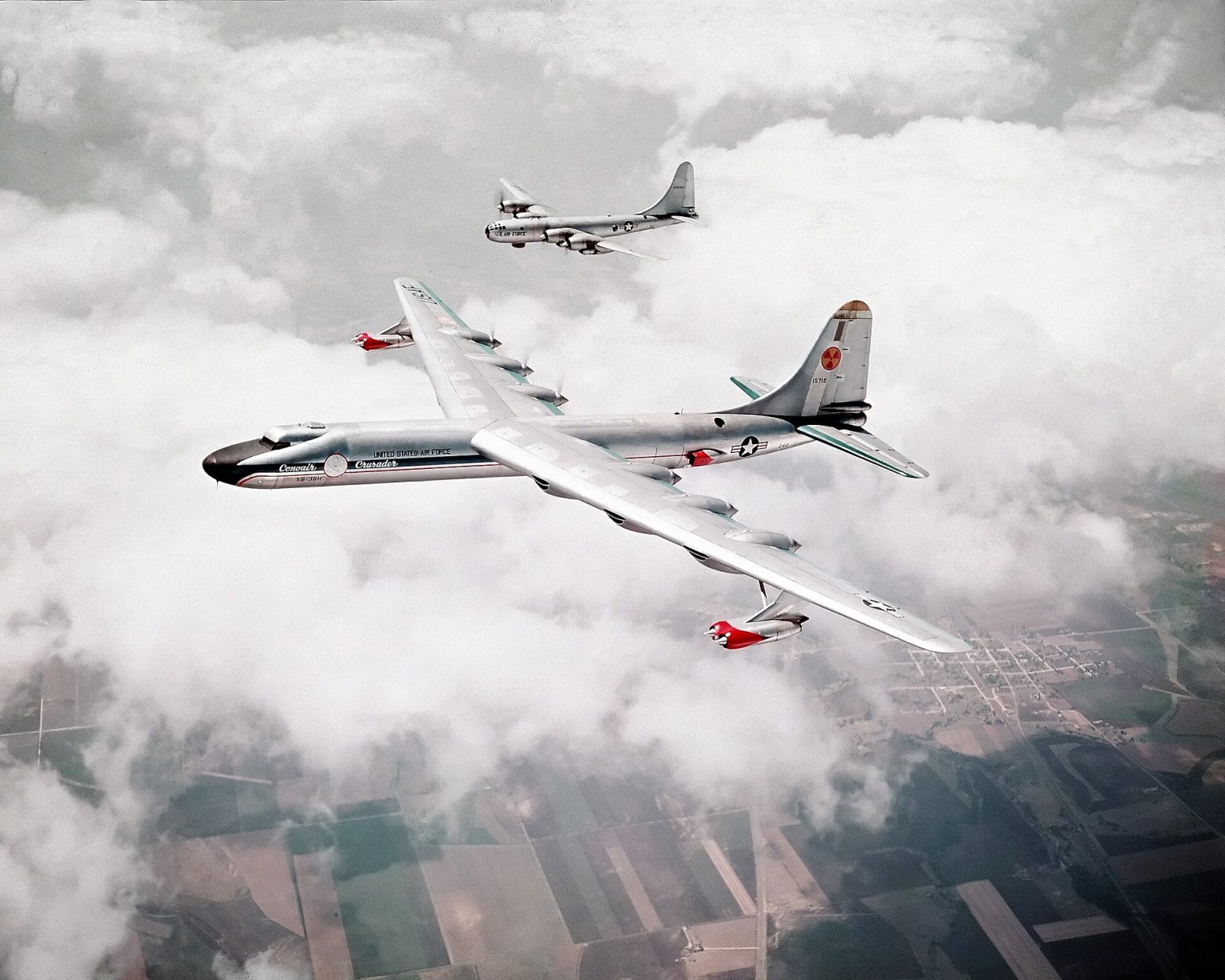
Convair B-36
“Peacemaker”
The largest mass-produced piston aircraft ever flown — a ten-engined giant with a wing wider than a modern airliner, built to carry the atomic bomb across an ocean and back without ever landing. The West called it the “aluminum overcast.”
The bomber built to cross an ocean and come home
The B-36 was conceived in the darkest month of 1941. With Britain seemingly on the brink of falling, U.S. planners asked a terrifying question: if there were no friendly airfields left in Europe, could America still strike Nazi Germany directly from bases on its own soil? The answer they demanded was a bomber that could fly roughly 10,000 miles — carry a heavy bomb load to a target 5,000 miles away and return — without ever refuelling. Nothing remotely like it existed.
Convair’s solution, first flown on 8 August 1946, was simply enormous. Its wing spanned about 70 metres — wider than a modern Boeing 747 — and was over two metres thick at the root, thick enough for a crew member to crawl out toward the engines in flight. Six huge Pratt & Whitney R-4360 Wasp Major radial engines were buried in the trailing edge, driving pusher propellers. By the time it reached Strategic Air Command in 1948, the war it was designed for was long over — but a new one had begun, and the B-36 became the first aircraft that could deliver an atomic bomb from the continental United States to the Soviet Union and fly back.
It was the backbone of American nuclear deterrence for a decade, and it never dropped a bomb in anger. Critics mocked it as slow, vulnerable and obsolete the day it was born — a piston relic in the jet age. Its defenders answered that a bomber that keeps the peace by never being used has done its job perfectly. When the all-jet B-52 Stratofortress arrived, the Peacemaker was retired in 1959, having flown for barely a decade but having anchored the most dangerous stand-off in history.
01The Convair B-36’s origins: why 1941 America needed a 10,000-mile bomber
The requirement that produced the B-36 was written in April 1941, before the United States had even entered the war. The fear was concrete: if Britain fell, the U.S. would lose every forward base within striking distance of Germany, and any bomber launched from North America would need intercontinental legs. The Army Air Forces asked for a machine that could carry 10,000 lb of bombs to a target 5,000 miles away and return — a 10,000-mile round trip with no refuelling, at a time when the best heavy bombers could barely manage a fraction of that.
Development was deliberately slowed once the B-29 proved able to reach Japan from Pacific island bases, and the giant Convair design was not urgently needed during the war. It was the arrival of the atomic bomb and the Cold War that gave it a mission: an aircraft that could put a nuclear weapon on Moscow from Texas. The B-36 was, in a sense, a weapon designed for one war and pressed into service for another.
What makes it special
“Six turning and four burning”
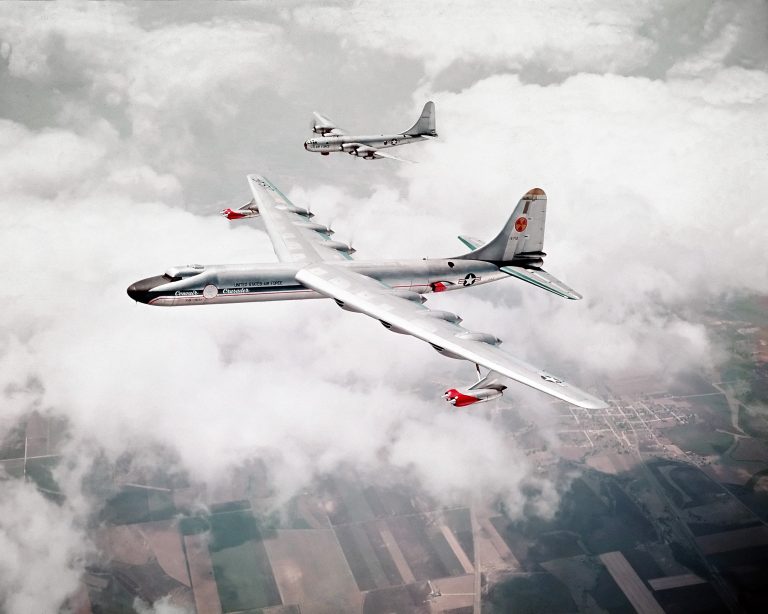
Early B-36s flew on six Pratt & Whitney R-4360 Wasp Major radials — the most powerful piston aero-engines ever mass-produced, each a 28-cylinder monster — mounted backwards to drive pusher propellers. From the D-model, Convair bolted on four General Electric J47 turbojets in two underwing pods for extra dash speed over the target. Crews summed up the unique ten-engine layout in one phrase: “six turning and four burning.”
True intercontinental range
The B-36 was the first bomber that could genuinely reach another continent and return without air-to-air refuelling. Its combat radius stretched past 5,000 km and its ferry range toward 16,000 km, carried on a vast, deep wing packed with fuel. That single capability — strike from home soil and come back — is what made it the foundation of early U.S. nuclear deterrence.
A pressurised world inside the wing
The crew of about 15 lived in two pressurised compartments joined by an 25-metre tunnel running through the wing centre-section, traversed on a wheeled trolley. The wing was so deep — more than two metres at the root — that a flight engineer could crawl inside it toward the engines during flight. It was less an aeroplane than a flying building.
02The B-36’s Wasp Major engines: why six giant radials faced backwards
Each R-4360 Wasp Major packed 28 cylinders in four rows and produced around 3,800 horsepower — the most powerful piston aero-engine ever to reach mass production. On the B-36 they were mounted as pushers, buried in the thick wing with the propellers on the trailing edge, which kept the wing aerodynamically clean but left the engines prone to cooling problems and even in-flight fires. Engine fires were a recurring hazard; one of them triggered the type’s first major loss in 1950. The later addition of four J47 jets gave the aircraft a burst of speed for the bomb run and shortened its take-off, producing the celebrated “six turning, four burning” configuration.
03The B-36 Peacemaker’s size: just how big the “aluminum overcast” was
With a wingspan of about 70 metres and a length near 49 metres, the B-36 remains the largest mass-produced piston-engined aircraft ever built and had the longest wingspan of any combat aircraft in history. Its wing area of roughly 443 square metres dwarfed contemporaries; parked next to a B-29 — itself a huge bomber — the Peacemaker looked from another scale entirely. The nickname “aluminum overcast” captured the sight of one passing overhead. Yet it was subsonic and, by the mid-1950s, increasingly vulnerable to jet fighters — which is why its reign was measured in a single decade.
Full specifications
Baseline note: the figures below describe the B-36J as delivered in 1953–54 — the last and heaviest production standard, with six Pratt & Whitney R-4360-53 Wasp Major radials driving pusher propellers and four General Electric J47-GE-19 turbojets in two underwing pods, the arrangement crews summed up as "six turning, four burning". Deltas for the piston-only B-36A and B-36B of 1948–49, for the B-36D of 1949 that first carried the jet pods, for the RB-36D reconnaissance aircraft and for the stripped B-36J-III Featherweight of 1954 are given in grey. Three cautions apply before any number below is quoted. First, the two most-copied English data tables for this aeroplane do not describe the same aircraft: the National Museum of the United States Air Force sheet (435 mph, 43,600 ft, 166,165 lb empty) is a Featherweight B-36J-III, while Knaack and the Convair standard aircraft characteristics for the B-36J as built give 411 mph, 39,900 ft and 171,035 lb, and a page that mixes rows from both invents an aeroplane that never flew. Second, the jet pods change everything they touch — speed, ceiling, take-off run, fuel burn — so a piston-only B-36B figure and a ten-engined B-36D figure are not comparable and are separated here. Third, production totals genuinely disagree: 383, 384 and 385 all appear in reputable sources, and the arithmetic behind them is set out in the variants section below.
Dimensions & weights
- Crew
- 15 — two pilots, a bombardier, a navigator, two flight engineers, two radio operators, three forward gunners, a nose gunner, three rear gunners and a tail gunner, split between two pressurised compartments. The stripped B-36J-III Featherweight flew with 13, the RB-36D with 22 to work the cameras and the RB-36D-III with 19. Nine is sometimes quoted for the deepest Featherweight fit and is best treated as a minimum rather than a norm
- Length
- 49.40 m (162 ft 1 in) — unchanged from the XB-36 to the last B-36J. Only the NB-36H, with its lead-shielded reactor-crew nose, and the projected Fairchild M-534 booster carrier would have altered it
- Wingspan
- 70.10 m (230 ft 0 in) — the longest span of any combat aircraft ever built, and still is. A B-52H spans 56.39 m, an An-124 73.30 m. The span was fixed early: Wright Field chose Consolidated’s six-engine trailing-edge layout in November 1941 and the wing grew to 230 ft before the first prototype was delivered
- Height
- 14.22 m (46 ft 9 in) on the museum sheet; Baugher and the Convair tables give 46 ft 8 in (14.20 m), and aviastar prints 47 ft 11 in. The difference is tyre pressure and loading state, not structure
- Wing area
- 443.3 m² (4,772 sq ft) — the largest wing ever put on a mass-produced aeroplane, and the reason the B-36 could loiter above 40,000 ft on piston power when no 1940s fighter could reach it
- Wing thickness at root
- 2.29 m (7 ft 6 in) measured perpendicular to the chord — deep enough for a flight engineer to crawl outboard through the wing in flight to reach the backs of the engines and the main gear wells, though only at low altitude where the crawlway could be kept breathable
- Empty weight
- 77,580 kg (171,035 lb) for the B-36J as built. The B-36D weighed 73,197 kg (161,371 lb) empty and the piston-only B-36B 63,793 kg (140,640 lb) — the jet pods, heavier gear and added fuel put on some fourteen tonnes across five years. The Featherweight B-36J-III came back down to 75,371 kg (166,165 lb)
- Combat weight
- 120,700 kg (266,100 lb) for the B-36J; 113,535 kg (250,300 lb) for the B-36D and 103,285 kg (227,700 lb) for the B-36B. This is the weight at the target, not at brake release, and it is the figure the ceiling numbers assume
- Maximum take-off weight
- 185,970 kg (410,000 lb) for the B-36J on strengthened undercarriage. The B-36D was limited to 167,830 kg (370,000 lb) and the B-36B to 141,070 kg (311,000 lb). Maximum landing weight on the B-36D was 161,930 kg (357,000 lb), an unusually small margin below take-off weight for the period
- Wing loading
- 419 kg/m² (85.9 lb/sq ft) at maximum take-off weight, falling to 272 kg/m² (55.8 lb/sq ft) at combat weight. That second figure is the whole aeroplane in one number: a heavy bomber with the wing loading of a trainer, which is how a piston bomber lived at 40,000 ft
- Maximum bomb load
- ~39,000 kg (86,000 lb) with weight and range restrictions; 32,660 kg (72,000 lb) was the normal maximum. Four bomb bays in tandem, each with snap-action doors. For scale, a B-17G carried 3,600 kg (7,900 lb) internally, so one B-36 lifted the load of roughly ten Flying Fortresses
- Main landing gear
- Four-wheel bogies on each main leg from the B-36A onward. The XB-36 flew on single main wheels 2.79 m (9 ft 2 in) tall, 0.91 m (3 ft) wide and weighing 599 kg (1,320 lb) each — the largest aircraft tyres yet made, holding the rubber of sixty car tyres, and so concentrated a load that only three runways in the United States could take them. A tracked, tank-like gear was also tried on the XB-36 and abandoned as heavy and noisy
Performance
- Maximum speed
- 661 km/h (411 mph, 357 kn) at 11,095 m (36,400 ft) for the B-36J as built, all ten engines running. The B-36D was quicker at 707 km/h (439 mph) at 9,790 m because it was lighter; the Featherweight B-36J-III is credited with 700 km/h (435 mph). The piston-only B-36B managed 613 km/h (381 mph)
- Cruising speed
- 327 km/h (203 mph, 176 kn) on the six radials alone for the B-36J; 370 km/h (230 mph) for the B-36J-III and 362 km/h (225 mph) for the B-36D. Lighting the four J47s lifted cruise beyond 645 km/h (400 mph), but the jets drank fuel and were normally used only for take-off, climb and the run to the target
- Service ceiling
- 12,160 m (39,900 ft) for the B-36J at combat weight. The B-36D reached 13,780 m (45,200 ft), the museum B-36J-III sheet claims 13,290 m (43,600 ft), and GlobalSecurity prints 13,930 m (45,700 ft). The spread is real and reflects weight, not measurement error
- Featherweight ceiling
- 14,325 m (47,000 ft) for a stripped B-36J-III, with missions flown at 15,240 m (50,000 ft) and the lightened reconnaissance RB-36-III credited with 17,680 m (58,000 ft). Soviet air-defence radar of the early 1950s, largely SCR-270 sets and copies, was reckoned effective only to about 12,190 m (40,000 ft), which is precisely why the Featherweight programme existed
- Combat ceiling
- 11,825 m (38,800 ft) for the piston-only B-36B — the figure that mattered operationally before the jet pods arrived, and the one that made critics call the aeroplane obsolete on delivery
- Rate of climb
- 9.75 m/s (1,920 ft/min) initial for the B-36J; 11.2 m/s (2,210 ft/min) for the lighter B-36D and 7.67 m/s (1,510 ft/min) for the piston-only B-36B. A full-weight climb to operating altitude took the better part of an hour
- Take-off run
- 1,340 m (4,400 ft) for the B-36D, or 1,733 m (5,685 ft) to clear a 15 m (50 ft) obstacle. The jet pods cut roughly 610 m (2,000 ft) off the piston-only run, which was the argument that won them their place
- Combat radius
- ~5,670 km (3,525 miles) for the B-36D with a 4,540 kg (10,000 lb) load — the 1941 requirement, met at last, eight years late. With the maximum 86,000 lb bomb load the radius collapsed to about 3,254 km (1,757 nm), and that trade is the honest measure of the aeroplane
- Combat range
- 6,413 km (3,985 miles) on the museum B-36J-III sheet. Knaack’s B-36D tables give 12,070 km (7,500 miles) maximum range and the B-36B 13,155 km (8,175 miles); the figures are not contradictory, they are different profiles, and any table printing them side by side without saying which is which is worthless
- Ferry range
- 16,000 km (10,000 miles) unrefuelled — the B-36 had no in-flight refuelling capability at all, which was both its point and, by 1955, its epitaph. The RB-36D is credited with 14,965 km (9,300 miles)
- Endurance
- ~40 h for a standard training sortie, typically flown as a 40-hour leg, a ground turnaround and a 24-hour second leg. A B-36B total mission time of 42.43 h appears in the Convair tables, and an RB-36D with a bomb-bay tank could stay up close to 50 h. A 40-hour mission with the jets used only for take-off and climb covered about 14,800 km (9,200 miles)
Propulsion & systems
- Piston engines
- 6 × Pratt & Whitney R-4360-53 Wasp Major 28-cylinder four-row air-cooled radials, 3,800 hp (2,834 kW) each for take-off, driving pusher propellers on the wing trailing edge. The B-36D and B-36B used the 3,500 hp R-4360-41; the XB-36 flew on 3,000 hp R-4360-25s totalling only 18,000 hp, which is why the prototype needed such long take-off runs. Installed piston power on the B-36J is 22,800 hp (17,000 kW)
- Turbojets
- 4 × General Electric J47-GE-19 of 23.1 kN (5,200 lbf) each, paired in two pods under the outer wings, fitted from the B-36D of 1949 onward and burning the same 115/145 avgas as the radials. Total 92.5 kN (20,800 lbf). Combined with the radials the installation was rated at an equivalent 40,000 hp for short periods
- Propellers
- 3-blade Curtiss Electric constant-speed, fully feathering pushers, 5.79 m (19 ft) in diameter. The pusher layout was chosen to keep the wing in clean air, and it worked aerodynamically; it also put the carburettor ahead of the engine rather than behind it, out of the warm air, and that single consequence caused most of the type’s engine fires
- Carburettor icing and fires
- The defining defect — in cold, humid air the intake iced, the mixture ran rich, and unburned fuel ignited in the exhaust. Three such fires caused the loss of B-36B 44-92075 over British Columbia on 13 February 1950, the first loss of an American nuclear weapon. Crews rewrote the slogan as "two turning, two burning, two smoking, two choking and two more unaccounted for"
- Lubricating oil
- One 379 L (100 US gal) tank per radial, 2,270 L in all — more oil than a fighter carried fuel. The Wasp Majors had an appetite to match
- Spark plugs
- 336 per engine change-out — 56 plugs on each of six engines, routinely fouled by the lead in the 115/145 octane anti-knock fuel. The B-36 was also too large for most hangars, so this work was done outdoors at Arctic and desert bases in temperatures from −51 °C to 38 °C
- Fuel
- Integral wing tanks across the full 70 m span, plus a droppable 11,356 L (3,000 US gal) tank that could occupy a bomb bay on reconnaissance and long-range fits. Published total internal capacity figures for the B-36 vary so widely between sources that none is repeated here; the RB-36F was specifically built with extra tankage and the B-36J with increased tankage again
- Bombing and navigation system
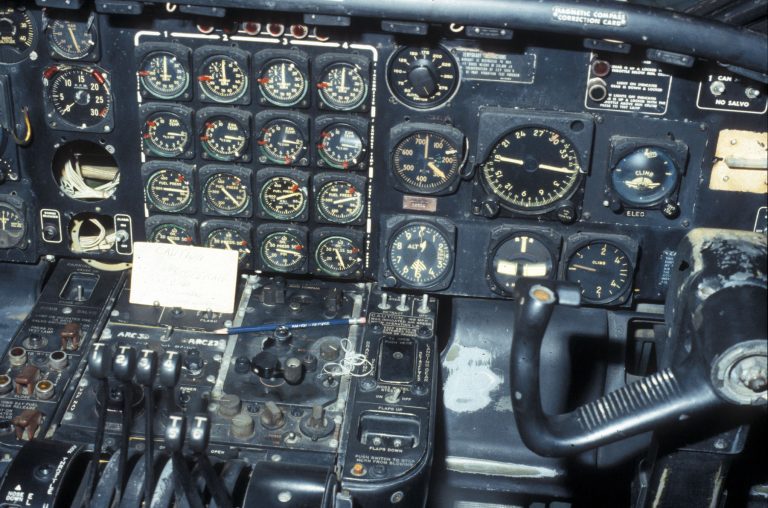
- K-3A radar bombing and navigation from the B-36D onward, replacing the AN/APQ-24 of the B-36B and allowing one crewman to work as both radar operator and bombardier. Optical bombing used the Norden-derived sight in the glazed nose, but at 40,000 ft over cloud the radar was the primary means
- Fire-control and tail radar
- AN/APG-32 gun-laying radar for the tail turret from the B-36D, replacing the AN/APG-3. The other seven positions were aimed optically from periscopic and blister sighting stations, with any gunner able to take control of more than one turret
- Bomb bays
- Four in tandem with snap-action doors that opened and closed in two seconds, introduced on the B-36D in place of the earlier sliding type — a real gain at high subsonic speed and high altitude, where open doors cost both speed and trim. The two aft bays could be combined to take a single Mk 17
- Pressurisation and crew quarters
- Two pressurised compartments joined by a pressurised tunnel running through the bomb bays, traversed on a wheeled trolley by hauling on a rope. The aft compartment held six bunks and a galley and led to the tail turret. Lieutenant General James Edmundson likened flying the aeroplane to "sitting on your front porch and flying your house around"; the compartments themselves were cramped for fifteen men on a 40-hour sortie
- Structure
- Aluminium with magnesium skinning over much of the fuselage, which gave the type its characteristic dull grey-green sheen. RB-36s are recognisable by the bright polished aluminium of the camera compartment against that dull magnesium, and by a varying series of radomes under the aft fuselage
04The B-36 Peacemaker’s operating costs: what a ten-engine giant cost to run
The B-36 was among the most expensive aircraft programmes of its era. Contemporary figures put the flyaway unit cost at very roughly $4.1 million in early-1950s dollars — a substantial sum, though sources vary and it should be read as an order-of-magnitude estimate rather than a precise, audited number. Maintaining ten engines, six of them enormous 28-cylinder radials that were notoriously hard to keep running, made the type maintenance-heavy; but a firm, sourced cost-per-flight-hour figure for the B-36 does not exist in the open record. Any exact modern dollar figure attached to it is an estimate. Programme totals across the roughly 384 airframes built ran into the billions.
Armament & payload
The B-36 carried sixteen cannon it did not need and the only bombs nothing else could lift
The B-36 was armed to two entirely different purposes and it is worth separating them at the outset. Defensively it carried sixteen 20 mm M24A1 cannon in eight remotely controlled mountings — six retractable turrets in the fuselage plus fixed nose and tail positions — which made it, on paper, the most heavily gunned aeroplane the United States ever put into squadron service. Offensively it carried nothing at all for most of its career except gravity bombs, and the ones that mattered were nuclear. It was the only aircraft in the world cleared for the whole first generation of American thermonuclear weapons, up to and including the Mk 17, a 42,000 lb device that filled two of its four bomb bays.
The guns were a failure of the interesting kind: they worked, and they were still a liability. Recoil vibration from gunnery practice shook electrical wiring loose and knocked out vacuum-tube avionics, a chain of events that contributed to the loss of B-36B 44-92035 on 22 November 1950. They cost weight and altitude, and altitude was the only real defence a 230-ft bomber had against a MiG-15. By 1954 the Air Force had reached the same conclusion the Silverplate B-29s had reached a decade earlier and began stripping them out: Featherweight I removed the six fuselage turrets, Featherweight II the rear crew comforts and parasite-fighter fittings, and Featherweight III combined both, leaving the tail guns alone, cutting the crew from fifteen to thirteen and buying several thousand feet of ceiling.
On the offensive side the aeroplane was, for about seven years, the only delivery vehicle the United States possessed for its largest weapons. The modification that made this possible was called the Grand Slam Installation. The B-36 had not been designed with nuclear weapons in mind — they were still secret when it was laid out — and the B-36A could not carry them at all, yet the type stepped into the nuclear role the moment it became operational and never left it. It also carried the T-12 Cloudmaker, a 43,600 lb conventional earthquake bomb no other aircraft could lift, and on one test flight dropped two of them. It never released a weapon in anger. Every loadout below is a peacetime or planned fit, and the one operational release on record was an accident: on 22 May 1957 a B-36 dropped an unarmed Mk 17 short of Kirtland Air Force Base when it came off its mounts on approach.
Gun
- 16 × 20 mm M24A1 cannon — the American-built development of the Hispano-Suiza HS.404, in eight twin mountings: six retractable turrets paired side by side in forward dorsal, aft dorsal and ventral positions, plus non-retractable nose and tail positions. All eight were remotely controlled.
- ~9,200 rounds of 20 mm carried on the B-36D, roughly 575 per gun — enough for a genuine running engagement rather than the token allowance of a bomber’s tail stinger. Baugher’s B-36B page prints 92,000 rounds, which is a decimal-point slip.
- Sighting from optical periscopic and blister stations, with the tail turret radar-directed by AN/APG-32 from the B-36D onward (AN/APG-3 before that). Gunners could take control of more than one turret, so a reduced crew still covered the aircraft.
- The vibration problem — sustained firing loosened wiring and upset the valve electronics behind the navigation and control systems, a defect that killed at least one crew and was never properly cured.
- Stripped out from 1954. Featherweight III B-36D, F, H and J aircraft retained only the twin 20 mm tail turret; the last 14 B-36Js were built to that standard on the line rather than converted.
Air-to-air
- No air-to-air missile was ever carried or planned. Guided air-to-air weapons did not exist in usable form when the B-36 entered service, and by the time they did the type was leaving it.
- The intended answer to interceptors was instead a parasite fighter. The McDonnell XF-85 Goblin, a 4.5 m egg-shaped jet with four .50 in Brownings, was designed to ride in a B-36 bomb bay and dock on a trapeze. Trials flown from an EB-29B showed docking was punishing even for test pilots, and the Goblin would have been no match for a MiG-15. Cancelled 1949.
- Project Tip Tow and Project Tom-Tom tried the opposite trick, clamping F-84s to the bomber’s wingtips to raise effective aspect ratio and range. Tip Tow ended when an EF-84D flipped onto the wing of its EB-29A and both crews were killed; Tom-Tom, flying RF-84Fs off a converted GRB-36D (redesignated JRB-36F), survived a few more months before the B-36’s own wingtip vortices ended it.
- What actually defended the aircraft was altitude: cruise above 12,000 m put it beyond the reliable reach of Soviet radar and above the practical ceiling of the interceptors of the late 1940s. That margin had gone by 1951.
Air-to-surface guided
- Bell GAM-63 RASCAL — a rocket-powered supersonic stand-off missile with a nuclear warhead, carried on the DB-36H director conversion for launch trials in the mid-1950s. The operational RASCAL role passed to the B-47 and the programme was cancelled in 1958.
- Republic-Ford JB-2 — the American copy of the V-1 flying bomb, launched from beneath B-36 wings by the 3200th Proof Test Group at Eglin in early 1949, and later flown as an aerial target for infrared gunsight trials.
- Convair XGAM-71 Buck Duck — a decoy missile shaped to return the radar signature of a B-36, so that one aircraft in a three-ship formation could carry up to seven of them and swamp Soviet air defences. It did not enter service.
- No guided air-to-surface weapon was ever carried operationally. For its whole front-line career the B-36 was an unguided gravity bomber, which is exactly why its 12,000 m cruise mattered so much.
Bombs
- Mk 17 thermonuclear — 7.52 m long, 1.56 m in diameter, 19,050 kg (42,000 lb), about 15 megatons, occupying the two aft bays together. Some 200 were built between October 1954 and November 1955 and the B-36 was the only aircraft that could carry one. Later rounds used a 20 m parachute so the bomber had time to escape the fireball.
- Mk 24 — externally identical to the Mk 17, differing only in the primary, 15 to 20 megatons; and the Mk 14 of 5 to 7 megatons, the first deployed American thermonuclear bomb. The B-36 was the sole carrier of all three.
- Fission and later thermonuclear stores — Mk 4, Mk 5, Mk 6 and Mk 18 implosion bombs, and the lighter Mk 15, Mk 21, Mk 36 and Mk 39 hydrogen bombs as they arrived. No other aircraft in the arsenal could take the whole list.
- Conventional — 32,660 kg (72,000 lb) as a normal maximum and up to 39,000 kg (86,000 lb) with restrictions, across four tandem bays; the T-12 Cloudmaker earthquake bomb of 19,780 kg (43,600 lb) was carried in pairs on test, one released from 9,145 m and the second from 12,190 m.
- Operation Castle, 1954 settled the question the crews had been asking. B-36s flown at realistic delivery distances from 15-megaton shots came home with flash and blast damage. Veterans said they were confident of reaching the target and not of surviving the drop.
Rockets
- None. No unguided rocket armament was ever fitted to or proposed for the B-36, offensively or defensively — unusual for a large aircraft of its generation, and worth stating plainly rather than padding.
- Nor were rocket-assisted take-off bottles used. With 22,800 hp of radial power and, from 1949, four turbojets, the aeroplane got itself off the ground; the jet pods cut about 610 m from the take-off run and did the job JATO would otherwise have done.
- The nearest thing to a rocket in the inventory was the rocket-boosted GAM-63 RASCAL missile on the DB-36H, covered under air-to-surface guided above.
- Defensive rocketry of the era — the air-to-air folding-fin rockets that armed contemporary interceptors — was never considered here. The B-36’s answer to fighters was cannon, then altitude, then nothing.
Pods & other stores
- Jet pods — the two underwing nacelles carrying paired J47-GE-19s are the type’s defining external store, fitted from the B-36D of 1949 and retrofitted to 59 of the 73 B-36Bs.
- Spare-engine ferry pods — streamlined containers resembling oversized drop tanks, one each side of the fuselage, each able to carry two spare R-4360s between bases; empty, they were stowed in the bomb bays. Convair developed them in 1950 and no record exists of their ever being used.
- Reconnaissance fit (RB-36D) — forward bay converted to a pressurised, manned compartment with 14 cameras and a darkroom (up to 23 cameras in service, mostly K-17C, K-22A, K-38 and K-40); second bay with up to 80 T-86 photoflash bombs; third bay with the 11,356 L droppable tank; fourth bay full of electronic countermeasures. One aircraft, ERB-36D 44-92088, carried the 6.10 m focal-length Boston Camera, which could resolve a golf ball from 13,700 m.
- FICON trapeze — ten GRB-36D motherships carried a Republic RF-84K Thunderflash semi-recessed in the bomb bay on a retractable trapeze, launching and recovering it near the target. Twenty-five RF-84Ks were built and the combination served briefly in 1955–56.
- NB-36H reactor installation — a 1 MW air-cooled reactor weighing 15,875 kg in the aft bay, a four-tonne lead disc amidships, a lead-and-rubber crew capsule and a 0.30 m leaded-glass windscreen. The heaviest and strangest store any B-36 ever carried, and it powered nothing.
Three typical loadouts
- Single-weapon strategic strike, 1955
- One Mk 17 thermonuclear bomb of 19,050 kg spanning the two aft bomb bays under the Grand Slam Installation; forward bays carrying electronic countermeasures and, on the longest routings, a bomb-bay fuel tank; full 16-gun defensive fit or, from 1954, tail guns only. Planned as a one-way sortie from Alaska or Greenland, over the target, and on to a recovery field in Europe, Morocco or the Middle East.
- Maximum conventional load
- Up to 39,000 kg (86,000 lb) of general-purpose bombs across four bays, or two T-12 Cloudmakers of 19,780 kg each. Radius with the maximum load fell to roughly 3,250 km against 5,670 km with a 4,540 kg load, so this was a demonstration fit rather than a war plan — and no B-36 ever flew it in combat.
- Strategic reconnaissance sortie, RB-36D, 1951–54
- Fourteen to twenty-three cameras and a darkroom in the manned forward bay; 80 T-86 photoflash bombs; an 11,356 L droppable tank; a bay of electronic countermeasures; the full sixteen-cannon armament retained and a crew of 22. Endurance approaching 50 hours and an operational ceiling of 15,240 m — the fit that overflew Novaya Zemlya from RAF Sculthorpe and worked the Chinese and Soviet Far East from Yokota.
Sourcing caveat: nuclear loadouts are drawn from declassified weapon histories and from Knaack, and describe clearance and carriage rather than any recorded operational load; the Strategic Air Command alert fits of 1954–58 remain partly classified. Ammunition figures vary between Convair standard aircraft characteristics and later secondary sources, and the six-turret arrangement was progressively removed from 1954, so any single armament line for the "B-36" is wrong for roughly half the fleet at any given date.
Variants
The B-36 was obsolete when it flew and was rebuilt twice to stay useful
The B-36 changed more between 1946 and 1954 than most types manage across a whole career, and almost all of it was forced. The requirement was written in April 1941 for an aeroplane that could bomb Germany from North America; the prototype flew in August 1946, fifteen months after Germany surrendered. What saved the programme was the Cold War arriving on cue — the Berlin airlift in 1948, the first Soviet atomic test in 1949 — and the awkward fact that the first American thermonuclear weapons were too big for anything else to lift.
The single biggest change was the addition of the four J47 jets in 1949, which turned an aircraft that critics were calling obsolete on delivery into one that could dash to a target and climb above the interceptors of the day. The second was the Featherweight programme of 1954, which threw the guns away to buy back the altitude the jets and the extra weight had cost. Both were admissions that the original design had been overtaken; both worked.
Production totals do not reconcile cleanly, and it is worth saying why. The main airframe count is 384, made up of one XB-36, one YB-36 and 382 production machines; some sources give 383 by counting 21 rather than 22 B-36As, and 385 appears in accident summaries, probably by counting the YB-36A conversion separately. The bomber-versus-reconnaissance split is likewise soft, because the B-36B airframes were shuffled between B-36D and RB-36D conversions: the commonly reproduced variant list gives the B-36D as 22 built plus 64 conversions, Baugher as 22 built plus 59 conversions and 81 delivered. Treat any single figure with suspicion.
- XB-36 (1946, 1 built)
- Unarmed prototype, six 3,000 hp R-4360-25 radials, single main wheels 2.79 m tall that only three American runways could take. First flight 8 August 1946. Cooling limitations held its ceiling below 9,000 m, well short of the 1941 specification. Later used to test a tracked landing gear, which proved heavy and noisy.
- YB-36 / YB-36A (1947–48, 1 built)
- Second prototype, s/n 42-13571, with the raised high-visibility bubble canopy and redesigned nose that became the production standard; flew 4 December 1947 and reached 12,000 m. Rebuilt as YB-36A with four-wheel bogies, then converted to RB-36E. It later became the original Air Force Museum exhibit, and was scrapped when a B-36J replaced it.
- B-36A (1948, 22 built)
- Interim, unarmed and nuclear-incapable, delivered for crew training with the 7th Bomb Group at Carswell. One was destroyed in static test. It nevertheless flew the demonstration that mattered: 11,140 km in 33 hours with a 4,540 kg bomb load on 8 April 1948. All survivors became RB-36Es.
- B-36B (1948–50, 73 built)
- The first genuinely combat-capable version: 3,500 hp R-4360-41 engines, full sixteen-cannon armament, AN/APQ-24 bombing radar and nuclear capability. Piston-only, and therefore the version the Navy attacked as obsolete. Thirty-nine were flown temporarily with cameras as RB-36B; most were later converted to B-36D or RB-36D.
- B-36D (1949–51, 22 built plus conversions)
- The transformation. Four J47-GE-19 turbojets in two underwing pods, K-3A bombing and navigation system, AN/APG-32 tail radar and snap-action bomb-bay doors. The converted prototype 44-92057 flew on 26 March 1949 and the first production aircraft on 11 July 1949. Sources disagree over whether 59 or 64 B-36Bs were converted.
- RB-36D / RB-36E / RB-36F / RB-36H (1949–54, ~143 built and converted)
- The reconnaissance family, and arguably the version that did the real work. Forward bomb bay replaced by a manned camera compartment with a darkroom, second bay for photoflash bombs, third for fuel, fourth for countermeasures, crew of 22, full armament retained. RB-36Ds probed the Soviet Arctic from 1951, overflew Novaya Zemlya from RAF Sculthorpe and worked the Chinese and Soviet Far East from Yokota under LeMay’s direction.
- B-36F / B-36H (1951–54, 34 and 83 built)
- Successive refinements on the B-36D pattern: the F introduced the 3,800 hp R-4360-53, the H a rearranged flight deck and revised equipment. The H was the most numerous bomber variant and, at about $4.15 million apiece, the most expensive.
- B-36J and B-36J-III Featherweight (1953–54, 33 built, last 14 as III)
- Final production standard: strengthened undercarriage for a 185,970 kg take-off weight and increased fuel tankage. The last fourteen came off the line as Featherweight IIIs with everything but the tail turret deleted, blisters replaced by flat windows and the crew cut to thirteen, which bought a ceiling of 14,325 m and missions at 15,240 m. The last B-36J was delivered on 14 August 1954.
- GRB-36D and JRB-36F (1955–56, 10 plus trials aircraft)
- FICON motherships, carrying a Republic RF-84K on a retractable trapeze in the bomb bay for launch and recovery near the target; ten conversions and 25 RF-84Ks saw brief service. A related conversion, JRB-36F, flew the Tom-Tom wingtip-coupling trials with RF-84Fs until the bomber’s wingtip vortices made the idea untenable.
- NB-36H (1955–57, 1 converted)
- B-36H 51-5712, tornado-damaged at Carswell in September 1952 and rebuilt under the Aircraft Nuclear Propulsion programme with a 1 MW air-cooled reactor in the aft bay, a four-tonne lead shield, a lead-and-rubber crew capsule and a 0.30 m leaded-glass windscreen. It flew 47 sorties and 215 hours, the reactor critical for 89 of them, and never used it for propulsion. The follow-on Convair X-6 was cancelled.
- DB-36H (1952–55, small number converted)
- Director aircraft for Bell GAM-63 RASCAL stand-off missile trials, carrying the missile semi-recessed and guiding it after release. The operational RASCAL mission went to the B-47 before cancellation in 1958.
- YB-60 and XC-99 (1949–52, 2 and 1 built)
- The two significant offshoots. The YB-60, initially YB-36G, married a B-36F fuselage to swept wings and eight XJ57 turbojets; it lost decisively to Boeing’s YB-52 and was terminated. The XC-99 was a double-deck transport on B-36 wings and engines, the largest piston-engined land transport ever built, in service for a decade from 1949; it survives, dismantled, in the care of the National Museum of the United States Air Force.
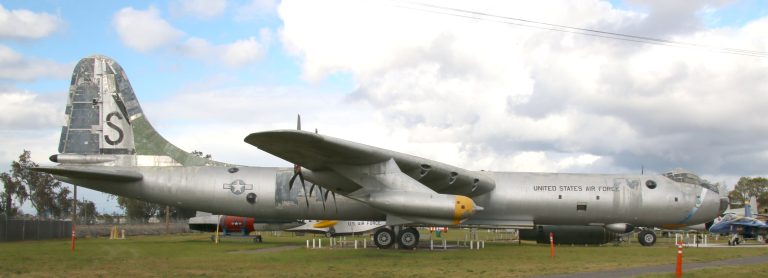
Four complete B-36s survive from 384 built, all of them originals and none a reproduction; there is no flying example and there never will be. RB-36H 51-13730 is at the Castle Air Museum, Atwater, California, having stood at Chanute Air Force Base, Illinois, from 1957 to 1991. B-36J 52-2217 is at the Strategic Air Command and Aerospace Museum near Ashland, Nebraska, moved there from Offutt Air Force Base. B-36J 52-2220 is at the National Museum of the United States Air Force at Wright-Patterson, Ohio; its flight from Davis-Monthan on 30 April 1959 was the last flight ever made by a B-36, and it is displayed beside the 2.74 m lower main gear strut, single wheel and tyre from the XB-36. B-36J 52-2827, the last of the line and named City of Fort Worth, is at the Pima Air and Space Museum in Tucson, having been lent to the city of Fort Worth on 12 February 1959, left outdoors for decades at Greater Southwest International Airport and then at the short-lived Southwest Aerospace Museum, repossessed by the NMUSAF and fully restored at Pima. The sole XC-99 also survives, dismantled and in store; 32 B-36s were written off in accidents between 1949 and 1957 and everything else was flown to Davis-Monthan and scrapped from February 1956 onward.
From wartime idea to nuclear shield
An impossible requirement
With Britain apparently near collapse, the U.S. Army Air Forces ask for a bomber able to strike Europe from North America and return — a 10,000-mile round trip without refuelling.
The giant flies
The XB-36 prototype makes its first flight on 8 August at Fort Worth, Texas — the largest bomber the world had yet seen.
Into Strategic Air Command
The first operational B-36s reach SAC’s 7th Bombardment Group at Carswell AFB, giving America its first true intercontinental nuclear delivery aircraft.
“Revolt of the Admirals”
The B-36 sits at the centre of a bitter inter-service fight, as the Navy questions whether the bomber, not its cancelled supercarrier, should carry the nuclear mission.
The first Broken Arrow
On 13–14 February a B-36B suffers engine fires over British Columbia; the crew jettison a Mark 4 bomb into the Pacific — the first loss of a U.S. nuclear weapon.
The nuclear-powered experiment
The one-off NB-36H flies with an operating nuclear reactor aboard, testing shielding for a proposed atomic-powered bomber that was never built.
The Peacemaker retires
The last B-36 flight is made on 30 April as the all-jet B-52 Stratofortress takes over the strategic mission. The type never fired a shot in combat.
Twelve stories from the age of the Peacemaker
The bomber for a Britain that might fall
A wartime nightmare — no bases left in Europe — produced the demand for a 10,000-mile bomber.
Read the full story
Wider than a 747
The B-36 remains the largest mass-produced piston aircraft and the longest-winged combat aircraft ever built.
Read the full story
Six turning, four burning
The ten-engine layout gave the aircraft its most famous phrase.
Read the full story
The 28-cylinder monster
The Wasp Major was the most powerful piston aero-engine ever mass-produced — and a maintenance nightmare.
Read the full story
The first Broken Arrow
America lost its first nuclear weapon from a burning B-36 off the coast of Canada.
Read the full story
The Revolt of the Admirals
The giant bomber ignited one of the fiercest inter-service fights in American history.
Read the full story
The flying reactor
One B-36 carried a working nuclear reactor aloft to test a dream that never flew.
Read the full story
A weapon that never fought
The Peacemaker’s entire career passed without a single combat mission.
Read the full story
Eyes over the enemy
Camera-carrying RB-36 variants turned the bomber into a strategic spy platform.
Read the full story
A fighter in its belly
The B-36 experimented with carrying its own parasite jet fighter for protection.
Read the full story
Passing the torch
The all-jet B-52 ended the Peacemaker’s reign after barely a decade.
Read the full story
Only four survive
Of 384 built, a mere handful of Peacemakers escaped the scrapyard.
Read the full story
The Peacemaker in pictures
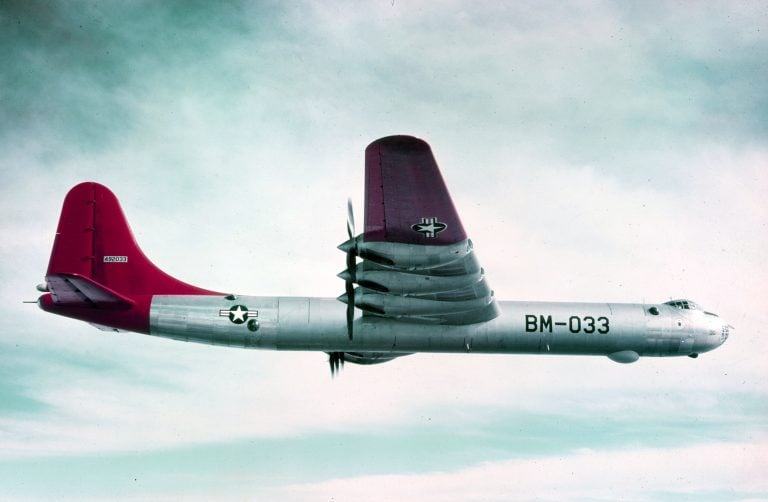
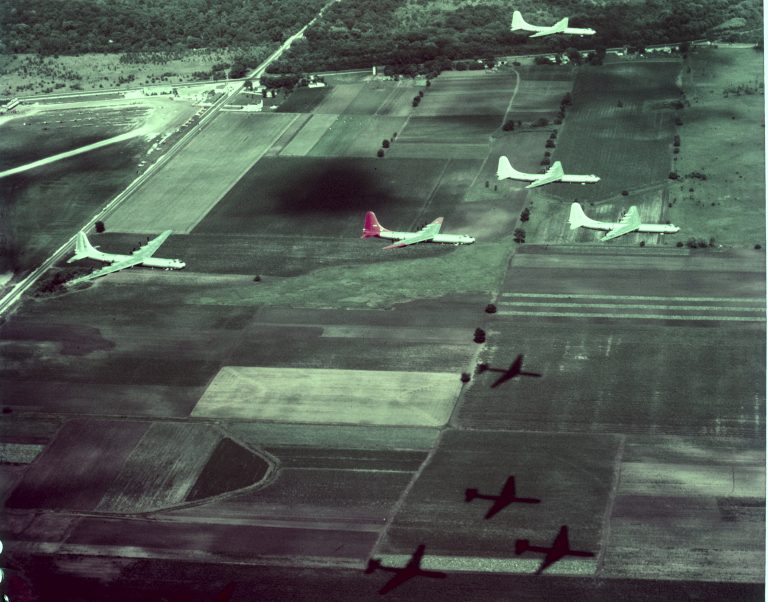
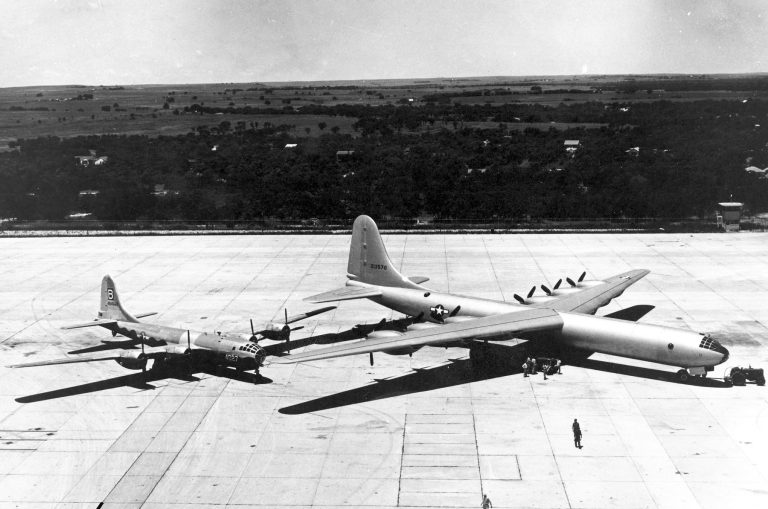
An all-American aircraft
The score that defines it: none, by design
The B-36 Peacemaker never flew a combat mission, never dropped a bomb in anger and never met an enemy aircraft in the air. That is not a footnote — it is the whole point. The Peacemaker was a deterrent weapon whose success was measured by the war it helped prevent. For a decade it stood ready to carry America’s nuclear arsenal across the world, and its entire record is written in readiness rather than kills.
Compare the combat record of every military aircraft. Figures as of July 2026.
Everything people ask about the B-36 Peacemaker
Can I fly in a B-36?
Why does the B-36 have both propellers and jets?
How big is the B-36 Peacemaker?
Did the B-36 ever see combat?
What was the 1950 B-36 “Broken Arrow”?
How far could the B-36 fly?
Why was the B-36 retired so quickly?
Are any B-36s still around?
You can’t fly the B-36.
These, you can.
Some legends only live in museums — others are fuelled and waiting. MiGFlug has put civilians in real military jet cockpits since 2004.
 Fly the L-39 AlbatrosThe world’s most-flown jet trainer — aerobatics included
 Fly the F-104 Starfighter“The missile with a man in it”
 Fly the MiG-21The Cold War’s most-produced jet
 Fly the T-33 Shooting StarAmerica’s first jet trainer
 Fly the DH VampireA piece of early jet history
 Fly the S.211Agile Italian jet trainer
 Fly the MB-326The classic Aermacchi jet
 Fly the MiG-15The Soviet legend of the Korean War
Continue the tour
Every fact, checked
- National Museum of the U.S. Air Force — Convair B-36J fact sheetPrimary reference for dimensions, weights, crew, service dates and the last B-36 flight.
- The War Zone — America’s First Broken Arrow IncidentDetailed account of the 13–14 February 1950 B-36B loss off British Columbia.
- Smithsonian Air & Space — B-36: Bomber at the CrossroadsThe programme politics, the “Revolt of the Admirals” and the B-36’s strategic role.
- Simple Flying — The Convair B-36 Bomber: A HistoryOverview of design, the six-turning-four-burning powerplant and career.
- The National Interest — The Biggest Bomber Ever BuiltContext on the B-36 as the largest mass-produced piston bomber and deterrent.
- Vintage Aviation News — Castle Air Museum RB-36HSurvivor history and reconnaissance-variant background.
- Airplanes-Online — About the B-36 PeacemakerDevelopment timeline, service entry and surviving-airframe details.
- Bureau of Aircraft Accidents Archives — B-36 recordCross-check for the type’s accident history.