
A mediocre little wing-warping monoplane made deadly by the first practical machine gun that could fire straight through a spinning propeller. For a few months over the Western Front it made the Fokker name a byword for fear — the “Fokker Scourge” of 1915–16.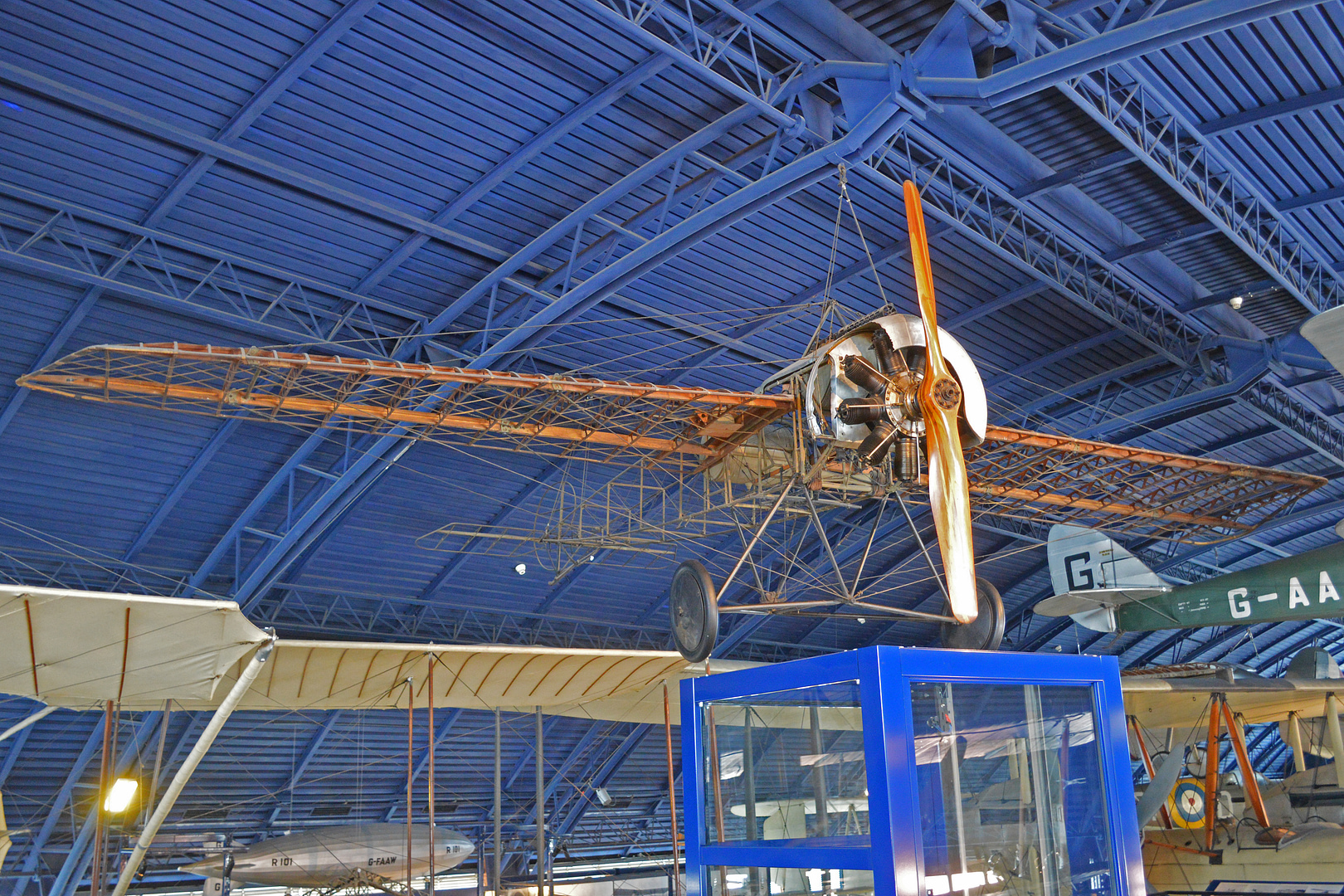
Fokker Eindecker
“The monoplane that won the sky with one gun — and a good idea it did not invent”
The Fokker Eindecker: how a modest monoplane and one clever gun gave Germany the sky in 1915
El Fokker Eindecker — German for simply “monoplane” — is one of history’s great reminders that a fighter is a weapons system, not just an airframe. On its own the Eindecker was unremarkable. Anthony Fokker’s design team took the layout of the pre-war French Morane-Saulnier H, built it with a welded steel-tube fuselage and a wire-braced, wing-warping monoplane wing, and hung an Oberursel rotary engine of about 80 to 100 horsepower on the nose. It was slow, it climbed indifferently, and it turned on a wing that twisted rather than using ailerons. As a flying machine it was already dated the day it appeared.
What made it lethal was bolted to the top of the fuselage: a single 7.92 mm lMG 08 “Spandau” machine gun coupled to a working synchronisation (interrupter) gear — the Fokker Stangensteuerung, a pushrod mechanism that timed the gun to fire between the blades of the spinning propeller. For the first time a pilot could aim his whole aeroplane at an enemy and fire straight ahead, without shooting off his own propeller. Point the nose, press the trigger. It sounds obvious now; in mid-1915 it was revolutionary.
The effect on the Western Front was immediate and one-sided. From the late summer of 1915 into the spring of 1916, small numbers of Eindeckers — never more than a few dozen at the front at any time — hunted the slow, largely defenceless Allied two-seater reconnaissance machines almost at will. British and French airmen called this grim season the “Fokker Scourge”, and the British press coined the bitter phrase “Fokker Fodder” for the crews sent up against it. The aircraft itself had not improved; the tactics y el gun had changed everything.
The Eindecker also made the first German air heroes. Max Immelmann, the “Eagle of Lille”, and Oswald Boelcke flew it to early fame and, in January 1916, became the first airmen awarded the Pour le Mérite. Boelcke used his time on the Eindecker to think systematically about aerial fighting, distilling hard lessons into the Dicta Boelcke — the founding rules of fighter tactics that air forces still teach in spirit today.
It did not last. The Eindecker’s dominance rested on a temporary technical monopoly, and monopolies in war are brief. By the spring and summer of 1916 the Allies fielded nimble, better-climbing machines — the Nieuport 11 “Bébé” y Nieuport 17, and the pusher Airco DH.2 — and the French had their own synchronised guns coming. Suddenly the slow, warping-winged Fokker was the hunted, not the hunter. Immelmann was dead by June 1916; the Eindecker was pulled from the front line before the year was out. Its reign had lasted barely nine months, but it had changed air warfare permanently: after the Eindecker, every serious fighter carried a synchronised gun firing through the propeller.
“The Eindecker won nothing with its wings. It won with a gun that could shoot where the pilot looked — and with two men who worked out what to do with it.”
01The Fokker Eindecker’s origins: a copied French monoplane, rescued by an idea Fokker did not invent
The airframe began as a near-copy of the Morane-Saulnier Type H, a French sporting and scouting monoplane Fokker’s firm studied closely. Fokker rebuilt it in his own idiom — a welded chrome-molybdenum steel-tube fuselage in place of wood, and his characteristic one-piece warping wing — producing the unarmed M.5 reconnaissance monoplane, from which the armed A-series and then the E-series (Eindecker) fighters were derived.
The decisive addition, the synchronisation gear, has a tangled history that is often told too simply. The concept was not Fokker’s: the Swiss engineer Franz Schneider had patented a synchroniser in 1913, and the Frenchman Raymond Saulnier had experimented with one in 1914 before falling back on crude propeller deflector wedges — the same bullet-deflecting plates that Roland Garros famously used in early 1915 (a different, cruder solution than true synchronisation). When Garros was forced down behind German lines in April 1915, his deflector-equipped Morane was captured. The popular story that Fokker then personally invented synchronisation in 48 hours is a marketing legend Fokker himself encouraged. In reality his engineers — among them Heinrich Lübbe and colleagues — developed a practical pushrod interrupter that timed the gun rather than deflecting bullets. The honest summary: the working mechanism is popularly credited to Fokker but built on earlier ideas, and engineered by his team.
What the Fokker Eindecker actually was: three parts, one of which mattered
The synchronised gun — the whole point
A single 7.92 mm lMG 08 “Spandau”, mechanically linked to the engine so it fired only when a propeller blade was clear. This, not the airframe, is why the Eindecker mattered. It let one man aim the aeroplane and the gun as a single instrument.
A borrowed, wing-warping airframe
A welded steel-tube fuselage carrying a wire-braced monoplane wing derived from the Morane-Saulnier H. Roll control came from warping (twisting) the whole wing, not from ailerons — already old-fashioned by 1915 and heavy to fly.
An Oberursel rotary engine
A 9-cylinder Oberursel rotary — essentially a licence copy of the French Gnome — of roughly 80 hp (E.I/E.II) to 100 hp (E.III). The whole engine spun with the propeller, giving strong gyroscopic torque that shaped how the aircraft turned.
02The Fokker Eindecker’s armament: the Spandau gun and the Stangensteuerung interrupter, explained
Early Eindeckers (E.I) usually carried a single air-cooled lMG 08 — the aircraft version of the Maxim-derived MG 08, universally nicknamed “Spandau” after the arsenal that built it. The gun was fixed, pointing straight forward over the cowling, and fed by a fabric or metal-link belt. The Fokker Stangensteuerung (“pushrod control”) took a drive off the engine and, through a system of cams and rods, physically interrupted the gun’s firing at the instants a blade was in front of the muzzle. Rate of fire dropped a little compared with a free-firing gun, but the pilot could now hold the target in his sights and shoot down the line of flight.
Later variants raised the firepower: the E.IV was designed around two — occasionally three — synchronised guns, though the extra weight and the drag hurt an airframe that was already struggling to keep up with newer Allied fighters. Reliability of the gear varied; jams and the occasional shot-through propeller blade were not unknown, and pilots treated the mechanism with respect.
03The Fokker Eindecker’s flying qualities: warping wings, rotary torque and honest hard work
By the standards of even 1916 the Eindecker was not pleasant to fly. Roll was commanded by warping the flexible wing via cables to a control “cloche”, which was heavy and imprecise and grew worse as speed rose. The rotary engine had essentially one power setting; pilots managed thrust by “blipping” the ignition with a button, cutting and restoring the spark. The spinning mass of the engine produced strong gyroscopic precession, so the aircraft turned readily one way and reluctantly the other — a quirk skilled pilots exploited and novices feared.
Performance was modest: an E.III made roughly 130–140 km/h flat out and took a long time to reach its ceiling of about 3,600 m. It was the gun and the tactics of men like Boelcke — diving out of the sun, attacking from the blind spot behind and below a two-seater — that turned this ordinary flying machine into a killer.
04The Fokker Eindecker variants: from the E.I to the twin-gun E.IV
E.I (1915): first production fighter version, ~80 hp Oberursel U.0, one gun — the machine that opened the Fokker Scourge. E.II: a mostly parallel development with the more powerful ~100 hp U.I rotary and a slightly shorter wing. E.III: the most numerous and best-known variant, ~100 hp, one gun, the definitive Eindecker and the type most often preserved. E.IV: an attempt to keep the design competitive with a heavier ~160 hp two-row Oberursel U.III and twin guns; the bigger engine was unreliable and the airframe was by then outclassed. Total production of all Eindecker variants is usually given as about 416 aircraft, though sources disagree and the figure should be treated as approximate.
Fokker Eindecker (E.III) specifications, with the figures worth doubting flagged
Airframe & Performance (E.III)
- Multitud
- 1 — pilot
- Longitud
- ~7.2 m (some sources ~7.3 m)
- Envergadura
- ~9.5 m (9.52 m)
- Altura
- ~2.4 m
- Área del ala
- ~16 m²
- Empty / loaded weight
- ~399 kg / ~610 kg (approx.)
- Max speed
- ~140 km/h (87 mph); sources vary ~130–140 km/h (estimate)
- Techo de servicio
- ~3,600 m (approx.)
- Climb
- ~30 min to 3,000 m (estimate)
- Endurance
- ~1.5 hours
- Roll control
- Wing warping (no ailerons)
Powerplant, Armament, Production & Cost
- Engine (E.III)
- Oberursel U.I 9-cyl rotary, ~100 hp (Gnome licence copy)
- Engine (variants)
- ~80 hp U.0 (E.I) · ~160 hp two-row U.III (E.IV)
- Armament (E.I–E.III)
- 1 × 7.92 mm lMG 08 “Spandau”, synchronised
- Armament (E.IV)
- 2 (occasionally 3) synchronised guns
- Synchroniser
- Fokker Stangensteuerung pushrod interrupter gear
- Number built
- ~416 all variants (figures vary — approximate)
- First combat use
- Summer 1915 (E.I)
- Front-line service
- 1915 – late 1916
- Unit cost (1915)
- Not reliably recorded
- Cost per flight hour
- Not reliably recorded (1915) · modern airworthy reproductions are estimated to cost several hundred to ~US$1,000+ per hour to operate (rough estimate, not an original figure)
05The Fokker Eindecker’s operating costs: why there is no honest “price per hour” for a 1915 fighter
No reliable unit price or cost-per-flight-hour survives for the Eindecker. In 1915 military aircraft were procured in small batches under wartime conditions; the currency (the pre-inflation gold Mark), the accounting, and the record-keeping simply do not translate into a meaningful modern figure. Any “cost” you see quoted for an original Eindecker is effectively invented.
What can be said is that the type was cheap and quick to build by the standards of the day — a steel-tube fuselage and a simple warping wooden wing, powered by an existing rotary engine. The real running cost today attaches to the airworthy reproductions flown by collections such as The Vintage Aviator in New Zealand: rotary engines are thirsty, temperamental and expensive to maintain, and hand-built WWI aircraft demand specialist care. Operating estimates for such machines run from several hundred dollars to over a thousand dollars per flying hour — but that is a modern reproduction figure, clearly flagged as an estimate, not a historical cost.
06Fokker Eindecker variants and serial figures: reading the E.I–E.IV numbers with caution
Production totals for the Eindecker are quoted inconsistently across references. The commonly cited overall figure is about 416 aircraft across the E.I, E.II, E.III and E.IV, with the E.III the most numerous. Some sources break the numbers down differently or count the unarmed M.5 monoplanes and A-series scouts alongside the fighters, which inflates or deflates the tally depending on how you draw the line. Treat any precise breakdown as an approximation; the honest statement is that Eindeckers were built in the low hundreds, never in the thousands, and that only a handful were ever at the front simultaneously — part of why so few genuine airframes survive today.
The Fokker Eindecker’s brief, decisive career
The idea, before Fokker
Franz Schneider patents a gun-synchroniser in 1913; Raymond Saulnier experiments with one in 1914. The concept of firing through the propeller arc predates the Eindecker by years.
Garros captured
Roland Garros, flying a Morane fitted with crude bullet-deflecting wedges, is forced down behind German lines. His aircraft is captured and studied — sharpening German interest in forward-firing guns.
The Eindecker is armed
Fokker’s team develops a practical pushrod interrupter gear and fits it to the M.5-derived monoplane, creating the E.I — the first purpose-built fighter to combine a fixed forward gun with reliable synchronisation.
First victories
Kurt Wintgens scores an early Eindecker success in July; through the late summer Boelcke and Immelmann begin building their tallies. The “Fokker Scourge” opens over the Western Front.
The Scourge at its height
Small numbers of Eindeckers dominate Allied reconnaissance aircraft. The RFC is forced to fly escorted formations; British crews grimly call themselves “Fokker Fodder”.
The first Pour le Mérite airmen
Max Immelmann and Oswald Boelcke become the first aviators awarded Prussia’s highest order — the “Blue Max” — cementing the Eindecker’s aces as national heroes.
The tide turns
The Nieuport 11 “Bébé” and the Airco DH.2 reach the front. Faster, better-climbing and more manoeuvrable, they end the Eindecker’s monopoly within months.
Eclipse and withdrawal
Immelmann is killed on 18 June 1916. Outclassed and outnumbered, the Eindecker is pulled from front-line service by the end of the year — but every fighter that followed carried its great innovation, the synchronised gun.
The people and legends behind the Fokker Eindecker
Max Immelmann becomes Germany’s first air hero
A former cadet with a reputation for mechanical fussiness became the face of the Fokker Scourge.
Read the full story
Oswald Boelcke writes the rules of air fighting
The Eindecker gave Boelcke the tool; he supplied the thinking that outlived the aircraft.
Read the full story
The “Immelmann turn”: name, myth and reality
The manoeuvre in the aerobatics manual is probably not the one Immelmann actually flew.
Read the full story
Kurt Wintgens and the first synchronised-gun victory
Weeks before Immelmann and Boelcke made headlines, a quieter pilot may have drawn first blood.
Read the full story
Roland Garros and the deflector wedges
Before synchronisation, one Frenchman simply armoured his propeller — and inadvertently helped the enemy.
Read the full story
The RFC’s grim winter of 1915–16
A handful of monoplanes forced a whole air service to change how it flew.
Read the full story
Anthony Fokker and a very useful legend
The most famous story about the synchroniser is the one its beneficiary told about himself.
Read the full story
Blipping, warping and gyroscopic torque
Flying the Eindecker was a workout of switches, cables and physics.
Read the full story
How Max Immelmann died — and the argument that followed
His death on 18 June 1916 became a controversy that touched the Eindecker’s own weak point.
Read the full story
Boelcke’s school and the aces who followed
The Eindecker era ended, but the thinking it fostered produced the war’s great fighter pilots.
Read the full story
The genuine E.III at the Science Museum, London
One of very few real Eindeckers left in the world sits, quietly, in South Kensington.
Read the full story
The Vintage Aviator’s airworthy reproduction
You cannot fly an original — but faithful reproductions have put the Eindecker back in the air.
Read the full story
The Fokker Eindecker in photographs
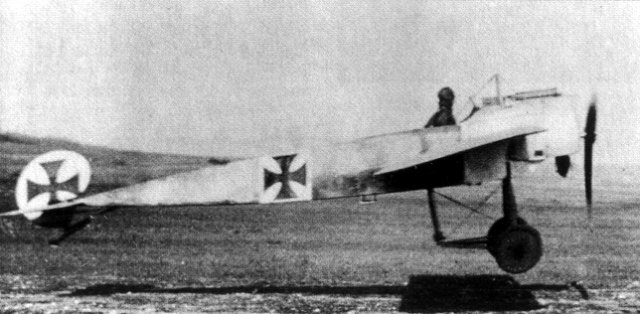
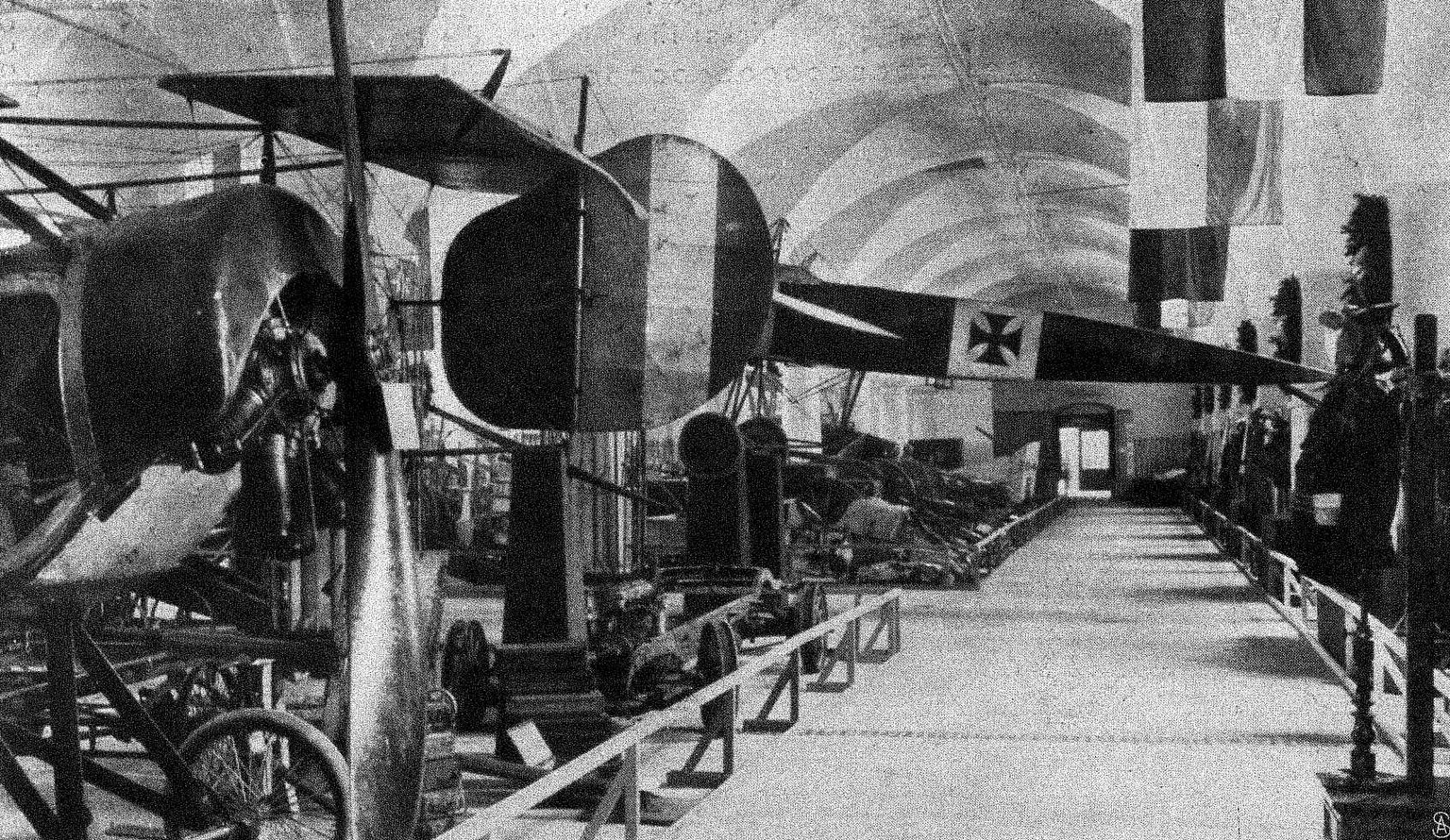
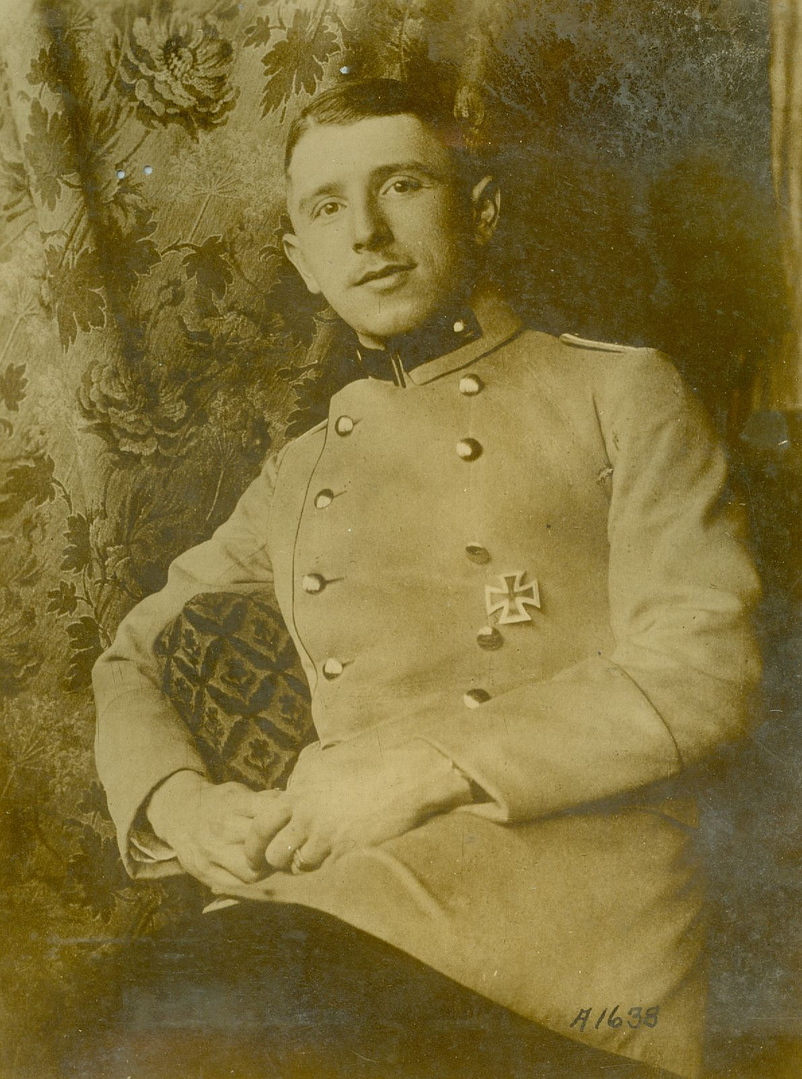
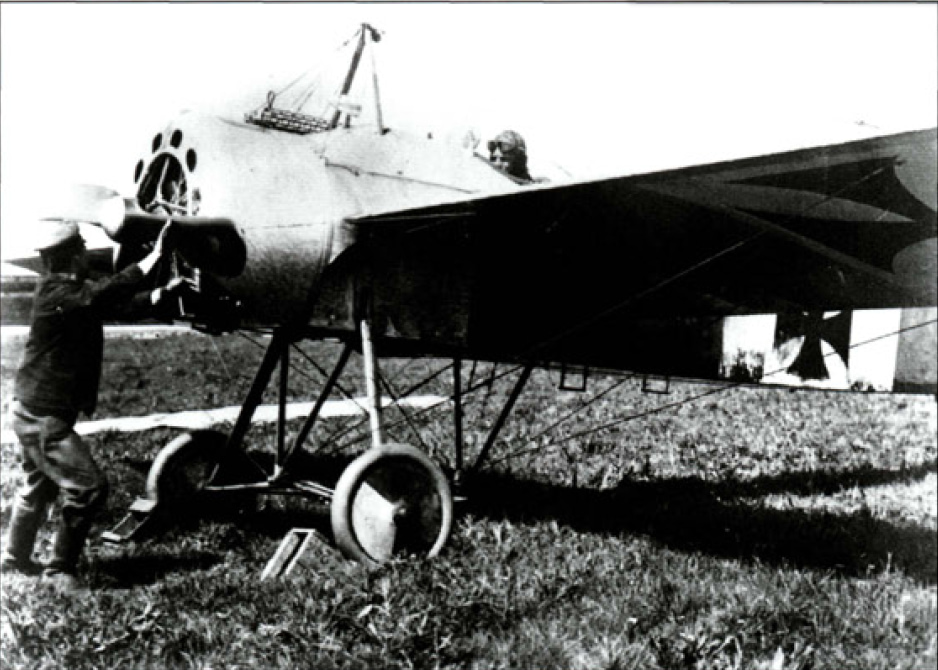
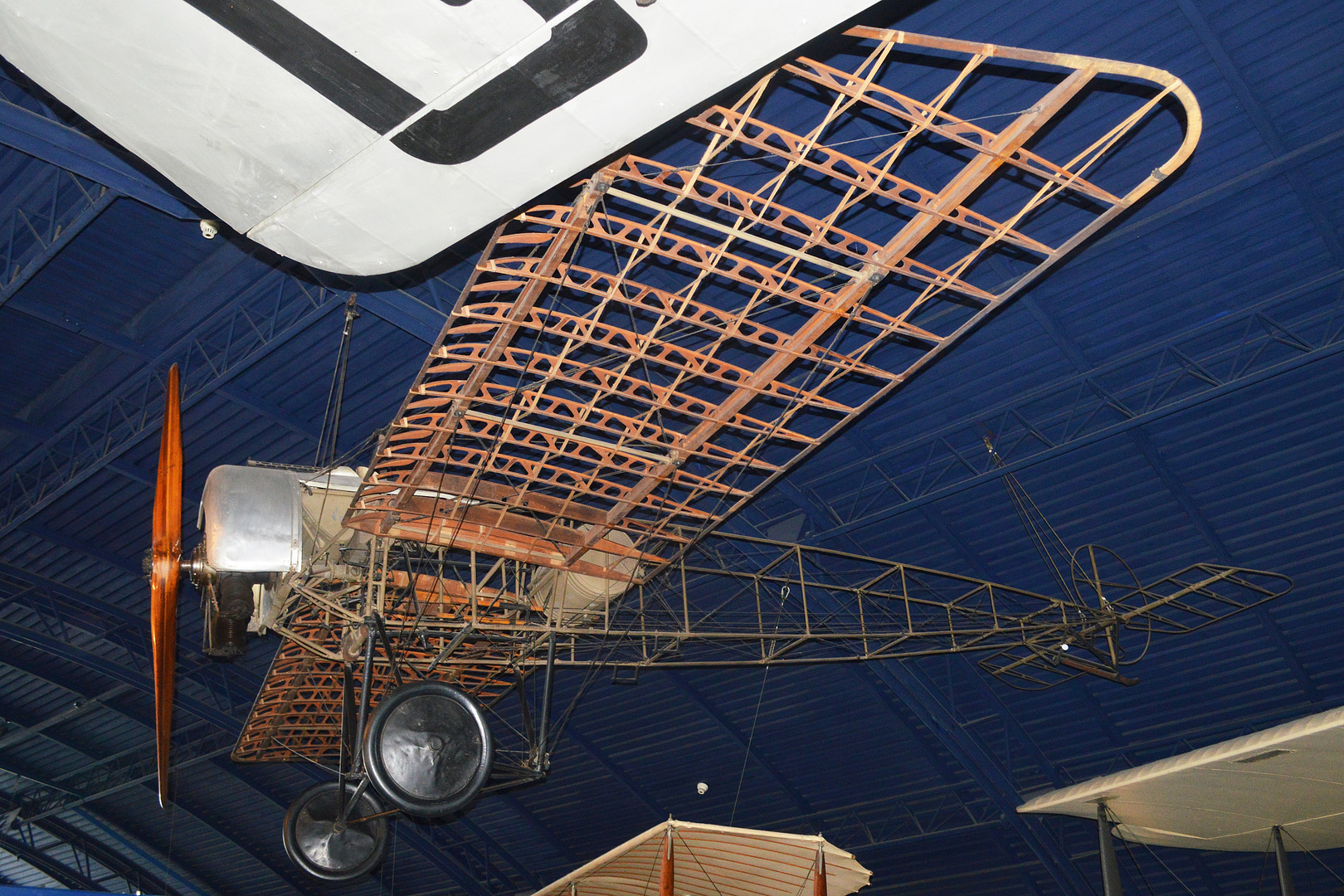
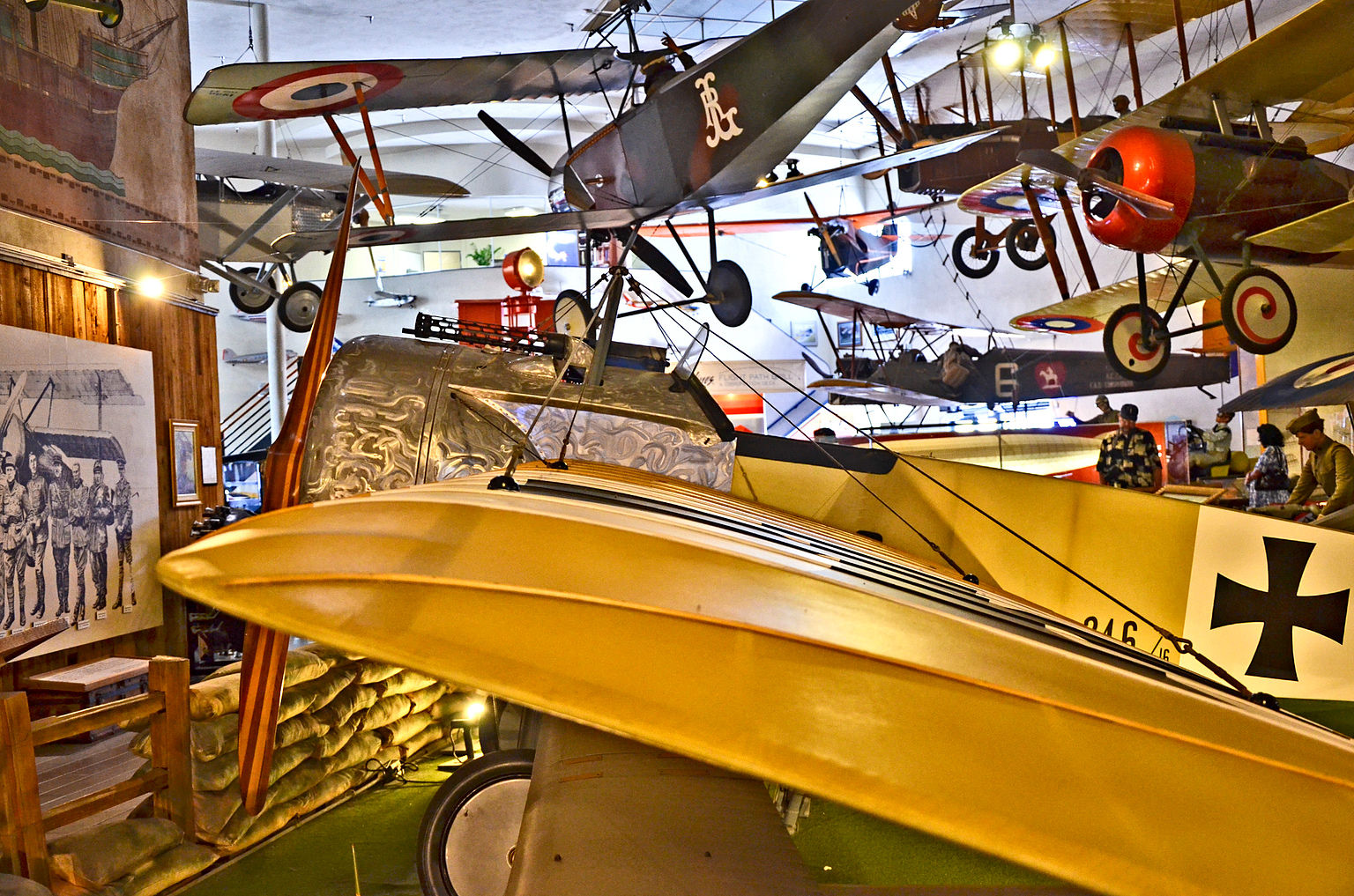
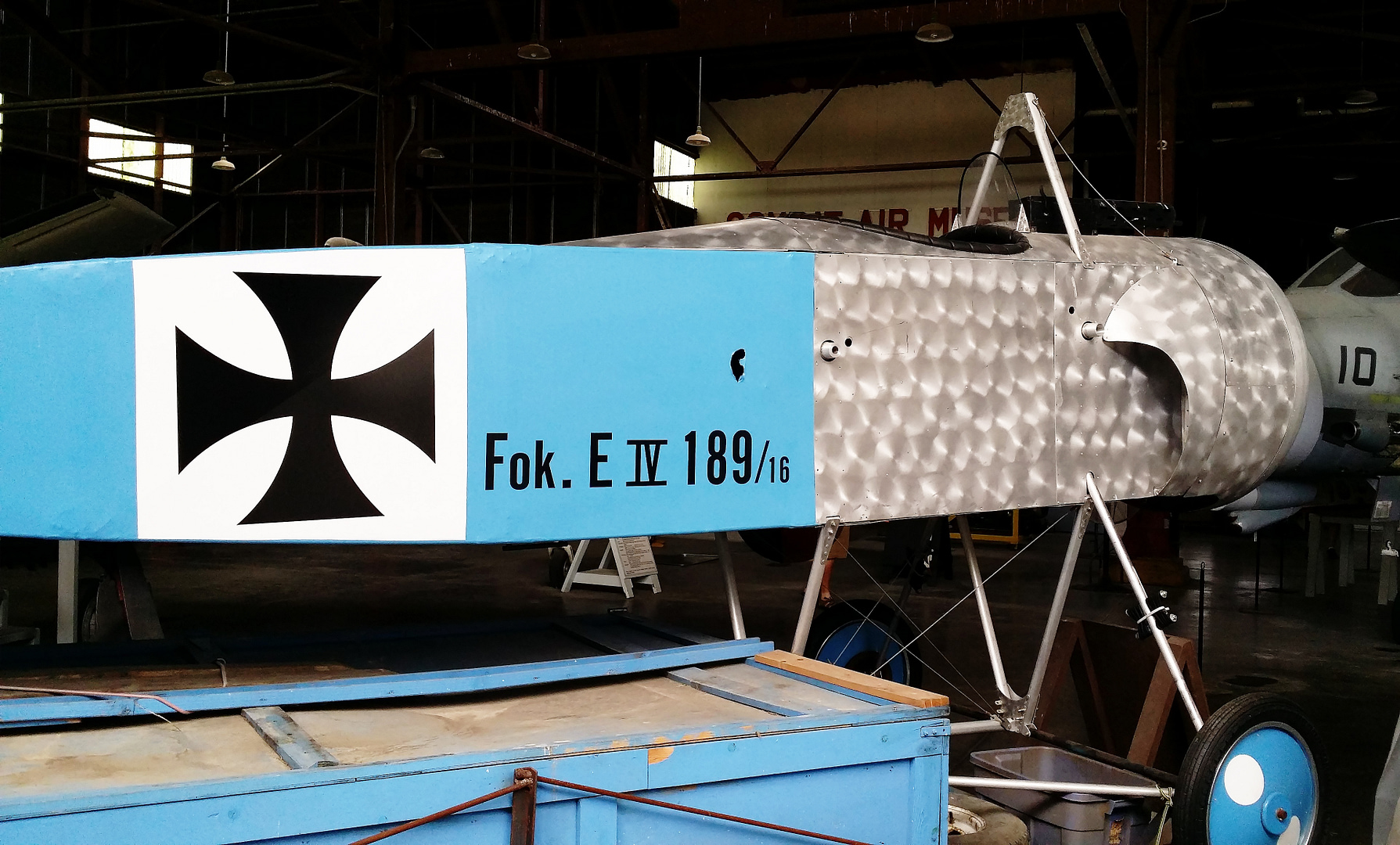
Tap any photograph to enlarge. All images are public domain or Creative Commons via Wikimedia Commons; individual credits are shown on each caption.
The Fokker Eindecker in the air
Real footage of The Vintage Aviator Collection’s airworthy Fokker Eindecker (1915) reproduction and its Oberursel-type rotary engine, filmed by the Historical Aviation Film Unit — a rare look at how the Fokker Scourge fighter actually flew. (Channel: Historical Aviation Film Unit · ~41,900 views · 2024.)
Where the Fokker Eindecker flew, fought and survives
The Eindecker was a German aircraft through and through — designed, built and overwhelmingly flown by Germany, with a handful passing to its Central Powers allies. It had no export career; its worldwide footprint today is measured in the few genuine survivors and the airworthy reproductions that keep it flying. Toggle the categories to see origin, wartime operators, captured examples and where airframes and replicas are found today.
The mark the Fokker Eindecker left on air warfare
Victory tallies and production figures from the First World War are inherently uncertain, and Eindecker numbers in particular are quoted inconsistently across sources. Figures here are given as approximations. The Eindecker’s true significance is not a body count but a principle: it proved the synchronised forward-firing gun, and every fighter that followed was built around that idea.
Fokker Eindecker: your questions answered
Can I fly in a Fokker Eindecker?
What made the Fokker Eindecker so dangerous in 1915–16?
Did Anthony Fokker invent the synchronisation gear?
Was the Fokker Eindecker actually a good aircraft?
What is the “Immelmann turn”, and did Max Immelmann invent it?
How many Fokker Eindeckers were built, and do any survive?
You can’t fly the Nieuport 17.
These, you can.
Some legends only live in museums — others are fuelled and waiting. MiGFlug has put civilians in real military jet cockpits since 2004.
 Fly the L-39 AlbatrosThe world’s most-flown jet trainer — aerobatics included
 Fly the F-104 Starfighter“The missile with a man in it”
 Fly the MiG-21The Cold War’s most-produced jet
 Vuela el T-33 Shooting StarAmerica’s first jet trainer
 Fly the DH VampireA piece of early jet history
 Fly the S.211Agile Italian jet trainer
 Fly the MB-326The classic Aermacchi jet
 Fly the MiG-15The Soviet legend of the Korean War
Explore more of the collection
Where this Fokker Eindecker profile comes from
- Science Museum, LondonHome of the genuine surviving Fokker E.III (serial 210/16), captured on the Western Front in 1916.
- Smithsonian National Air and Space MuseumFirst World War aviation, fighter development and the coming of the synchronised gun.
- Imperial War Museums — The Birth of Military AviationThe Fokker Scourge of 1915–16 and the Allied response that ended it.
- Royal Air Force MuseumThe Royal Flying Corps’ ordeal against the Eindecker and the “Fokker Fodder” era.
- San Diego Air & Space Museum — Fokker E.IIIA flyable Fokker E.III reproduction and notes on the type’s history.
- The Museum of Flight — Fokker E.III ReproductionMuseum reference on the Eindecker’s design and combat significance.
- Military Aviation Museum — Fokker E.III EindeckerA flying Eindecker reproduction with historical background on the type.
- The Vintage AviatorOn building and flying accurate airworthy Fokker Eindecker reproductions and their rotary engines.
- J.M. Bruce — standard WWI aircraft referencesBruce’s technical works (e.g. German Aircraft of the First World War) underpin the Eindecker’s specifications and serial figures cited here.