

Aermacchi MB-339
Italy’s jet trainer
The docile, stepped-cockpit trainer that taught generations of Italian pilots, became the smoke-trailing heart of the Frecce Tricolori, and went to war over the South Atlantic in Argentine hands.
The trainer that became a national symbol
By the early 1970s the Italian Air Force needed a modern jet to replace the Aermacchi MB-326, the straight-wing trainer that had carried Italian and export pilots through the jet age since the 1950s. Rather than start from a clean sheet, Aermacchi’s designers at Varese reworked the MB-326’s proven airframe into a new machine with a raised, stepped tandem cockpit and swept tail. The result, the MB-339, first flew on 12 August 1976 and entered service in 1979.
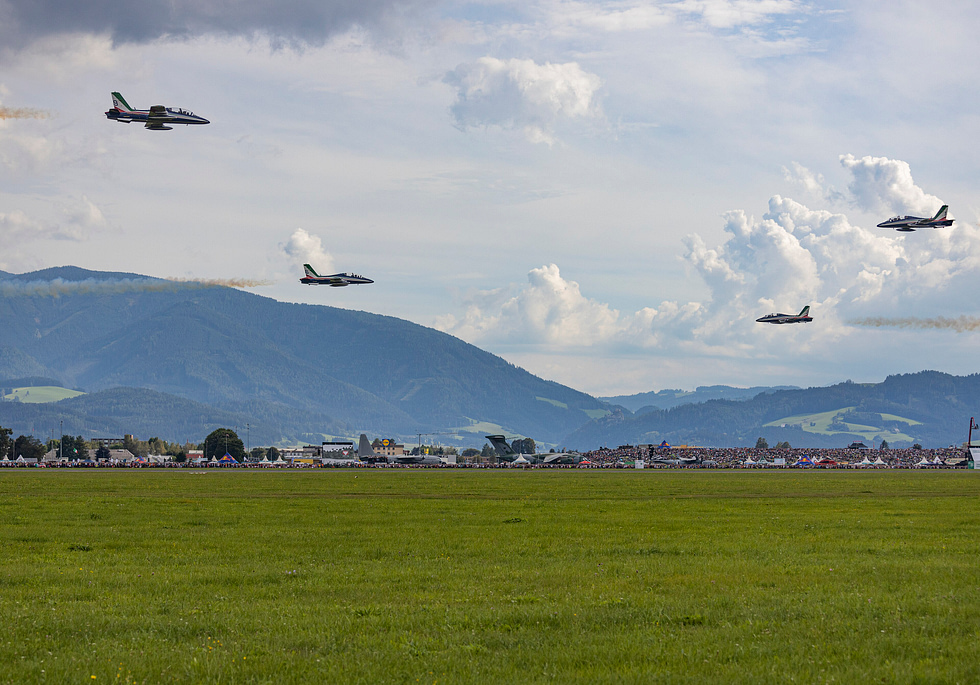
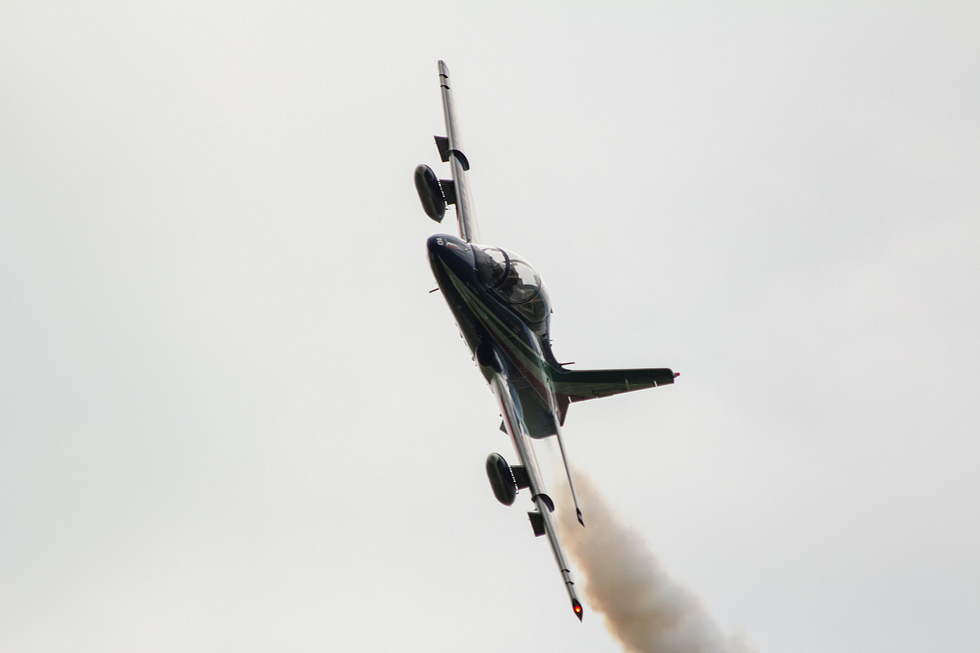
It was never meant to be fast or fierce. The MB-339 was built to be honest — forgiving enough for a student on an early solo, yet capable enough to teach weapons delivery and formation flying. That same docility made it the natural choice for Italy’s Frecce Tricolori display team, who adopted the type in 1982 and still fly ten of them — nine in formation and a soloist — making them the largest aerobatic team in the world.
But the MB-339 also went to war. Argentina’s Navy flew it in ground attack during the 1982 Falklands conflict; Eritrea used armed examples against Ethiopia at the end of the 1990s. And the type is bound up with one of aviation’s worst public tragedies — the 1988 Ramstein air-show disaster. Nearly half a century after its first flight, the MB-339 is only now being retired in Italy in favour of the Aermacchi M-346.
01From MB-326 to MB-339: how Aermacchi evolved a Cold-War classic
The MB-339 is best understood as a deep evolution of the MB-326 rather than an all-new aircraft. Aermacchi kept the earlier jet’s wing and much of its structure — a decision that cut cost and risk — but raised the rear (instructor) seat and reshaped the forward fuselage to give both crew a proper view over the nose, the classic stepped tandem cockpit. A new swept fin and rudder improved handling at the margins of the envelope. Power came from an uprated Rolls-Royce Viper. The lineage runs on: the related MB-326 is covered in its own exhibit, and the two aircraft together trace Aermacchi’s long dominance of the Western jet-trainer market.
What makes the MB-339 special
A stepped cockpit built to teach
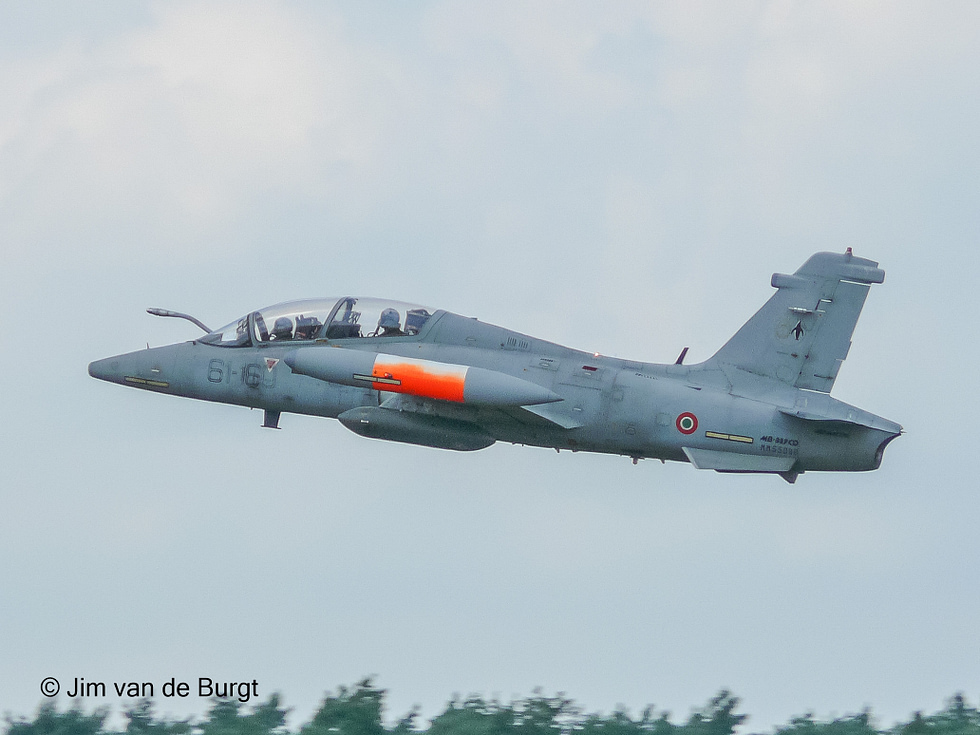
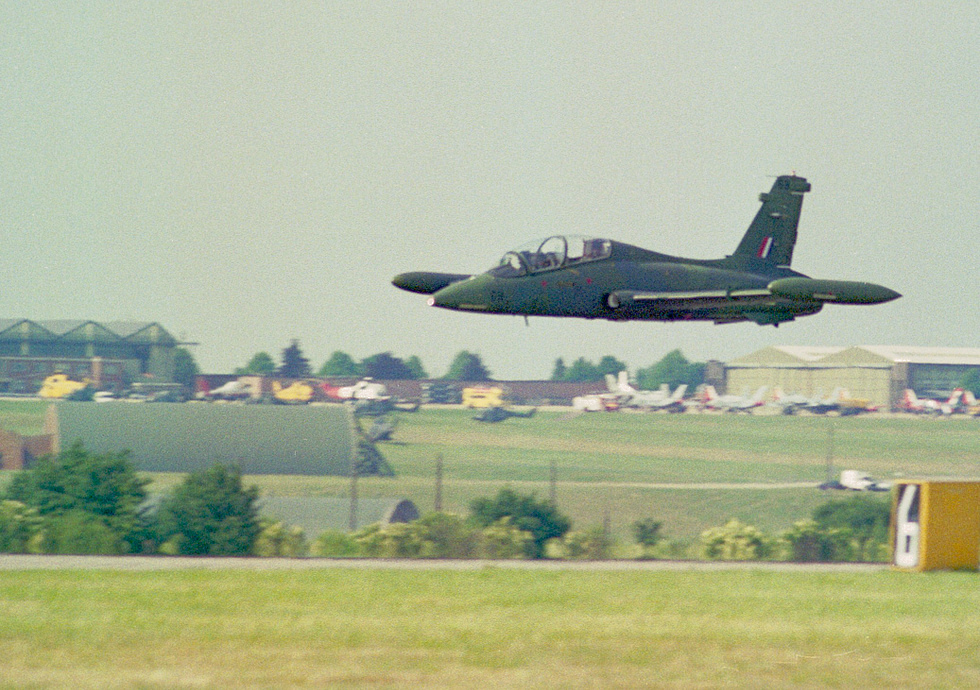
The MB-339’s defining feature is its raised rear seat. On the MB-326 the instructor sat low, with a poor view forward; on the MB-339 the back-seater is stepped up behind the student, giving a clear sightline over the nose for landings and weapons work. Combined with docile, honest handling and Martin-Baker Mk 10 ejection seats, it made an ideal machine for taking a pilot from first solo to combat-ready.
The Rolls-Royce Viper — simple and robust
Power comes from a single Rolls-Royce Viper turbojet — the Mk 632 of about 4,000 lbf (17.8 kN) in the MB-339A, and the more powerful Viper 680 (~4,300 lbf) in the C/CD and Eritrean CE variants. It is an old, un-reheated design, but it is cheap to run, tolerant and easy to maintain — exactly what an air force wants in a jet that logs thousands of training hours.
Trainer by day, light striker by need
Six underwing hardpoints let the MB-339 carry up to about 1,815 kg of stores: gun pods, bombs, rockets, air-to-air missiles and, on the C/CD, the Marte anti-ship missile. The single-seat MB-339K Veltro 2 pushed this furthest with two 30 mm DEFA cannon, though it found no buyers. In practice the type’s war record was written by lightly-armed trainers pressed into attack.
02The MB-339’s cockpit: why a raised back seat mattered
Training accidents often happen in the circuit and on approach, where an instructor who cannot see what the student sees is nearly helpless. The MB-339’s stepped layout — the rear seat lifted well above the front — was a direct answer, giving the instructor a genuine view of the runway during the most dangerous phases of flight. The wide, uncluttered canopy and gentle stall behaviour reinforced the design goal: an aircraft that lets a student make mistakes and recover from them. It is unglamorous engineering, but it is the reason the MB-339 endured for decades as a primary and advanced trainer.
03The MB-339’s versatility: anti-ship missiles on a trainer
The dedicated attack subtypes gave the MB-339 a punch out of proportion to its trainer roots. The MB-339C/CD added a digital nav/attack system and could carry the Marte Mk 2 sea-skimming anti-ship missile — a genuine maritime-strike capability on an airframe designed to teach students to fly. The one-off MB-339K Veltro 2 deleted the second seat entirely for a pair of 30 mm cannon and a heavier weapons load. Few of these attack versions sold, and the type’s real combat use came from ordinary armed trainers — but the versatility was real, and it is why small air forces bought the MB-339 as a do-everything jet.
Full specifications
Airframe & Performance
- Multitud
- 2 (tandem, stepped)
- Longitud
- ~10.97 m (MB-339C ~11.24 m)
- Envergadura
- ~10.86 m (11.22 m over tip tanks)
- Altura
- ~3.99 m
- Peso vacío
- ~3,125 kg
- Max takeoff weight
- ~6,350 kg (with external stores)
- Max speed
- ~898 km/h (485 kn) at sea level
- Techo de servicio
- ~14,000 m (~46,700 ft)
- Ferry range
- ~1,760 km
- Tasa de ascenso
- ~33.5 m/s
Propulsion & Systems
- Motor
- 1 × Rolls-Royce Viper (Mk 632 / 680)
- Empuje
- ~17.8–19.6 kN (~4,000–4,400 lbf)
- Asientos eyectables
- Martin-Baker Mk 10 (zero-zero)
- Puntos duros
- 6 · up to ~1,815 kg
- Armamento
- Gun pods, bombs, rockets, AAMs, Marte anti-ship
- First flight
- 12 August 1976
- Built
- ~230 (from 1978)
- Cost per flight hour
- No reliable public figure
04The MB-339’s numbers: why specs vary between sources
Published MB-339 figures differ because the family spans two decades and several distinct variants. The early MB-339A trainer, the uprated MB-339C/CD, the smoke-equipped PAN of the Frecce Tricolori and the single-seat Veltro 2 carry different engines, weights and dimensions, so a length of ~10.97 m for the A can become ~11.24 m for the C, and empty and maximum weights shift with fuel, tip tanks and stores. The values here are typical mid-range figures; treat any single precise number as variant-dependent. No credible open cost-per-flight-hour figure exists for the type.
From drawing board to long goodbye
Requirement & selection
The Italian Air Force seeks an MB-326 replacement; Aermacchi’s MB-339 design is chosen in 1975.
First flight
The prototype flies on 12 August 1976, powered by a single Rolls-Royce Viper turbojet.
Enters service
The MB-339A becomes the Italian Air Force’s standard advanced trainer.
Frecce Tricolori & the Falklands
Italy’s display team adopts the MB-339PAN; the same year Argentine Navy MB-339s see combat in the South Atlantic.
The C/CD generation
The digital nav/attack MB-339C first flies, adding modern avionics and, later, an aerial-refuelling probe.
Ramstein disaster
Three Frecce Tricolori MB-339s collide during a display in West Germany; 70 people are killed, hundreds injured.
Combat over the Horn
Eritrean MB-339CEs fly bombing missions during the war with Ethiopia.
The M-346 succession
Italy confirms the Aermacchi M-346 will replace the MB-339, including with the Frecce Tricolori.
Twelve stories from the MB-339
Born from the MB-326
Aermacchi reworked its proven MB-326 into a modern stepped-cockpit trainer.
Read the full story
Into the air over Varese
The prototype MB-339 first flew on 12 August 1976.
Read the full story
The world’s largest aerobatic team
The Frecce Tricolori fly ten MB-339s — nine in formation plus a soloist.
Read the full story
Crippa’s lone attack run
A single MB-339 burst over the San Carlos landings and strafed HMS Argonaut.
Read the full story
A jet lost near Goose Green
The same day, an armed MB-339 was shot down and its pilot killed.
Read the full story
The Ramstein disaster
Three Frecce Tricolori MB-339s collided over a crowded air show; 70 people died.
Read the full story
The honest trainer
Pilots praise the MB-339 for doing exactly what they expect.
Read the full story
One Viper, endlessly reliable
The Rolls-Royce Viper is old and simple — and that is its virtue.
Read the full story
The single-seat striker that never sold
The MB-339K deleted the back seat for two cannon and a heavier load.
Read the full story
Bombing over the Horn
Eritrean MB-339CEs flew strike missions against Ethiopia.
Read the full story
A trainer that went global
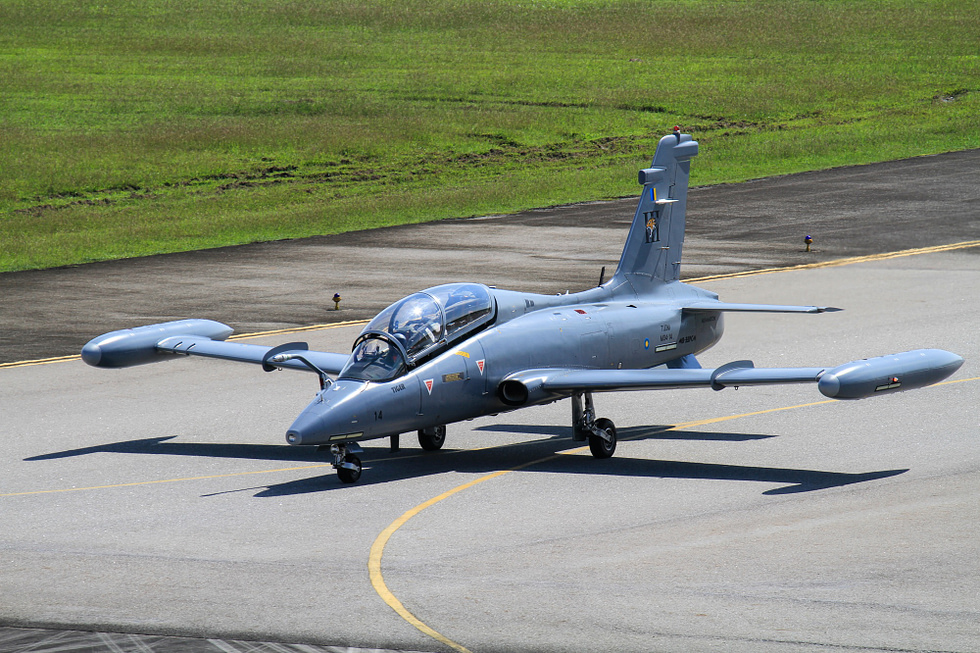
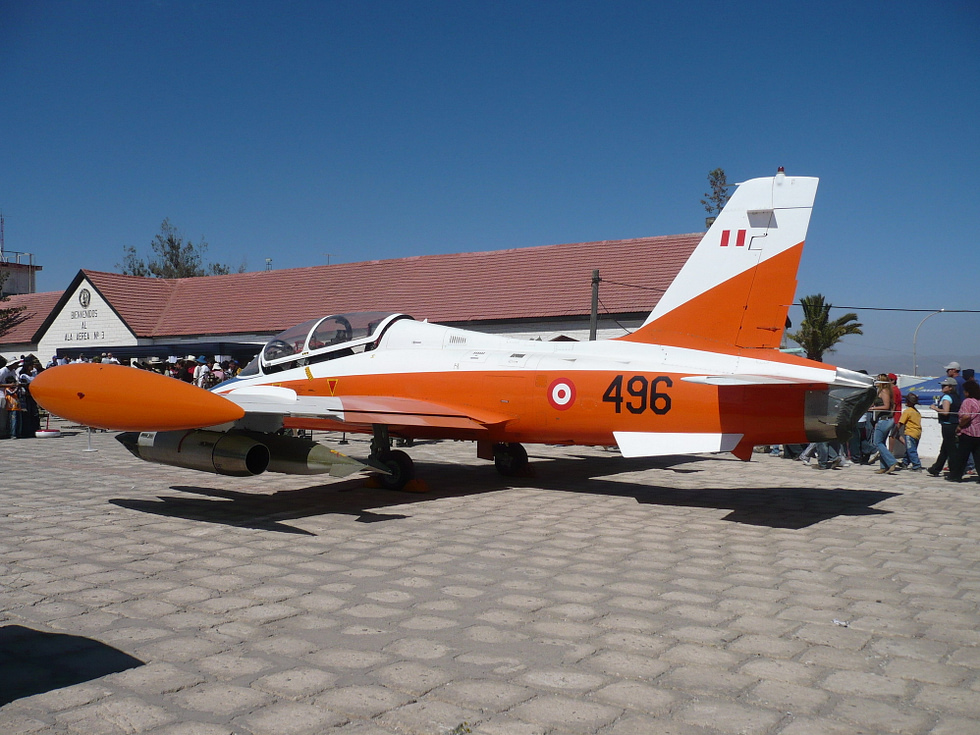
Argentina, Malaysia, Nigeria, Peru, the UAE, Ghana, New Zealand and others bought the MB-339.
Read the full story
Handing over to the M-346
After nearly 50 years, Italy is replacing the MB-339 with the M-346.
Read the full story
The MB-339 in pictures
The MB-339 in motion
Video coming soon. We are selecting a suitable clip of the Aermacchi MB-339 — Frecce Tricolori display flying and Italian Air Force training sorties — to feature here. In the meantime, explore the gallery above and the stories below.
The MB-339 in motion
Growling Sidewinder — one of the most-watched MB-339 films on YouTube.
Where the MB-339 flies
A trainer that went to war
The MB-339 was never designed to fight, and its combat record is modest and sober. It saw action in Argentine hands during the 1982 Falklands War — most famously a single, daring attack on a British frigate — and again in Eritrean service against Ethiopia at the close of the 1990s. Its losses were real, and its story is inseparable from tragedy on the ground at Ramstein.
Compare the combat record of every military aircraft. Figures as of July 2026.
Everything people ask about the MB-339
Can a civilian fly in an MB-339?
What is the Aermacchi MB-339?
Why do the Frecce Tricolori fly the MB-339?
Did the MB-339 see combat?
What happened at the Ramstein air show?
How fast is the MB-339?
Who else flew the MB-339?
Is the MB-339 still in service?
You can’t fly the MB-339.
These, you can.
Some legends only live in museums — others are fuelled and waiting. MiGFlug has put civilians in real military jet cockpits since 2004.
 Fly the L-39 AlbatrosThe world’s most-flown jet trainer — aerobatics included
 Fly the F-104 Starfighter“The missile with a man in it”
 Fly the MiG-21The Cold War’s most-produced jet
 Vuela el T-33 Shooting StarAmerica’s first jet trainer
 Fly the DH VampireA piece of early jet history
 Fly the S.211Agile Italian jet trainer
 Fly the MB-326The classic Aermacchi jet
 Fly the MiG-15The Soviet legend of the Korean War
Continue the tour
Every fact, checked
- GlobalSecurity.org — Aermacchi MB.339Development history, variants and service overview.
- Global Military — MB-339 specifications & operatorsSpecifications, variants and operator listing.
- Military Factory — Aermacchi MB.339Airframe data and armament options.
- Difesa Online — The Argentine MB-339s of the MalvinasDetailed account of Crippa’s attack and the 21 May 1982 loss.
- Key.Aero — A Frecce Tricolori pilot recalls RamsteinFirst-hand account of the 1988 disaster.
- The Aviationist — Frecce Tricolori historyThe team’s adoption of the MB-339 and its display record.
- flugzeuginfo.net — MB.339 technical dataCross-reference for dimensions and performance.
- Naval-History.net — San Carlos air battles, 21 May 1982Falklands air-action reference for the MB-339 sorties.