
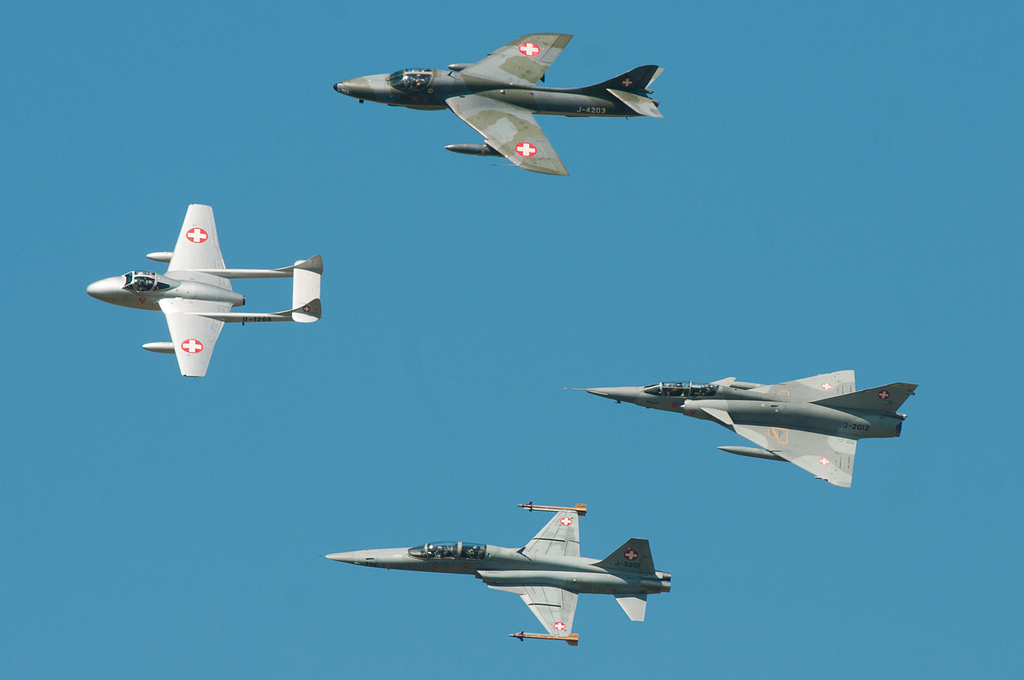
de Havilland DH.100
“Vampire”
Britain’s second jet fighter — the graceful twin-boom pioneer that made the first jet carrier landing, the first jet crossing of the Atlantic and a world altitude record, then taught the world to fly jets. Eighty years on it is one of the very few genuine 1940s jets a civilian can still fly.
The twin-boom pioneer
The de Havilland Vampire is the graceful twin-boom pioneer that bridged the piston and jet ages. Designed under Geoffrey de Havilland’s team from 1941 and first flown on 20 September 1943, it followed the Gloster Meteor into service as Britain’s second jet fighter — entering the RAF in 1946, too late for the Second World War.
Small, simple and forgiving, it rewrote the record books almost as a sideline. On 3 December 1945 a Sea Vampire flown by Lieutenant-Commander Eric “Winkle” Brown landed on HMS Ocean — the first jet ever to land on a carrier. In July 1948 six RAF Vampires became the first jet aircraft to cross the Atlantic, and in March 1948 John Cunningham took one to a world altitude record of 59,446 ft.
Built in the thousands and licence-produced on four continents — in France, Switzerland, Australia, India and Italy — the Vampire and its two-seat T.11 trainer taught the world to fly jets, from Britain and Sweden to India and Switzerland, which flew the type until 1990. Eighty years on, that same docile little jet is one of the very few genuine 1940s fighters civilians can still fly today — with MiGFlug.
01The Vampire’s twin booms: why de Havilland split the tail
The Vampire’s defining feature was its twin-boom layout. Early turbojets were weak, and a long jet-pipe wasted precious thrust. By mounting the single de Havilland Goblin engine centrally and carrying the tail on two slim booms, de Havilland kept the exhaust pipe short and straight — minimising thrust losses from the low-power engine.
The by-product was one of aviation’s most recognisable silhouettes: instantly “the Vampire” to anyone who sees it. The stubby fuselage nacelle used a mixed wood-and-metal construction — a plywood-and-balsa pod drawing directly on de Havilland’s Mosquito heritage — married to metal booms and wings.
What makes the Vampire special
Twin-boom layout for jet efficiency
With only a weak early turbojet available, de Havilland mounted the Goblin centrally and carried the tail on twin booms, keeping the exhaust pipe short and straight to preserve precious thrust. The solution also gave the Vampire its unmistakable silhouette — the shape that says “Vampire” at a glance.
The de Havilland Goblin turbojet
Frank Halford’s robust, single-stage centrifugal-flow Goblin (~3,100–3,350 lbf) was simpler and more reliable than early axial designs — the same basic engine family that also helped launch America’s first jets — and made the Vampire practical to build and maintain in the 1940s.
Wood-and-metal — and docile handling
A plywood-skinned nacelle inherited from the Mosquito saved strategic metal and weight. The result is a light, honest, aerobatic aircraft with gentle manners — exactly why the Vampire remains a favourite warbird and is well suited to civilian passenger flights today.
02The Vampire’s wooden nose: a jet built like a Mosquito
The Vampire’s fuselage pod used a plywood-and-balsa sandwich lifted straight from de Havilland’s wooden wonder, the Mosquito. It saved scarce aluminium and weight, and it meant a cutting-edge jet fighter was, in part, built like a WWII bomber — furniture-makers and cabinet shops among its subcontractors. The mixed construction kept the airframe light, which is one reason the Vampire is such an honest, aerobatic machine to fly.
03The Vampire’s “firsts”: carrier, Atlantic and altitude
For a modest little fighter, the Vampire holds an outsized place in the record books. On 3 December 1945 a Sea Vampire made the first-ever jet landing on an aircraft carrier, HMS Ocean. In March 1948 John Cunningham set a world altitude record of 59,446 ft (18,119 m). And in July 1948 six RAF Vampires island-hopped from Britain to Canada to become the first jets to cross the Atlantic — proving the short-legged early jet could be a strategic aircraft, not just a point defender.
Full specifications
Airframe & Performance
- Multitud
- 1 (FB.5 fighter) / 2 (T.11 trainer, side-by-side)
- Longitud
- ~9.37 m (30 ft 9 in)
- Envergadura
- ~11.6 m (FB.5; F.1 was 12.2 m)
- Altura
- ~2.7 m
- Max speed
- ~880 km/h (~548 mph) — subsonic
- Techo de servicio
- ~12,200 m (~40,000 ft)
- First flight
- 20 September 1943
- Into service
- 1946 (RAF)
Propulsion & Systems
- Motor
- 1 × de Havilland Goblin centrifugal turbojet
- Empuje
- ~3,100–3,350 lbf
- Armament (fighters)
- 4 × 20 mm Hispano cannon; up to ~900 kg bombs/rockets
- Number built
- ~3,300 (≈3,268), plus wide licence production
- Licence build
- France, Switzerland, Australia, India, Italy
- Unit cost
- Not reliably published (early-postwar figure)
- Cost per flight hour
- No reliable public figure
04The Vampire’s variants: from FB.5 to the T.11 that trained the world
Key variants tell the Vampire’s story. The F.1/F.3 were the early fighters; the FB.5 y FB.6 fighter-bombers became the mainstay. The NF.10 was a two-seat night-fighter, while the naval Sea Vampire pioneered carrier jet operations. Most important for today, the two-seat T.11 (DH.115) trainer schooled a generation of jet pilots worldwide — and it is the side-by-side two-seat version that MiGFlug passengers fly in. Firm unit-cost figures for the Vampire are not reliably published; treat any circulating number as an approximate early-postwar estimate.
Eighty years of the Vampire
Design begins
Work starts at de Havilland around the new Goblin turbojet, using a twin-boom layout to keep the jet-pipe short.
First flight
Prototype LZ548/G flies at Hatfield, piloted by Geoffrey de Havilland Jr.
First jet carrier landing
Eric “Winkle” Brown lands a Sea Vampire on HMS Ocean — the first jet ever to operate from a ship.
Enters RAF service
The Vampire joins the RAF as Britain’s second jet fighter.
World altitude record
John Cunningham climbs a Vampire to 59,446 ft (18,119 m).
First jet across the Atlantic
Six RAF Vampires island-hop from Britain to Canada via Iceland and Greenland.
Peak service
FB.5/FB.6 fighter-bombers and the T.11 trainer in worldwide licence production.
Combat in Indian service
Action in the Goa operation (1961) and the 1965 Indo-Pakistani War; other minor conflicts.
Last military Vampires retire
The Swiss Air Force retires the last military Vampires; the type flies on as warbirds.
Twelve Vampire stories
First jet across the Atlantic
In July 1948 six RAF Vampires became the first jets ever to cross the Atlantic.
Read the full story
First jet carrier landing
On 3 December 1945 Eric “Winkle” Brown put a Sea Vampire onto HMS Ocean.
Read the full story
Swiss Vampires in Alpine service to 1990
Switzerland flew 182 Vampires, most built at Emmen, for over four decades.
Read the full story
The twin-boom look
That split tail was engineering, not styling — and it became an icon.
Read the full story
The T.11 that taught the world
The two-seat T.11 gave thousands of pilots their first taste of jet flight.
Read the full story
Warbird flights with MiGFlug
Through MiGFlug you can strap into a genuine Vampire and fly a real 1940s jet.
Read the full story
The wooden nose from the Mosquito
The Vampire’s fuselage pod borrowed plywood-and-balsa construction from the Mosquito.
Read the full story
Reaching for the stratosphere
In March 1948 John Cunningham took a Vampire to a world altitude record.
Read the full story
Halford’s Goblin
Frank Halford’s centrifugal Goblin made the Vampire possible.
Read the full story
The Vampire goes to war
Never a great dogfighter by the jet age, Vampires still saw scattered action.
Read the full story
The Sea Vampire family
Navalised Vampires pioneered carrier jet operations and trials flying.
Read the full story
Built on four continents
From French Mistrals to Indian HAL machines, the Vampire was licence-built worldwide.
Read the full story
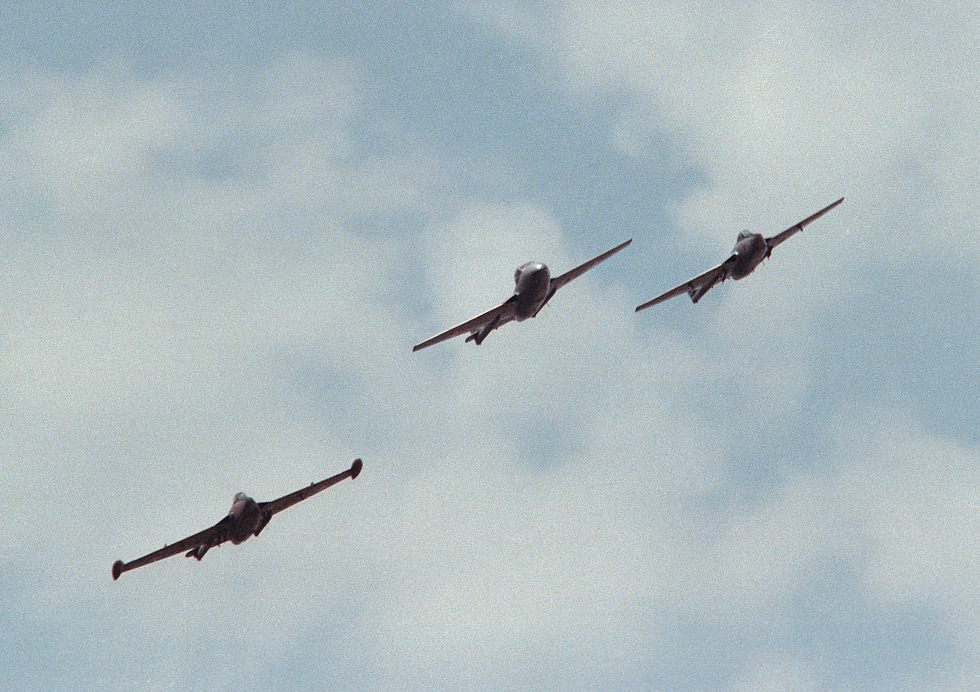
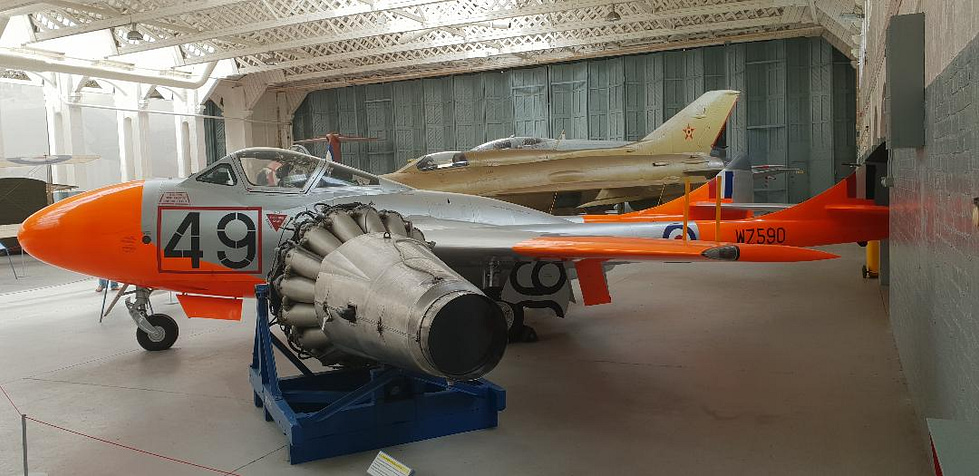
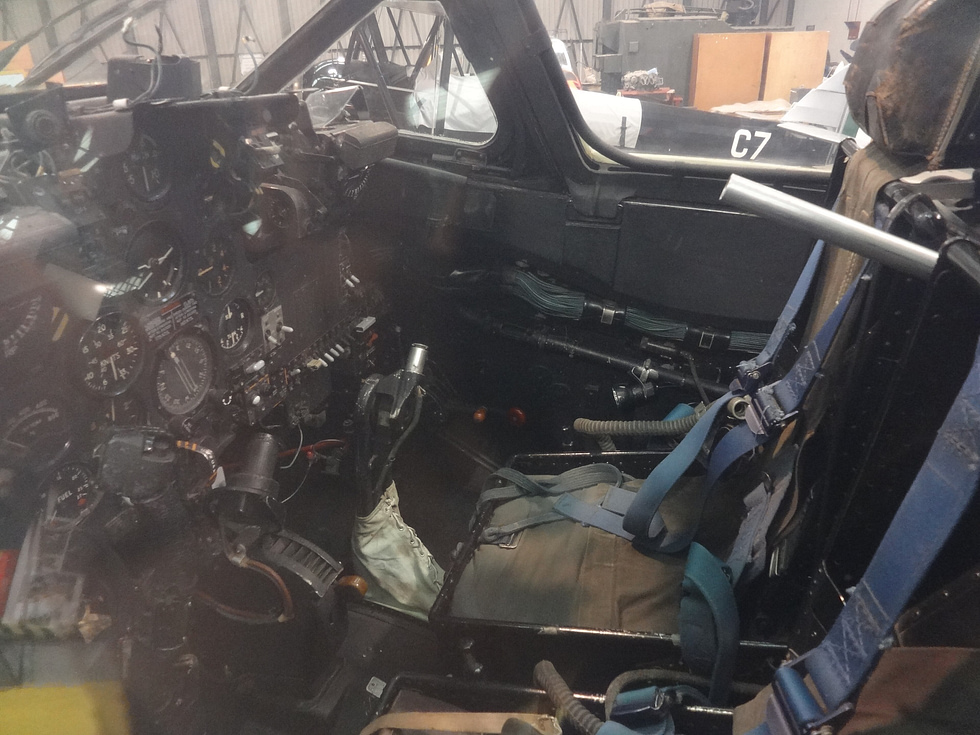
The Vampire in pictures
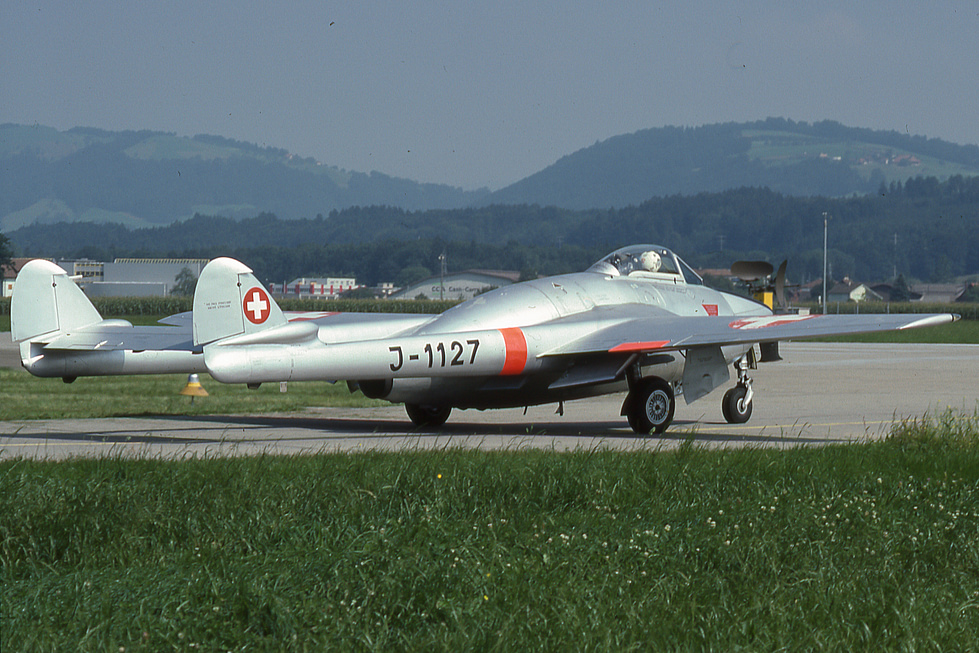
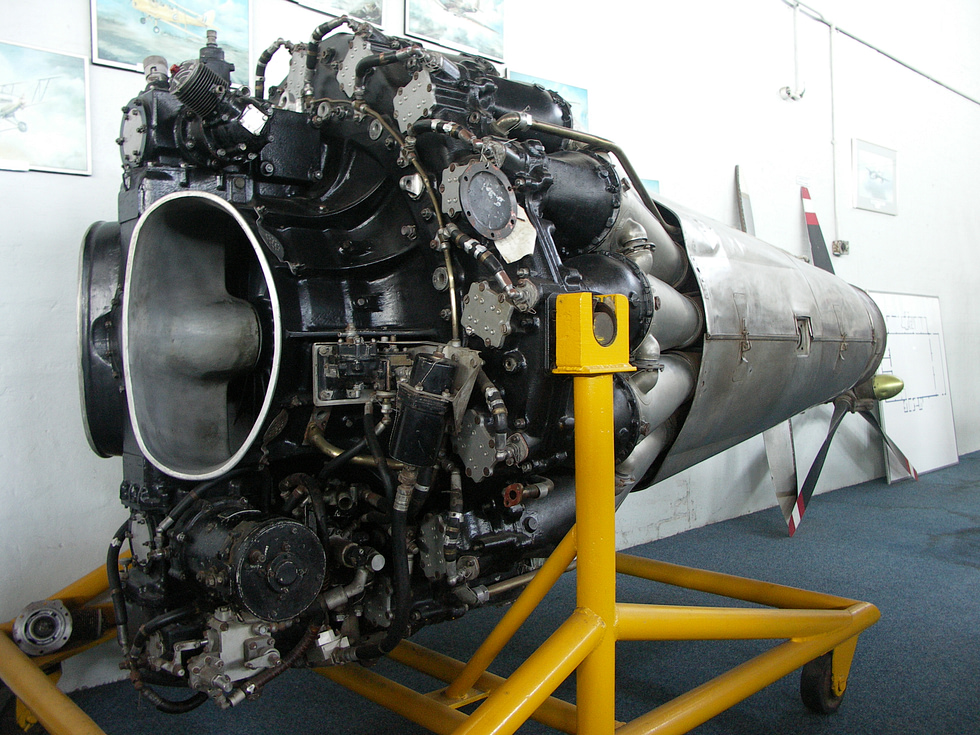
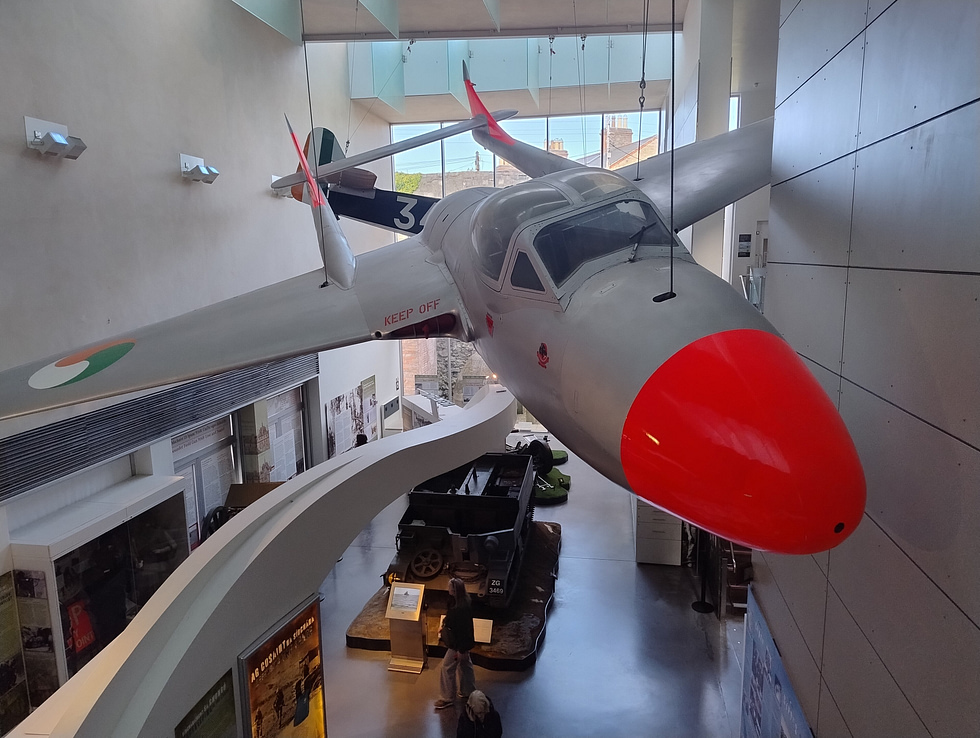
The Vampire in motion
Video coming soon.
The DH Vampire in motion
Dark Skies — one of the most-watched DH Vampire films on YouTube.
Where the Vampire flew
A record-breaker, not a dogfighter
The Vampire’s real claim to fame is a run of “firsts”, not its kill tally. It was the first jet to land on and take off from an aircraft carrier (1945), the first jet to cross the Atlantic (1948) and the holder of a 1948 world altitude record. Its combat career was minor and scattered — and exact loss/kill figures are contested, so treat them as indicative.
Compare the combat record of every military aircraft. Figures as of July 2026.
Everything people ask about the Vampire
Can I fly in a Vampire?
Is the Vampire a two-seater?
How fast is the Vampire?
Is the Vampire still flyable today?
What “firsts” does the Vampire hold?
How many Vampires were built?
Tú can actually fly the Vampire.
Pick your cockpit.
Some legends only live in museums — others are fuelled and waiting. MiGFlug has put civilians in real military jet cockpits since 2004.
 Fly the L-39 AlbatrosThe world’s most-flown jet trainer — aerobatics included
 Fly the F-104 Starfighter“The missile with a man in it”
 Fly the MiG-21The Cold War’s most-produced jet
 Vuela el T-33 Shooting StarAmerica’s first jet trainer
 Fly the DH VampireA piece of early jet history
 Fly the S.211Agile Italian jet trainer
 Fly the MB-326The classic Aermacchi jet
 Fly the MiG-15The Soviet legend of the Korean War
Continue the tour
Every fact, checked
- MiGFlug — Vampire flight (near London)The flight offering, side-by-side seating, specification and location.
- Military Factory — DH.100 VampireSpecifications, variants and build numbers.
- Vintage Aviation News — First flight of the VampireDevelopment, service, the Atlantic first and Swiss service to 1990.
- Vintage Aviation News — 23 March 1948 altitude recordJohn Cunningham and the 59,446 ft record.
- Key.Aero — When the RAF Vampire became a record-breakerDetails of the 1948 transatlantic crossing.
- AirVectors — Vampire in foreign serviceLicence production and combat across many operators.
- Aces Flying High — Swiss DH.100 Vampire182 Swiss aircraft, licence build and retirement in 1990.
- Vulcan to the Sky — Eric Brown on the first jet carrier landingThe Sea Vampire landing on HMS Ocean, 3 December 1945.