
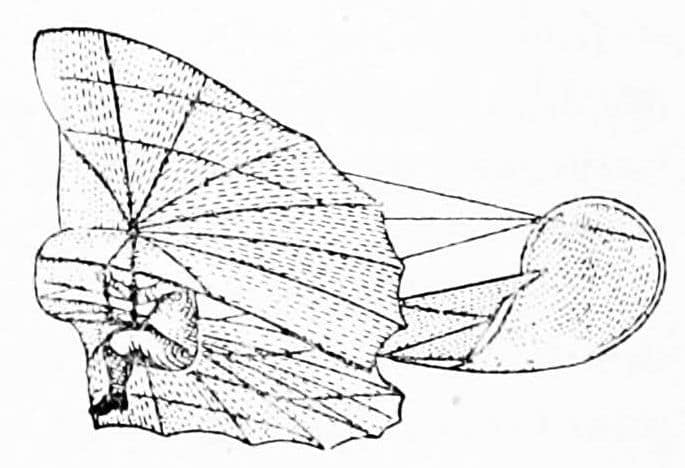
On the afternoon of August 9, 1896, Otto Lilienthal took off from a hillside near Stölln, Germany, in his standard monoplane glider — the same machine he had flown hundreds of times before. A sudden gust caught him wrong. The glider stalled. He fell from about 15 metres and hit the ground hard, breaking his spine.
The next day, in a Berlin hospital, his last recorded words were: “Sacrifices must be made.” He died on August 10, 1896, at the age of 48. By then, he had made more than 2,000 successful glider flights — more controlled, documented heavier-than-air flights than anyone who had ever lived. He had done more to prove that human flight was possible than any person since Cayley. And his death galvanised two brothers in Ohio who had been watching from afar.

The Engineer Who Built Wings
Lilienthal was not an eccentric dreamer. He was a trained mechanical engineer with a methodical mind and a lifelong obsession, shared with his brother Gustav, that began in childhood. Growing up in Anklam in Prussian Pomerania, the two boys spent hours watching storks — the enormous birds famous for their soaring flight — and discussing how their wings worked.
In 1889, Lilienthal published Der Vogelflug als Grundlage der Fliegekunst — “Bird Flight as the Basis of Aviation.” It was not a popular science book. It was a rigorous engineering text that measured, calculated, and tabulated the aerodynamic properties of curved wing surfaces. Lilienthal had built a whirling-arm apparatus — a rotating beam with wing models attached — and spent years generating empirical lift data. His tables of lift coefficients for curved wings were used directly by the Wright Brothers a decade later. They trusted the data because it was careful, meticulous, and real.
“To invent an airplane is nothing. To build one is something. To fly is everything.”
— Otto Lilienthal2,000 Flights From a Hillside
Beginning in 1891, Lilienthal started flying full-size gliders from a hill near Berlin. His early machines were hang gliders in the truest sense: a wooden frame with cambered canvas wings, with Lilienthal suspended below by his arms, controlling the glider by shifting his body weight. There were no mechanical controls. Direction and stability came entirely from the pilot moving his hips and legs.
It worked. His flights were real gliding flight — controlled, sustained, photographed. The photographs were the crucial element. Lilienthal allowed himself to be extensively photographed in flight, and the images circulated worldwide in newspapers and scientific journals. For millions of people, this was the first visual proof that a person could fly. Not in a balloon — not floating passively — but in a heavier-than-air machine, under control, with purpose.
He designed and flew at least 16 different glider types over five years, gradually extending his range and refining his technique. His longest flights covered nearly 400 metres. He was working on an engine — a small carbonic acid gas motor to add thrust — when the accident happened.
The Legacy That Launched Kitty Hawk
Wilbur Wright read about Lilienthal’s death in a newspaper in 1896. Years later, he described that moment as the point when his interest in flight became serious. “My brother and I had admired Lilienthal’s work more than that of any other of the men who had attempted to solve the problem of human flight,” Wilbur wrote. Orville called him “the greatest of the precursors.”
The Wrights took Lilienthal’s lift tables as their starting point. They built a glider based on his data, flew it at Kitty Hawk in 1900 and 1901, and were puzzled when it generated far less lift than predicted. After testing in their hand-built wind tunnel in Dayton, they discovered that Lilienthal’s measurements — while careful — had used a slightly wrong value for a key aerodynamic constant. The Wrights recalculated it, generated their own corrected tables, and redesigned their glider accordingly. In 1902, it flew perfectly.
Without Lilienthal’s data — right or slightly wrong — the Wrights would have had to start from scratch. With it, they had a foundation to stand on and a specific error to find. That is how science works: each generation builds on the last, corrects the errors, and advances. Lilienthal’s “sacrifices” were not wasted. They were the price of a foundation that somebody else would build on — seven years later, on a beach in North Carolina.
Sources: Otto Lilienthal, Der Vogelflug als Grundlage der Fliegekunst (1889); Tom D. Crouch, A Dream of Wings (1981); Wikipedia, “Otto Lilienthal”


 English
0 Comments