
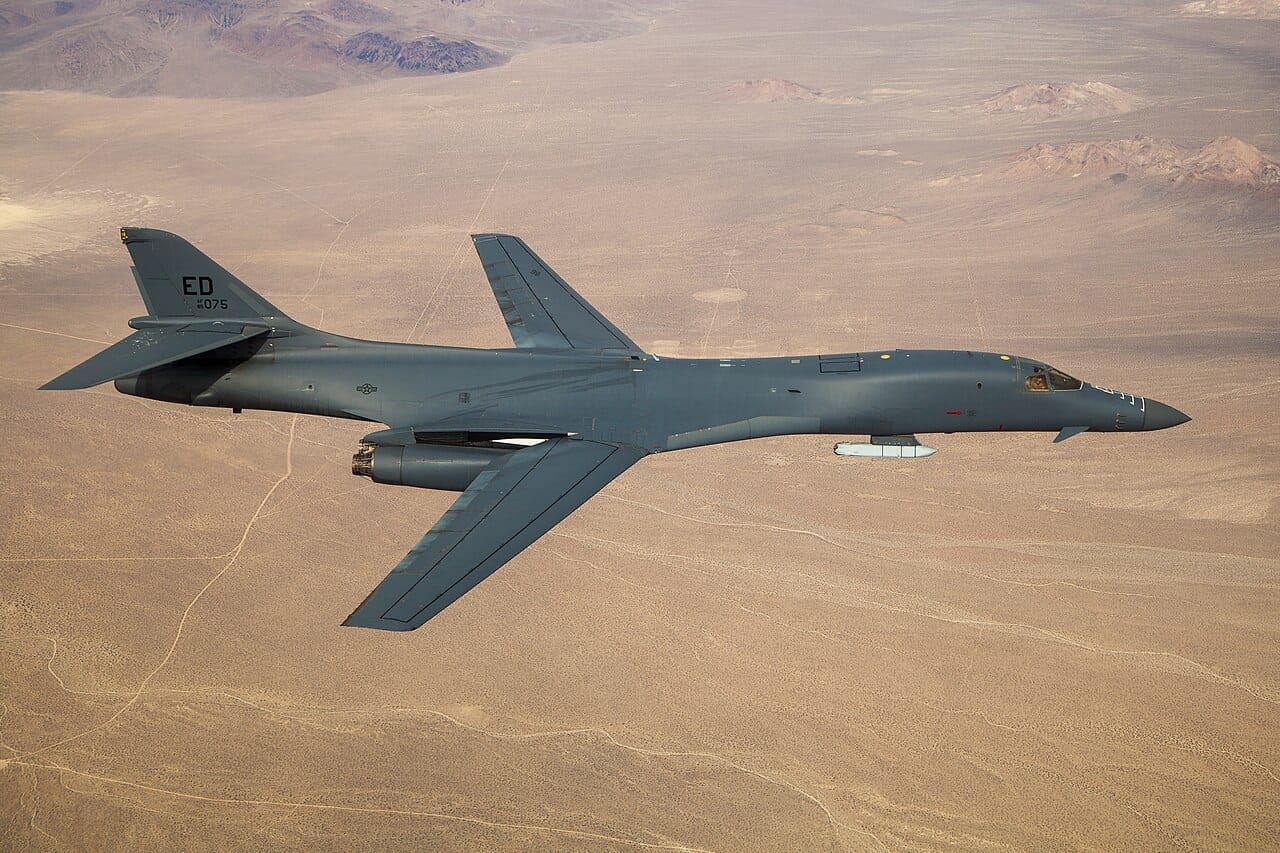
RAF Fairford has become a American fortress. On the Gloucestershire tarmac, parked wing-tip to wing-tip, sit 21 heavy bombers—15 B-1B Lancers and 6 B-52H Stratofortresses—representing the largest forward-deployed bomber concentration since the Cold War. Three additional B-1Bs arrived on March 26, completing what can only be described as a show of force with unmistakable strategic intent.
This isn’t routine rotation. The 15 B-1 Lancers now at Fairford account for roughly a third of the entire active Lancer fleet—America’s most advanced conventional strike platform. Each one carries devastating conventional payload. Up to 75,000 pounds of ordnance per aircraft. Multiply that across 15 bombers and the sheer destructive capacity becomes staggering.
The Permission That Changed Everything
UK Prime Minister Keir Starmer green-lit this deployment on March 1, formally authorizing US use of British air bases for what was characterized as a “specific and limited defensive purpose.” The language is diplomatic. The reality is less ambiguous. These bombers are positioned for sustained operations against Iran, with the operational codename Epic Fury hanging over every flight plan.
The briefing documents speak of destroying Iranian missiles “at source”—a euphemism for preemptive strikes designed to degrade missile production, storage, and launch capabilities. Whether those strikes come depends on escalation in a region already teetering on a knife’s edge. But make no mistake: this force is not assembled as a bluff.
B-1 Lancers: Built for This Moment
The B-1B Lancer is purpose-built for exactly this scenario. Swing-wing geometry allows it to carry weapons loads at supersonic speeds. Its infrared countermeasures and low-observable characteristics give it advantages older B-52s lack. But the real story is the load-carrying capacity. Where a fighter jet carries 10,000 pounds of ordnance, a B-1 carries 75,000.
Fifteen such aircraft, properly employed, can reduce target sets that would require hundreds of sorties from legacy platforms. And that efficiency matters in a theater where air defenses have evolved dramatically since the last major bombing campaign. Iranian air defense networks, bolstered by Russian and Chinese systems, aren’t the pushover they once were.
The Stratofortress complement—those six B-52Hs—brings a different skill set. The B-52 excels at sustained operations, can loiter longer, and carries cruise missiles that can strike from standoff range. Their presence suggests planners are thinking in terms of extended operations, not a single knockout punch.
The Calculation Behind Concentration
Why park this many bombers in one place? Risk assessment says it’s worth it. RAF Fairford, 80 miles west of London, sits within NATO airspace. The base itself is as hardened as any US installation. And geographically, it’s a 4.5-hour flight to Iran—ideal strike range for standoff weapons delivery.
The concentration also sends a message: America’s commitment is visible, tangible, and overwhelming. When Iranian military planners see satellite imagery of 21 bombers arrayed on a single runway, the psychological impact is as important as the ordnance. This is deterrence through presence.
Yet there’s risk embedded in that visibility. Concentrated forces are tempting targets. Every strategic competitor watching RAF Fairford understands this calculus. The Americans are betting Iran won’t strike first—that the force posture itself prevents escalation rather than triggers it.
What Comes Next
These bombers will remain on alert. Crews cycle through. Maintenance teams work through the night. Daily, the force remains poised to execute Operation Epic Fury on command. Whether those orders come depends on factors far beyond Gloucestershire—diplomatic negotiations, Iranian actions, regional flashpoints that haven’t ignited yet.
What’s certain is this: the largest bomber buildup in decades sits ready on the English countryside. The message is sent. Whether it prevents war or precipitates one remains the question that keeps strategists awake.
Sources: Air & Space Forces Magazine; Defense News; Stars and Stripes
 English