The airline industry has a maths problem it cannot solve fast enough. In 2026, the United States is short approximately 24,000 pilots — the widest gap between supply and demand since the post-pandemic travel boom began. Airlines are hiring aggressively, flight schools are oversubscribed, and regional carriers are offering signing bonuses that would have seemed absurd five years ago. And yet the gap keeps growing, because the problem is structural: more pilots are retiring than the training pipeline can replace.
The FAA’s Aerospace Forecast projects that this imbalance will persist through at least the mid-2040s. Roughly 4,300 airline pilots hit the mandatory retirement age of 65 every year, and that number will remain elevated for two decades as the massive cohorts hired in the 1980s and 1990s age out. On the supply side, the 1,500-hour Airline Transport Pilot certificate requirement — enacted after the Colgan Air 3407 crash — means that a new pilot needs years of experience before qualifying for the right seat of a regional jet, let alone the left seat of a mainline widebody.
Quick Facts
US pilot shortfall (2026): ~24,000
Mandatory retirements: ~4,300/year through 2042
ATP hour requirement: 1,500 hours (FAA Part 121)
Major airline pay increases (2023–2025): 30–50% cumulative at Delta, United, American, Southwest, Alaska
Training cost: $80,000–$150,000 from zero to ATP
Forecast: Shortage persists through mid-2040s (FAA Aerospace Forecast 2025–2045)
The Retirement Wave
The core of the crisis is demographics. The airline industry hired massively in the 1980s following deregulation, and again in the 1990s during the boom years. Those pilots are now reaching the mandatory retirement age of 65 in enormous cohorts. Each major airline loses hundreds of captains per year — experienced aviators with tens of thousands of hours who cannot be replaced by a freshly certificated first officer. The institutional knowledge walking out the door every month is irreplaceable on any timeline.
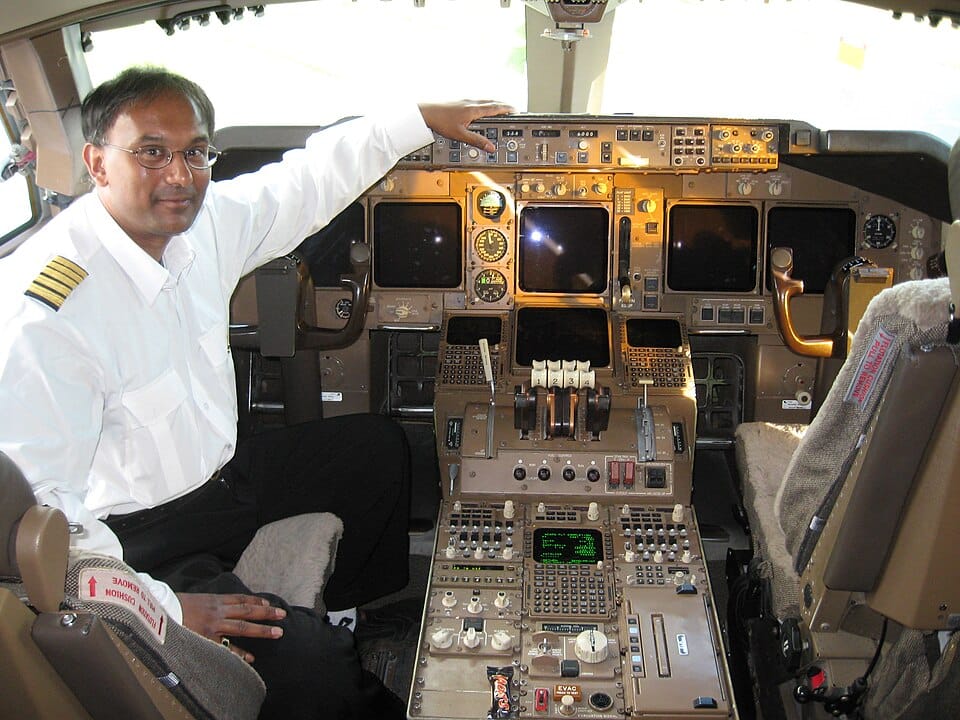
A Boeing 747 cockpit — the left seat that airlines worldwide are struggling to fill. The US alone faces a 24,000-pilot shortfall in 2026. Photo: Wikimedia Commons
At the same time, the post-pandemic travel recovery has pushed passenger demand to record levels. Airlines need more aircraft, more routes, and more crews. The gap between the pilots retiring and the pilots entering service is approximately 24,000 — a number that Oliver Wyman, the aviation consultancy, calls the most critical shortfall of the decade.
The 1,500-Hour Bottleneck
After the Colgan Air 3407 crash near Buffalo in 2009 — which killed 50 people and was attributed partly to inadequate pilot experience — Congress mandated that all Part 121 airline first officers hold an Airline Transport Pilot certificate, requiring 1,500 hours of flight time. The intention was safety. The consequence was a dramatic reduction in the flow of new pilots into the airline system.
A student pilot who begins training today needs roughly 18 to 24 months to earn a commercial certificate with around 250 hours. They then need to accumulate another 1,250 hours — typically as a flight instructor, banner tow pilot, or cargo runner — before qualifying for an airline job. The total time from first lesson to airline first officer is three to five years. The total cost is $80,000 to $150,000, much of it financed by student loans.
A Boeing test pilot at work — training a new airline captain takes years and hundreds of thousands of dollars, creating a pipeline that cannot expand quickly enough to meet demand. Photo: Boeing / Wikimedia Commons
How Airlines Are Responding
The majors have responded with unprecedented compensation. Pilot contract settlements between 2023 and 2025 delivered cumulative pay increases of 30 to 50 percent at all five major US carriers. A senior widebody captain at Delta or United now earns over $400,000 per year before overtime. Regional airline pay — historically so low that it drove pilots to leave aviation entirely — has more than doubled at carriers like Republic, SkyWest, and Envoy.
Airlines have also invested heavily in pipeline programmes. United’s Aviate Academy, Delta Propel, and American’s Cadet Academy are designed to attract candidates early, subsidise training costs, and guarantee a career path from flight school to the mainline cockpit. These programmes are working — applications are up — but the output is measured in hundreds of graduates per year against a shortage measured in thousands.
What It Means for Passengers
The pilot shortage is already visible in schedules. Regional routes have been cut across the United States as small carriers cannot staff their flights. Communities that once had multiple daily connections to hubs now have one — or none. The regional airline model that connects small cities to the national air network is under existential pressure, and no amount of signing bonuses can fix a training pipeline that takes years to produce a qualified pilot.
For aspiring aviators, the calculus has never been more favourable. Job security is effectively guaranteed for anyone who earns an ATP certificate in the next decade. Starting pay at regionals now exceeds $100,000. And the path to a major airline — once a decade-long odyssey — has compressed to five or six years for pilots who enter the pipeline today. The industry is desperate. The seats are empty. The question is whether enough people will choose to fill them.
Sources: Oliver Wyman, FAA Aerospace Forecast 2025–2045, Capital Analytics, ATP Flight School, AeroTime
Before AWACS, air warfare was a knife fight in a dark room. Pilots relied on their own radar, ground controllers with limited visibility, and radio calls that were often confused, late, or wrong. After AWACS, one side had the lights on and the other did not. The...
On May 1, 1960, CIA pilot Francis Gary Powers took off from Peshawar, Pakistan in a Lockheed U-2 spy plane. His mission: fly across the entire Soviet Union at 70,000 feet, photographing military installations, and land in Bodø, Norway. He never made it. A Soviet S-75...
When the Sukhoi Su-47 Berkut rolled out in 1997, it looked like nothing else in the sky. Its wings swept forward instead of back — an aerodynamic concept that promised extraordinary agility, superior low-speed handling, and enhanced controllability at high angles of...



 English
0 Comments