
Imagine a C-17 Globemaster — the workhorse cargo plane that usually hauls Humvees and MREs — opening its rear ramp at 25,000 feet and disgorging a stream of cruise missiles that fan out across the sky, each steering itself toward a separate target hundreds of miles away. Now imagine that happening from dozens of cargo planes simultaneously, delivering thousands of weapons in a single coordinated strike.
That is the future the U.S. Air Force just put a price tag on: $12.6 billion for nearly 28,000 cruise missiles, each costing less than a mid-range sports car.
Quick Facts
Programme: Family of Affordable Mass Munitions (FAMM)
Total buy: ~28,000 cruise missiles over five years (FY2027–FY2031)
Budget: $12.6 billion across the Future Years Defense Program
Unit cost target: ~$400,000–$500,000 per missile (vs. ~$2 million for a Tomahawk)
Delivery system: Rapid Dragon — palletised launchers dropped from C-17 and C-130 cargo aircraft
Capacity: Up to 45 missiles per C-17 sortie; up to 12 per C-130
FY2027 request: $300 million for 1,000 missiles (ramping to 7,990 in FY2031)
The End of the Exquisite Weapon
For decades, American air power was built on precision and expense. A single JASSM-ER cruise missile costs roughly $2 million. A Tomahawk runs about the same. These weapons are devastatingly accurate, but their cost limits how many the military can buy — and how many commanders are willing to spend in a single engagement. In a war against China, with thousands of targets spread across the Western Pacific, the math does not work. You run out of missiles before you run out of targets.
The Family of Affordable Mass Munitions — FAMM — is the Pentagon’s answer. Instead of fewer, better, more expensive weapons, FAMM inverts the logic: cheaper weapons in overwhelming numbers. At $400,000 to $500,000 per missile, the Air Force can afford to buy them by the tens of thousands. And by the tens of thousands, they can saturate even the most sophisticated integrated air defence system.

Cargo Planes as Missile Trucks
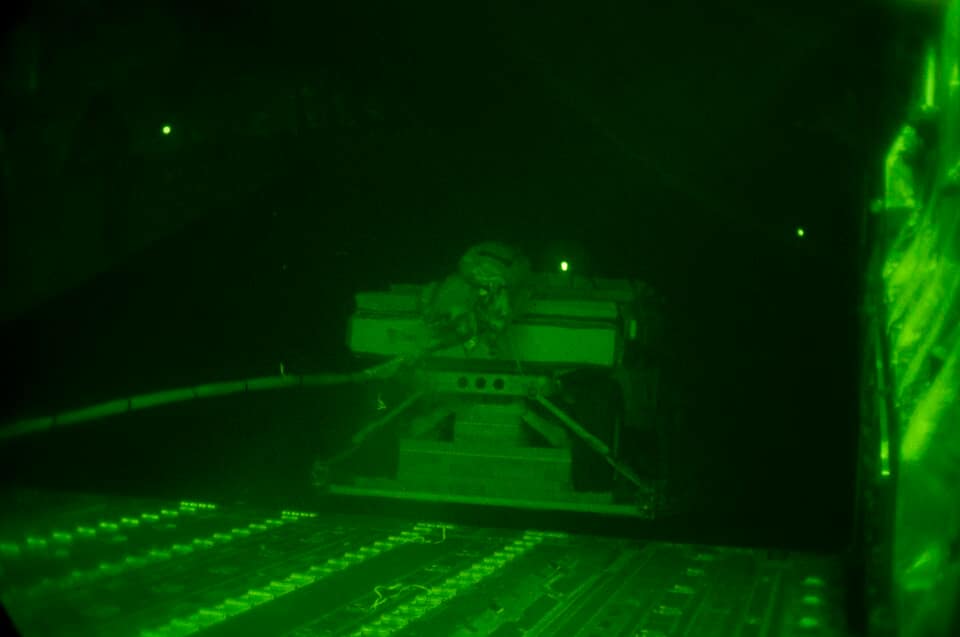
The delivery method is as radical as the economics. Rapid Dragon is a palletised launch system that converts any military cargo aircraft into a standoff missile platform. Cruise missiles are loaded onto standardised pallets, rolled into a C-17 or C-130, and airdropped through the rear cargo ramp. Parachutes stabilise the pallets as they fall, then the missiles ignite their engines and proceed autonomously to their targets.
A single C-17 can carry and launch up to 45 FAMM-class cruise missiles in one sortie. A C-130 can deploy 12. The Air Force operates roughly 220 C-17s and over 300 C-130s. Even if only a fraction are used in a missile-delivery role, the numbers become staggering — a single wave of 50 cargo aircraft could put over 2,000 cruise missiles in the air simultaneously.
This transforms aircraft that were never designed to fight into some of the most potent strike platforms in the inventory. A C-17 loaded with Rapid Dragon pallets delivers more cruise missile firepower than an entire destroyer’s vertical launch system — and it can do it from bases far beyond the reach of enemy anti-ship missiles.

The Ramp-Up
The production plan is aggressive by Pentagon standards. The Air Force is requesting $300 million in fiscal year 2027 to buy the first 1,000 missiles. That number jumps to 5,300 in FY2028, then continues climbing to 7,990 in FY2031. If Congress funds the full programme, the USAF will have nearly 28,000 FAMM missiles in its inventory by the early 2030s — more cruise missiles than most countries have military aircraft.
The specific missile type has not been publicly identified, though it is expected to be a small, turbine-powered weapon with a range of several hundred miles, GPS/INS guidance, and a warhead large enough to destroy hardened targets. Multiple defence contractors are competing for the contract, and the Air Force has emphasised that it wants a weapon simple enough to mass-produce on commercial production lines — not a hand-built, gold-plated masterpiece.
Why This Matters
The FAMM programme represents a philosophical shift in American air warfare. Since the Gulf War, the U.S. military has fought with small numbers of very expensive, very precise weapons against adversaries who could not shoot back effectively. That era is ending. China’s integrated air defence network — layered with S-400-class systems, anti-ship ballistic missiles, and electronic warfare — is designed specifically to defeat the kind of small, exquisite strike packages America has relied on for 30 years.
The Air Force’s response is not to build a better penetrator. It is to build a bigger hammer. Twenty-eight thousand cruise missiles, cheap enough to lose by the hundred, launched from cargo planes China cannot target with anti-ship missiles — that is a doctrine built not for surgical strikes, but for attrition on a scale not seen since the Second World War.
The age of the $2 million cruise missile is not over. But it is about to have very cheap company.
Sources: Air & Space Forces Magazine, Breaking Defense, Orbital Today


 English
0 Comments